
Bring Local Seo
to LangChain
Learn how to connect Local Falcon to LangChain and start using 13 AI agent tools in minutes. Fully managed, enterprise secure, and ready to use without writing a single line of code.
What is the Local Falcon MCP Server?
Connect your Local Falcon account to any AI agent and take full control of your local search visibility and automated rank tracking workflows through natural conversation.
What you can do
- Scan & Report Orchestration — List and manage all completed high-fidelity scan reports programmatically, retrieving detailed geo-grid ranking data and competitor metrics
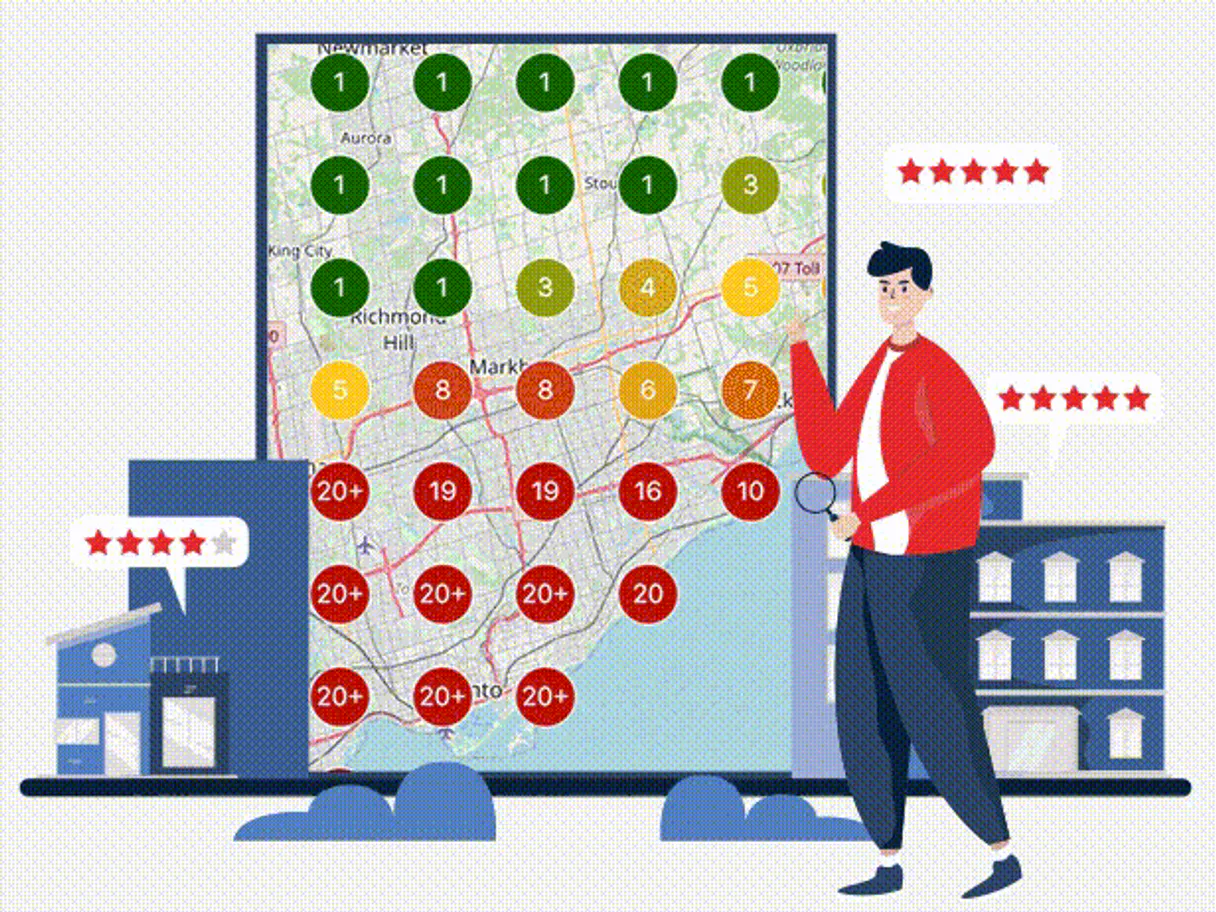
- Real-Time Visibility Intelligence — Programmatically trigger new geo-grid scans for specific keywords and locations to monitor your local search performance in real-time
- Ranking Architecture — Access high-fidelity metrics including ARP (Average Ranking Position), ATRP, and SoLV (Share of Local Voice) directly through your agent
- Competitor Monitoring — Access high-fidelity ranking data for local competitors at every grid point to coordinate your search optimization strategy
- Operational Monitoring — Verify account-level API connectivity and monitor scan credit usage directly through your agent for instant performance reporting
How it works
1. Subscribe to this server
2. Retrieve your API Key from your Local Falcon dashboard (API Credentials section)
3. Start orchestrating your local SEO from Claude, Cursor, or any MCP client
No more manual checking of individual rank trackers or missing local visibility drops. Your AI acts as your dedicated local search coordinator and SEO architect.
Who is this for?
- SEO Managers — instantly retrieve local ranking recaps and monitor SoLV trends using natural language commands
- Agency Owners — generate automated geo-grid reports and verify competitor performance without leaving your workspace
- Marketing Operations — automate the management of scheduled scans and campaign reporting through simple AI queries
Built-in capabilities (13)
Add a keyword
Add a location
Verify connectivity
Get location details
Get scan details
Get scan report
Get scan results
Get trend report
List keywords
List locations
List scans
List scans by location
Run a new scan
Why LangChain?
LangChain's ecosystem of 500+ components combines seamlessly with Local Falcon through native MCP adapters. Connect 13 tools via Vinkius and use ReAct agents, Plan-and-Execute strategies, or custom agent architectures. with LangSmith tracing giving full visibility into every tool call, latency, and token cost.
- —
The largest ecosystem of integrations, chains, and agents. combine Local Falcon MCP tools with 500+ LangChain components
- —
Agent architecture supports ReAct, Plan-and-Execute, and custom strategies with full MCP tool access at every step
- —
LangSmith tracing gives you complete visibility into tool calls, latencies, and token usage for production debugging
- —
Memory and conversation persistence let agents maintain context across Local Falcon queries for multi-turn workflows
Local Falcon in LangChain
Local Falcon and 3,400+ other MCP servers. One platform. One governance layer.
Teams that connect Local Falcon to LangChain through Vinkius don't need to source, host, or maintain individual MCP servers. Every tool call runs inside a hardened runtime with credential isolation, DLP, and a signed audit chain.
Raw MCP | Vinkius | |
|---|---|---|
| Server catalog | Find and host yourself | 3,400+ managed |
| Infrastructure | Self-hosted | Sandboxed V8 isolates |
| Credential handling | Plaintext in config | Vault + runtime injection |
| Data loss prevention | None | Configurable DLP policies |
| Kill switch | None | Global instant shutdown |
| Financial circuit breakers | None | Per-server limits + alerts |
| Audit trail | None | Ed25519 signed logs |
| SIEM log streaming | None | Splunk, Datadog, Webhook |
| Honeytokens | None | Canary alerts on leak |
| Custom domains | Not applicable | DNS challenge verified |
| GDPR compliance | Manual effort | Automated purge + export |
Why teams choose Vinkius for Local Falcon in LangChain
The Local Falcon MCP Server runs on Vinkius-managed infrastructure inside AWS — a purpose-built runtime with per-request V8 isolates, Ed25519 signed audit chains, and sub-40ms cold starts. All 13 tools execute in hardened sandboxes optimized for native MCP execution.
Your AI agents in LangChain only access the data you authorize, with DLP that blocks sensitive information from ever reaching the model, kill switch for instant shutdown, and up to 60% token savings. Enterprise-grade infrastructure, zero maintenance.
* Every MCP server runs on Vinkius-managed infrastructure inside AWS - a purpose-built runtime with per-request V8 isolates, Ed25519 signed audit chains, and sub-40ms cold starts optimized for native MCP execution. See our infrastructure
How Vinkius secures
Local Falcon for LangChain
Every tool call from LangChain to the Local Falcon MCP Server is protected by DLP redaction, cryptographic audit chains, V8 sandbox isolation, kill switch, and financial circuit breakers.
Frequently asked questions
How do I find my Local Falcon API Key?
Log in to your account, navigate to the API Credentials page, and copy your unique Bearer Token or API Key.
Can I run new scans via AI?
Yes! The run_localfalcon_scan tool allows your agent to trigger real-time geo-grid scans by providing business and keyword metadata.
How do I check my scan credit balance?
Use the check_localfalcon_status tool to retrieve your current account metrics and remaining high-fidelity scan credits programmatically.
How does LangChain connect to MCP servers?
Use langchain-mcp-adapters to create an MCP client. LangChain discovers all tools and wraps them as native LangChain tools compatible with any agent type.
Which LangChain agent types work with MCP?
All agent types including ReAct, OpenAI Functions, and custom agents work with MCP tools. The tools appear as standard LangChain tools after the adapter wraps them.
Can I trace MCP tool calls in LangSmith?
Yes. All MCP tool invocations appear as traced steps in LangSmith, showing input parameters, response payloads, latency, and token usage.
MultiServerMCPClient not found
Install: pip install langchain-mcp-adapters