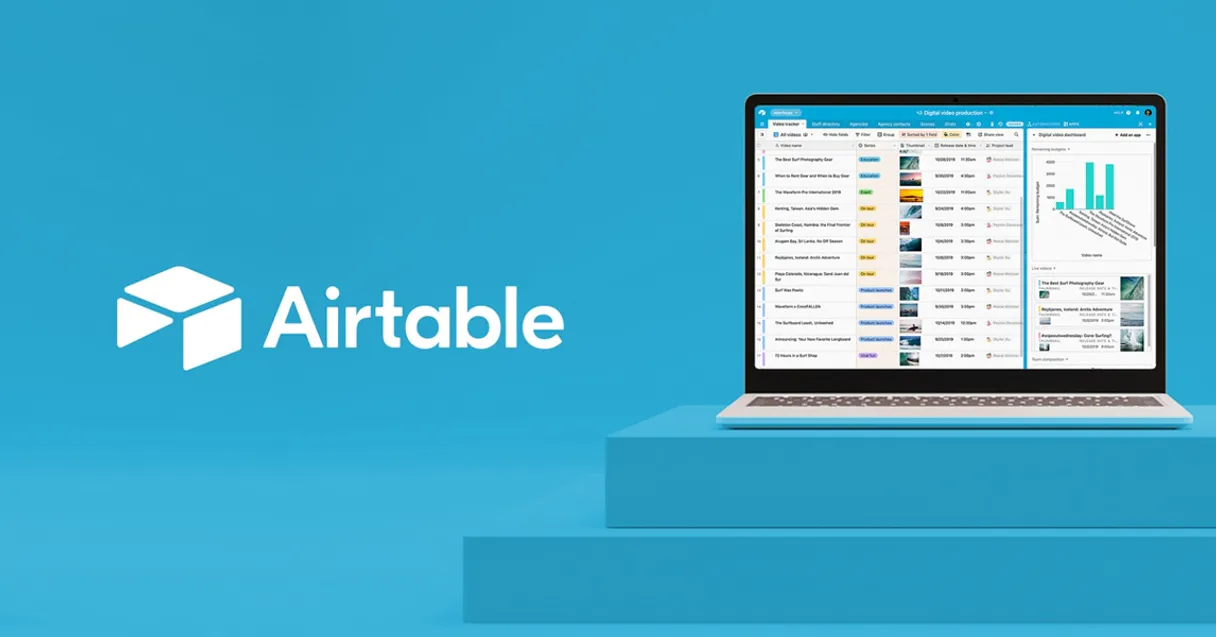
Airtable MCP. Talk to your spreadsheets and manage structured data via chat.
Works with every AI agent you already use
…and any MCP-compatible client

Just plug in your AI agents and start using Vinkius.
Airtable connects your structured data bases to your AI agent. Use it to query records, read schemas, update spreadsheets, and build automated workflows directly through chat.
You can list bases, query specific records, or bulk-add data without leaving your chat client.
What your AI agents can do
Create records
Adds new records to a table in bulk based on provided data.
Delete records
Removes specified records from a table in bulk.
Get base metadata
Retrieves the full schema details for an entire Airtable base.
The agent reads your entire workspace structure, listing every base and table available for querying.
You get a detailed list of every column and its data type for a specific table.
The agent runs complex, formula-driven queries to find specific rows that match detailed criteria.
You tell the agent to add new entries or change data (like status or ownership) across multiple existing records.
The agent safely deletes records, ensuring you remove outdated or duplicate data in bulk.
Ask AI about this MCP
Supported MCP Clients
Waiting for input…
Airtable MCP Server: 10 Tools for Data Management
Use these tools to programmatically list, read, search, create, and update records across any Airtable base.
019d754bcreate records
Adds new records to a table in bulk based on provided data.
019d754bdelete records
Removes specified records from a table in bulk.
019d754bget base metadata
Retrieves the full schema details for an entire Airtable base.
019d754bget record
Fetches the details of a single, specific record by its ID.
019d754blist bases
Lists all the primary bases (the large containers) in your entire Airtable account.
019d754blist fields
Retrieves the column names and types for a specific table within a base.
019d754blist records
Lists all records from a specified table, without filtering.
019d754blist tables
Shows all the individual tables contained inside a single base.
019d754bsearch records
Finds records using complex filters and formulas (e.g., 'Status = Done').
019d754bupdate records
Modifies the data (status, name, etc.) for multiple selected records simultaneously.
Choose How to Get Started
Build a custom MCP for your own tools, or connect a ready-made integration from our catalog.
Build Your Own
Turn any API into an MCP. Import a spec, define Agent Skills, or deploy with MCPFusion.
- Import from OpenAPI, Swagger, or YAML specs
- Create Agent Skills with progressive disclosure
- Deploy to edge with MCPFusion framework
- Built in DLP, auth, and compliance on every call
- Real time usage dashboard and cost metering
- Publish to catalog or keep private
Make Your AI Do More
Start with Airtable, then connect any of our 4,700+ other servers whenever your AI needs more. One click, no limits.
- Use this MCP plus 4,700+ others, all in one place
- Add new capabilities to your AI anytime you want
- Every connection is secured and compliant automatically
- Track usage and costs across all your servers
- Works with Claude, ChatGPT, Cursor, and more
- New servers added to the catalog every week
What you can do with this MCP connector
Your AI agent treats your Airtable data like a natural conversation. You stop writing clunky API calls and just talk to your bases. The agent handles all the querying, filtering, and updating for you. You'll use this to read schemas, find records, update sheets, and build automated workflows right from your chat window.
List available bases and tables: You can list every primary base and every individual table across your entire workspace. The agent reads your full data structure, showing you exactly what you're working with.
Retrieve base schema details: You get a detailed rundown of every column and its data type for any specific table. You can check the field names and types before you write a single query.
Search and filter records: You tell the agent to find specific rows using complex filters and formulas—like finding every record where the 'Status' is 'Done.' The agent runs these formula-driven queries to pull out exactly what you need.
Create and modify records: You can ask the agent to add new entries or change existing data. You'll use create_records to bulk-add data to a table, and update_records to change status or ownership across multiple records at once. You'll also use delete_records to safely remove outdated or duplicate data in bulk.
Read specific records and lists: You can fetch the details of a single record by its ID using get_record, or you can list all records from a table using list_records. For targeted searches, search_records finds records using complex filters, while list_tables shows all the tables inside a single base.
If you need to see everything, you can run list_bases to get all the primary bases in your account. If you're working inside a base, you can use list_fields to see all the column names and types for a specific table.
Use Case Example: You want to know every lead in your CRM that hasn't been touched since last month. You ask your agent to search_records using date criteria. The agent finds the matching rows. Next, you tell it to update the 'Last Contacted' field for all those records to today's date using update_records.
You've just run a complex workflow—query, then modify—without leaving your chat client.
How Airtable MCP Works
- 1 Add the integration and provide an Airtable Personal Access Token to your workspace.
- 2 Chat with your bases using your AI client and give a specific command (e.g., 'Find all overdue tasks').
- 3 The agent translates your request into the necessary tool calls, executes them against Airtable, and presents the results back to you in chat.
The bottom line is, you talk to your data instead of writing code.
Who Is Airtable MCP For?
The project manager tired of manually cross-referencing data across multiple spreadsheets. The sales ops professional who wastes time writing complex filters in the UI. The content team needing to update dozens of records weekly. This is for anyone whose job requires reading, writing, or structuring data in Airtable.
Uses the agent to audit project bases, automatically flagging or updating statuses for overdue tasks across the entire project grid.
Queries the CRM base for lead performance metrics last month, then bulk updates the stage or ownership of those leads.
Reviews the editorial calendar base to find empty records, then asks the agent to draft and populate initial social media copy into those slots.
What Changes When You Connect
- Stop jumping between tabs. You can list bases and tables to understand your entire workspace structure, then use
search_recordsto pull specific data—all from your chat window. No manual navigation needed. - You never have to manually write a
SELECT * FROMquery again. Usesearch_recordsandlist_recordsto run complex filters and retrieve results based on plain English commands. - Need to fix data formatting across 500 rows? Instead of opening the grid view, just tell the agent to use
update_records. It changes the data in bulk, fast. - Discovery is simple. Use
list_basesandlist_tablesto see the high-level architecture of your data, thenlist_fieldsto confirm the exact column names before querying. - Managing data flow is safe. Use
create_recordsordelete_recordswhen you need to add or remove data, but the agent handles the scope, so you don't risk deleting the wrong thing.
Real-World Use Cases
Finding all high-priority, overdue marketing assets
A marketing lead needs to know which assets are due next week but haven't been assigned. They ask their agent to run a search. The agent uses search_records to filter the 'Assets' table by 'Due Date' and 'Status' criteria, listing only the high-priority items that need immediate attention.
Bulk updating lead statuses after a sales call
A sales rep finishes a week of calls and needs to update 30 leads. Instead of opening the CRM base and clicking 30 times, they tell the agent to run update_records on the 'Leads' base, setting the status for all relevant records to 'Contacted' and logging the date.
Generating new tasks for the development sprint
A project manager wants to fill out the backlog. They ask the agent to create_records in the 'Tasks' base, specifying the assignee, the title, and the priority for five new features, instantly populating the grid.
Auditing a base for unused or duplicate data
An operations analyst wants to clean up old data. They ask the agent to use list_bases first to scope the area, then list_records to check for entries older than 6 months, allowing them to safely use delete_records on the identified set.
The Tradeoffs
Manual data flow
Trying to update 10 records by manually opening the base, finding each row, and changing the status one by one. This takes minutes and is highly error-prone.
→
Ask the agent to run update_records on the specific base and table, passing the criteria and the new status. The agent handles the bulk operation in one step.
Scope confusion
Running a query on the wrong base or table because you forgot the exact ID. You waste time debugging why the data doesn't appear.
→
First, run list_bases to see all available containers, then use list_tables to pinpoint the correct table structure. This narrows your search before you even query.
Over-reliance on UI filters
Using the visual filter dropdowns in Airtable, which are limited and can't handle complex, nested criteria or cross-base lookups.
→
Use the agent to run search_records. You can describe the complex logic in natural language, and the agent handles the underlying formula required.
When It Fits, When It Doesn't
Use this if your job requires reading, writing, or restructuring data in Airtable based on complex, natural language inputs. You need to know what data exists, where it lives, and need to perform bulk actions (like status changes or adding leads) without leaving your chat client.
Don't use this if you only need to view a few rows of data you already know the IDs for (use get_record). Don't use this if you are building a custom, standalone application that needs deep, programmatic control over every single API call (you'll need a dedicated API client). This is for augmenting your workflow, not replacing your entire application layer.
Independent Platform Disclaimer: Vinkius is an independent platform and is not affiliated with, endorsed by, sponsored by, verified by, or otherwise authorized by Airtable. All third-party trademarks, logos, and brand names are the property of their respective owners. Their use on this website is strictly for informational purposes to identify service compatibility and interoperability.
VINKIUS INFRASTRUCTURE
Cloud Hosted
Managed infra
V8 Isolated
Sandboxed per request
Zero-Trust Proxy
No stored credentials
DLP Enforced
Policy on every call
GDPR Compliant
EU data residency
Token Compression
~60% cost reduction
Works with Claude, ChatGPT, Cursor, and more
The Model Context Protocol standardizes how applications expose capabilities to LLMs. Instead of operating in isolation, your AI gains direct access to external platforms, live data, and real-world actions through secure, standardized connections.
This server provides 10 capabilities that interface natively with Claude, ChatGPT, Cursor, and any MCP client. No middleware. No custom integration required.
Available Capabilities
Data operations shouldn't require 15 clicks and a dozen copied IDs.
Today, updating project data means jumping into Airtable, navigating to the correct base, selecting the table, finding the right row, and clicking through dropdown menus and formula fields. If you have 30 records to update, you repeat that process 30 times, risking human error every single time.
With this MCP server, you just tell your agent, 'Change the status of all tasks assigned to Mark that are overdue.' The agent runs `update_records` in the background, handles the filtering, and updates all 30 records in one go. Done.
Airtable MCP Server: Manage records, bases & tables
Before this, figuring out which data was available required running through menus: clicking 'Bases' to see containers, then 'Tables' to see sheets, and finally guessing the field names. It was slow, manual discovery.
Now, you simply ask the agent to 'List all available bases.' The agent runs `list_bases` and gives you a clean, structured list. It's immediate, accurate, and ready for the next step.
Common Questions About Airtable MCP
How do I list all the bases available in Airtable using the Airtable MCP Server? +
Run the list_bases tool. This tool reads your entire workspace and gives you a list of every base container you have access to.
Can I update records in Airtable using the Airtable MCP Server? +
Yes, use the update_records tool. You can specify the records and the new values, allowing you to change statuses or fields in bulk.
What is the difference between `list_records` and `search_records` with Airtable MCP Server? +
Use list_records to get every single record in a table. Use search_records when you need to filter those records using complex criteria or formulas (e.g., 'Status = Done').
How do I find the field names in a base? +
Use the list_fields tool. It retrieves the column names and data types for a specific table, helping you structure your query correctly.
How do I use `create_records` to add new data to an Airtable base? +
You specify the target base and table, then provide the data points. The agent handles the structure and bulk entry, letting you populate multiple records at once.
What happens if I try to update a record with invalid data using `update_records`? +
The agent validates the input against the existing schema. If data fails validation, it returns a specific error message telling you exactly which field needs fixing.
Can I use `list_fields` to check the structure of a base before querying data? +
Yes, list_fields retrieves the table's schema. This lets you know all available columns, their data types, and field names before you run a complex query.
What is the role of the Airtable Personal Access Token when using this MCP Server? +
The token authorizes your AI client to talk to your Airtable account. It's the key that lets the agent read, write, and modify data across your bases.
Can the agent query and filter records using Airtable native formulas? +
Yes! The AI agent understands Airtable's native filterByFormula parameter. You can ask it to "Find all records where Status is 'Done' and Priority is 'High'", and it will translate your request into the exact Airatble formula required to fetch only that data.
How do I ensure the agent adds data to the correct columns? +
Before writing, the agent will typically fetch the schema of the Table to understand the exact column spelling, ID, and data type (like Checkbox, Formula, or Single Select). You just need to say "Add a new row for John Doe with Status Lead", and it will align the values to the existing column structure.
If my base has tens of thousands of records, will it hallucinate? +
No. The integration paginates large queries to ensure accurate results. If you ask a broad open question on a 50,000-row base, the agent will gracefully fetch the data in chunks and summarize the response using the actual API output.
Multi-server workflows that include Airtable MCP
Audit Agency Websites Using MCP Servers
Your agency manages 15 client Webflow sites but nobody checks if last month's landing page update actually improved conversions , the designer shipped it, the PM marked it done, and the page sits there with a 0.4% conversion rate that nobody measures
Build Data-Backed Investment Theses Using MCP
Funding trends mapped, public market multiples benchmarked, sector thesis documented , build your investment thesis on data, not slides
Build Market Landscape Maps Using MCP Servers
Every player mapped, every round tracked, every segment visualized , walk into the IC meeting with the market map, not a guess
Govern Feature Flags Across Tools Using MCP
127 feature flags in production and nobody knows which ones are safe to remove , your agent audits both platforms and tells you
Match Startup Founders to Mentors Using MCP
Mentor expertise mapped, startup needs matched, introductions sent , connect each cohort company with the right advisor in minutes, not weeks
MCP Recipe for Automating Agency Client Intake
Your agency's client intake process involves a form, a spreadsheet, 4 manual emails, and 3 people , and it still takes 5 days because the PM forgot to send the brand guidelines request on step 6 of the 12-step checklist
Use it with your favorite AI tools
Connect this server to Cursor, Claude, VS Code, and more.
More in this category
GitHub Alternative
Manage repositories, issues, pull requests and workflows via GitHub — search code, audit commits and track CI/CD from any AI agent.
Sentry
Grant your AI agent full access to Sentry's Application Performance Monitoring tools to track raw exceptions, resolve error logs, and inspect crash stack traces dynamically.
Baserow
Manage no-code databases via Baserow — list tables, query rows, create records and manage schemas from any AI agent.
You might also like
Nubank MX
Manage your Nubank Mexico banking from any AI agent — check balances, review transactions, send SPEI transfers, pay bills, and track spending analytics.
KanbanTool
Visualize your workflow with Kanban boards that show bottlenecks, track cycle times, and help your team deliver consistently.
TurfHop
Manage your lawn care and landscaping business with route planning, job scheduling, and customer billing in one app.