AlisQI MCP. Audit quality results, not just read them.
Works with every AI agent you already use
…and any MCP-compatible client

Just plug in your AI agents and start using Vinkius.
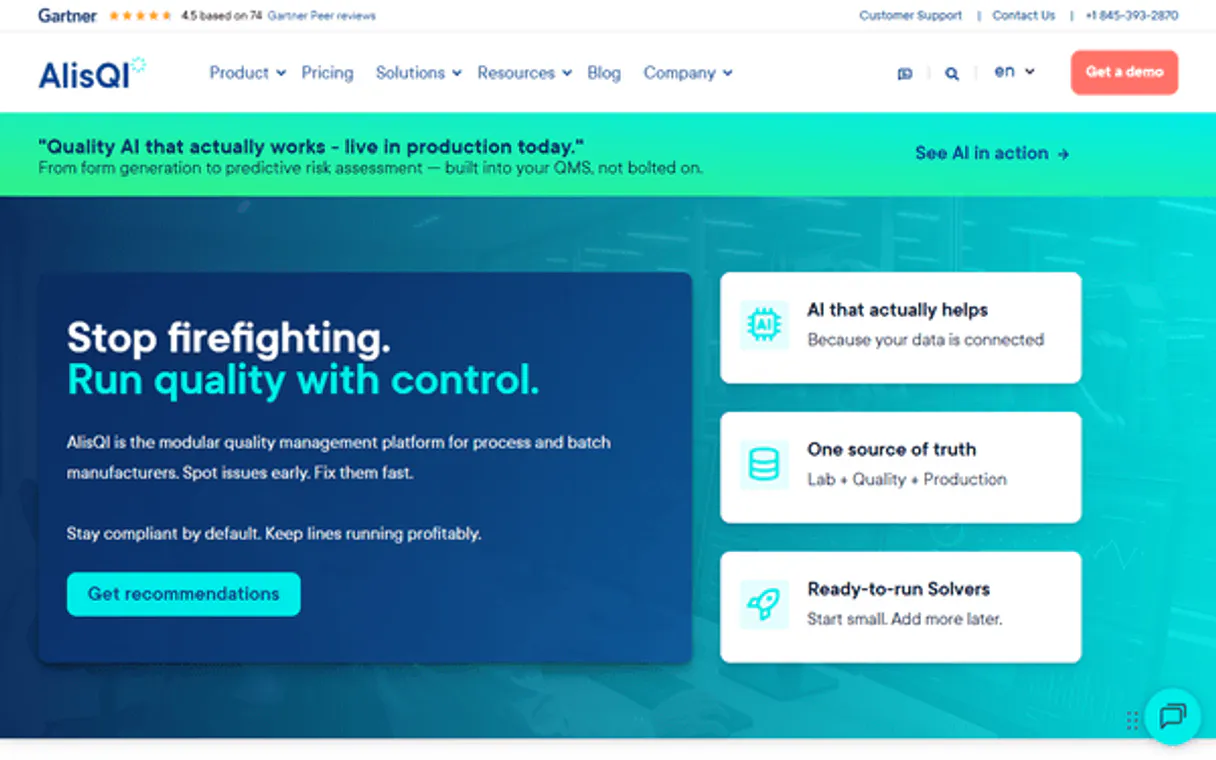
AlisQI: Manage professional Quality Management System (QMS) data via AI. This server connects your AI client to AlisQI, letting you audit results, list analysis sets, and track technical metadata using natural conversation.
You can list all analysis sets, get specific results, and monitor webhooks to keep your quality operations running smoothly.
What your AI agents can do
Get analysis set details
Retrieves specific metadata for a defined analysis set.
Get api info
Checks the current operational status of the API connection.
Get result attachments
Lists and retrieves technical metadata for quality result attachments.
List available analysis sets and audit their field definitions to map out your quality data model.
Retrieve specific quality results using get_result_details, or create/update records using store_results.
List active webhooks to confirm that quality events, like non-conformities, are correctly triggering external systems.
List attachments and retrieve technical metadata for quality documents.
List all analysis sets, choice lists, and dynamic fields used across your QMS.
Ask AI about this MCP
Supported MCP Clients
Waiting for input…
AlisQI MCP Server: 10 Tools for Quality Data Management
Use these ten tools to list, retrieve, store, and audit every piece of data within your AlisQI Quality Management System.
019d754cget analysis set details
Retrieves specific metadata for a defined analysis set.
019d754cget api info
Checks the current operational status of the API connection.
019d754cget result attachments
Lists and retrieves technical metadata for quality result attachments.
019d754cget result details
Gets the full record and specific data points for a single quality result.
019d754clist active webhooks
Lists all webhooks that trigger when specific quality events occur.
019d754clist analysis sets
Retrieves a list of all configured analysis sets in your QMS.
019d754clist choice lists
Lists all selection menus used for standardized data entry.
019d754clist fields
Retrieves a list of all dynamic fields defined in your data model.
019d754clist results
Lists quality results, supporting filters to narrow down the results.
019d754cstore results
Creates a new quality record or updates an existing one with result data.
Choose How to Get Started
Build a custom MCP for your own tools, or connect a ready-made integration from our catalog.
Build Your Own
Turn any API into an MCP. Import a spec, define Agent Skills, or deploy with MCPFusion.
- Import from OpenAPI, Swagger, or YAML specs
- Create Agent Skills with progressive disclosure
- Deploy to edge with MCPFusion framework
- Built in DLP, auth, and compliance on every call
- Real time usage dashboard and cost metering
- Publish to catalog or keep private
Make Your AI Do More
Start with AlisQI, then connect any of our 4,700+ other servers whenever your AI needs more. One click, no limits.
- Use this MCP plus 4,700+ others, all in one place
- Add new capabilities to your AI anytime you want
- Every connection is secured and compliant automatically
- Track usage and costs across all your servers
- Works with Claude, ChatGPT, Cursor, and more
- New servers added to the catalog every week
What you can do with this MCP connector
You connect your AI agent to AlisQI to manage your professional Quality Management System (QMS) data. Your agent lets you audit results, list analysis sets, and track technical metadata using natural conversation. You can list all analysis sets, get specific results, and monitor webhooks to keep your quality operations running smoothly.
Find and structure data sets
To map out your quality data model, you'll first list all available analysis sets using list_analysis_sets. You can then inspect the details of a specific set with get_analysis_set_details to understand its structure. You'll also check all dynamic fields defined in your data model by running list_fields, and you can see every selection menu used for standardized data entry by calling list_choice_lists.
Check and update quality results
Your agent retrieves the full record and specific data points for a single quality result using get_result_details. You can also list quality results, using filters to narrow down what you're looking for, by calling list_results. Need to save or change a record? store_results lets you create a new quality record or update an existing one with result data.
Monitor data flow triggers
To confirm that quality events—like non-conformities—are correctly triggering external systems, you list all active webhooks using list_active_webhooks. You'll also check the API connection's current operational status with get_api_info.
Inspect documentation and metadata
When you need to audit quality documents, your agent lists and retrieves technical metadata for result attachments using get_result_attachments. You can also get details about the specific technical metadata for a defined analysis set using get_analysis_set_details.
List and manage core data components
Your agent handles the fundamentals of your QMS: you can list all analysis sets, all choice lists, and all dynamic fields using list_analysis_sets, list_choice_lists, and list_fields.
How AlisQI MCP Works
- 1 Subscribe to this server and enter your AlisQI Instance URL and Bearer Token.
- 2 Your AI client connects to the server and executes a tool call (e.g.,
list_analysis_sets). - 3 The server sends the structured data (e.g., list of sets, fields, or results) back to your AI client, which presents it to you in conversation.
The bottom line is you talk to your agent, and the agent talks to AlisQI for you.
Who Is AlisQI MCP For?
The Quality Manager who needs to audit non-conformity trends fast. The Laboratory Technician who needs to look up complex analysis requirements on the fly. The Operations Lead who needs to verify data integrity across multiple systems. If your job involves proving compliance or tracking quality metrics, this is for you.
Runs audits on result sets and tracks non-conformity trends by calling tools like list_results and list_active_webhooks.
Checks analysis requirements or enters quality data directly via chat using the available toolset.
Verifies QMS data integrity and audits metadata definitions by listing fields and checking schema details.
What Changes When You Connect
- See the full data model using
list_fieldsandlist_analysis_sets. You don't have to jump between three different schema tabs to map out where a piece of data comes from. - Track compliance events automatically. Run
list_active_webhooksto confirm that non-conformities trigger your incident management system, which is critical for audits. - Stop guessing what data exists. Use
get_analysis_set_detailsto pull up the exact schema definition for any analysis set before you write a query. - Process results directly from the chat. Instead of manually logging into the portal, use
store_resultsto write a quality record or update a finding. - Get full context on specific entries. Use
get_result_detailsandget_result_attachmentstogether to pull both the data point and the supporting document metadata in one go. - Filter massive result sets instantly.
list_resultslets you filter quality data by date range, status, or set name without building a complex API call.
Real-World Use Cases
Investigating a Batch Failure
A Quality Manager notices a spike in failed environmental monitoring results. They ask their agent to run list_results filtered by 'failure' status and 'last 30 days'. The agent returns the top 10 failure IDs. The manager then uses get_result_details on the worst offender to see the exact recorded deviation and who stored the finding.
Onboarding a New Data Stream
A Data Engineer needs to know if a new sensor feed (e.g., humidity) is captured by the QMS. They first run list_fields to see all current dynamic fields. If the sensor data isn't there, they use get_analysis_set_details to confirm which sets should contain that field, guiding the data mapping effort.
Auditing Workflow Readiness
An Operations Lead is preparing for an audit and needs proof that non-conformities trigger external alerts. They run list_active_webhooks. The agent confirms the webhook ID and target system, immediately proving the workflow is operational.
Documenting a New Procedure
A Laboratory Technician writes up a new procedure. Before finalizing, they use list_choice_lists to verify the correct standard dropdown menus are available, and then use list_analysis_sets to ensure the structure supports the new type of data collection.
The Tradeoffs
Building a massive list of APIs
The developer tries to write a Python script that calls list_analysis_sets, then loops through all results, and for each result, calls get_analysis_set_details. This script becomes brittle and fails if the API response structure changes even slightly.
→ Let your AI agent handle the orchestration. Instead of writing the loop, you just ask your agent: 'List all analysis sets, and for each one, pull its details.' The agent handles the sequential calls using the underlying tools, keeping your code clean.
Ignoring the state of the system
Assuming a webhook is active because it was set up last month, without checking its current status. You waste time debugging the downstream system when the failure is upstream.
→
Always start by running list_active_webhooks. This checks the real-time status of your quality event triggers, confirming they are currently operational.
Treating data storage as a manual process
Manually compiling a report and uploading it, forgetting to log the record in the QMS, leaving a compliance gap.
→
Use store_results directly through your agent. You can pass the data and the context in a single chat command, ensuring the record is created or updated immediately in AlisQI.
When It Fits, When It Doesn't
Use this server if your core problem is understanding, validating, or manipulating structured quality data within AlisQI. You need to know why a result is X, what the field Y means, or if the failure event triggers a follow-up. You need schema discovery and audit capabilities.
Don't use this if you just need to view simple dashboards or generate basic text summaries. For simple visualization, you might only need the basic list_results tool. If your goal is purely to interact with a different system (like an external ERP), then you need a different type of integration, not just a data retrieval layer. This server is about deep, structured QMS data access.
Independent Platform Disclaimer: Vinkius is an independent platform and is not affiliated with, endorsed by, sponsored by, verified by, or otherwise authorized by AlisQI. All third-party trademarks, logos, and brand names are the property of their respective owners. Their use on this website is strictly for informational purposes to identify service compatibility and interoperability.
VINKIUS INFRASTRUCTURE
Cloud Hosted
Managed infra
V8 Isolated
Sandboxed per request
Zero-Trust Proxy
No stored credentials
DLP Enforced
Policy on every call
GDPR Compliant
EU data residency
Token Compression
~60% cost reduction
Works with Claude, ChatGPT, Cursor, and more
The Model Context Protocol standardizes how applications expose capabilities to LLMs. Instead of operating in isolation, your AI gains direct access to external platforms, live data, and real-world actions through secure, standardized connections.
This server provides 10 capabilities that interface natively with Claude, ChatGPT, Cursor, and any MCP client. No middleware. No custom integration required.
Available Capabilities
Finding the source of a data point shouldn't require logging into three different tabs.
Today, figuring out why a final product failed requires a painful drill-down. You start on the results dashboard, see a deviation, and then you have to click over to the 'Analysis Sets' tab to see what parameters were measured. Next, you jump to 'Fields' just to confirm the unit of measure. It's a copy-paste nightmare across three different screens.
With the AlisQI MCP Server, you ask your agent: 'What is the definition for the 'Moisture Content' field in the 'Final Product Audit' set?' The agent runs `get_analysis_set_details` and returns the full technical definition instantly, right in your chat. You get the answer, not a dozen tabs.
Using AlisQI MCP Server: Audit and Store Results
Manual auditing means running reports, exporting CSVs, and manually updating findings in a separate spreadsheet. You lose the audit trail and the official record in the QMS.
Now, your agent handles it. You tell it to 'Store a result for batch 789: moisture content is 12.5%.' The agent executes `store_results`, creating the official, timestamped record inside AlisQI, and you get confirmation. It's done.
Common Questions About AlisQI MCP
How do I check if a non-conformity event is properly triggering external systems using `list_active_webhooks`? +
Yes, list_active_webhooks checks the live status of your triggers. It tells you if the webhook is configured, what ID it uses, and if there are any reported errors, confirming the workflow is operational.
Which tool should I use to see all possible data fields in AlisQI? +
Use list_fields. This tool pulls a complete list of all dynamic fields currently defined in your QMS, giving you a full map of your available data points.
Can I list all available analysis sets with `list_analysis_sets`? +
Yes. list_analysis_sets returns a comprehensive list of every analysis set configured in your AlisQI instance, letting you pick which data stream you want to focus on.
What is the best way to find technical metadata for a result attachment? +
You need get_result_attachments. This tool lists the files attached to a quality result and provides the technical metadata, so you know exactly what you're looking at.
How do I write or update a quality result record using `store_results`? +
You pass the necessary data (e.g., 'Batch 123, Result: Pass') and the context to the agent, which then executes store_results. This ensures the record is written correctly with all required metadata.
How can I view the definition of a specific analysis set using `get_analysis_set_details`? +
You call get_analysis_set_details with the set's ID. This returns the full metadata, including all required fields and their data types. You can then see exactly what data the set expects.
What do I use `list_results` for, and how do I filter the quality data? +
The list_results tool lets you retrieve quality results. You pass filters like date range or set name in the request body. This narrows down the results so you only see the data you need.
How do I handle potential API errors or check the general connection status using `get_api_info`? +
Run get_api_info to check the server's general status. It confirms the connection is live and provides current operational metrics. If the data is stale, you'll get an explicit error message.
How do I find my AlisQI Bearer Token? +
Log in to AlisQI, navigate to Menu > Management > Integration Hub. You can generate and manage your API tokens there. Each token inherits the permissions of the associated user account.
Is the data model the same for everyone? +
No, AlisQI uses a dynamic, user-defined data model. This means field names and analysis sets are specific to your company's configuration. Use the list_analysis_sets tool to discover your unique structure.
Can I attach files to quality results via the agent? +
Currently, the agent can retrieve metadata for existing attachments using the get_result_attachments tool. For uploading new files, we recommend using the AlisQI web interface or specific integration endpoints.
Use it with your favorite AI tools
Connect this server to Cursor, Claude, VS Code, and more.
More in this category
Travelport
Access Travelport's Global Distribution System to search and book flights, hotels, and manage travel reservations directly through AI.
AssessTEAM
Evaluate employee performance, run 360-degree reviews, and track team goals with streamlined assessment workflows.
UKG Pro
Manage HR data, employee profiles, and payroll via UKG Pro.
You might also like
Interest Amortization Engine
Generate exact SAC and Price (French) amortization schedules for real estate litigation.
BLS Wages — OEWS Occupational Employment
The holy grail of HR data. Use Occupational Employment and Wage Statistics (OEWS) to extract exact median earnings broken down by detailed professions and states.
Toast
Manage restaurant orders, menus, employees, labor, tables, and payments for your Toast POS through natural conversation.