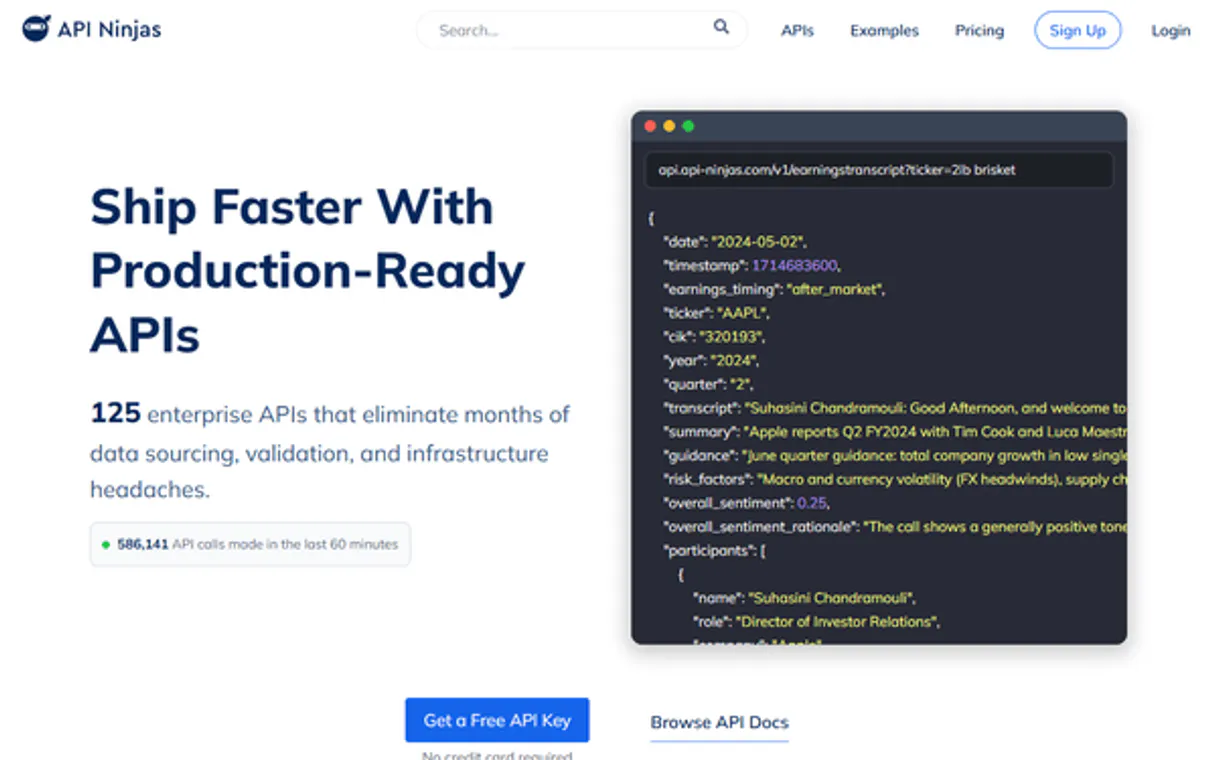
API Ninjas Nutrition MCP. Turn food descriptions into quantified nutrient data.
Works with every AI agent you already use
…and any MCP-compatible client

Just plug in your AI agents and start using Vinkius.
API Ninjas Nutrition provides fast, NLP-powered food analysis. Type any food description—like '200g grilled salmon' or '3 eggs and 2 slices of toast'—and get instant nutrient breakdowns.
It returns calories, protein, fat, carbs, fiber, sugar, sodium, and cholesterol data per serving. It also helps you search for recipes by keyword.
What your AI agents can do
Ninja analyze nutrition
Analyze the nutritional content of any food item by passing a natural language description and getting detailed nutrient metrics.
Ninja search recipes
Search for recipes by keyword and receive the resulting titles and serving details.
Pass a food item description in natural language to get a complete nutrient breakdown, including calories, fat, protein, and carbs.
Search for recipes using simple keywords and receive a list of titles along with their serving information.
Retrieve individual metrics like sodium, cholesterol, or saturated fat from the food analysis results.
Analyze combined food descriptions (e.g., '3 eggs and 2 slices of toast') in one call.
Ask AI about this MCP
Supported MCP Clients
Waiting for input…
API Ninjas Nutrition MCP Server: 2 Tools for Nutrition & Recipes
Use these tools to analyze food composition from text and search for recipe ideas using natural language processing.
019d754eninja analyze nutrition
Analyze the nutritional content of any food item by passing a natural language description and getting detailed nutrient metrics.
019d754eninja search recipes
Search for recipes by keyword and receive the resulting titles and serving details.
Choose How to Get Started
Build a custom MCP for your own tools, or connect a ready-made integration from our catalog.
Build Your Own
Turn any API into an MCP. Import a spec, define Agent Skills, or deploy with MCPFusion.
- Import from OpenAPI, Swagger, or YAML specs
- Create Agent Skills with progressive disclosure
- Deploy to edge with MCPFusion framework
- Built in DLP, auth, and compliance on every call
- Real time usage dashboard and cost metering
- Publish to catalog or keep private
Make Your AI Do More
Start with API Ninjas Nutrition, then connect any of our 4,700+ other servers whenever your AI needs more. One click, no limits.
- Use this MCP plus 4,700+ others, all in one place
- Add new capabilities to your AI anytime you want
- Every connection is secured and compliant automatically
- Track usage and costs across all your servers
- Works with Claude, ChatGPT, Cursor, and more
- New servers added to the catalog every week
What you can do with this MCP connector
API Ninjas Nutrition gives your AI client fast, NLP-powered food analysis. You can type any food description—like '200g grilled salmon' or '3 eggs and 2 slices of toast'—and get instant nutrient breakdowns. You'll get calories, protein, fat, carbs, fiber, sugar, sodium, and cholesterol data for every serving. If you need to check specific stuff, you can also pull out individual metrics like sodium, cholesterol, or saturated fat from the analysis.
The ninja_analyze_nutrition tool lets you analyze a food item using a natural language description and returns detailed nutrient metrics. You can also use the ninja_search_recipes tool to search for recipes using simple keywords, and it returns the resulting titles and serving details. You just gotta drop a keyword in and get a list of titles and how much each serving is.
How API Ninjas Nutrition MCP Works
- 1 Tell your AI client to use the
ninja_analyze_nutritiontool, providing a descriptive string of the food item and its quantities. - 2 The server processes the text using NLP and returns a structured JSON object containing the full list of macronutrients and micronutrients.
- 3 Your AI client reads the structured data, giving you immediate, actionable nutritional facts for the meal or recipe.
The bottom line is, you send a description, and the server sends back a quantified nutritional report.
Who Is API Ninjas Nutrition MCP For?
Meal prep coaches, registered dietitians, and fitness application developers need this. They deal with the constant pain point of manually calculating macro counts from varied food sources. This server lets them process unstructured text inputs and return reliable, structured nutrient data.
Uses ninja_analyze_nutrition to quickly calculate the macro breakdown for a patient's custom meal plan based on text descriptions.
Uses the tools to validate client diet logs, analyzing complex food combinations and identifying nutritional gaps.
Uses ninja_search_recipes to find ideas, then runs ninja_analyze_nutrition on the resulting ingredients to ensure the recipes hit target macro goals.
What Changes When You Connect
- Analyzes complex meals: Instead of calculating macros piece by piece,
ninja_analyze_nutritionaccepts descriptions like '3 eggs and 2 slices of toast,' giving you a single, aggregated nutrient report. - Full data set: You get more than just calories. The analysis returns protein, total fat, saturated fat, carbs, fiber, sugar, sodium, and cholesterol, letting you track comprehensive health metrics.
- Streamlines meal planning: Use
ninja_search_recipesto find recipe ideas, then immediately feed the ingredients intoninja_analyze_nutritionto validate the macro count against your client's goals. - Handles varied inputs: The tool doesn't require perfect measurements. Inputting '200g salmon' or '1 lb brisket' works, making it useful for real-world, imperfect logging.
- Built-in structure: All nutrient data is returned per serving size in grams, keeping your data consistent and ready for immediate calculation.
- API Ninjas Nutrition makes tracking easier: It's a proven alternative to other nutrition APIs, providing reliable data for diet-focused applications.
Real-World Use Cases
Client needs a macro count for a custom meal.
A dietitian inputs '1 cup quinoa, 100g chicken breast, and mixed greens.' The agent runs ninja_analyze_nutrition, which returns the exact calories, protein, and fat breakdown. The dietitian can then adjust the serving size or ingredients until the client hits their target macro profile.
Recipe testing for low-carb diets.
A recipe developer needs to ensure a new dish stays low-carb. They use ninja_search_recipes to find a candidate dish, then run ninja_analyze_nutrition on the primary ingredients. The server reports the total carbs and fat, allowing them to modify the recipe before testing it with people.
Logging a random lunch combo.
A fitness coach asks their AI client to analyze a logged lunch: 'a side of brisket and a handful of almonds.' The coach runs ninja_analyze_nutrition, which quickly processes the combined input and returns the total sodium and protein, letting the coach give immediate feedback.
Generating a shopping list with nutritional targets.
A user asks for recipes under 500 calories. The agent first uses ninja_search_recipes to get candidate titles, and then uses ninja_analyze_nutrition on the ingredients of the top three, filtering them to ensure the total nutrient count is within the specified calorie budget.
The Tradeoffs
Trying to use nutrition for general data lookup
Asking the system for the nutritional data of a common item like 'water' or 'air' and expecting a specific nutrient profile. The tool is designed for food items.
→
Stick to food descriptions. Use ninja_analyze_nutrition with specific inputs like '200g grilled salmon' or '1 cup brown rice.' The tool works best with identifiable food sources.
Overloading the search with too many constraints
Running a single query like 'low carb, high protein, must be tropical, and under 300 calories' in one go, hoping the tool figures out the perfect recipe.
→
Break it up. First, use ninja_search_recipes to narrow the field by a primary keyword (e.g., 'tropical'). Then, use ninja_analyze_nutrition on the resulting ingredients to validate the macro constraints.
Assuming single-step analysis is enough
Getting a basic macro count for a single item, then stopping. This leaves you without knowing if the item has high sodium or cholesterol, which matters for specific diets.
→
Always check the full output of ninja_analyze_nutrition. It returns sodium and cholesterol, not just the main macros. Use all the available data points.
When It Fits, When It Doesn't
Use this if your workflow requires converting unstructured, plain-text food descriptions into structured, quantified nutritional data (e.g., '2 cups of rice and 1 chicken breast'). You must track multiple metrics (protein, fat, sodium, etc.).
Don't use this if you just need general cooking inspiration or a list of ingredients without knowing the nutritional impact. For that, ninja_search_recipes is a good start. Don't use this if you need to manage a complex, multi-day diet plan; you'll need a dedicated state management layer built on top of these tools.
It's best for focused, single-meal or single-recipe analysis where the input is text-based.
Independent Platform Disclaimer: Vinkius is an independent platform and is not affiliated with, endorsed by, sponsored by, verified by, or otherwise authorized by API Ninjas. All third-party trademarks, logos, and brand names are the property of their respective owners. Their use on this website is strictly for informational purposes to identify service compatibility and interoperability.
VINKIUS INFRASTRUCTURE
Cloud Hosted
Managed infra
V8 Isolated
Sandboxed per request
Zero-Trust Proxy
No stored credentials
DLP Enforced
Policy on every call
GDPR Compliant
EU data residency
Token Compression
~60% cost reduction
Works with Claude, ChatGPT, Cursor, and more
The Model Context Protocol standardizes how applications expose capabilities to LLMs. Instead of operating in isolation, your AI gains direct access to external platforms, live data, and real-world actions through secure, standardized connections.
This server provides 2 capabilities that interface natively with Claude, ChatGPT, Cursor, and any MCP client. No middleware. No custom integration required.
Available Capabilities
Tracking macros from a journal is a messy, manual process.
Right now, if you're logging meals, you're copy-pasting from multiple sources—a food label, a recipe card, a restaurant's website. You spend time converting 'about 1/2 cup' into grams and then manually finding the calorie and protein counts. It’s tedious, and you’re always guessing the serving size.
With the API Ninjas Nutrition MCP Server, your agent takes the raw text—'120g of grilled salmon and a side salad'—and gives you a single, structured report. You get the exact calorie, protein, fat, and sodium counts without the manual conversion or the guesswork.
Use API Ninjas Nutrition MCP Server: Quantify food intake from text.
You eliminate the need to jump between ingredient databases and calculator apps. The agent runs `ninja_analyze_nutrition` directly on your text input, providing an immediate, quantified report of the full meal.
It's not just a count; it's a reliable data point. Your AI client gets clean, consistent metrics—protein, fat, carbs, sodium—every time you run the tool.
Common Questions About API Ninjas Nutrition MCP
How does the ninja_analyze_nutrition tool work? +
The ninja_analyze_nutrition tool accepts any food description in natural language. It then returns a detailed JSON object with measured nutrient values, including calories, protein, and fat.
Can I use ninja_analyze_nutrition for mixed meals? +
Yes. You can pass combined descriptions like '3 eggs and 2 slices of toast.' The tool analyzes all listed ingredients and aggregates the nutritional data into one report.
How do I find recipes using ninja_search_recipes? +
You tell the agent to search for recipes using a simple keyword. The tool returns recipe titles and serving information that you can then use for further analysis.
Does API Ninjas Nutrition have rate limits? +
Yes, the service includes rate limits. The documentation specifies simple X-Api-Key header authentication.
What kind of data does ninja_analyze_nutrition provide? +
It provides a wide range of data points: calories, protein, total fat, saturated fat, carbs, fiber, sugar, sodium, and cholesterol.
What kind of food descriptions can I input into the ninja_analyze_nutrition tool? +
You can input plain English descriptions of any food. The tool handles specific measurements like '200g salmon' or '3 eggs and 2 slices of toast' automatically for analysis.
How do I handle different units of measurement with ninja_analyze_nutrition? +
The tool handles various units like pounds, grams, and counts. You just describe the food as you normally would; the NLP engine figures out the data.
Does the ninja_search_recipes tool require a specific format for keywords? +
No, you simply provide the recipe name or keyword. The tool searches for recipes based on general text input, making it flexible.
How does it compare to Nutritionix? +
API Ninjas Nutrition is simpler and faster for basic lookups. It's the spiritual successor to CalorieNinjas. Use Nutritionix for branded/restaurant data and more advanced NLP, or API Ninjas for quick, lightweight analysis.
Use it with your favorite AI tools
Connect this server to Cursor, Claude, VS Code, and more.
More in this category
Brandwatch
Access consumer research via Brandwatch — list projects, track queries, and retrieve social mentions directly from any AI agent.
Corrently Regional Green Index
Universal regional energy intelligence — get green power forecasts by ZIP code via AI.
UTM Campaign Builder
Equip Marketing Agents to generate flawless tracking links. Safely encode UTM parameters and prevent broken Google Analytics routing.
You might also like
Traefik Proxy
Monitor and manage your Traefik Proxy infrastructure — inspect routers, services, and middlewares directly from your AI agent.
Desku.io
Unify customer support across email, chat, and social with AI-assisted ticket resolution that speeds up response times.
Presenton
Automate presentation generation via Presenton — create AI slide decks and manage exports directly from any AI agent.