
Coolify MCP Server for Cursor 10 tools — connect in under 2 minutes
Cursor is an AI-first code editor built on VS Code that integrates LLM-powered coding assistance directly into the development workflow. Its Agent mode enables autonomous multi-step coding tasks, and MCP support lets agents access external data sources and APIs during code generation.
ASK AI ABOUT THIS MCP SERVER
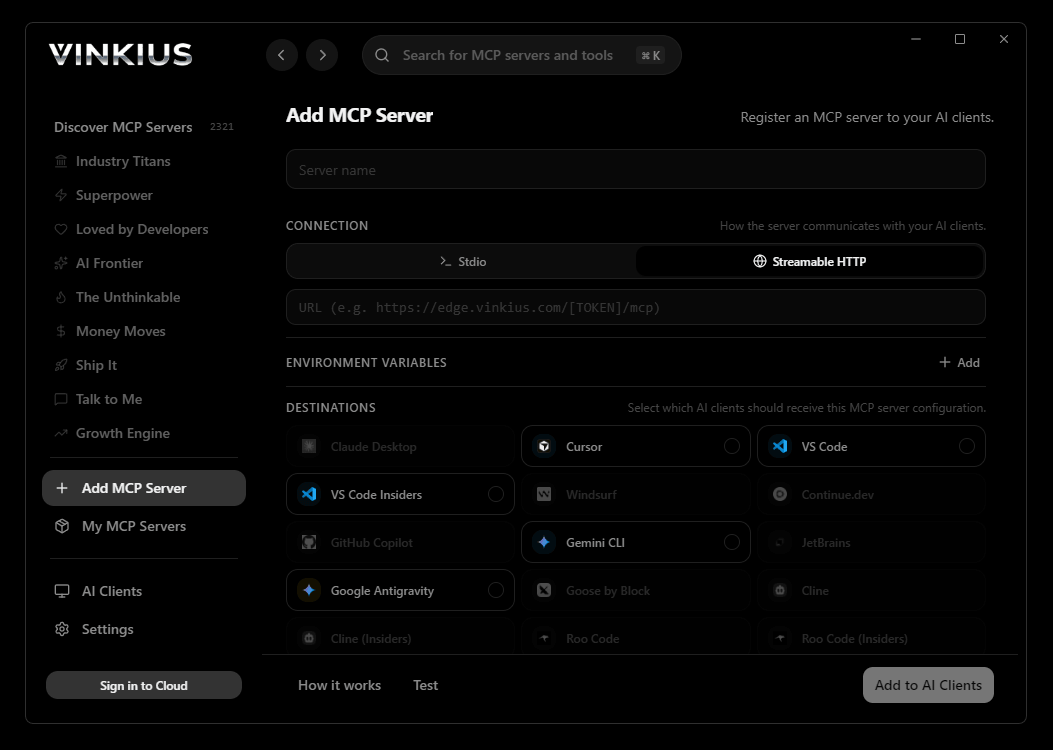
Vinkius supports streamable HTTP and SSE.
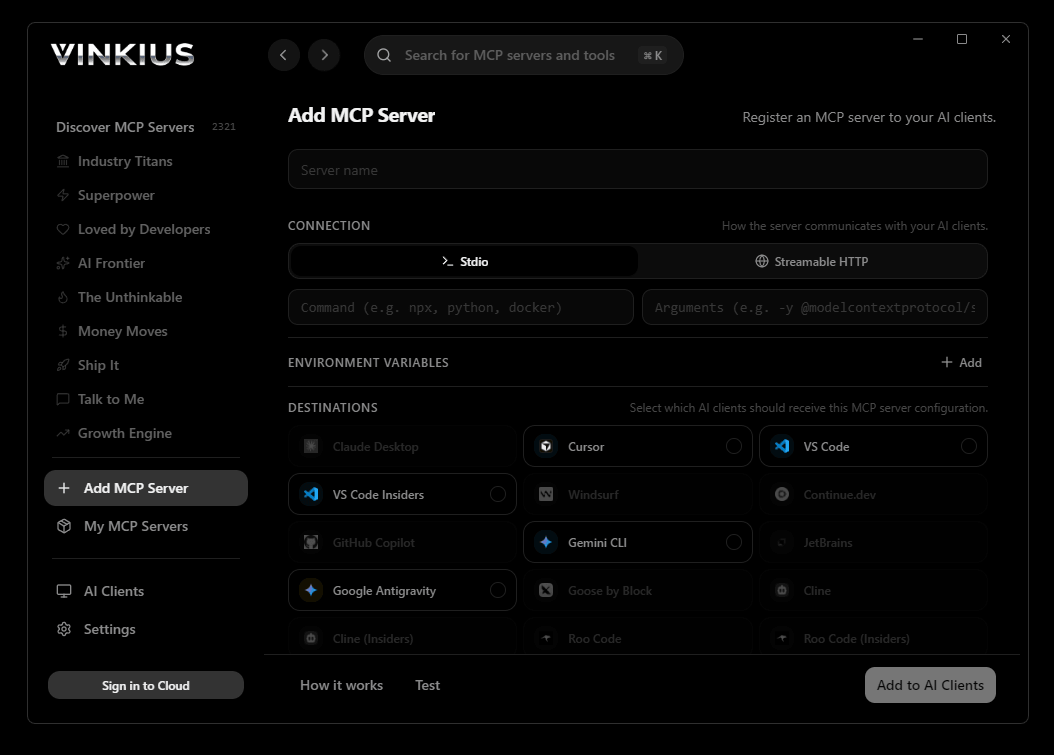
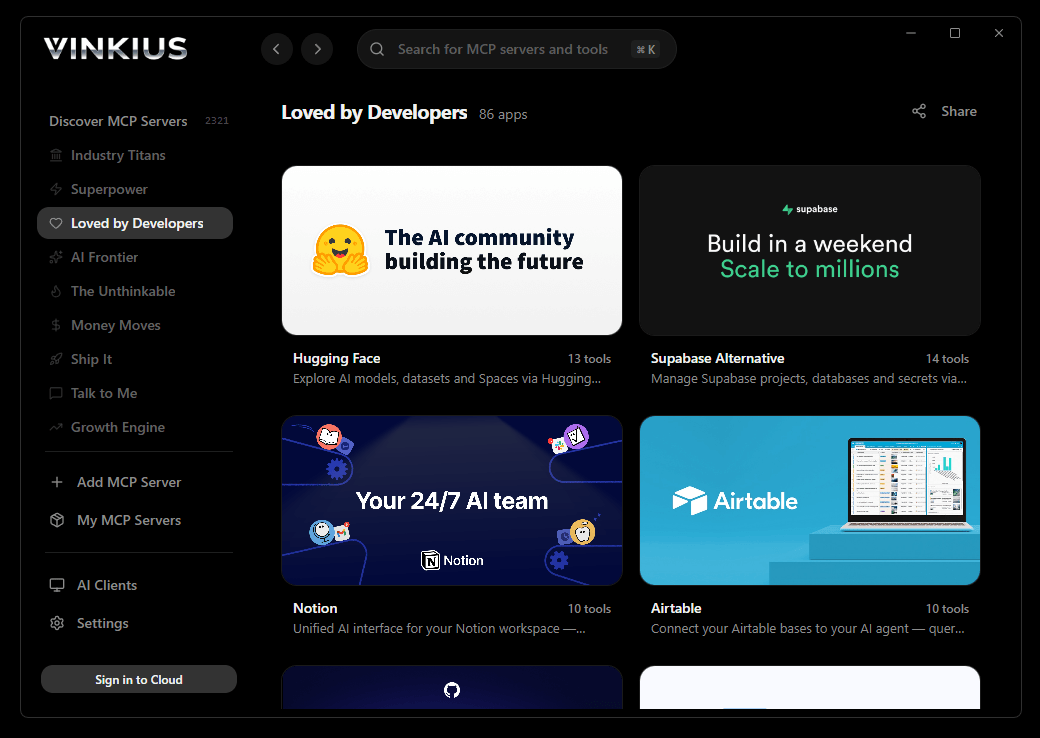
Vinkius Desktop App
The modern way to manage MCP Servers — no config files, no terminal commands. Install Coolify and 2,500+ MCP Servers from a single visual interface.

{
  "mcpServers": {
    "coolify": {
      "url": "https://edge.vinkius.com/[YOUR_TOKEN_HERE]/mcp"
    }
  }
}
* Every MCP server runs on Vinkius-managed infrastructure inside AWS - a purpose-built runtime with per-request V8 isolates, Ed25519 signed audit chains, and sub-40ms cold starts optimized for native MCP execution. See our infrastructure
About Coolify MCP Server
Connect your Coolify instance to any AI agent and take full control of your self-hosting and private cloud workflows through natural conversation.
Cursor's Agent mode turns Coolify into an in-editor superpower. Ask Cursor to generate code using live data from Coolify and it fetches, processes, and writes. all in a single agentic loop. 10 tools appear alongside file editing and terminal access, creating a unified development environment grounded in real-time information.
What you can do
- Server Monitoring — List self-hosted nodes and retrieve intricate networking parameters including IP properties and Docker swarm statuses
- Application Management — List all managed frontend/backend apps and fetch elaborate internal topology metrics like mapped GitHub branches and Traefik proxy paths
- Lifecycle Control — Start, stop, and restart applications natively, allowing you to recycle container states and apply configuration updates instantly
- Deployment Automation — Trigger raw build pipelines to fetch the latest commits, rebuild Nixpacks images, and roll out updated Docker versions
- Database Oversight — Manage PostgreSQL, MySQL, and Redis configurations and extrapolate internal connection strings for secure application linking
- Resource Navigation — asociating Project repositories to explicit application UUIDs required for downstream mutations and operational auditing
The Coolify MCP Server exposes 10 tools through the Vinkius. Connect it to Cursor in under two minutes — no API keys to rotate, no infrastructure to provision, no vendor lock-in. Your configuration, your data, your control.
How to Connect Coolify to Cursor via MCP
Follow these steps to integrate the Coolify MCP Server with Cursor.
Open MCP Settings
Press Cmd+Shift+P (macOS) or Ctrl+Shift+P (Windows/Linux) → search "MCP Settings"
Add the server config
Paste the JSON configuration above into the mcp.json file that opens
Save the file
Cursor will automatically detect the new MCP server
Start using Coolify
Open Agent mode in chat and ask: "Using Coolify, help me...". 10 tools available
Why Use Cursor with the Coolify MCP Server
Cursor AI Code Editor provides unique advantages when paired with Coolify through the Model Context Protocol.
Agent mode turns Cursor into an autonomous coding assistant that can read files, run commands, and call MCP tools without switching context
Cursor's Composer feature can generate entire files using real-time data fetched through MCP. no copy-pasting from external dashboards
MCP tools appear alongside built-in tools like file reading and terminal access, creating a unified agentic environment
VS Code extension compatibility means your existing workflow, keybindings, and extensions all work alongside MCP tools
Coolify + Cursor Use Cases
Practical scenarios where Cursor combined with the Coolify MCP Server delivers measurable value.
Code generation with live data: ask Cursor to generate a security report module using live DNS and subdomain data fetched through MCP
Automated documentation: have Cursor query your API's tool schemas and generate TypeScript interfaces or OpenAPI specs automatically
Infrastructure-as-code: Cursor can fetch domain configurations and generate corresponding Terraform or CloudFormation templates
Test scaffolding: ask Cursor to pull real API responses via MCP and generate unit test fixtures from actual data
Coolify MCP Tools for Cursor (10)
These 10 tools become available when you connect Coolify to Cursor via MCP:
get_application
Examines mapped GitHub branches, automatic rollout toggles (push to deploy), and assigned Traefik reverse proxy FQDN paths. Fetch elaborate internal topology metrics for a given Application
get_database
Highly required when linking newly provisioned Web Apps to Backend Datastores. Extrapolate internal configuration arrays for a Database
get_server
Verifies IP properties, SSH connection validation statuses, and Docker executing ports resolving across the cluster. Get configuration schema mapped to a specific Coolify Server Node
list_applications
Generates the crucial map associating Project repositories to explicit application UUIDs required for downstream mutations (like restarting and stopping). List all frontend/backend Applications actively managed by Coolify
list_databases
Isolates database bounding boxes mapping to applications so you can properly retrieve Connection Strings and backup cadence timelines. List managed PostgreSQL, MySQL, and Redis configurations
list_servers
Used to identify the raw physical endpoints running Docker swarms that host subsequent applications. List all self-hosted Server Nodes attached to Coolify
restart_application
Ensures updated config `.env` variables injected via Coolify take effect immediately in runtime RAM. Bounce a Coolify application recycling its container states
start_application
Spin up containers mapped to a suspended Application UUID
stop_application
Used precisely for pausing billing or restricting web perimeter ingress during a cyber incident directly via the Coolify dashboard API. Halt execution algorithms suspending the mapped Application
trigger_deployment
Performs `git fetch`, rebuilds Nixpacks images, caches dependencies, and rolls the updated Docker image out directly over the previous active application version. Trigger a raw build pipeline fetching the latest Git commit
Example Prompts for Coolify in Cursor
Ready-to-use prompts you can give your Cursor agent to start working with Coolify immediately.
"List all active servers in my Coolify instance"
"Trigger a deployment for application 'backend-api'"
"What is the connection string for database 'user-db-prod'?"
Troubleshooting Coolify MCP Server with Cursor
Common issues when connecting Coolify to Cursor through the Vinkius, and how to resolve them.
Tools not appearing in Cursor
Server shows as disconnected
Coolify + Cursor FAQ
Common questions about integrating Coolify MCP Server with Cursor.
What is Agent mode and why does it matter for MCP?
Where does Cursor store MCP configuration?
mcp.json file. You can configure servers at the project level (.cursor/mcp.json in your project root) or globally (~/.cursor/mcp.json). Project-level configs take precedence.Can Cursor use MCP tools in inline edits?
How do I verify MCP tools are loaded?
Connect Coolify with your favorite client
Step-by-step setup guides for every MCP-compatible client and framework:
Anthropic's native desktop app for Claude with built-in MCP support.
AI-first code editor with integrated LLM-powered coding assistance.
GitHub Copilot in VS Code with Agent mode and MCP support.
Purpose-built IDE for agentic AI coding workflows.
Autonomous AI coding agent that runs inside VS Code.
Anthropic's agentic CLI for terminal-first development.
Python SDK for building production-grade OpenAI agent workflows.
Google's framework for building production AI agents.
Type-safe agent development for Python with first-class MCP support.
TypeScript toolkit for building AI-powered web applications.
TypeScript-native agent framework for modern web stacks.
Python framework for orchestrating collaborative AI agent crews.
Leading Python framework for composable LLM applications.
Data-aware AI agent framework for structured and unstructured sources.
Microsoft's framework for multi-agent collaborative conversations.
Connect Coolify to Cursor
Get your token, paste the configuration, and start using 10 tools in under 2 minutes. No API key management needed.