
FlightAware MCP Server for Claude Code 12 tools — connect in under 2 minutes
Claude Code is Anthropic's agentic CLI for terminal-first development. Add FlightAware as an MCP server in one command and Claude Code will discover every tool at runtime — ideal for automation pipelines, CI/CD integration, and headless workflows via the Vinkius.
ASK AI ABOUT THIS MCP SERVER
Vinkius supports streamable HTTP and SSE.
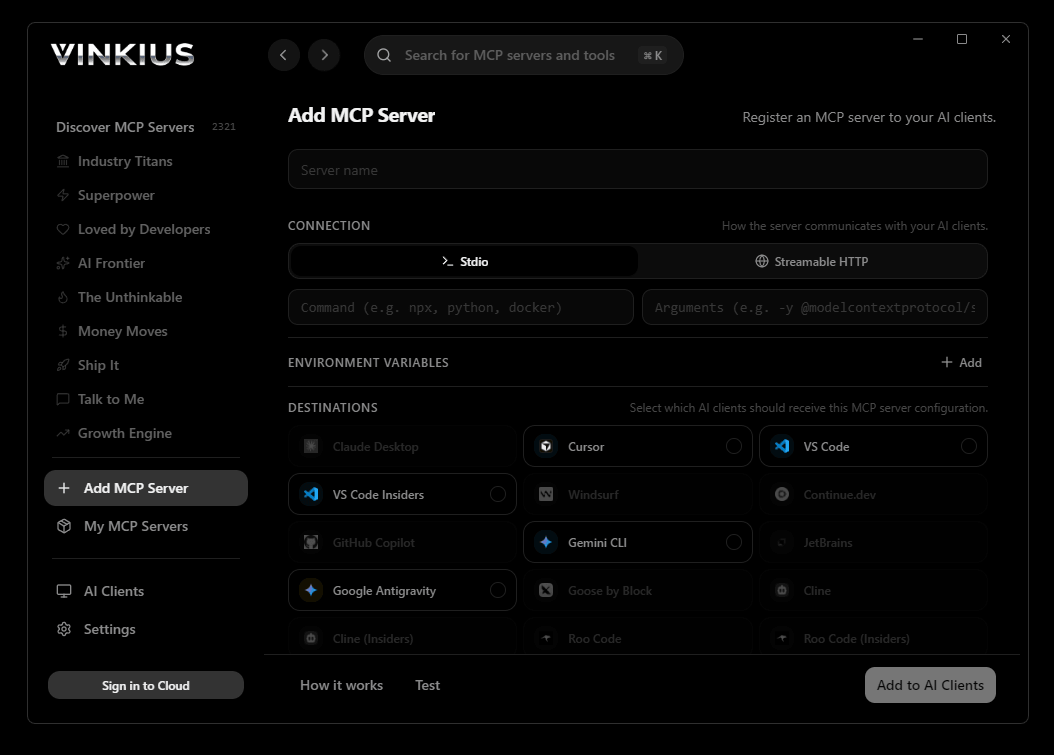
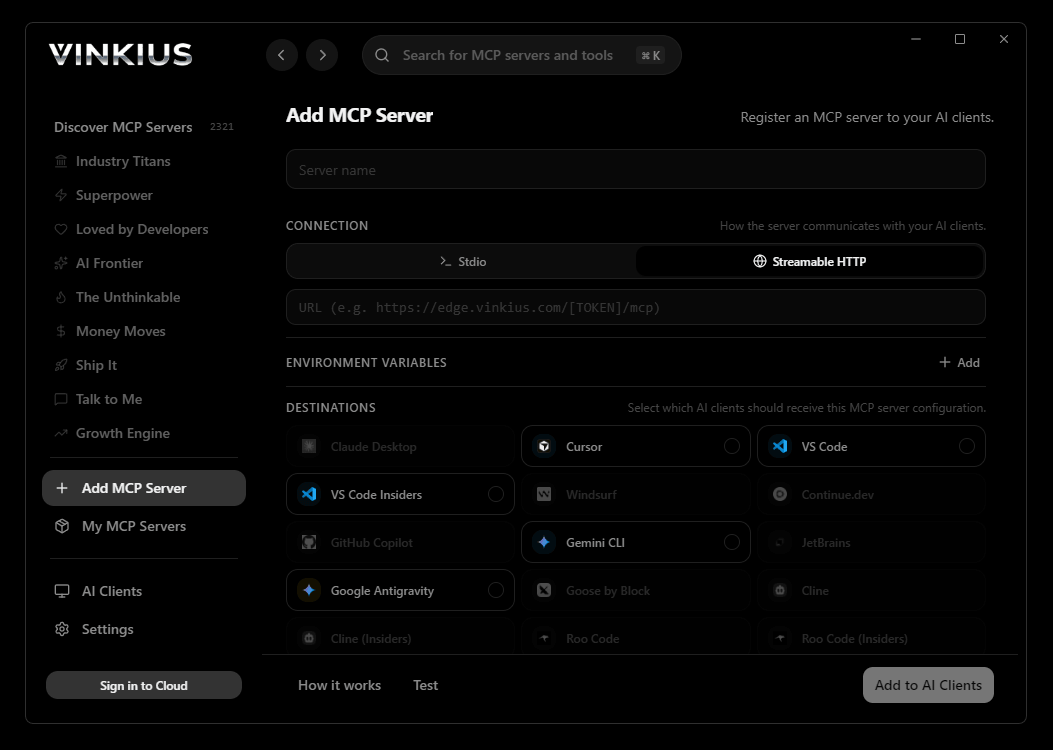
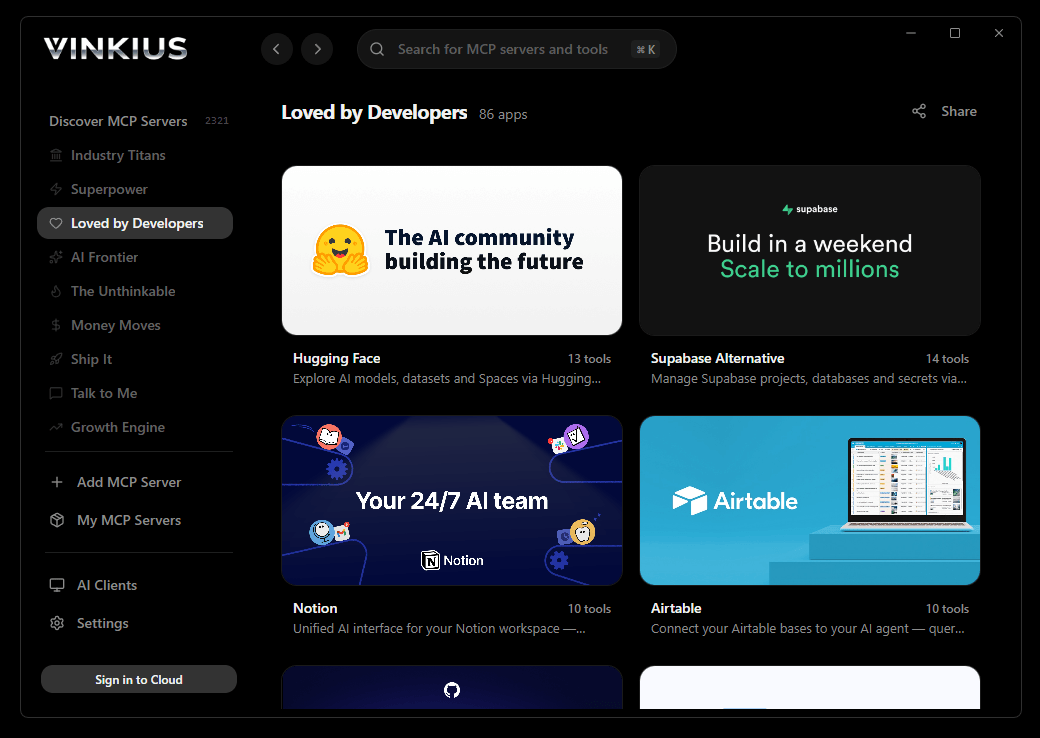
Vinkius Desktop App
The modern way to manage MCP Servers — no config files, no terminal commands. Install FlightAware and 2,500+ MCP Servers from a single visual interface.

# Your Vinkius token — get it at cloud.vinkius.com
claude mcp add flightaware --transport http "https://edge.vinkius.com/[YOUR_TOKEN_HERE]/mcp"
* Every MCP server runs on Vinkius-managed infrastructure inside AWS - a purpose-built runtime with per-request V8 isolates, Ed25519 signed audit chains, and sub-40ms cold starts optimized for native MCP execution. See our infrastructure
About FlightAware MCP Server
Connect your FlightAware AeroAPI aviation data platform to any AI agent and take full control of global flight tracking, airport operations monitoring, and historical flight analysis through natural conversation.
Claude Code registers FlightAware as an MCP server in a single terminal command. Once connected, Claude Code discovers all 12 tools at runtime and can call them headlessly — ideal for CI/CD pipelines, cron jobs, and automated workflows where FlightAware data drives decisions without human intervention.
What you can do
- Flight Search — Find active and recent flights by flight number, tail number, or origin-destination pair
- Flight Status — Get complete status details including gates, runways, scheduled vs. actual times, and delay indicators
- Route Tracking — Access filed flight plans with all waypoints, airways, and altitude restrictions
- Flight Maps — Retrieve static map images showing complete flight tracks from departure to arrival
- Airport Intelligence — Query airport static data, arrivals, departures, and real-time weather observations
- Airline Operations — Monitor entire airline fleets with all active flights by operator/airline code
- Aircraft Registry — Look up aircraft specifications, ownership, registration status, and equipment type
- Historical Analysis — Access flight history dating back to 2011 with complete track points and performance data
- Route Planning — Discover commonly filed routes between any two airports for flight planning and research
- Weather Impact — Check METAR/TAF weather data to assess meteorological impact on flight operations
The FlightAware MCP Server exposes 12 tools through the Vinkius. Connect it to Claude Code in under two minutes — no API keys to rotate, no infrastructure to provision, no vendor lock-in. Your configuration, your data, your control.
How to Connect FlightAware to Claude Code via MCP
Follow these steps to integrate the FlightAware MCP Server with Claude Code.
Install Claude Code
Run npm install -g @anthropic-ai/claude-code if not already installed
Add the MCP Server
Run the command above in your terminal
Verify the connection
Run claude mcp to list connected servers, or type /mcp inside a session
Start using FlightAware
Ask Claude: "Using FlightAware, show me..." — 12 tools are ready
Why Use Claude Code with the FlightAware MCP Server
Claude Code provides unique advantages when paired with FlightAware through the Model Context Protocol.
Single-command setup: `claude mcp add` registers the server instantly — no config files to edit or applications to restart
Terminal-native workflow means MCP tools integrate seamlessly into shell scripts, CI/CD pipelines, and automated DevOps tasks
Claude Code runs headlessly, enabling unattended batch processing using FlightAware tools in cron jobs or deployment scripts
Built by the same team that created the MCP protocol, ensuring first-class compatibility and the fastest adoption of new protocol features
FlightAware + Claude Code Use Cases
Practical scenarios where Claude Code combined with the FlightAware MCP Server delivers measurable value.
CI/CD integration: embed FlightAware tool calls in your deployment pipeline to validate configurations or fetch secrets before shipping
Headless batch processing: schedule Claude Code to query FlightAware nightly and generate reports without human intervention
Shell scripting: pipe FlightAware outputs into other CLI tools for data transformation, filtering, and aggregation
Infrastructure monitoring: run Claude Code in a cron job to query FlightAware status endpoints and alert on anomalies
FlightAware MCP Tools for Claude Code (12)
These 12 tools become available when you connect FlightAware to Claude Code via MCP:
get_aircraft_info
g., "N12345" for US-registered, "G-EUUU" for UK). Returns aircraft type (manufacturer and model), registration country, owner/operator information, registration status, year built, engine type (jet, turboprop, piston), number of engines, and category (airline, business jet, private, cargo, military). Critical for aviation enthusiasts, fleet tracking, aircraft utilization analysis, and private aviation monitoring. AI agents should reference this when users ask "tell me about aircraft N12345", "who owns this tail number", or need aircraft specifications to contextualize flight data. Get registration details and specifications for a specific aircraft
get_airport_arrivals
Returns a list of inbound flights with airline/operator, flight number, aircraft type, origin airport, scheduled and estimated/actual arrival times, arrival runway and gate, and current flight status (en-route, landed, delayed, cancelled, diverted). Essential for airport operations management, passenger pickup coordination, ground handling planning, and arrival delay monitoring. AI agents should reference this when users ask "what flights are arriving at X", "show me arrivals at Y airport", or need to track inbound flights for a specific destination. List arriving flights at a specific airport
get_airport_departures
Returns a list of outbound flights with airline/operator, flight number, aircraft type, destination airport, scheduled and estimated/actual departure times, departure runway and gate, and current flight status (scheduled, boarding, departed, delayed, cancelled, diverted). Critical for airport operations coordination, passenger departure monitoring, gate management, and departure delay tracking. AI agents use this when users ask "what flights are leaving from X", "show me departures at Y airport", or need to track outbound flights from a specific origin. List departing flights from a specific airport
get_airport_info
g., "KJFK" for New York JFK, "KLAX" for Los Angeles International). Returns airport name, location (city, state, country), ICAO/IATA/FAA/LID codes, geographic coordinates (latitude, longitude, elevation), timezone, runway information, and canonical FlightAware ID. Essential for airport identification, travel planning, flight briefing preparation, and geographic reference. AI agents should use this when users ask "tell me about airport X", "what is the ICAO code for Y", or need airport metadata to contextualize flight queries. Get static information and details for a specific airport
get_airport_routes
Returns route strings, frequency of use, typical altitudes, and associated flight examples. Essential for flight planning, route optimization analysis, aviation research, and pilot briefing preparation. AI agents should reference this when users ask "what routes are flown between X and Y", "show me common paths from JFK to LAX", or need to understand routing options between airport pairs for planning or analysis purposes. Get routes between two specific airports
get_airport_weather
Returns METAR (avi routine weather report) data including wind speed and direction, visibility, cloud layers, temperature, dewpoint, altimeter setting, present weather phenomena (rain, snow, fog, thunderstorms), and automated weather remarks. Also provides TAF (terminal aerodrome forecast) for upcoming weather conditions. Essential for flight planning, aviation safety assessment, delay prediction due to weather, and pilot briefing preparation. AI agents should query this when users ask "what is the weather at X airport", "is weather affecting flights at Y", or need to assess meteorological impact on flight operations. Get current weather observations and forecast for a specific airport
get_flight_map
The map shows the filed route, actual track points, departure and arrival airports, and current aircraft position (if airborne). Useful for visual flight presentation, passenger communication, operations dashboards, and flight tracking displays. AI agents should reference this when users request to "show me the flight path" or "where is this flight on a map". Returns image URL that can be embedded in responses or displayed directly. Get a static map image showing the flight track
get_flight_route
Returns the route as a structured list of fixes, navaids, and airway segments from departure to arrival airport. Essential for flight following, aviation enthusiast tracking, pilot briefing preparation, and route analysis. AI agents use this to visualize flight paths, compare filed routes against actual tracks, analyze common routing patterns between airport pairs, and provide pilots with route reference data. Get the filed flight plan route for a specific flight
get_flight_status
Returns departure and arrival airports with terminals and gates, scheduled/estimated/actual times for pushback, takeoff, landing, and arrival, current flight status (en-route, landed, diverted, cancelled, in-hold), delay indicators, aircraft registration and type, route description, and diversion airports if applicable. Critical for passenger travel updates, airline operations coordination, and flight tracking dashboards. AI agents should reference this when users request detailed status for a known flight ID, including gate assignments, delay reasons, and actual vs. scheduled time comparisons. Get complete status details for a specific flight
get_historical_flights
Access continuous flight history data dating back to January 1, 2011, including actual departure and arrival times, route flown, all track points (latitude, longitude, altitude, ground speed, timestamp), arrival status, and delay indicators. Essential for post-flight analysis, operational trend identification, schedule reliability assessment, on-time performance tracking, and aviation safety investigations. AI agents use this when users ask "show me the history of flight X", "how has this route performed over time", or need to analyze historical flight patterns for reliability studies. Get historical flight data and track for a specific flight
get_operator_flights
g., "UAL" for United Airlines, "DAL" for Delta, "BAW" for British Airways). Returns flight numbers, aircraft types, origin-destination pairs, scheduled and actual times, and current status for all flights in the operator fleet. Essential for airline operations monitoring, fleet utilization analysis, competitor intelligence, and passenger rebooking during disruptions. AI agents use this when users ask "show me all United flights", "what is Delta flying right now", or need to track an entire airline operational picture. List all flights operated by a specific airline or operator
search_flights
The query can be a flight number (e.g., "UAL123"), aircraft tail number/registration (e.g., "N12345"), or origin-destination pair (e.g., "KJFK-KLAX"). Returns complete flight identification, airline/operator, aircraft type, departure and arrival airports, scheduled and actual times, current position (if airborne), altitude, ground speed, and flight status (en-route, landed, diverted, cancelled). Essential for real-time flight tracking, passenger pick-up coordination, logistics planning, and aviation operations monitoring. AI agents should use this when users ask "where is flight X", "what flights are flying from A to B", or "show me all flights by tail number N". Search for active and recent flights by flight number, tail number, or route
Example Prompts for FlightAware in Claude Code
Ready-to-use prompts you can give your Claude Code agent to start working with FlightAware immediately.
"Search for all active United Airlines flights from Newark (KEWR) to San Francisco (KSFO)."
"What is the current weather at Chicago O'Hare (KORD) and are flights being delayed due to conditions?"
"Show me the complete flight history and track points for British Airways flight BAW117 from London to New York yesterday."
Troubleshooting FlightAware MCP Server with Claude Code
Common issues when connecting FlightAware to Claude Code through the Vinkius, and how to resolve them.
Command not found: claude
npm install -g @anthropic-ai/claude-codeConnection timeout
FlightAware + Claude Code FAQ
Common questions about integrating FlightAware MCP Server with Claude Code.
How do I add an MCP server to Claude Code?
claude mcp add --transport http "" in your terminal. Claude Code registers the server and discovers all tools immediately.Can Claude Code run MCP tools in headless mode?
How do I list all connected MCP servers?
claude mcp in your terminal to see all registered servers and their status, or type /mcp inside an active Claude Code session.Connect FlightAware with your favorite client
Step-by-step setup guides for every MCP-compatible client and framework:
Anthropic's native desktop app for Claude with built-in MCP support.
AI-first code editor with integrated LLM-powered coding assistance.
GitHub Copilot in VS Code with Agent mode and MCP support.
Purpose-built IDE for agentic AI coding workflows.
Autonomous AI coding agent that runs inside VS Code.
Anthropic's agentic CLI for terminal-first development.
Python SDK for building production-grade OpenAI agent workflows.
Google's framework for building production AI agents.
Type-safe agent development for Python with first-class MCP support.
TypeScript toolkit for building AI-powered web applications.
TypeScript-native agent framework for modern web stacks.
Python framework for orchestrating collaborative AI agent crews.
Leading Python framework for composable LLM applications.
Data-aware AI agent framework for structured and unstructured sources.
Microsoft's framework for multi-agent collaborative conversations.
Connect FlightAware to Claude Code
Get your token, paste the configuration, and start using 12 tools in under 2 minutes. No API key management needed.