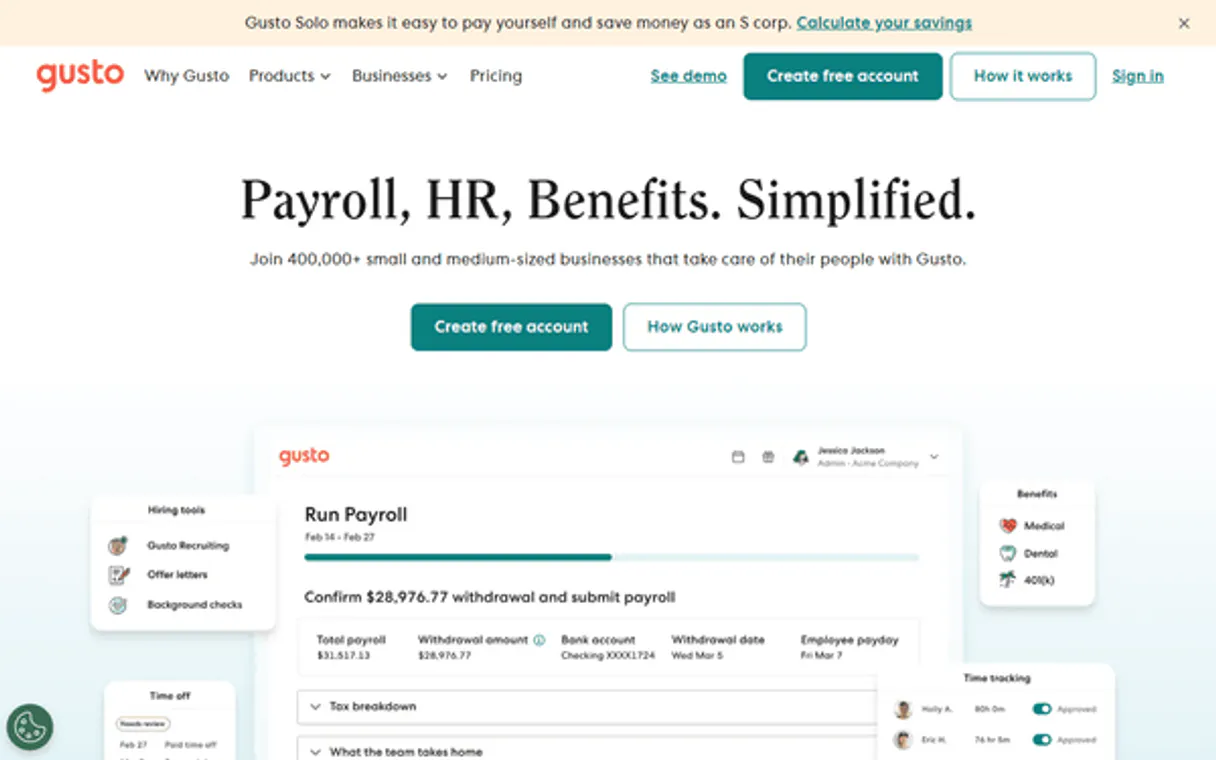
Gusto MCP. Access employee data, payroll, and benefits from one chat.
Works with every AI agent you already use
…and any MCP-compatible client

Just plug in your AI agents and start using Vinkius.
Gusto MCP Server manages everything related to employee records, payroll, and benefits. Your AI agent connects to this server to view employee profiles, run payroll reports, check time-off balances, and access company configuration details.
It's a central data hub for HR and payroll operations.
What your AI agents can do
Get company
Gets the foundational details and configuration settings for the entire company.
Get employee
Retrieves specific, detailed records for a single employee, including compensation.
Get payroll
Pulls the full financial breakdown for a single payroll run.
Retrieves core information about the managed company, including configuration and legal details.
Fetches specific details for any employee, including their compensation and role.
Retrieves the full financial details for a specified payroll run, showing gross pay, taxes, and deductions.
Provides a list of all configured company benefits, including enrollment information for employees.
Allows listing and managing multiple companies associated with the account.
Retrieves the organizational structure by listing all company departments.
Generates a list of employees within a specific company or department.
Provides a list of all office locations managed by the company.
Lists all past payroll runs, providing dates and summaries for quick access.
Retrieves detailed information about all time-off policies, including accrual rules.
Ask AI about this MCP
Supported MCP Clients
Waiting for input…
Gusto MCP Server: 10 Tools for HR Data Management
Use these 10 tools to query, list, and retrieve structured data about employees, payroll runs, benefits, and company policies.
019d75adget company
Gets the foundational details and configuration settings for the entire company.
019d75adget employee
Retrieves specific, detailed records for a single employee, including compensation.
019d75adget payroll
Pulls the full financial breakdown for a single payroll run.
019d75adlist benefits
Lists all available company benefits, including enrollment status for employees.
019d75adlist companies
Lists all different companies that are managed through the Gusto account.
019d75adlist departments
Lists the internal departments that make up the company's organization.
019d75adlist employees
Retrieves a list of employees, usually filtered by a specific company or department.
019d75adlist locations
Lists all physical office locations associated with the company.
019d75adlist payrolls
Lists summaries of all past payroll runs, allowing you to pick a specific date.
019d75adlist time off policies
Lists all configured time-off policies, detailing accrual rates and rules.
Choose How to Get Started
Build a custom MCP for your own tools, or connect a ready-made integration from our catalog.
Build Your Own
Turn any API into an MCP. Import a spec, define Agent Skills, or deploy with MCPFusion.
- Import from OpenAPI, Swagger, or YAML specs
- Create Agent Skills with progressive disclosure
- Deploy to edge with MCPFusion framework
- Built in DLP, auth, and compliance on every call
- Real time usage dashboard and cost metering
- Publish to catalog or keep private
Make Your AI Do More
Start with Gusto, then connect any of our 4,700+ other servers whenever your AI needs more. One click, no limits.
- Use this MCP plus 4,700+ others, all in one place
- Add new capabilities to your AI anytime you want
- Every connection is secured and compliant automatically
- Track usage and costs across all your servers
- Works with Claude, ChatGPT, Cursor, and more
- New servers added to the catalog every week
What you can do with this MCP connector
Your AI agent can run your whole HR and payroll stack through this server. It lets you pull everything you need about your staff, benefits, and company setup. You'll be checking records, running reports, and managing the books all from one place.
get_company lets you grab the core details and configuration for the whole business.
get_employee pulls up specific staff profiles, including their salary and role.
get_payroll shows the full financial breakdown for any single payroll run—you'll see gross pay, taxes, and deductions.
list_benefits gives you a list of all company benefits, and it shows which employees are enrolled in each one.
list_companies lets you see every company managed under the Gusto account.
list_departments shows the organization structure by listing all the company's internal departments.
list_employees pulls a roster of staff, letting you filter by a specific company or department.
list_locations lists every physical office location connected to the company.
list_payrolls provides summaries of past payroll runs, so you can pick a specific date to check.
list_time_off_policies gives you all the configured time-off policies, detailing accrual rates and rules.
How Gusto MCP Works
- 1 Your AI agent calls the Gusto MCP Server and specifies the data needed (e.g., 'I need payroll details for Q2').
- 2 The server runs the appropriate tool (like
get_payrollorlist_employees) and pulls the data from Gusto. - 3 The server sends the structured data back to your AI agent, which uses it to answer the user's request.
The bottom line is your AI agent gets clean, structured HR data from Gusto without you having to log in or copy anything.
Who Is Gusto MCP For?
Operations managers and HR analysts who deal with compliance and data reconciliation. If your job involves checking if an employee has enough PTO, or running a payroll report for tax filing, this is for you. You're tired of jumping between the payroll portal, the benefits portal, and the HRIS just to get one answer.
Uses the server to check employee records and verify time-off balances before approving leave requests.
Uses the server to list payroll runs and view gross-to-net calculations for tax reporting and auditing.
Uses the server to list departments and locations to map out the company's full organizational structure.
What Changes When You Connect
- See an employee's full profile, compensation, and title instantly with
get_employee. No need to navigate the HR portal to find a single person's salary details. - Run full payroll audits by using
get_payrollorlist_payrolls. You get the full breakdown of gross earnings, taxes, and deductions in one structured output. - Understand the company's structure by running
list_departmentsorlist_locations. You map out the whole org chart without leaving your agent interface. - Check PTO balances and policies quickly.
list_time_off_policiesshows accrual rates, while other tools help verify if an employee can take the time off. - View every benefit plan (401k, dental, health) and who is enrolled using
list_benefits. It's a quick audit of your benefits compliance. - Manage multiple legal entities by using
list_companies. This lets you run reports across all your managed subsidiaries in one go.
Real-World Use Cases
Auditing Payroll Compliance
The compliance team needs to verify if the tax deductions for last month's paychecks were correct. They ask their agent to use list_payrolls to find the correct run date, and then run get_payroll to pull the specific tax and deduction line items for a full audit trail.
Onboarding a New Hire
The manager needs to know exactly what benefits the new hire qualifies for. They prompt the agent to run list_benefits. The agent pulls the list, and the manager can immediately confirm if the required 401k plan is available and who is enrolled.
Organizational Restructure
The executive needs a list of all employees in the newly formed 'Product' department. They ask the agent to use list_departments first, then use list_employees filtered by the new department ID to get the exact roster.
Time Off Policy Review
HR needs to compare the current sick leave policy to the new company policy. They ask the agent to run list_time_off_policies, which compares the accrual rates and rules for all available PTO types in one view.
The Tradeoffs
Manual Data Collection
A user logs into Gusto, clicks 'Payroll', then clicks 'Employees' to check PTO. They then copy-paste the data into a spreadsheet for review.
→
Let your AI agent do the clicks. Use list_payrolls to find the run date, then list_employees and get_employee to get the combined data in one go.
When It Fits, When It Doesn't
Use this server if your primary need is structured, read-only data retrieval about company structure, employee records, or financial history. If you need to change data—like updating an employee's address or changing a benefit enrollment—this won't help. For transactional changes, you need a dedicated write-API tool. If you just need to know 'who reported to whom' and nothing else, a simple directory service might suffice, but this server gives you the full payroll and benefits context. If you need to run a complex predictive model (e.g., 'What if we increase the 401k match by 2%?'), you'll need to build that logic on top of the data you get from get_payroll and list_benefits.
Independent Platform Disclaimer: Vinkius is an independent platform and is not affiliated with, endorsed by, sponsored by, verified by, or otherwise authorized by Gusto. All third-party trademarks, logos, and brand names are the property of their respective owners. Their use on this website is strictly for informational purposes to identify service compatibility and interoperability.
VINKIUS INFRASTRUCTURE
Cloud Hosted
Managed infra
V8 Isolated
Sandboxed per request
Zero-Trust Proxy
No stored credentials
DLP Enforced
Policy on every call
GDPR Compliant
EU data residency
Token Compression
~60% cost reduction
Works with Claude, ChatGPT, Cursor, and more
The Model Context Protocol standardizes how applications expose capabilities to LLMs. Instead of operating in isolation, your AI gains direct access to external platforms, live data, and real-world actions through secure, standardized connections.
This server provides 10 capabilities that interface natively with Claude, ChatGPT, Cursor, and any MCP client. No middleware. No custom integration required.
Available Capabilities
Sifting through HR portals shouldn't require logging in three times.
Before this, getting a complete view of an employee's standing required jumping through five different dashboards. You'd start in the HRIS to see their profile, then jump to the payroll system to check tax status, and finally click into the PTO section just to see their accrued time. It's a painful, multi-tab, copy-paste process.
Now, your agent calls the Gusto MCP Server. It runs the necessary tools—like `get_employee` and `list_time_off_policies`—and returns the full, combined data set. You get the answer instantly, structured and ready to use.
Gusto MCP Server: View payroll, benefits, and employee details.
Previously, pulling a single payroll summary meant running a report that was hours old and lacked the specific deduction breakdown. You also had to manually check if the benefit plan listed matched the current enrollment status.
Now, your agent handles the complexity. It pulls the `get_payroll` data and cross-references it with `list_benefits` and `get_employee` data simultaneously. It's a single, reliable data source.
Common Questions About Gusto MCP
How do I use the Gusto MCP Server to check an employee's PTO balance? +
You need to use list_time_off_policies to see the configured rules, and then get_employee to pull the specific employee's current accrual and balance.
Can I list all payroll runs using the Gusto MCP Server? +
Yes, use the list_payrolls tool. This gives you a list of all historical pay periods, letting you select the specific run you need to audit.
What does the `list_benefits` tool do? +
The list_benefits tool shows every benefit the company offers (health, dental, 401k) and includes the enrollment information for employees.
How do I get the company's legal details? +
Call get_company. This tool retrieves core corporate information, including the EIN and overall company configuration details.
Does the Gusto MCP Server help with departments? +
Yes, use list_departments to see the organizational structure and list_employees to list all employees within a specific department.
How do I use the `list_employees` tool to find employees in a specific department? +
You filter the list of employees by department. After calling list_employees, your agent can refine the results to show only staff in the department you name. This is useful for targeted reports.
What information can I get about a company's structure using `list_departments` and `list_locations`? +
These tools map out the company's organizational structure. You can see all defined departments and all physical office locations. This helps you understand where staff are placed and which departments exist.
Can I get detailed information about payroll runs using the `get_payroll` tool? +
Yes, get_payroll provides comprehensive run details. It shows total gross earnings, various tax deductions (federal, state), and the final net pay amount. This gives a full picture of the payment cycle.
Can I view payroll details? +
Yes! Use list_payrolls to see all runs, then get_payroll for detailed breakdowns per employee.
Can I see employee benefits? +
Yes! Use list_benefits with a company ID to see all configured benefit plans including health, dental, and retirement.
Can I list all employees? +
Yes! Use list_employees with a company ID to get the full roster with names, departments, and roles.
Use it with your favorite AI tools
Connect this server to Cursor, Claude, VS Code, and more.
More in this category
Hyperswitch
Manage payments, customers, and refunds via Hyperswitch API.
Griffin
Manage your banking & fintech operations via Griffin — list accounts, monitor transactions, and handle verifications via AI.
Bsale
Automate cloud POS operations via Bsale — issue electronic invoices, manage inventory, track stock levels, and register clients from any AI agent.
You might also like
CONSENSUS
Share interactive product demos with prospects that track engagement and reveal which features matter most to each buyer.
Scaleway
Manage Scaleway cloud infrastructure — list, create, and control virtual instances directly from your AI agent.
Prismic
Query and manage your Prismic headless CMS content — search documents, list custom types, and retrieve specific content directly from any AI agent.