
Honeywell Process MCP Server for Cline 10 tools — connect in under 2 minutes
Cline is an autonomous AI coding agent inside VS Code that plans, executes, and iterates on tasks. Wire Honeywell Process through Vinkius and Cline gains direct access to every tool. from data retrieval to workflow automation. without leaving the terminal.
ASK AI ABOUT THIS MCP SERVER
Vinkius supports streamable HTTP and SSE.
Vinkius Desktop App
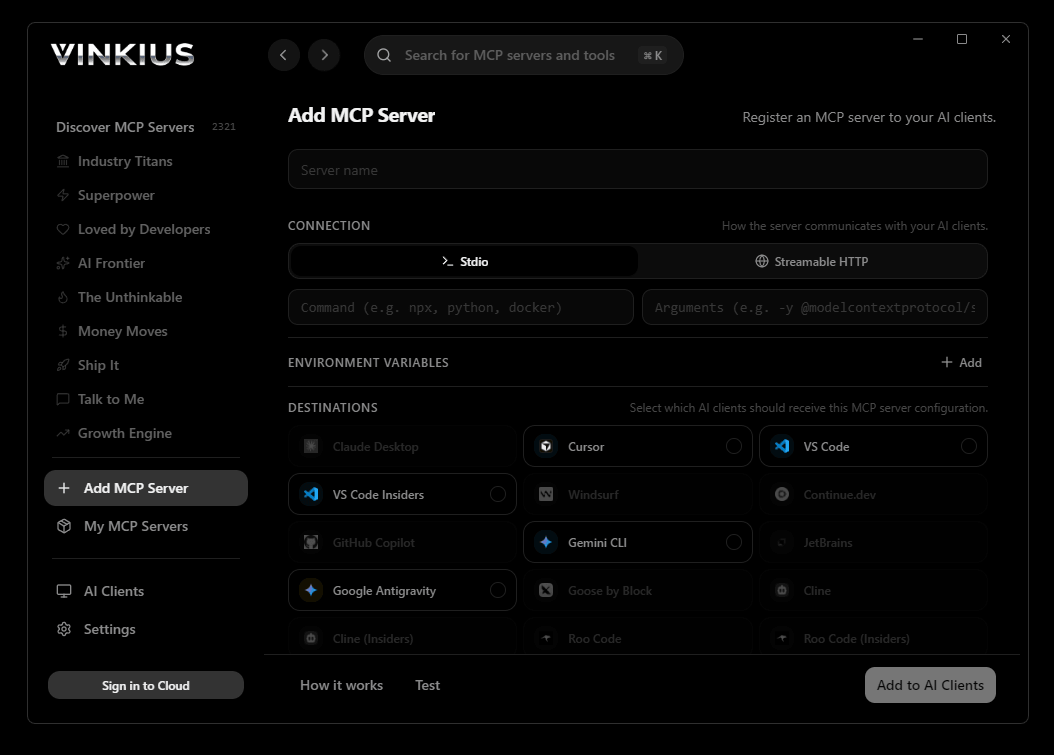
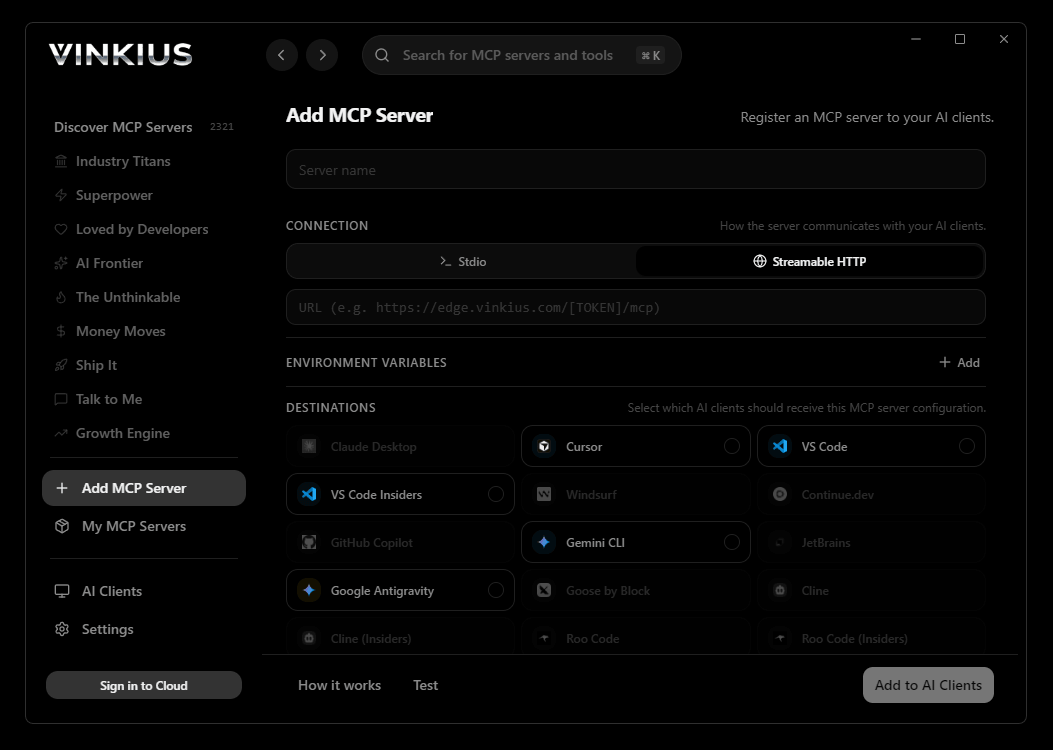
The modern way to manage MCP Servers — no config files, no terminal commands. Install Honeywell Process and 2,500+ MCP Servers from a single visual interface.

{
  "mcpServers": {
    "honeywell-process": {
      "url": "https://edge.vinkius.com/[YOUR_TOKEN_HERE]/mcp"
    }
  }
}
* Every MCP server runs on Vinkius-managed infrastructure inside AWS - a purpose-built runtime with per-request V8 isolates, Ed25519 signed audit chains, and sub-40ms cold starts optimized for native MCP execution. See our infrastructure
About Honeywell Process MCP Server
Connect Honeywell Process to any AI agent via MCP.
How to Connect Honeywell Process to Cline via MCP
Follow these steps to integrate the Honeywell Process MCP Server with Cline.
Open Cline MCP Settings
Click the MCP Servers icon in the Cline sidebar panel
Add remote server
Click "Add MCP Server" and paste the configuration above
Enable the server
Toggle the server switch to ON
Start using Honeywell Process
Ask Cline: "Using Honeywell Process, help me...". 10 tools available
Why Use Cline with the Honeywell Process MCP Server
Cline provides unique advantages when paired with Honeywell Process through the Model Context Protocol.
Cline operates autonomously. it reads your codebase, plans a strategy, and executes multi-step tasks including MCP tool calls without step-by-step prompts
Runs inside VS Code, so you get MCP tool access alongside your existing extensions, terminal, and version control in a single window
Cline can create, edit, and delete files based on MCP tool responses, enabling end-to-end automation from data retrieval to code generation
Transparent execution: every tool call and file change is shown in Cline's activity log for full visibility and approval before committing
Honeywell Process + Cline Use Cases
Practical scenarios where Cline combined with the Honeywell Process MCP Server delivers measurable value.
Autonomous feature building: tell Cline to fetch data from Honeywell Process and scaffold a complete module with types, handlers, and tests
Codebase refactoring: use Honeywell Process tools to validate live data while Cline restructures your code to match updated schemas
Automated testing: Cline fetches real responses from Honeywell Process and generates snapshot tests or mocks based on actual payloads
Incident response: query Honeywell Process for real-time status and let Cline generate hotfix patches based on the findings
Honeywell Process MCP Tools for Cline (10)
These 10 tools become available when you connect Honeywell Process to Cline via MCP:
create_maintenance_ticket
The ticket includes asset identification, problem description, priority level, requested completion date, and any relevant diagnostic data. Upon creation, the system assigns a work order number, routes the ticket to the appropriate maintenance team, and triggers notifications. Use this tool to formally log equipment issues, schedule preventive maintenance, or escalate asset health concerns to the maintenance workflow. Create a new maintenance work order or ticket for an asset
get_asset_details
Returns comprehensive information including hardware specifications, firmware version, network configuration, installation date, assigned location, maintenance history summary, and current operational parameters. Use this tool when you need in-depth information about a particular scanner, sensor, controller, or any other registered device in the Honeywell ecosystem. Get detailed information about a specific Honeywell asset or device
get_asset_health
Health data includes overall health score, component-level status, predicted remaining useful life, active fault codes, sensor readings, and recommended actions. Use this tool to quickly assess whether an asset requires immediate attention, verify post-maintenance recovery, or integrate health data into broader asset management workflows. Requires the specific asset identifier to retrieve targeted diagnostic information. Get real-time health status and diagnostics for a specific asset
get_maintenance_logs
Each log entry includes work order reference, technician details, parts replaced, labor hours, root cause analysis, and resolution notes. Use this tool to track maintenance history, identify recurring failure patterns, verify warranty service records, or audit compliance with preventive maintenance schedules. Filter by asset ID to focus on a specific device, or use date range and log type parameters to narrow the search. Access maintenance and repair logs for Honeywell industrial assets
get_operational_alerts
Alerts include equipment anomalies, threshold violations, process deviations, connectivity issues, and safety warnings. Each alert contains severity level, source asset, description, timestamp, and acknowledgment status. Use this tool to identify current operational issues, review recent incident history, or assess the overall health status of industrial processes. Filter by severity, status, or date range to narrow down results. List operational alerts and notifications from the Honeywell process monitoring system
get_process_metrics
Metrics include throughput rates, efficiency scores, uptime percentages, cycle times, and quality indices across production lines or individual assets. Use this tool to evaluate operational performance, identify bottlenecks, compare shifts or lines, and generate performance reports. Results can be filtered by time range, asset group, or specific metric categories to focus the analysis on relevant operational data. Get real-time and historical process performance metrics
get_production_data
Data is organized by production line, shift, or time period. Use this tool to analyze production trends, verify output targets, compare actual vs. planned production, or generate operational summaries. Filter by site, line, date range, or product type to focus the analysis on specific segments of the production operation. Retrieve production output and operational data from the Honeywell process system
get_scan_events
Each event includes timestamp, device ID, scan type, decoded data, and success/failure status. Use this tool to audit scanning operations, trace barcode or RFID read events, investigate scan failures, or analyze throughput patterns for specific devices or across the entire facility. Optionally filter by a specific asset ID to focus on one device. Retrieve scan event history from Honeywell scanning and mobility devices
get_shift_reports
Reports include output quantities, downtime events, quality metrics, safety observations, and operator notes. Use this tool to review historical shift performance, compare shift-to-shift results, identify recurring issues, or prepare management summaries. Optionally specify a shift ID to retrieve a single detailed report. Retrieve shift operation reports summarizing production activity
list_assets
Supports optional filtering by site, type, or status. Use this tool when you need to discover available assets, check device registration status, or build an overview of the industrial infrastructure. Returns asset IDs, names, types, locations, and current operational status for each registered device. List all registered assets and devices in the Honeywell Operational Intelligence platform
Troubleshooting Honeywell Process MCP Server with Cline
Common issues when connecting Honeywell Process to Cline through the Vinkius, and how to resolve them.
Server shows error in sidebar
Honeywell Process + Cline FAQ
Common questions about integrating Honeywell Process MCP Server with Cline.
How does Cline connect to MCP servers?
Can Cline run MCP tools without approval?
Does Cline support multiple MCP servers at once?
Connect Honeywell Process with your favorite client
Step-by-step setup guides for every MCP-compatible client and framework:
Anthropic's native desktop app for Claude with built-in MCP support.
AI-first code editor with integrated LLM-powered coding assistance.
GitHub Copilot in VS Code with Agent mode and MCP support.
Purpose-built IDE for agentic AI coding workflows.
Autonomous AI coding agent that runs inside VS Code.
Anthropic's agentic CLI for terminal-first development.
Python SDK for building production-grade OpenAI agent workflows.
Google's framework for building production AI agents.
Type-safe agent development for Python with first-class MCP support.
TypeScript toolkit for building AI-powered web applications.
TypeScript-native agent framework for modern web stacks.
Python framework for orchestrating collaborative AI agent crews.
Leading Python framework for composable LLM applications.
Data-aware AI agent framework for structured and unstructured sources.
Microsoft's framework for multi-agent collaborative conversations.
Connect Honeywell Process to Cline
Get your token, paste the configuration, and start using 10 tools in under 2 minutes. No API key management needed.