
IndoorAtlas (Indoor Positioning) MCP Server for Cursor 10 tools — connect in under 2 minutes
Cursor is an AI-first code editor built on VS Code that integrates LLM-powered coding assistance directly into the development workflow. Its Agent mode enables autonomous multi-step coding tasks, and MCP support lets agents access external data sources and APIs during code generation.
ASK AI ABOUT THIS MCP SERVER
Vinkius supports streamable HTTP and SSE.
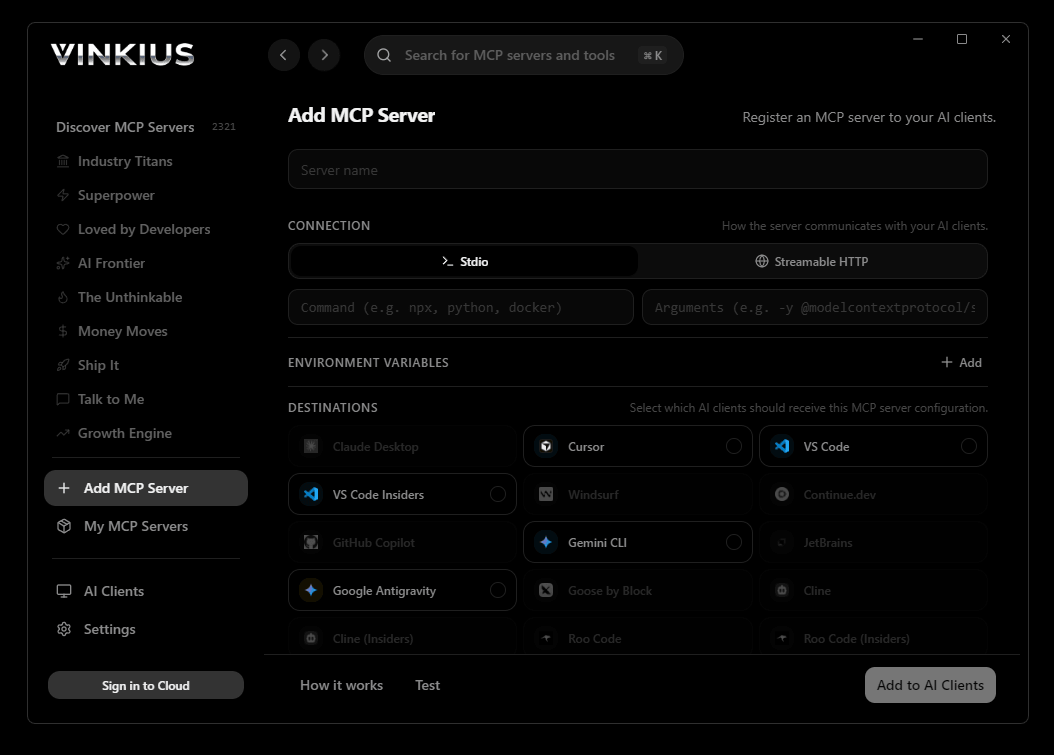
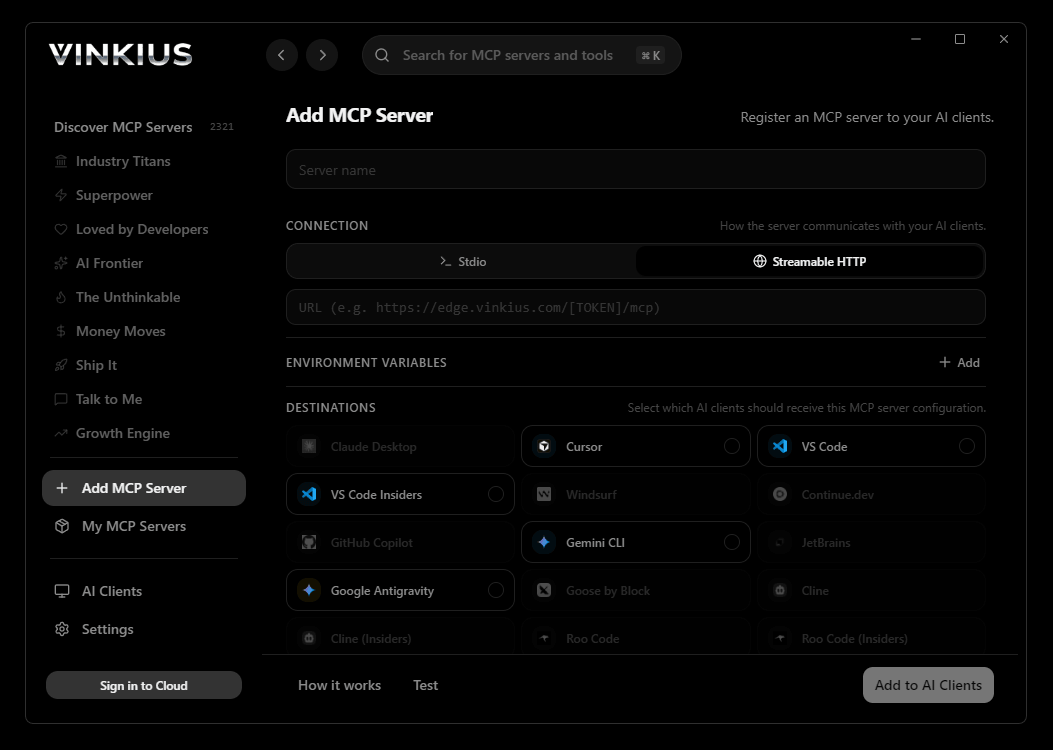
Vinkius Desktop App
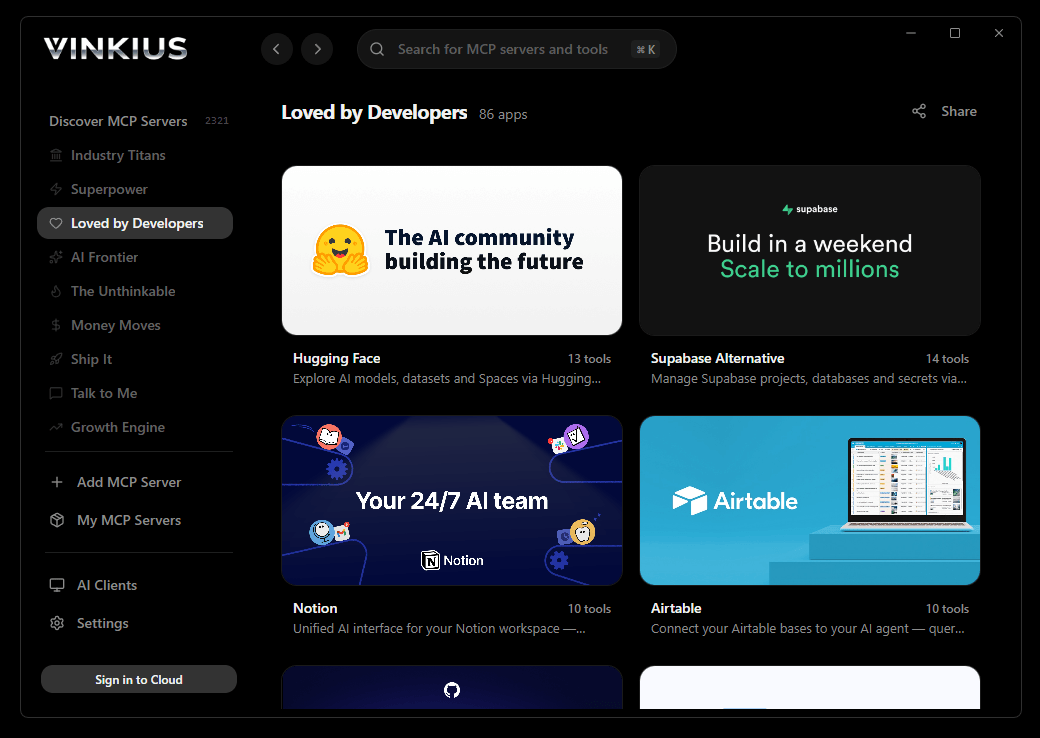
The modern way to manage MCP Servers — no config files, no terminal commands. Install IndoorAtlas (Indoor Positioning) and 2,500+ MCP Servers from a single visual interface.

{
  "mcpServers": {
    "indooratlas-indoor-positioning": {
      "url": "https://edge.vinkius.com/[YOUR_TOKEN_HERE]/mcp"
    }
  }
}
* Every MCP server runs on Vinkius-managed infrastructure inside AWS - a purpose-built runtime with per-request V8 isolates, Ed25519 signed audit chains, and sub-40ms cold starts optimized for native MCP execution. See our infrastructure
About IndoorAtlas (Indoor Positioning) MCP Server
Connect your IndoorAtlas account to any AI agent and take full control of your smart building infrastructure and indoor positioning services through natural conversation.
Cursor's Agent mode turns IndoorAtlas (Indoor Positioning) into an in-editor superpower. Ask Cursor to generate code using live data from IndoorAtlas (Indoor Positioning) and it fetches, processes, and writes. all in a single agentic loop. 10 tools appear alongside file editing and terminal access, creating a unified development environment grounded in real-time information.
What you can do
- Venue Management — List all registered indoor venues and retrieve detailed metadata including geographic anchor points and floor counts directly from your agent
- Floorplan Orchestration — Upload new floor plans as GeoJSON and manage geo-referencing to real-world coordinates for accurate indoor positioning
- Map Generation — Trigger the radio map generation process to compute positioning models from signal fingerprint data and floor geometry
- Analytics & Sessions — Retrieve historical positioning sessions and trace data to analyze occupancy patterns, dwell times, and path optimization
- Wi-Fi Positioning — Determine indoor location from Wi-Fi scans using the Positioning API to receive estimated coordinates and floor levels
- Calibration Audit — Inspect fingerprinting walk paths to assess calibration coverage and identify areas needing additional signal mapping
The IndoorAtlas (Indoor Positioning) MCP Server exposes 10 tools through the Vinkius. Connect it to Cursor in under two minutes — no API keys to rotate, no infrastructure to provision, no vendor lock-in. Your configuration, your data, your control.
How to Connect IndoorAtlas (Indoor Positioning) to Cursor via MCP
Follow these steps to integrate the IndoorAtlas (Indoor Positioning) MCP Server with Cursor.
Open MCP Settings
Press Cmd+Shift+P (macOS) or Ctrl+Shift+P (Windows/Linux) → search "MCP Settings"
Add the server config
Paste the JSON configuration above into the mcp.json file that opens
Save the file
Cursor will automatically detect the new MCP server
Start using IndoorAtlas (Indoor Positioning)
Open Agent mode in chat and ask: "Using IndoorAtlas (Indoor Positioning), help me...". 10 tools available
Why Use Cursor with the IndoorAtlas (Indoor Positioning) MCP Server
Cursor AI Code Editor provides unique advantages when paired with IndoorAtlas (Indoor Positioning) through the Model Context Protocol.
Agent mode turns Cursor into an autonomous coding assistant that can read files, run commands, and call MCP tools without switching context
Cursor's Composer feature can generate entire files using real-time data fetched through MCP. no copy-pasting from external dashboards
MCP tools appear alongside built-in tools like file reading and terminal access, creating a unified agentic environment
VS Code extension compatibility means your existing workflow, keybindings, and extensions all work alongside MCP tools
IndoorAtlas (Indoor Positioning) + Cursor Use Cases
Practical scenarios where Cursor combined with the IndoorAtlas (Indoor Positioning) MCP Server delivers measurable value.
Code generation with live data: ask Cursor to generate a security report module using live DNS and subdomain data fetched through MCP
Automated documentation: have Cursor query your API's tool schemas and generate TypeScript interfaces or OpenAPI specs automatically
Infrastructure-as-code: Cursor can fetch domain configurations and generate corresponding Terraform or CloudFormation templates
Test scaffolding: ask Cursor to pull real API responses via MCP and generate unit test fixtures from actual data
IndoorAtlas (Indoor Positioning) MCP Tools for Cursor (10)
These 10 tools become available when you connect IndoorAtlas (Indoor Positioning) to Cursor via MCP:
create_venue
The venue serves as the top-level container for floor plans and positioning data. After creation, upload floor plan images and calibrate for positioning accuracy. Create a new indoor venue in the IndoorAtlas platform by specifying the building name, geographic coordinates of the entrance, and initial configuration parameters for indoor positioning deployment
get_fingerprint_paths
Returns GeoJSON LineString features representing calibration paths. Use to assess calibration coverage and identify areas of the floor that need additional fingerprinting for better positioning accuracy. Retrieve the fingerprinting walk paths recorded for a specific floor plan as GeoJSON, showing the routes surveyors walked while collecting Wi-Fi/BLE signal data for positioning calibration
get_session_data
Returns the complete position trace as a series of timestamped fixes. Use for path visualization, behavioral analysis, and positioning quality assessment. Large sessions may contain thousands of position fixes. Retrieve the full positioning trace data for a specific IndoorAtlas session, including timestamped coordinate fixes, floor transitions, accuracy metrics, and sensor readings throughout the session duration
get_venue_details
Returns the venue configuration including coordinate reference, building dimensions, and mapping completeness metrics. Use to inspect a venue before deploying positioning or wayfinding features. Retrieve detailed metadata for a specific IndoorAtlas venue including its geographic anchor point, floor count, total mapped area, calibration status, and associated floor plan identifiers
list_floorplans
Returns an array of floor plan metadata objects ordered by floor number. Each entry includes the plan dimensions, pixel-to-meter scale, and whether radio map generation has been completed. List all floor plans uploaded to a specific IndoorAtlas venue, returning floor plan IDs, floor numbers, dimensions, geo-alignment status, and map generation readiness for each level of the building
list_positioning_sessions
Returns a paginated list of positioning sessions. Each session represents a continuous period of indoor tracking by a single device. Use for occupancy analytics, dwell time analysis, and path optimization studies. List historical indoor positioning sessions recorded by IndoorAtlas, returning session IDs, start/end times, venue associations, and device information for analytics and path replay
list_venues
Returns an array of venue objects. Each venue represents a physical building that has been set up for indoor positioning. Use to discover available venues before requesting floor plans or positioning data. List all indoor venues registered in your IndoorAtlas organization, returning venue IDs, names, geographic coordinates, and configuration status for each mapped building or facility
position_from_wifi_scan
Returns estimated coordinates with uncertainty radius. Use for server-side positioning when mobile SDK integration is not feasible. Determine indoor position from a Wi-Fi access point scan using the IndoorAtlas Positioning API, submitting observed signal strengths to receive a calculated latitude, longitude, floor level, and accuracy estimate
trigger_map_generation
This is a critical step — positioning will not work on a floor until map generation completes successfully. The process is asynchronous and may take several minutes depending on floor plan complexity. Trigger the IndoorAtlas radio map generation process for a specific floor plan, initiating the server-side computation that creates the positioning model from fingerprint data and floor plan geometry
upload_floorplan_geojson
After upload, trigger map generation to enable positioning on this floor. Upload a new floor plan to an IndoorAtlas venue as a GeoJSON document, geo-referencing the indoor map image to real-world coordinates for accurate positioning overlay
Example Prompts for IndoorAtlas (Indoor Positioning) in Cursor
Ready-to-use prompts you can give your Cursor agent to start working with IndoorAtlas (Indoor Positioning) immediately.
"List all indoor venues in my IndoorAtlas account"
"Check the calibration paths for the 3rd floor of the 'Retail Mall'"
"List the most recent positioning sessions recorded today"
Troubleshooting IndoorAtlas (Indoor Positioning) MCP Server with Cursor
Common issues when connecting IndoorAtlas (Indoor Positioning) to Cursor through the Vinkius, and how to resolve them.
Tools not appearing in Cursor
Server shows as disconnected
IndoorAtlas (Indoor Positioning) + Cursor FAQ
Common questions about integrating IndoorAtlas (Indoor Positioning) MCP Server with Cursor.
What is Agent mode and why does it matter for MCP?
Where does Cursor store MCP configuration?
mcp.json file. You can configure servers at the project level (.cursor/mcp.json in your project root) or globally (~/.cursor/mcp.json). Project-level configs take precedence.Can Cursor use MCP tools in inline edits?
How do I verify MCP tools are loaded?
Connect IndoorAtlas (Indoor Positioning) with your favorite client
Step-by-step setup guides for every MCP-compatible client and framework:
Anthropic's native desktop app for Claude with built-in MCP support.
AI-first code editor with integrated LLM-powered coding assistance.
GitHub Copilot in VS Code with Agent mode and MCP support.
Purpose-built IDE for agentic AI coding workflows.
Autonomous AI coding agent that runs inside VS Code.
Anthropic's agentic CLI for terminal-first development.
Python SDK for building production-grade OpenAI agent workflows.
Google's framework for building production AI agents.
Type-safe agent development for Python with first-class MCP support.
TypeScript toolkit for building AI-powered web applications.
TypeScript-native agent framework for modern web stacks.
Python framework for orchestrating collaborative AI agent crews.
Leading Python framework for composable LLM applications.
Data-aware AI agent framework for structured and unstructured sources.
Microsoft's framework for multi-agent collaborative conversations.
Connect IndoorAtlas (Indoor Positioning) to Cursor
Get your token, paste the configuration, and start using 10 tools in under 2 minutes. No API key management needed.