
Logseq MCP. Manage your local knowledge graph via chat.
 Gemini
 Works with every AI agent you already use
…and any MCP-compatible client









Just plug in your AI agents and start using Vinkius.
Logseq (Knowledge Management) MCP Server lets your AI agent treat your local knowledge graph like a database. It connects to Logseq, letting you programmatically create pages (`create_page`), append specific blocks (`insert_block`), search content across the entire graph (`search_content`), or manage structure by listing all pages (`list_pages`).
Full control over your private notes without touching the UI.
What your AI agents can do
Create page
Creates a new, organized page in your Logseq graph with native markdown content.
Delete block
Removes an active block from the target graph, safely dropping child dependencies and nodes.
Delete page
Deletes an entire Logseq page irreversibly, including all associated metadata loops.
The agent can create new pages, delete entire pages, and pull metadata for any page by name or UUID.
You can append new outliner blocks to a page, modify existing block properties, or safely remove specific nodes within the graph.
The server allows you to list all pages in the graph or extract deeply nested, hierarchical trees for structural analysis.
Execute local queries across your entire knowledge base, finding specific text targets regardless of where they live.
Ask AI about this MCP
Supported MCP Clients
Gemini Waiting for input…
Logseq (Knowledge Management) MCP Server: 10 Tools for Outliners
These tools let your AI agent read, write, and audit every aspect of your local Logseq outliner graph—from listing pages to modifying individual blocks.
019d75c9create page
Creates a new, organized page in your Logseq graph with native markdown content.
019d75c9delete block
Removes an active block from the target graph, safely dropping child dependencies and nodes.
019d75c9delete page
Deletes an entire Logseq page irreversibly, including all associated metadata loops.
019d75c9get current graph
Validates the environment by identifying and parsing the current graph's native array limits.
019d75c9get page
Retrieves all metadata for a specific Logseq page using its name or UUID.
019d75c9get page blocks
Extracts the complete, hierarchical block tree array from a specified page map.
019d75c9insert block
Appends a new outliner block to a specific page and updates all necessary nodes immediately.
019d75c9list pages
Returns a list of every single page currently existing in the Logseq graph.
019d75c9search content
Executes local queries, extracting bound text targets across the entire knowledge base and multiple indices.
019d75c9update block
Modifies raw properties within a specific Logseq block while preserving its unique UUID bounds and linking indices.
Choose How to Get Started
Build a custom MCP for your own tools, or connect a ready-made integration from our catalog.
Build Your Own
Turn any API into an MCP. Import a spec, define Agent Skills, or deploy with MCPFusion.
- Import from OpenAPI, Swagger, or YAML specs
- Create Agent Skills with progressive disclosure
- Deploy to edge with MCPFusion framework
- Built in DLP, auth, and compliance on every call
- Real time usage dashboard and cost metering
- Publish to catalog or keep private
Make Your AI Do More
Start with Logseq (Knowledge Management), then connect any of our 4,700+ other servers whenever your AI needs more. One click, no limits.
- Use this MCP plus 4,700+ others, all in one place
- Add new capabilities to your AI anytime you want
- Every connection is secured and compliant automatically
- Track usage and costs across all your servers
- Works with Claude, ChatGPT, Cursor, and more
- New servers added to the catalog every week
What you can do with this MCP connector
Logseq Knowledge Graph Operations MCP Server
You're tired of your AI agent just poking around the Logseq UI like a tourist? This server lets your agent treat your local knowledge graph like it's a proper database. You get full, programmatic control over every note and link without ever touching the visual interface. It exposes tools that let your AI client read, write, and restructure your entire private knowledge base.
Managing Pages: Creating and Deleting Containers
You can tell your agent to build new pages instantly; use create_page to generate a fresh, organized page right into your graph with native markdown content. If a project or idea is dead, you've got delete_page—it nukes the whole Logseq page irreversibly, taking out all associated metadata loops.
To check what you're working with, run list_pages; it spits out a list of every single page currently living in your graph. Need to know everything about one specific location? Use get_page to pull all metadata for any page by its name or UUID.
Manipulating Blocks: The Fine Detail Work
The real power is down at the block level, where you can make surgical changes. You'll use insert_block to append a new outliner block onto a specific page and update every necessary node immediately. If something needs tweaking, don't worry; update_block modifies raw properties within one specific block while keeping its unique UUID bounds and linking indices intact.
Wanna remove a section? Use delete_block; it safely pulls an active block from the target graph, dropping any child dependencies or nodes that relied on it.
Auditing and Structure Control
Want to map out your whole damn system before you mess with it? The server lets you run get_page_blocks, which extracts the complete, hierarchical block tree array for a page you specify. For environmental sanity checks, running get_current_graph identifies and parses the current graph's native array limits.
You can also get a full snapshot of a single page using get_page_blocks to extract that deeply nested structure for analysis.
Search and Retrieval: Finding the Needle in the Haystack
Forget the built-in search bar; it's too limited. The search_content tool executes local queries across your entire knowledge base, pulling out bound text targets from every index, no matter where they live. It’s way better.
This setup gives your AI client total command over your notes. You can programmatically read metadata, append content blocks, delete entire pages, and search across the whole graph—all controlled by simple function calls.
How Logseq MCP Works
- 1 Subscribe to the server and enable the HTTP API in Logseq settings.
- 2 Give your AI client the Logseq API Token and Host URL for authentication.
- 3 Your agent calls a tool—say,
search_content—and gets back structured data detailing what's in your local graph.
The bottom line is: you tell your AI client what to do with the knowledge base; the server executes the command directly against Logseq's private API.
Who Is Logseq MCP For?
Knowledge workers who live in outliners, developers managing technical documentation, and PKM enthusiasts building complex personal knowledge bases. You're here because manually clicking through dozens of files to piece together an idea is a massive waste of time.
Uses search_content to find every mention of a specific keyword across hundreds of meeting notes, then uses list_pages to compile the sources.
Manages project documentation by using create_page for new specs and insert_block to add feature requirements directly from their IDE terminal.
Runs a full audit (get_current_graph) to map the structural relationships between different project ideas, ensuring no link is broken.
What Changes When You Connect
- Centralized search: Instead of opening tabs, use
search_contentto query your whole corpus for specific text targets across all pages and namespaces. It finds what you need instantly. - Structured updates: Need to refine a project requirement? Use
update_blockto modify raw properties inside an existing block without risking broken links or UUID bounds. - Graph mapping: Understand the structure of your notes with
get_page_blocks. This tool extracts the full, nested outliner hierarchy so you can audit how ideas connect. - Content generation: Start a new project by calling
create_pageand giving it an initial markdown header. It's ready to accept blocks right away. - Data integrity: Don't accidentally lose notes. Use
get_pageto check the metadata for a page before you decide to delete it withdelete_page.
Real-World Use Cases
Finding all mentions of 'Kubernetes'
A developer needs every instance where they mentioned 'Kubernetes' across their project notes. Instead of manually searching page by page, the agent runs search_content. It returns a list of relevant blocks and pages instantly, telling them exactly where to look.
Building a new meeting record
A team member finishes a call. They ask their agent to create a page called 'Client Sync' using create_page. The agent returns the empty shell; the user then uses insert_block multiple times to add specific action items and owners.
Reviewing an old project structure
The PKM enthusiast wants to know how deeply nested their 'AI Research' notes are. They use get_page_blocks on the main page, which returns a full hierarchical tree array, visualizing all sub-ideas and relationships in one view.
Cleaning up orphaned data
The user finds an outdated project note they need to remove entirely. Instead of just deleting content, the agent runs delete_page, ensuring that all metadata loops are destroyed securely and irreversibly from the graph.
The Tradeoffs
Listing pages vs. Searching
The user tries to find 'Q3 budget' by running list_pages and scrolling through hundreds of results, hoping one title matches.
→
Don't list them. Run search_content with the query 'Q3 budget'. This tool executes a local search across every block and title and returns only the relevant hits.
Updating content manually
The user changes text in an old note, but forgets to update the corresponding link or parent block elsewhere.
→
Use update_block on the source block. This tool modifies properties while preserving UUID bounds and linking indices across your graph, keeping everything consistent.
Relying on UI navigation
The user has to open Logseq, click into the Project Alpha page, then scroll down to find the correct block ID.
→
Just tell your agent: 'Add a block to Project Alpha: Verify API endpoints.' The agent uses insert_block and handles all the internal navigation for you.
When It Fits, When It Doesn't
Use this server if your workflow demands atomic, programmatic interaction with an outliner's inner workings. You need to append a block, read metadata, or search across thousands of discrete notes without ever opening the UI. For simple viewing (e.g., 'Show me all pages'), list_pages works fine. But if you need to change data—add content (insert_block), modify properties (update_block), or audit structure (get_page_blocks)—this server is necessary. Don't use it just because it exists; use it when the task requires deep, structural manipulation of the graph itself. If your goal is simply to draft text and link ideas manually, stick to Logseq’s normal workflow.
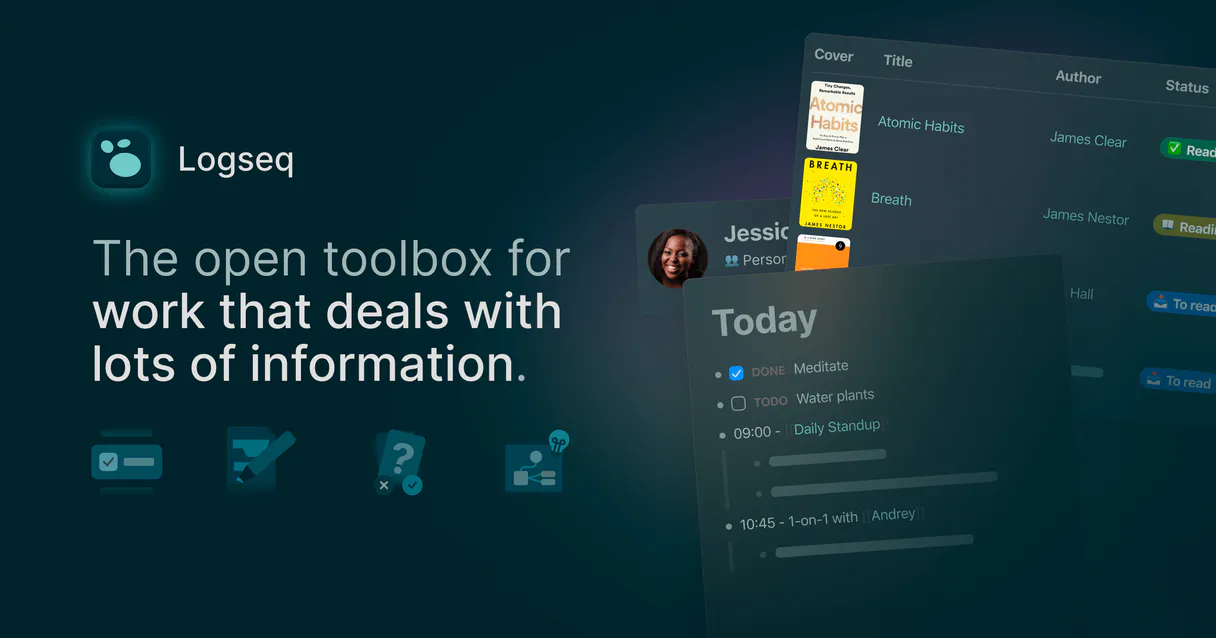
Independent Platform Disclaimer: Vinkius is an independent platform and is not affiliated with, endorsed by, sponsored by, verified by, or otherwise authorized by Logseq. All third-party trademarks, logos, and brand names are the property of their respective owners. Their use on this website is strictly for informational purposes to identify service compatibility and interoperability.
VINKIUS INFRASTRUCTURE
Cloud Hosted
Managed infra
V8 Isolated
Sandboxed per request
Zero-Trust Proxy
No stored credentials
DLP Enforced
Policy on every call
GDPR Compliant
EU data residency
Token Compression
~60% cost reduction
Works with Claude, ChatGPT, Cursor, and more
The Model Context Protocol standardizes how applications expose capabilities to LLMs. Instead of operating in isolation, your AI gains direct access to external platforms, live data, and real-world actions through secure, standardized connections.
This server provides 10 capabilities that interface natively with Claude, ChatGPT, Cursor, and any MCP client. No middleware. No custom integration required.
Available Capabilities
Tracking knowledge across multiple project notes shouldn't require opening ten tabs.
Right now, if you need to know every place you mentioned 'GraphQL setup,' you have to open the main index page, then click into Project A, search within it; then repeat that process for Project B, and so on. It’s a copy/paste nightmare just to gather context.
With this MCP server, your agent runs `search_content`. You ask for 'GraphQL setup,' and it scans every single block across the entire graph—all namespaces included—and returns a structured list of matches in seconds. That's how you get true visibility.
Using Logseq MCP Server: Add blocks and pages with `insert_block` and `create_page`.
Manually, starting a new section means creating the page in the sidebar, then opening it, and typing out your initial markdown header. If you need to add an action item later, you have to remember which block ID to target and what text to paste.
Now, tell your agent: 'Create a meeting notes page for today.' It runs `create_page` instantly. Then, ask it to use `insert_block` to add the first agenda point. The content gets there immediately, structured correctly, and ready to go.
Common Questions About Logseq MCP
How do I find a specific piece of text in my notes using search_content? +
You just tell your agent the query. search_content executes local queries across all indices, finding explicitly bound text targets anywhere in your graph, titles, or namespaces.
Can I use insert_block to add items to a page? +
Yes. Running insert_block appends new outliner chunks to the specified map. This is how you programmatically build meeting notes or task lists without manual input.
Does get_page really give me all the metadata for a page? +
It does. get_page retrieves all associated metadata, letting your agent understand the context and structure of that specific page before making any changes.
If I delete a page using delete_page, is it safe? +
Yes, it's irreversible. delete_page handles removing content arrays and destroying metadata loops securely from the graph.
How do I use get_current_graph to verify that my AI client is targeting the correct knowledge base? +
It validates your environment by parsing and listing active graph arrays. The tool returns explicit local database paths, confirming that your agent connects to the right storage before running any commands.
When I use delete_block, how does it safely handle child dependencies within a node? +
The process automatically handles dependent nodes. It removes only the target block while managing and preserving the structural integrity of all linked parent/child elements around it.
What deep structural information do I get when running get_page_blocks on a page? +
It extracts the full hierarchical tree structure. This gives you a complete map of nested blocks, showing complex relationships between ideas and sub-tasks on that specific page.
Does create_page just make an empty container, or does it handle initial content? +
It does more than just make an empty placeholder. create_page deploys the new page and inserts native markdown contents simultaneously, allowing you to build structure immediately.
Can I search across all my Logseq pages using my agent? +
Yes. Use the search_content tool to execute deep property searches across your graph indices. Your agent will filter titles, namespaces, and block scopes to find the exact information you need.
How do I add a new note to a specific page? +
Use the insert_block tool and provide the target Page name or ID. Your agent will drive the Logseq editor to add a new outliner chunk with your markdown content immediately.
Can my agent retrieve the hierarchical structure of a long page? +
Absolutely. The get_page_blocks tool extracts the full hierarchical tree from a page map. Your agent will return the nested arrays of outliner blocks, ensuring you have the complete structural context of your data.
Use it with your favorite AI tools
Connect this server to Cursor, Claude, VS Code, and more.
More in this category
Builder.io
Manage your visual CMS via Builder.io — track content entries, models, and symbols directly from any AI agent.

Netlify
Manage your Netlify sites and deployments via the Netlify API — list sites, trigger builds, and monitor forms directly from any AI agent.

Handlebars Template Compiler
Stop LLM string replacement hallucinations. Compile dynamic Handlebars templates perfectly for Martech emails and payloads.
You might also like

JSON Path Query Engine
Extract specific data from massive JSON payloads using JSONPath expressions.

ClickFunnels
Manage sales funnels and contacts via ClickFunnels 2.0 — track performance, monitor leads, and manage orders directly from any AI agent.

Reqres
Test your front-end against a real API — manage users, resources, and project records for prototyping and testing.