
MTA MCP Server for Windsurf 12 tools — connect in under 2 minutes
Windsurf brings agentic AI coding to a purpose-built IDE. Connect MTA through Vinkius and Cascade will auto-discover every tool. ask questions, generate code, and act on live data without leaving your editor.
ASK AI ABOUT THIS MCP SERVER
Vinkius supports streamable HTTP and SSE.
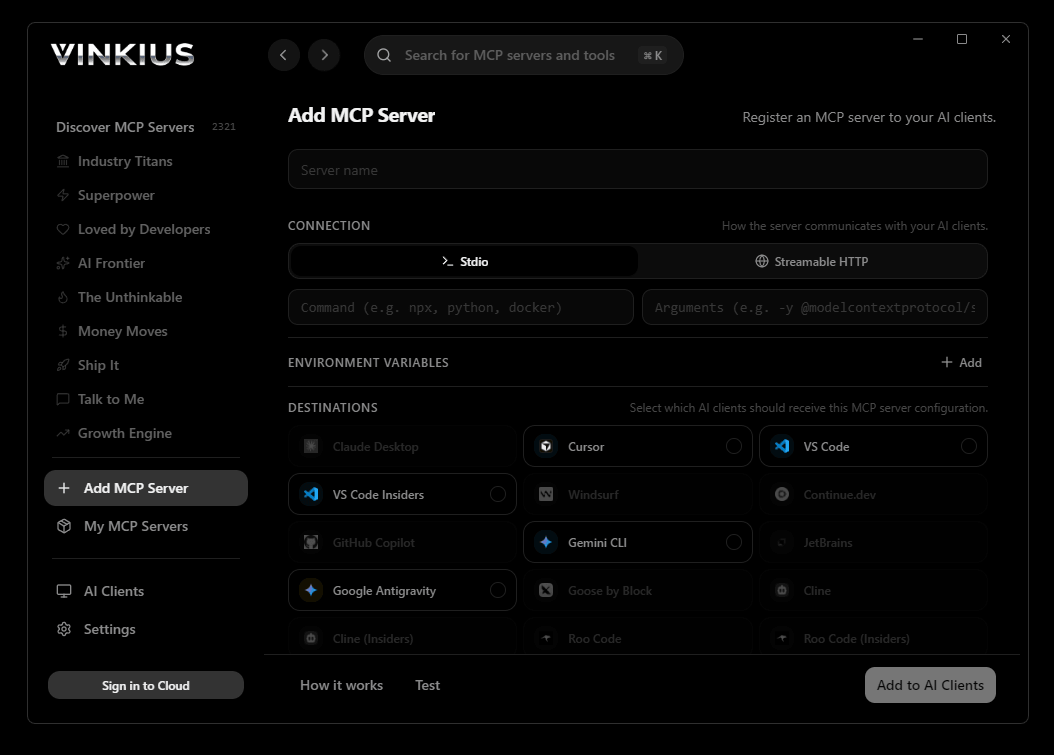
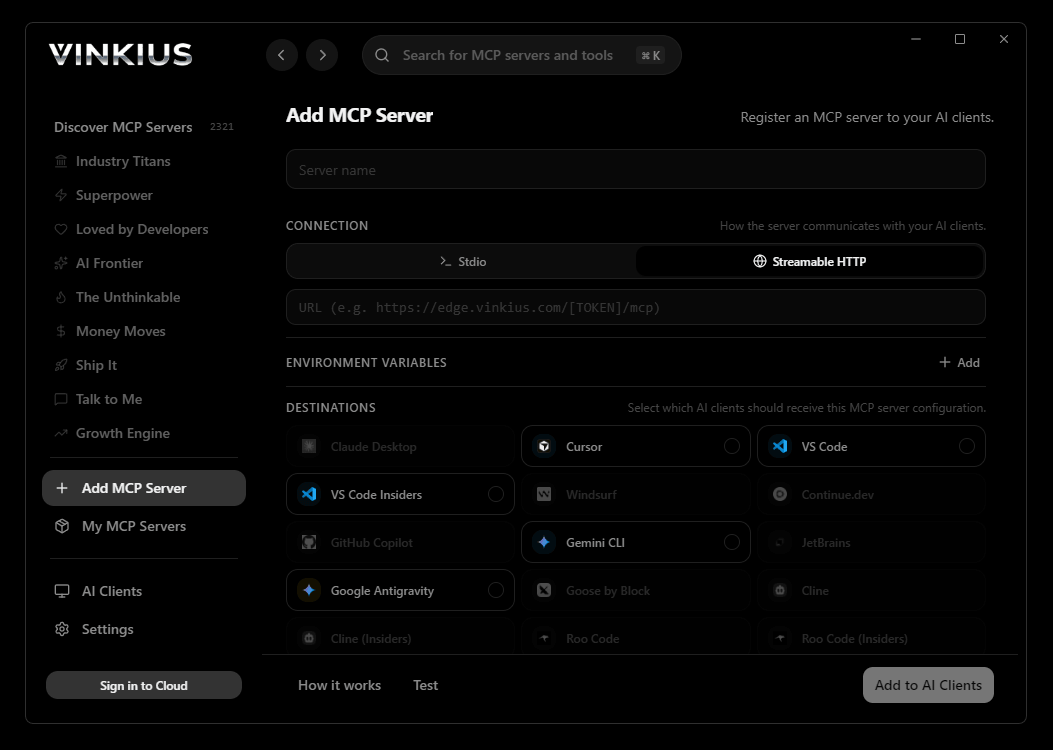
Vinkius Desktop App
The modern way to manage MCP Servers — no config files, no terminal commands. Install MTA and 2,500+ MCP Servers from a single visual interface.

{
  "mcpServers": {
    "mta": {
      "url": "https://edge.vinkius.com/[YOUR_TOKEN_HERE]/mcp"
    }
  }
}
* Every MCP server runs on Vinkius-managed infrastructure inside AWS - a purpose-built runtime with per-request V8 isolates, Ed25519 signed audit chains, and sub-40ms cold starts optimized for native MCP execution. See our infrastructure
About MTA MCP Server
Connect your MTA API New York City public transit data platform to any AI agent and take full control of real-time NYC Subway and MTA Bus tracking, arrival predictions, LIRR and Metro-North commuter rail monitoring, and service disruption awareness through natural conversation.
Windsurf's Cascade agent chains multiple MTA tool calls autonomously. query data, analyze results, and generate code in a single agentic session. Paste Vinkius Edge URL, reload, and all 12 tools are immediately available. Real-time tool feedback appears inline, so you see API responses directly in your editor.
What you can do
- Subway Real-Time Feeds — Access live GTFS-RT data for all NYC Subway lines with train positions and arrival predictions
- Bus Routes — List all MTA bus routes across Manhattan, Brooklyn, Queens, Bronx, and Staten Island
- Bus Stops — Get all stops for any bus route with coordinates and sequence information
- Bus Predictions — Get real-time estimated arrival times for any bus stop
- Bus Vehicle Tracking — Track real-time GPS positions of all active MTA bus vehicles
- Service Alerts — Monitor active disruptions across Subway, buses, LIRR, and Metro-North
- Subway Stations — List all 472 NYC Subway stations with coordinates, borough, and entrance data
- LIRR Tracking — Monitor Long Island Rail Road trains with real-time positions and arrivals
- Metro-North Tracking — Track Metro-North Railroad trains serving northern NYC suburbs
- Stop-Level Bus Monitoring — Monitor buses at specific stops with targeted arrival predictions
- Estimated Arrivals — Get route-filtered arrival estimates for buses at any stop
- System Connectivity — Verify API connectivity and synchronize timestamps
The MTA MCP Server exposes 12 tools through the Vinkius. Connect it to Windsurf in under two minutes — no API keys to rotate, no infrastructure to provision, no vendor lock-in. Your configuration, your data, your control.
How to Connect MTA to Windsurf via MCP
Follow these steps to integrate the MTA MCP Server with Windsurf.
Open MCP Settings
Go to Settings → MCP Configuration or press Cmd+Shift+P and search "MCP"
Add the server
Paste the JSON configuration above into mcp_config.json
Save and reload
Windsurf will detect the new server automatically
Start using MTA
Open Cascade and ask: "Using MTA, help me...". 12 tools available
Why Use Windsurf with the MTA MCP Server
Windsurf provides unique advantages when paired with MTA through the Model Context Protocol.
Windsurf's Cascade agent autonomously chains multiple tool calls in sequence, solving complex multi-step tasks without manual intervention
Purpose-built for agentic workflows. Cascade understands context across your entire codebase and integrates MCP tools natively
JSON-based configuration means zero code changes: paste a URL, reload, and all 12 tools are immediately available
Real-time tool feedback is displayed inline, so you see API responses directly in your editor without switching contexts
MTA + Windsurf Use Cases
Practical scenarios where Windsurf combined with the MTA MCP Server delivers measurable value.
Automated code generation: ask Cascade to fetch data from MTA and generate models, types, or handlers based on real API responses
Live debugging: query MTA tools mid-session to inspect production data while debugging without leaving the editor
Documentation generation: pull schema information from MTA and have Cascade generate comprehensive API docs automatically
Rapid prototyping: combine MTA data with Cascade's code generation to scaffold entire features in minutes
MTA MCP Tools for Windsurf (12)
These 12 tools become available when you connect MTA to Windsurf via MCP:
get_bus_estimated_arrival
Returns predicted arrival times, route information, destinations, wait times, and delay indicators for each expected bus. Supports both multi-route stop queries and single-route filtered queries. Essential for targeted arrival predictions, route-specific wait time estimation, and passenger trip timing. AI agents should reference this when users ask "when is the next M15 at this stop", "show arrival estimates for route B46 at stop 12345", or need route-filtered arrival data at a specific bus stop. Get estimated arrival times for buses at a stop, optionally filtered by route
get_bus_predictions
Returns predicted arrival times, route IDs, destination information, expected wait times, and whether buses are on schedule or delayed. Based on real-time vehicle tracking and schedule adherence. Essential for real-time bus arrival awareness, passenger waiting time estimation, trip timing, and connection coordination. AI agents should reference this when users ask "when is the next M15 bus at stop 12345", "show predictions for this stop", or need real-time arrival data for a specific bus stop. Stop IDs can be found using get_bus_stops. Get next bus arrival predictions for a specific bus stop
get_bus_routes
Returns route IDs, route names, operators (MTA New York City Bus, MTA Bus Company, private operators under MTA contract), and service area information. Covers local, limited-stop, and Select Bus Service (SBS) routes. Essential for route discovery, service area analysis, transit network understanding, and identifying route IDs for use in stop and prediction queries. AI agents should reference this when users ask "list all bus routes in Manhattan", "what routes serve Brooklyn", or need to identify route IDs for subsequent MTA Bus Time queries. List all MTA bus routes in New York City
get_bus_stops
Returns stop IDs (MonitoringRef), stop names, geographic coordinates (latitude, longitude), stop sequence order, and direction information. Essential for stop discovery, journey planning, accessibility mapping, and identifying stop IDs for use in arrival prediction queries. AI agents should use this when users ask "list all stops on the M15", "find bus stops along Broadway", or need to identify stop IDs for use in get_bus_predictions queries. List all stops for a specific MTA bus route
get_bus_vehicle_at_stop
Returns vehicle IDs, route IDs, current positions, expected arrival times, distances from stop, and operational status. More targeted than system-wide vehicle queries. Essential for stop-level bus tracking, passenger waiting awareness, and real-time arrival estimation at specific stops. AI agents should use this when users ask "what buses are coming to this stop", "track vehicles approaching stop 12345", or need stop-specific bus position data for passenger information. Get buses currently at or approaching a specific bus stop
get_bus_vehicles
Returns vehicle IDs, route affiliations, latitude/longitude coordinates, heading direction, speed, recorded time, and prediction availability. Covers all MTA New York City Bus and MTA Bus Company vehicles in active service. Essential for real-time bus fleet monitoring, passenger arrival estimation, route-level service awareness, and transit operations management. AI agents should use this when users ask "where are all the buses right now", "track bus positions system-wide", or need real-time vehicle position data for fleet visualization. Get real-time positions of all active MTA bus vehicles
get_lirr_feed
Returns train positions, trip updates, scheduled vs. real-time arrivals at stations, delays, track information, and service disruptions across all LIRR branches including Babylon, Ronkonkoma, Hempstead, Port Jefferson, Montauk, and more. Essential for commuter rail tracking, arrival predictions at Penn Station and Grand Central Madison, and LIRR service monitoring. AI agents should reference this when users ask "when is the next LIRR train to Penn Station", "track LIRR train positions", or need real-time commuter rail data for trip planning from Long Island into NYC. Get real-time LIRR train data from the Long Island Rail Road
get_metro_north_feed
Returns train positions, trip updates, scheduled vs. real-time arrivals, delays, track information, and service disruptions across all Metro-North lines including Hudson, Harlem, New Haven, Port Jervis, Pascack Valley, and more. Essential for commuter rail tracking, arrival predictions at Grand Central Madison, and Metro-North service monitoring. AI agents should use this when users ask "when is the next Metro-North train from White Plains", "track Metro-North positions", or need real-time commuter rail data for trip planning from Westchester, Connecticut, or the Hudson Valley into NYC. Get real-time Metro-North Railroad train data
get_service_alerts
Returns alert descriptions, affected lines and stations, severity levels, cause types (maintenance, incident, weather, special events, construction), start and end timestamps, and alternative service recommendations. Essential for service disruption awareness, alternative route planning, passenger communication, and understanding system reliability. AI agents should use this when users ask "are there any delays on the 4/5/6 line", "is LIRR running normally", or need to check service reliability before planning MTA journeys. Get current service alerts and disruptions across the MTA system
get_stations
Returns station IDs, station names, complex IDs (for multi-line stations), borough information (Manhattan, Brooklyn, Queens, Bronx, Staten Island), structure types (underground, elevated, embankment, open cut), latitude/longitude coordinates, and North/East/South/West entrance coordinates. Essential for station discovery, rail network mapping, route planning, and identifying station codes for use in journey planning queries. AI agents should use this when users ask "list all stations in Manhattan", "what is the station code for Times Square", or need to understand the NYC Subway network geography. List all NYC Subway stations with details
get_subway_feed
Supports feed IDs grouped by line: "1" (lines 1,2,3,4,5,6,S), "2" (lines A,C,E), "3" (lines B,D,F,M), "4" (lines G), "5" (lines J,Z), "6" (lines N,Q,R,W), "7" (lines L), "11" (Staten Island Railway), "16" (Shuttle 42nd St), "21" (Shuttle Franklin Ave), "26" (Shuttle Rockaway Park). Returns train positions, trip updates, scheduled vs. real-time arrivals, delays, and service disruptions. Essential for real-time subway tracking, arrival predictions, and service monitoring across the entire NYC Subway system. AI agents should use this when users ask "when is the next 1 train", "show real-time positions for the A line", or need live subway data for trip planning. Feed IDs are required and can be found in MTA documentation. Get real-time subway feed data for specific NYC Subway lines
get_system_time
Returns the official server timestamp in ISO 8601 format. Useful for synchronizing local clocks with the MTA system, verifying API connectivity, testing authentication, and timestamp alignment for real-time data correlation. AI agents should use this as a connectivity check before making more complex queries, or when users need to verify API responsiveness and authentication validity. Get the current MTA Bus Time system timestamp
Example Prompts for MTA in Windsurf
Ready-to-use prompts you can give your Windsurf agent to start working with MTA immediately.
"Show me the next trains on the 1/2/3 line."
"When is the next M15 bus arriving at the stop near 14th Street and 3rd Avenue?"
"Check if there are any service alerts affecting the LIRR right now."
Troubleshooting MTA MCP Server with Windsurf
Common issues when connecting MTA to Windsurf through the Vinkius, and how to resolve them.
Server not connecting
MTA + Windsurf FAQ
Common questions about integrating MTA MCP Server with Windsurf.
How does Windsurf discover MCP tools?
mcp_config.json file on startup and connects to each configured server via Streamable HTTP. Tools are listed in the MCP panel and available to Cascade automatically.Can Cascade chain multiple MCP tool calls?
Does Windsurf support multiple MCP servers?
mcp_config.json. Each server's tools appear in the MCP panel and Cascade can use tools from different servers in a single flow.Connect MTA with your favorite client
Step-by-step setup guides for every MCP-compatible client and framework:
Anthropic's native desktop app for Claude with built-in MCP support.
AI-first code editor with integrated LLM-powered coding assistance.
GitHub Copilot in VS Code with Agent mode and MCP support.
Purpose-built IDE for agentic AI coding workflows.
Autonomous AI coding agent that runs inside VS Code.
Anthropic's agentic CLI for terminal-first development.
Python SDK for building production-grade OpenAI agent workflows.
Google's framework for building production AI agents.
Type-safe agent development for Python with first-class MCP support.
TypeScript toolkit for building AI-powered web applications.
TypeScript-native agent framework for modern web stacks.
Python framework for orchestrating collaborative AI agent crews.
Leading Python framework for composable LLM applications.
Data-aware AI agent framework for structured and unstructured sources.
Microsoft's framework for multi-agent collaborative conversations.
Connect MTA to Windsurf
Get your token, paste the configuration, and start using 12 tools in under 2 minutes. No API key management needed.