
NASA Asteroids — Near-Earth Objects & Planetary Defense MCP, Ready to Go
Use NASA Asteroids MCP with Claude or Cursor to track near-Earth objects, monitor orbital hazards, and pull live planetary defense data.
No credit card required. Experience the power of this integration risk-free.
Track near-Earth objects and planetary defense hazards in real-time.
Works with every AI agent you already use
…and any MCP-compatible client









How fast is the NASA Asteroids — Near-Earth Objects & Planetary Defense Connector?
Average time for the server to become ready for requests over the last 13 days, measured until the initialize / tools/list handshake completes. Metrics are updated daily between 00:00 and 04:00 UTC. Create a free account, use this Connector on Vinkius Cloud, and connect it to your AI agent in seconds.
Waiting for input…
What AI agents can do with NASA Asteroids MCP: 5 Tools for Planetary Defense
Pull live feeds, orbital details, and fireball data from NASA and JPL sources using 5 dedicated tools.
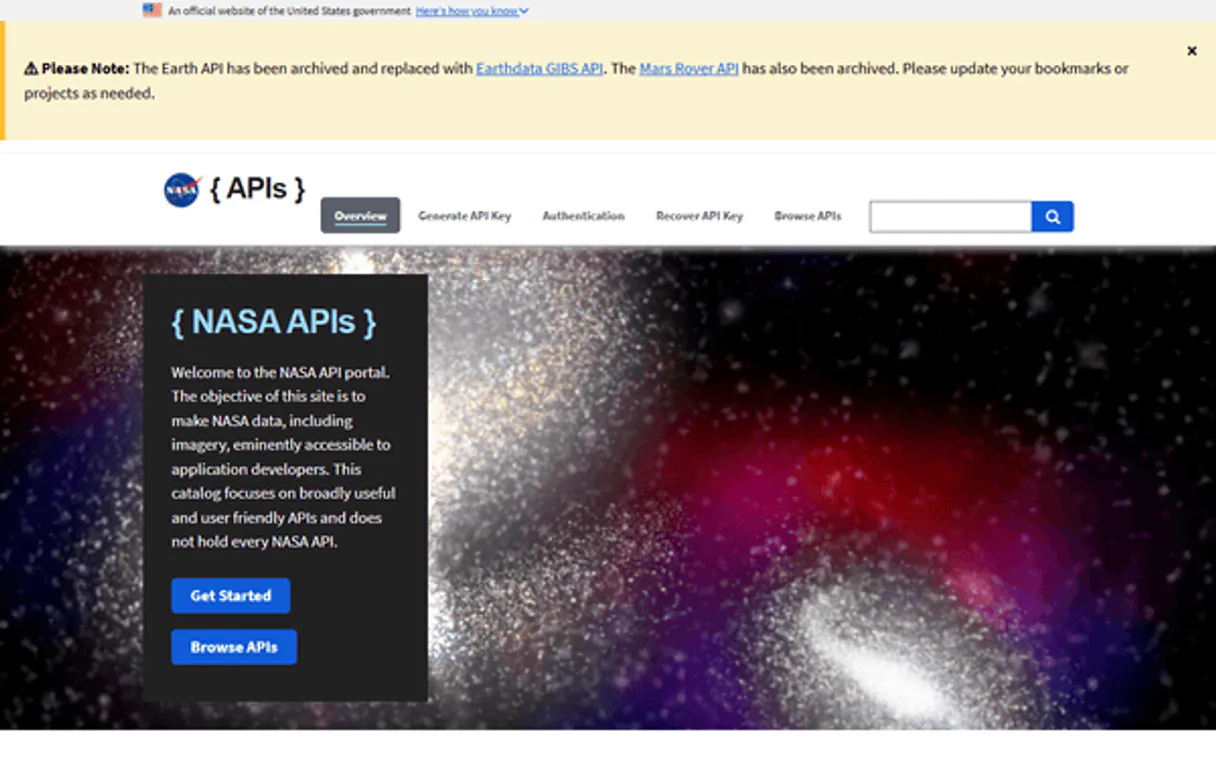
Get neo feed
Fetch a list of near-Earth asteroids approaching within a specific date range. This helps you see what's moving toward Earth right now.
Get neo lookup
Pull detailed stats like size and velocity for a specific NASA SPK-ID. Use this to get a full breakdown of a single rock.
Get neo browse
Scroll through the entire catalog of known near-Earth objects page by page. This is best for exploring the full database.
Get close approaches
Find future Earth encounters filtered by distance, date, and size. This is critical for monitoring planetary defense.
Get fireballs
Get data on atmospheric bolides including location, energy, and altitude. Use this to see recent fireball events worldwide.
A Connector is a URL. Vinkius runs it: hosting, security, governance, observability.
You're looking at one of 5,800+ managed Connectors. The real value isn't the catalog. It's the control plane that secures, governs, audits, and manages every interaction between your agents and the tools they use.
No Shadow AI
Every agent action is visible, approved, and auditable. Nothing runs outside your governance.
Absolute agent control
Fine-grained permissions for every agent, MCP, and tool. Instantly revoke access and audit every execution.
Cost control per token
Spend broken down to the token, tool, and agent. Budgets and hard limits. No surprise invoices.
Managed & monitored infra
We operate the runtime, authentication, scaling, retries, and monitoring. Your team manages AI, not infrastructure.
Data protection, DLP by design
Sensitive data is filtered before reaching the model. Access is governed so agents receive only the information they're allowed to use.
Token optimization, real savings
Lower AI costs by delivering the right context instead of unnecessary tools. Better accuracy, faster responses, and fewer wasted tokens.
NASA Asteroids MCP for Planetary Defense Data
This is for planetary defense researchers, amateur astronomers, and space data hobbyists who need to monitor orbital hazards without manual data entry.
Planetary Defense Researcher
Monitors orbital mechanics and hazard assessments for specific NEOs to identify potential threats.
Space Data Scientist
Pulls historical and real-time asteroid data for research papers or data visualizations.
Amateur Astronomer
Tracks upcoming close approaches to plan observations and stay informed on space weather.
Frequently Asked Questions
Can the NASA Asteroids MCP track real-time asteroid movements? +
Yes, it pulls live feeds from NASA's NeoWs and JPL's CNEOS. You can get current miss distances, velocities, and hazard assessments for objects moving toward Earth.
How does the NASA Asteroids MCP handle atmospheric fireballs? +
It pulls data from government sensors to show you where bolides were detected, their estimated size, altitude, and energy levels.
Can I use the NASA Asteroids MCP to find specific asteroids by ID? +
Yes, you can provide a NASA SPK-ID and the Connector will pull the full orbital and hazard profile for that specific object.
Is the NASA Asteroids MCP good for planetary defense research? +
It's perfect for that. It allows you to filter future close approaches by size, date, and distance thresholds to identify potential threats.
Does the NASA Asteroids MCP provide a list of all known asteroids? +
It allows you to browse the complete database of known near-Earth objects page by page so you can explore the full database.
Can I use the NASA Asteroids MCP to check for hazardous objects? +
Yes, the feed includes a specific flag for potentially hazardous asteroids, making it easy to filter out the most concerning objects.
What does 'potentially hazardous' mean? +
A Potentially Hazardous Asteroid (PHA) passes within 0.05 AU (~7.5 million km) and is larger than 140 meters. This doesn't mean it will hit Earth — just that its orbit warrants monitoring.
How frequently is the asteroid data updated? +
The NeoWs API is updated daily with the latest orbital calculations and close approach tracking data from JPL's Center for Near Earth Object Studies.
Does this API include data on historical asteroid impacts? +
Yes, the API provides access to fireball and bolide data, which tracks bright atmospheric meteor events detected by government sensors, including historical records.
Your AI, connected to everything.











No credit card required · Free tier available













Other Connectors in this category
openFDA Connector
Access the powerful openFDA databases for drug adverse events, food recalls, and medical device safety reports globally.
NOAA Forecast — US Weather Predictions Connector
Official NWS weather forecasts for any US location: 7-day daily forecasts, 156-hour hourly forecasts, raw grid data, and meteorologist forecast discussions from 122 Weather Forecast Offices.
Blockchain.com Data Connector
Access real-time Bitcoin blockchain data via Blockchain.com. Query blocks, transactions, and addresses directly from any AI agent.
Related Connectors
Lancerkit Connector
Connect Lancerkit to any AI agent via MCP.
ROC AUC Evaluator Connector
Compute the exact Area Under the ROC Curve for binary classification predictions. Local, mathematically perfect, zero LLM estimation.
EIA Energy Outlook — Forecasts & Projections Connector
Official U.S. energy forecasts: the Short-Term Energy Outlook (18-month price and supply projections), Annual Energy Outlook (30-year U.S. projections), International Energy Outlook (world projections), and country-level global energy data.