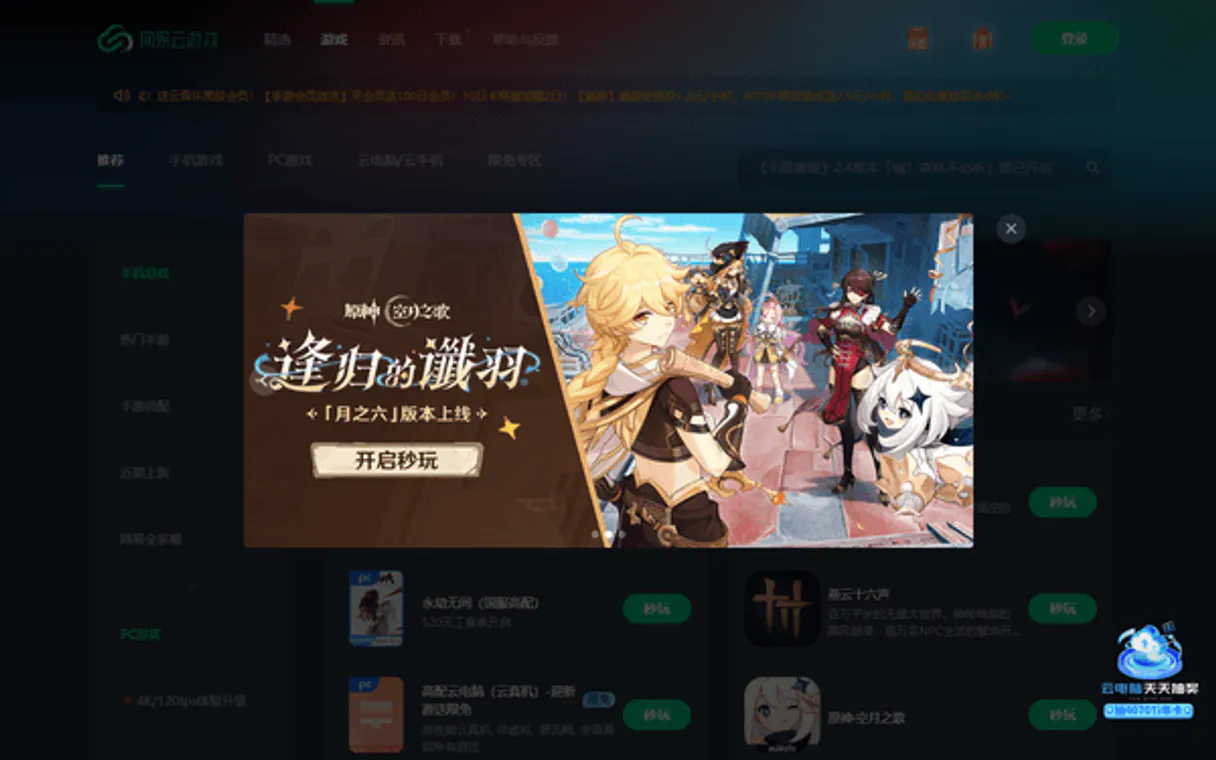
NetEase Cloud Gaming MCP. Control sessions, quotas, and server health instantly.
Works with every AI agent you already use
…and any MCP-compatible client

Just plug in your AI agents and start using Vinkius.
NetEase Cloud Gaming manages your entire cloud gaming lifecycle. This MCP lets your AI agent create, monitor, and terminate game sessions across NetEase's infrastructure.
You can also check user quotas, get server health stats, or list available games directly from your workflow.
What your AI agents can do
Add user quota
Increments a user's available play time on their account.
Create session
Starts a brand new cloud gaming session using specific game and user IDs.
Get cluster info
Retrieves detailed operational information for one specified server cluster.
Initializes a new, active cloud gaming instance for a user and game.
Forces the immediate termination of a running cloud gaming session ID.
Retrieves the overall operational status and health metrics for NetEase Cloud Gaming.
Adds specific amounts of play time to a user's account quota.
Fetches technical specifications and metadata for any listed NetEase cloud game title.
Lists all active, regional server clusters managed by the platform.
Ask AI about this MCP
Supported MCP Clients
Waiting for input…
NetEase Cloud Gaming: 10 Tools for Session Management
These ten tools let your AI client manage the full lifecycle of cloud gaming sessions—from listing games to checking system health.
019d845eadd user quota
Increments a user's available play time on their account.
019d845ecreate session
Starts a brand new cloud gaming session using specific game and user IDs.
019d845eget cluster info
Retrieves detailed operational information for one specified server cluster.
019d845eget game detail
Fetches technical specs and metadata for a single NetEase cloud game title.
019d845eget session status
Checks the current running status of an active gaming session ID.
019d845eget system health
Reports the overall operational health of the entire cloud platform.
019d845eget user quota
Returns the remaining play time balance for a specified user account.
019d845elist clusters
Provides a list of all active geographical server clusters available on NetEase Cloud Gaming.
019d845elist games
Generates an exhaustive catalog of all games supported by the platform.
019d845estop session
Forces the immediate shutdown and termination of a specific, running session ID.
Choose How to Get Started
Build a custom MCP for your own tools, or connect a ready-made integration from our catalog.
Build Your Own
Turn any API into an MCP. Import a spec, define Agent Skills, or deploy with MCPFusion.
- Import from OpenAPI, Swagger, or YAML specs
- Create Agent Skills with progressive disclosure
- Deploy to edge with MCPFusion framework
- Built in DLP, auth, and compliance on every call
- Real time usage dashboard and cost metering
- Publish to catalog or keep private
Make Your AI Do More
Start with NetEase Cloud Gaming, then connect any of our 4,700+ other servers whenever your AI needs more. One click, no limits.
- Use this MCP plus 4,700+ others, all in one place
- Add new capabilities to your AI anytime you want
- Every connection is secured and compliant automatically
- Track usage and costs across all your servers
- Works with Claude, ChatGPT, Cursor, and more
- New servers added to the catalog every week
What you can do with this MCP connector
Listen up. This MCP server connects your AI agent straight into NetEase Cloud Gaming's back end. It gives you total control over the entire gaming lifecycle—from starting a stream to shutting it down and managing user credits. You don't gotta jump through five different developer dashboards just to know if a session is running or how much time a user got left.
This tool handles all that stuff in one place.
Managing Game Sessions
When you need to get people playing, your agent uses the create_session tool; it spins up a brand new cloud gaming instance using specific game and user IDs. If something goes south or they're done with the game, you can force an immediate shutdown with stop_session, which kills that specific session ID instantly.
And if you need to know what's going on right now—whether the stream's up or stalled out—you check the current status using get_session_status.
Checking the Platform and Inventory
You gotta know where your stuff is running. You can pull a full list of all active geographical server clusters available on NetEase Cloud Gaming using list_clusters, and if you need specifics, get_cluster_info pulls detailed operational info for just one cluster ID. When it comes to the games themselves, you don't have to guess what titles are supported; list_games gives you a complete catalog of everything the platform runs.
If you want to know the technical specs or metadata for a specific game title, use get_game_detail. For overall confidence in the system, you check the total operational status with get_system_health; this reports the whole platform's health metrics.
Handling User Accounts and Quotas
Managing users means managing time. To see how much playtime a user has left, your agent calls get_user_quota, which returns that specific remaining balance for an account. If you gotta top off an account or grant extra access, the system lets you increment a user's available play time using add_user_quota.
Basically, this server gives your AI client all ten tools it needs to manage sessions, check where they're running, make sure the platform is healthy, and handle the user accounts—all from one workflow. It’s everything you need right here.
How NetEase Cloud Gaming MCP Works
- 1 First, you subscribe to the NetEase Cloud Gaming MCP and generate your necessary
AccessKeyandSecretKeythrough the developer portal. - 2 Next, your AI agent uses a tool—like
create_session—passing in game IDs and user credentials. The server initiates the cloud instance on the backend. - 3 Finally, the API returns the session ID and real-time status. You can then monitor it using tools like
get_session_status.
The bottom line is: you pass parameters to a tool, the MCP server talks to NetEase, and you get actionable operational data back in your chat window.
Who Is NetEase Cloud Gaming MCP For?
This is for Ops Engineers and Live Operations teams. If you're tired of clicking through three different dashboards just to know if a user session crashed or what the server load is, this saves hours. It lets you manage the entire gaming infrastructure—from quotas to live sessions—using plain chat commands.
Monitors global system health using get_system_health and adjusts user quotas with add_user_quota based on observed usage spikes.
Builds custom gaming portals by listing available games (list_games) and checking cluster locations (list_clusters).
Integrates in-game events with the cloud backend. They use create_session to spin up a game instance when a player hits a certain milestone.
What Changes When You Connect
- Check system uptime immediately. Instead of logging into a monitoring dashboard to find out if the platform is having issues, just call
get_system_healthto get one clean status report. - Manage user access right from your chat. Need to give a test account more play time? Use
add_user_quotainstead of going through the billing backend system. - Know exactly what's available. List all games with
list_games, or dive deep into one title usingget_game_detailbefore building integration points. - Control resource usage precisely. Start a session when needed (
create_session), and then guarantee it shuts down by callingstop_sessionto prevent billing waste. - Track user limits without guessing. Use
get_user_quotato see exactly how many minutes are left before a player hits their cap.
Real-World Use Cases
Player retention check after an outage
A player reports that their session keeps dropping. The agent runs get_session_status to confirm if the connection is unstable, then uses get_cluster_info to see if the local cluster has known issues. This quickly isolates whether it’s a client problem or an infrastructure failure.
Onboarding new game titles
The product team needs to check specs for 5 new games. They use list_games first, then run get_game_detail on each one individually to pull necessary data points (like required RAM or minimum network speed) before handing the info off to developers.
Handling a runaway test account
A QA engineer leaves a testing session running overnight. Instead of having to find the ID and manually stop it, they pass the ID to stop_session directly through their agent. The instance shuts down immediately, saving resources.
Checking premium user limits
A support agent needs to know if a high-value customer is running low on time. They use get_user_quota to check the remaining minutes, and if necessary, they can call add_user_quota instantly to extend the service.
The Tradeoffs
Assuming everything works
Just calling a general 'check status' tool without specifics. This returns vague data that doesn't help triage.
→
Always check get_system_health for the big picture, but if you need specific details, use list_clusters first, then narrow it down with get_cluster_info.
Ignoring quotas
Trying to start a session (create_session) without first checking if the user has enough time remaining. The process fails halfway through.
→
Always call get_user_quota before initiating a session. If the quota is low, use add_user_quota first.
Overloading one API endpoint
Trying to get game details and cluster info in one giant request, which fails due to size limits.
→
Break it up. Use list_games for the catalog, then use get_game_detail on specific titles. Keep your requests targeted.
When It Fits, When It Doesn't
Use this server if you need operational control over a live cloud gaming stream. Specifically, if your workflow needs to manage session creation/termination (create_session, stop_session) or track user playtime limits (get_user_quota). This is for Liveness and Inventory management.
Don't use it if you are building complex billing logic from scratch—you'll need a dedicated financial service. Also, don't use it just to store game metadata; use list_games and get_game_detail only when the data is needed at runtime for session setup.
This tool excels at 'Check-and-Act' patterns: Check health with get_system_health, check quota with get_user_quota, then Act by calling create_session. It keeps your infrastructure checks and user management in one place, which is a huge time saver.
Independent Platform Disclaimer: Vinkius is an independent platform and is not affiliated with, endorsed by, sponsored by, verified by, or otherwise authorized by NetEase Cloud Gaming. All third-party trademarks, logos, and brand names are the property of their respective owners. Their use on this website is strictly for informational purposes to identify service compatibility and interoperability.
VINKIUS INFRASTRUCTURE
Cloud Hosted
Managed infra
V8 Isolated
Sandboxed per request
Zero-Trust Proxy
No stored credentials
DLP Enforced
Policy on every call
GDPR Compliant
EU data residency
Token Compression
~60% cost reduction
Works with Claude, ChatGPT, Cursor, and more
The Model Context Protocol standardizes how applications expose capabilities to LLMs. Instead of operating in isolation, your AI gains direct access to external platforms, live data, and real-world actions through secure, standardized connections.
This server provides 10 capabilities that interface natively with Claude, ChatGPT, Cursor, and any MCP client. No middleware. No custom integration required.
Available Capabilities
Checking server status shouldn't require jumping between three different dashboards.
Today, checking if the platform is healthy means opening the main monitoring dashboard to look for green lights. Then you jump over to the cluster map to see which region is struggling. Finally, you open the billing portal just to verify user quotas weren't accidentally depleted.
With this MCP server, your agent handles it in three steps. You run `get_system_health` first—you get the global status instantly. Then you check regional load with `list_clusters`, and finally, confirm user availability using `get_user_quota`. It's all a single conversation.
NetEase Cloud Gaming MCP Server: Control sessions & quotas
Before this tool, starting an instance involved manually specifying the game ID and ensuring the user was logged in. If you forgot to check their play time first, the whole thing failed or cost money.
Now, your agent runs the full sequence: `get_user_quota` validates playtime > 0; if true, it calls `create_session`. It handles the entire logic flow and gives you a clean success message. The complexity goes away.
Common Questions About NetEase Cloud Gaming MCP
How do I use get_session_status to check if a game is running? +
You pass the active session ID to get_session_status. It returns the current state—like 'Running,' 'Paused,' or 'Error'—so you know what's actually happening with the stream.
What is the difference between list_clusters and get_cluster_info? +
list_clusters gives you a directory of all available regions. You use get_cluster_info when you need deep, specific details (like load or uptime) about one cluster by name.
Can I use add_user_quota to fix billing issues? +
Yes, if the issue is simply running out of minutes. You call add_user_quota and specify the amount in minutes that needs to be added back to the account balance.
How do I list all the games available on NetEase Cloud Gaming? +
Call list_games. This returns a complete catalog of every optimized title you can stream, giving you their internal IDs needed for session creation.
How does the `get_system_health` tool report on the NetEase Cloud Gaming platform's overall stability? +
It provides a snapshot of the entire infrastructure. The output details global system status, helping you quickly determine if there are any widespread issues across multiple server clusters before initiating work.
If I need specific technical specs, what does the `get_game_detail` tool provide for a given title ID? +
You get comprehensive data on a single game. This includes optimized performance requirements and detailed specifications needed to ensure that the chosen game can run correctly in a cloud instance.
What should I know about using the `stop_session` tool to terminate an active instance? +
This tool forces an immediate shutdown of a running session. It's best for cleanup or when a user needs to abandon a game quickly, preventing billing issues from orphaned instances.
How can I use `get_user_quota` to check a user's remaining allowance before starting work? +
The tool returns the exact amount of cloud play time left for that specific user. This allows you to verify if they have enough minutes before attempting to create or monitor any new session.
Can I check the remaining play time for a specific user? +
Yes! Use the get_user_quota tool. It will return the remaining minutes and total quota for the provided user ID.
How do I monitor the health of the entire cloud gaming platform? +
Use the get_system_health tool. Your agent will perform a global connectivity and status check on the NetEase Cloud Gaming infrastructure.
Can I list all available server clusters in Malaysia? +
Yes! Use the list_clusters tool to see the geographic distribution and health of server clusters optimized for cloud gaming.
Use it with your favorite AI tools
Connect this server to Cursor, Claude, VS Code, and more.
More in this category
Canva
Empower your AI agents to manage Canva designs, upload branding assets, and trigger automatic exports directly from your chat.
Salesmate
Automate sales CRM via Salesmate — manage contacts, track deals, and log activities directly with AI.
Xiaomi Push Service / 小米推送
Xiaomi's essential device push platform — send notifications to MIUI and Global devices via AI.
You might also like
BunnyDoc
Manage eSignatures via BunnyDoc — track document status, manage templates, and coordinate signature requests directly from any AI agent.
Sobot
Leading AI customer support and ticketing platform in China — manage tickets, agents, and knowledge via AI.
FullStory
Manage digital experience intelligence, track users, and retrieve session data via AI agents with FullStory.