
Nile (PostgreSQL for Multi-Tenant Apps) MCP Server for Claude Code 6 tools — connect in under 2 minutes
Claude Code is Anthropic's agentic CLI for terminal-first development. Add Nile (PostgreSQL for Multi-Tenant Apps) as an MCP server in one command and Claude Code will discover every tool at runtime. ideal for automation pipelines, CI/CD integration, and headless workflows via Vinkius.
ASK AI ABOUT THIS MCP SERVER
Vinkius supports streamable HTTP and SSE.
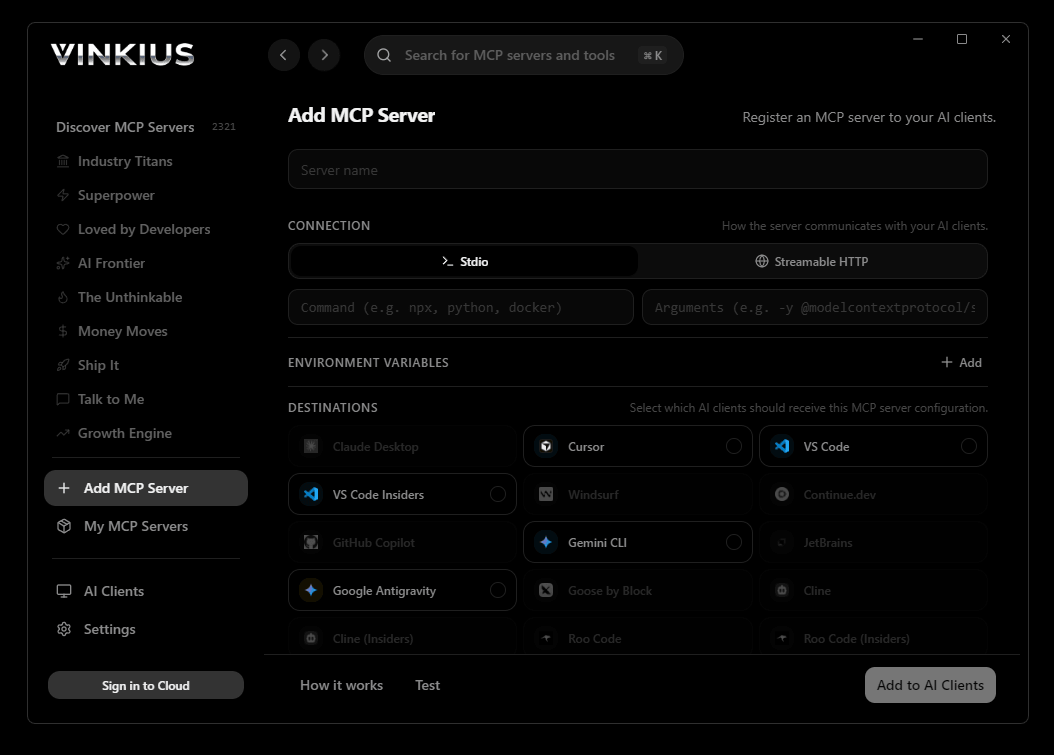
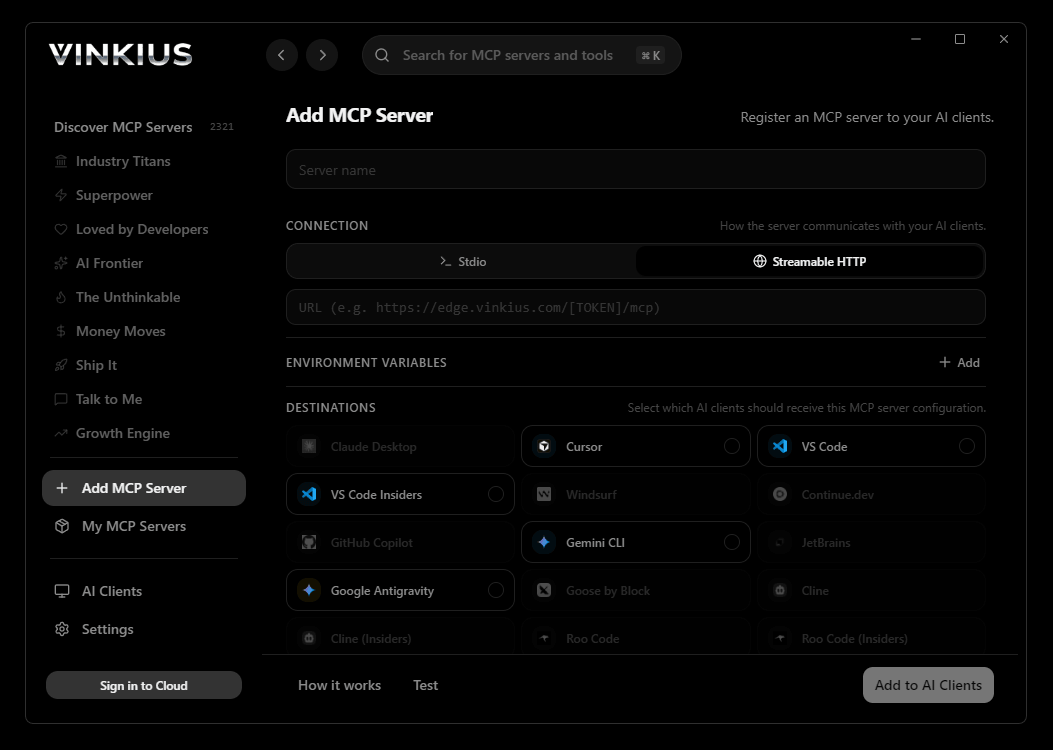
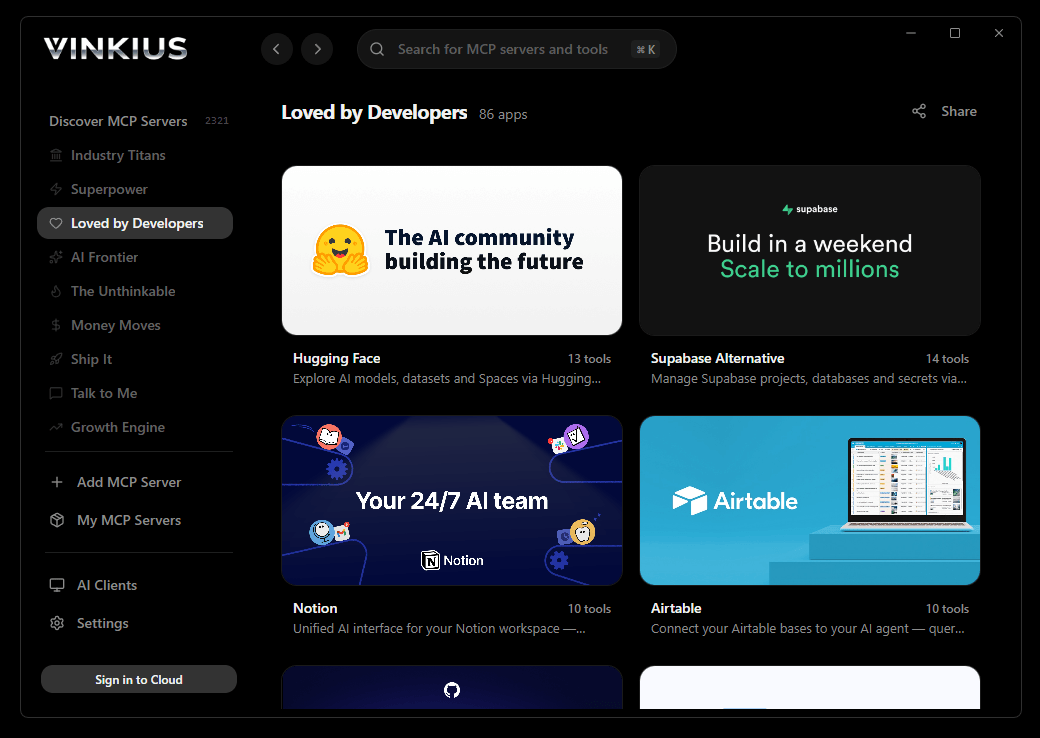
Vinkius Desktop App
The modern way to manage MCP Servers — no config files, no terminal commands. Install Nile (PostgreSQL for Multi-Tenant Apps) and 2,500+ MCP Servers from a single visual interface.
# Your Vinkius token. get it at cloud.vinkius.com
claude mcp add nile-postgresql-for-multi-tenant-apps --transport http "https://edge.vinkius.com/[YOUR_TOKEN_HERE]/mcp"
* Every MCP server runs on Vinkius-managed infrastructure inside AWS - a purpose-built runtime with per-request V8 isolates, Ed25519 signed audit chains, and sub-40ms cold starts optimized for native MCP execution. See our infrastructure
About Nile (PostgreSQL for Multi-Tenant Apps) MCP Server
Connect your Nile account to any AI agent and take full control of your tenant-aware PostgreSQL infrastructure, B2B tenant isolation, and database performance through natural conversation.
Claude Code registers Nile (PostgreSQL for Multi-Tenant Apps) as an MCP server in a single terminal command. Once connected, Claude Code discovers all 6 tools at runtime and can call them headlessly. ideal for CI/CD pipelines, cron jobs, and automated workflows where Nile (PostgreSQL for Multi-Tenant Apps) data drives decisions without human intervention.
What you can do
- Database Orchestration — List high-level PostgreSQL targets and retrieve detailed configuration JSON, including storage sizes and state tracking directly from your agent
- Virtualized Multi-Tenancy — Instantly provision and manage highly isolated virtual tenant boundaries (shards) to support multi-tenant SaaS architectures automatically within Postgres
- Operational Performance — Pull exact monitoring metrics reflecting true active connections, storage exhaustion layers, and compute utilization tracked over your database instances
- User Lifecycle Audit — Enumerate globally tracked users and correlate their identities to internal virtual tenants to ensure accurate cross-tenant access control
- Tenant Discovery — Query the strict virtual boundaries natively splitting tenant data to isolate exact SaaS tenant IDs before performing deep data inspections
- Metadata Retrieval — Deep-dive into specific Database endpoints to retrieve precise structural representations and operational state vectors instantly
The Nile (PostgreSQL for Multi-Tenant Apps) MCP Server exposes 6 tools through the Vinkius. Connect it to Claude Code in under two minutes — no API keys to rotate, no infrastructure to provision, no vendor lock-in. Your configuration, your data, your control.
How to Connect Nile (PostgreSQL for Multi-Tenant Apps) to Claude Code via MCP
Follow these steps to integrate the Nile (PostgreSQL for Multi-Tenant Apps) MCP Server with Claude Code.
Install Claude Code
Run npm install -g @anthropic-ai/claude-code if not already installed
Add the MCP Server
Run the command above in your terminal
Verify the connection
Run claude mcp to list connected servers, or type /mcp inside a session
Start using Nile (PostgreSQL for Multi-Tenant Apps)
Ask Claude: "Using Nile (PostgreSQL for Multi-Tenant Apps), show me...". 6 tools are ready
Why Use Claude Code with the Nile (PostgreSQL for Multi-Tenant Apps) MCP Server
Claude Code provides unique advantages when paired with Nile (PostgreSQL for Multi-Tenant Apps) through the Model Context Protocol.
Single-command setup: `claude mcp add` registers the server instantly. no config files to edit or applications to restart
Terminal-native workflow means MCP tools integrate seamlessly into shell scripts, CI/CD pipelines, and automated DevOps tasks
Claude Code runs headlessly, enabling unattended batch processing using Nile (PostgreSQL for Multi-Tenant Apps) tools in cron jobs or deployment scripts
Built by the same team that created the MCP protocol, ensuring first-class compatibility and the fastest adoption of new protocol features
Nile (PostgreSQL for Multi-Tenant Apps) + Claude Code Use Cases
Practical scenarios where Claude Code combined with the Nile (PostgreSQL for Multi-Tenant Apps) MCP Server delivers measurable value.
CI/CD integration: embed Nile (PostgreSQL for Multi-Tenant Apps) tool calls in your deployment pipeline to validate configurations or fetch secrets before shipping
Headless batch processing: schedule Claude Code to query Nile (PostgreSQL for Multi-Tenant Apps) nightly and generate reports without human intervention
Shell scripting: pipe Nile (PostgreSQL for Multi-Tenant Apps) outputs into other CLI tools for data transformation, filtering, and aggregation
Infrastructure monitoring: run Claude Code in a cron job to query Nile (PostgreSQL for Multi-Tenant Apps) status endpoints and alert on anomalies
Nile (PostgreSQL for Multi-Tenant Apps) MCP Tools for Claude Code (6)
These 6 tools become available when you connect Nile (PostgreSQL for Multi-Tenant Apps) to Claude Code via MCP:
create_tenant
Provision a new highly isolated virtual Tenant boundary inside the DB
get_database
Get configuration and state details for a specific Nile Database
get_metrics
Pull exact operational performance numbers tracking Database strain
list_databases
Identifies root connectivity endpoints (name bindings) necessary for querying physical data. List high-level tenant-aware PostgreSQL databases provisioned on Nile
list_tenants
List active virtualized B2B tenants living within a Nile database
list_users
Enumerate globally tracked users capable of accessing tenant slices
Example Prompts for Nile (PostgreSQL for Multi-Tenant Apps) in Claude Code
Ready-to-use prompts you can give your Claude Code agent to start working with Nile (PostgreSQL for Multi-Tenant Apps) immediately.
"List all active databases in my Nile account"
"Create a new isolated tenant called 'Acme-Corp' in the 'production-v1' database"
"Show me the compute and storage metrics for database 'production-v1'"
Troubleshooting Nile (PostgreSQL for Multi-Tenant Apps) MCP Server with Claude Code
Common issues when connecting Nile (PostgreSQL for Multi-Tenant Apps) to Claude Code through the Vinkius, and how to resolve them.
Command not found: claude
npm install -g @anthropic-ai/claude-codeConnection timeout
Nile (PostgreSQL for Multi-Tenant Apps) + Claude Code FAQ
Common questions about integrating Nile (PostgreSQL for Multi-Tenant Apps) MCP Server with Claude Code.
How do I add an MCP server to Claude Code?
claude mcp add --transport http "" in your terminal. Claude Code registers the server and discovers all tools immediately.Can Claude Code run MCP tools in headless mode?
How do I list all connected MCP servers?
claude mcp in your terminal to see all registered servers and their status, or type /mcp inside an active Claude Code session.Connect Nile (PostgreSQL for Multi-Tenant Apps) with your favorite client
Step-by-step setup guides for every MCP-compatible client and framework:
Anthropic's native desktop app for Claude with built-in MCP support.
AI-first code editor with integrated LLM-powered coding assistance.
GitHub Copilot in VS Code with Agent mode and MCP support.
Purpose-built IDE for agentic AI coding workflows.
Autonomous AI coding agent that runs inside VS Code.
Anthropic's agentic CLI for terminal-first development.
Python SDK for building production-grade OpenAI agent workflows.
Google's framework for building production AI agents.
Type-safe agent development for Python with first-class MCP support.
TypeScript toolkit for building AI-powered web applications.
TypeScript-native agent framework for modern web stacks.
Python framework for orchestrating collaborative AI agent crews.
Leading Python framework for composable LLM applications.
Data-aware AI agent framework for structured and unstructured sources.
Microsoft's framework for multi-agent collaborative conversations.
Connect Nile (PostgreSQL for Multi-Tenant Apps) to Claude Code
Get your token, paste the configuration, and start using 6 tools in under 2 minutes. No API key management needed.