
Open Trivia Database MCP. Structured Retrieval of Quiz Questions & Categories
 Gemini
 Works with every AI agent you already use
…and any MCP-compatible client









Just plug in your AI agents and start using Vinkius.
Open Trivia Database gives your AI agent direct access to a massive, structured collection of 13,000+ quiz questions. Need random science facts? Want to check how many 'Film & TV' questions exist? Use this server to pull filtered trivia data by category, difficulty, or type.
It handles session management so you don't get duplicate questions.
What your AI agents can do
Get category question count
Counts how many questions are currently stored under a specific topic or category.
Get global question count
Returns the total number of trivia questions in the entire database.
Get trivia questions
Retrieves a batch of random trivia questions, supporting category, difficulty, and type filters. Requires a session token.
Check the total number of questions available across the entire database or within a specific topic.
Retrieve a full list of every trivia category available for filtering and use.
Get a temporary token that guarantees the next batch of questions won't repeat content. Tokens expire after 6 hours.
Fetch random trivia questions instantly, filtering by category, difficulty, or type.
Ask AI about this MCP
Supported MCP Clients
Gemini Waiting for input…
Open Trivia Database: 6 Tools for Content Retrieval
These tools let your agent audit content volumes, list all available categories, manage unique question sessions, and pull filtered trivia sets.
019d8492get category question count
Counts how many questions are currently stored under a specific topic or category.
019d8492get global question count
Returns the total number of trivia questions in the entire database.
019d8492get trivia questions
Retrieves a batch of random trivia questions, supporting category, difficulty, and type filters. Requires a session token.
019d8492list categories
Lists all available categories for the database, providing their names and IDs.
019d8492request session token
Generates a fresh session token to guarantee unique questions in future calls. The token expires after 6 hours.
019d8492reset session token
Issues a new session token, allowing you to restart the process and receive all available question sets again.
Choose How to Get Started
Build a custom MCP for your own tools, or connect a ready-made integration from our catalog.
Build Your Own
Turn any API into an MCP. Import a spec, define Agent Skills, or deploy with MCPFusion.
- Import from OpenAPI, Swagger, or YAML specs
- Create Agent Skills with progressive disclosure
- Deploy to edge with MCPFusion framework
- Built in DLP, auth, and compliance on every call
- Real time usage dashboard and cost metering
- Publish to catalog or keep private
Make Your AI Do More
Start with Open Trivia Database, then connect any of our 4,700+ other servers whenever your AI needs more. One click, no limits.
- Use this MCP plus 4,700+ others, all in one place
- Add new capabilities to your AI anytime you want
- Every connection is secured and compliant automatically
- Track usage and costs across all your servers
- Works with Claude, ChatGPT, Cursor, and more
- New servers added to the catalog every week
What you can do with this MCP connector
Listen up: This server gives your AI client direct access to the Open Trivia Database. You don't have to scrape or worry about rate limits; your agent pulls structured knowledge straight into the conversation.
Checking Content Volumes (Auditing)
The get_global_question_count tool tells you exactly how many total trivia questions are sitting in the database—the whole shebang. Need to know if a specific topic is worth building on? Use get_category_question_count. This function counts all the questions available under one particular category or topic, giving you instant volume metrics.
Discovering Topics (Listing)
The list_categories tool pulls every single trivia category name and its corresponding ID. You gotta run this first to see what's available for filtering before your agent can pull anything useful.
Managing Uniqueness (Session Tokens)
When you need random questions, they gotta be unique. That's where the session tokens come in. Start by calling request_session_token. This generates a fresh token that guarantees the next batch of trivia won't repeat content for you. Remember, these tokens expire after six hours, so plan your usage accordingly. If your process stalls or you need to restart the entire flow, use reset_session_token to issue a brand-new token and get all available question sets again.
Retrieving Questions (The Main Event)
The core function is get_trivia_questions. You'll gotta pass it a session token first; that keeps the questions unique. This tool retrieves a batch of random trivia questions, and you can filter this pull down tight. You specify the category, you set the difficulty (easy or hard), and you even select the type of question.
It’s instant data retrieval built around your criteria.
How it Works in Practice
When building an educational tool, for instance, you run list_categories to map out all topics. Then, before showing a quiz, you hit request_session_token. Next, if you want to see how deep the 'Science' category goes, you check that count with get_category_question_count. Once you’re ready to play, your agent uses get_trivia_questions, passing in the token and specifying both the difficulty and the desired topic.
If you need a completely fresh round of unique questions later, you ditch the old token and run reset_session_token before making another call to pull random sets.
How Open Trivia Database MCP Works
- 1 First, ask your agent to run
list_categoriesto see what topics are available. - 2 Next, use
request_session_tokento grab a unique session ID. This prevents getting duplicate questions later. - 3 Finally, pass the token and desired filters (like 'Science' and 'hard') into
get_trivia_questions. The agent delivers your question set.
The bottom line is: it automates content auditing and retrieval by handling topic discovery and session state in one workflow.
Who Is Open Trivia Database MCP For?
Content Managers, educational app developers, and game designers. You're the person who has to constantly feed fresh, verifiable facts into an application—the pain is manual content auditing and worrying if your quiz questions are getting stale or repeating.
Uses list_categories to map out curriculum topics and then runs get_trivia_questions with specific difficulty filters to generate full test banks.
Periodically checks content depth using get_global_question_count before a major game release. Uses session tokens to ensure every quiz round feels fresh.
Audits the source material by calling get_category_question_count for key areas (e.g., 'History') to measure content coverage gaps.
What Changes When You Connect
- Stop worrying about content depth. Use
get_category_question_countto check how many questions are in 'Science' vs. 'Arts & Literature' before building a quiz. - Never run out of ideas. Running
list_categoriesimmediately shows you every available topic, letting your agent pull facts from anywhere without guesswork. - Get unique data streams on demand. Use
request_session_tokenandget_trivia_questionstogether to ensure the questions pulled are fresh, even if the database is huge. - Know your limits upfront. Run
get_global_question_countto get a solid metric of the total size of the knowledge base you're working with. - Handle content shifts easily. If your quiz feels repetitive, running
reset_session_tokengives the agent permission to pull an entirely new set of questions.
Real-World Use Cases
Building a daily knowledge quiz
The developer needs 10 unique, medium-difficulty questions about World History. They first run list_categories to confirm 'History' exists. Then they use request_session_token, followed by get_trivia_questions specifying the category and difficulty. The agent returns a structured list of ready-to-use facts.
Auditing a new content vertical
A client wants to know if they have enough 'Food & Drink' content for their app. They use get_category_question_count on that specific category. If the count is low, they might check get_global_question_count to see if other areas are stronger.
Testing a major update cycle
The team needs to verify question availability across all difficulty levels before launch. They run list_categories, then loop through the top 5 categories, calling get_category_question_count for 'easy', 'medium', and 'hard' on each.
Refreshing content in a live app
The trivia game is running, but the questions are getting stale. Instead of waiting 6 hours, the ops lead simply calls reset_session_token, which tells the agent to pull an entirely new batch via get_trivia_questions.
The Tradeoffs
Assuming random questions are always unique
Calling get_trivia_questions multiple times in a single session without token management. You'll get the same 5-10 questions repeatedly, which kills the user experience.
→
Always start by running request_session_token. Use that resulting token with your subsequent calls to get_trivia_questions to guarantee uniqueness.
Trying to filter without checking categories
Asking the agent for 'Space Trivia' and having it fail because the database uses a different name, like 'Science'. This wastes time and requires manual debugging.
→
First, run list_categories. This gives you the exact category IDs (like 'Science') to use in your get_trivia_questions calls.
Forgetting about token expiration
Running a massive content audit over 8 hours. The session token expires silently, and the final batch of questions fails or returns an error you can't easily debug.
→
If your workflow spans more than 6 hours, build in checks for request_session_token to refresh the key before calling get_trivia_questions.
When It Fits, When It Doesn't
Use this server if you need structured facts or quiz content that must adhere to specific categories, difficulty levels, and guaranteed uniqueness. You're building a platform where 'Arts & Literature' needs measurable questions, not just random text.
Don't use it if your goal is general research or simply finding out what happened in the 1920s—use a standard search API for that. If you only need to know how many questions exist, stick to get_global_question_count. But if you want the actual content, this is your tool.
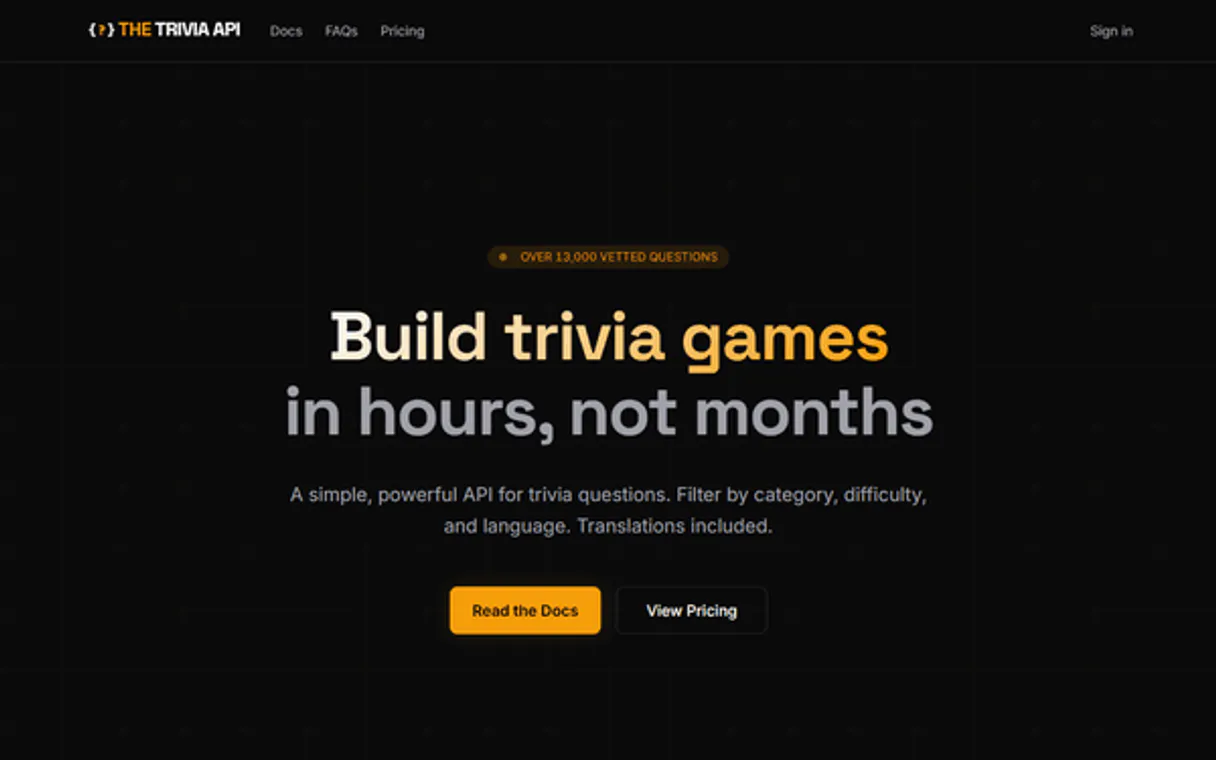
Independent Platform Disclaimer: Vinkius is an independent platform and is not affiliated with, endorsed by, sponsored by, verified by, or otherwise authorized by Open Trivia Database. All third-party trademarks, logos, and brand names are the property of their respective owners. Their use on this website is strictly for informational purposes to identify service compatibility and interoperability.
VINKIUS INFRASTRUCTURE
Cloud Hosted
Managed infra
V8 Isolated
Sandboxed per request
Zero-Trust Proxy
No stored credentials
DLP Enforced
Policy on every call
GDPR Compliant
EU data residency
Token Compression
~60% cost reduction
Works with Claude, ChatGPT, Cursor, and more
The Model Context Protocol standardizes how applications expose capabilities to LLMs. Instead of operating in isolation, your AI gains direct access to external platforms, live data, and real-world actions through secure, standardized connections.
This server provides 6 capabilities that interface natively with Claude, ChatGPT, Cursor, and any MCP client. No middleware. No custom integration required.
Available Capabilities
Manually auditing quiz content shouldn't take ten tabs and a spreadsheet.
Today, checking content depth means jumping between API documentation, manually running simple queries to count categories, and then cross-referencing those numbers in a separate sheet. You copy the category name from one place and paste it into another, hoping you didn't miss any filters or run into rate limits.
With this MCP server, your agent handles all that legwork. Ask it to audit content—it pulls the categories with `list_categories`, counts the volume in a topic using `get_category_question_count`, and gives you one clean response. You get data, not headaches.
Open Trivia Database MCP Server: Get unique question sets instantly.
Before this, getting a fresh set of 10 questions meant manually specifying the topic and difficulty, hoping you hadn't used those exact facts recently. You were always guessing if your content was stale or repetitive.
Now, just ask for it. The agent manages session tokens and pulls random sets via `get_trivia_questions`, ensuring variety every single time. Your content stream is guaranteed fresh.
Common Questions About Open Trivia Database MCP
How do I find out what topics are available using list_categories? +
Run the list_categories tool. It returns a structured list of all available trivia categories and their corresponding IDs, letting you pick exactly what you need.
Do I need an API key for get_trivia_questions? +
No, this server doesn't require an API key. You just need to manage your session tokens using request_session_token before calling the function.
What is the purpose of request_session_token? +
It generates a unique access token for your current task. Using this token in subsequent calls to get_trivia_questions prevents you from receiving duplicate questions.
Can I check total question volume with get_global_question_count? +
Yes, running get_global_question_count gives you a single number representing the entire database size. It's useful for scope planning.
If I need to know how many questions exist in a specific topic, should I use get_category_question_count? +
Yes. This tool returns an immediate count based on the category ID you provide. It lets you audit content depth before making requests for actual questions, saving API calls.
What is the process if my session token expires or starts returning duplicate questions? +
You must call reset_session_token. This action invalidates the old token and issues a brand new one, allowing you to continue drawing from the full pool of unique trivia results.
When using get_trivia_questions, how do I ensure I only receive questions of a specific difficulty? +
You pass the desired filter—like 'easy' or 'hard'—directly into the function call. This mechanism immediately narrows the results set to match your required cognitive level.
What is the time limit for my session token, and what should I do if I wait too long? +
The token expires after six hours of inactivity. If you wait that long, you must call request_session_token again to get fresh access and prevent duplicate questions.
Is an API Key required for The Trivia API? +
No. The Trivia API provides a free and open service. This server works out of the box without any static credentials required.
Can I filter questions by difficulty? +
Yes. Use the get_trivia_questions tool and provide the difficulties parameter (e.g., 'easy' or 'hard'). Your agent will return matching questions instantly.
What format are the answers in? +
The API provides a correct answer and a list of incorrect answers. Your agent automatically combines and sorts these into a list of choices for each question.
Use it with your favorite AI tools
Connect this server to Cursor, Claude, VS Code, and more.
More in this category
Obsidian Publish
Empower your AI to read your public or private Obsidian Publish sites. Index files, crawl navigation trees, and retrieve deep markdown knowledge.

Cohere (AI Platform)
Power enterprise AI via Cohere — generate text, perform chat completions, reorder documents, and manage embeddings directly from any AI agent.

TextRazor
Advanced Natural Language Processing (NLP) to extract entities, topics, and relations from text or URLs.
You might also like

Twilio SendGrid
Equip your AI agent with capabilities to natively dispatch HTML emails, prune suppression bounce lists, and manage marketing contacts via the SendGrid API.

Builder.io
Manage your visual CMS via Builder.io — track content entries, models, and symbols directly from any AI agent.

PeerTube (YouTube Alternative)
Interact with decentralized PeerTube instances — manage video feeds, download content, and handle user registration via AI.