
Particle IoT MCP Server for Claude Code 8 tools — connect in under 2 minutes
Claude Code is Anthropic's agentic CLI for terminal-first development. Add Particle IoT as an MCP server in one command and Claude Code will discover every tool at runtime. ideal for automation pipelines, CI/CD integration, and headless workflows via Vinkius.
ASK AI ABOUT THIS MCP SERVER
Vinkius supports streamable HTTP and SSE.
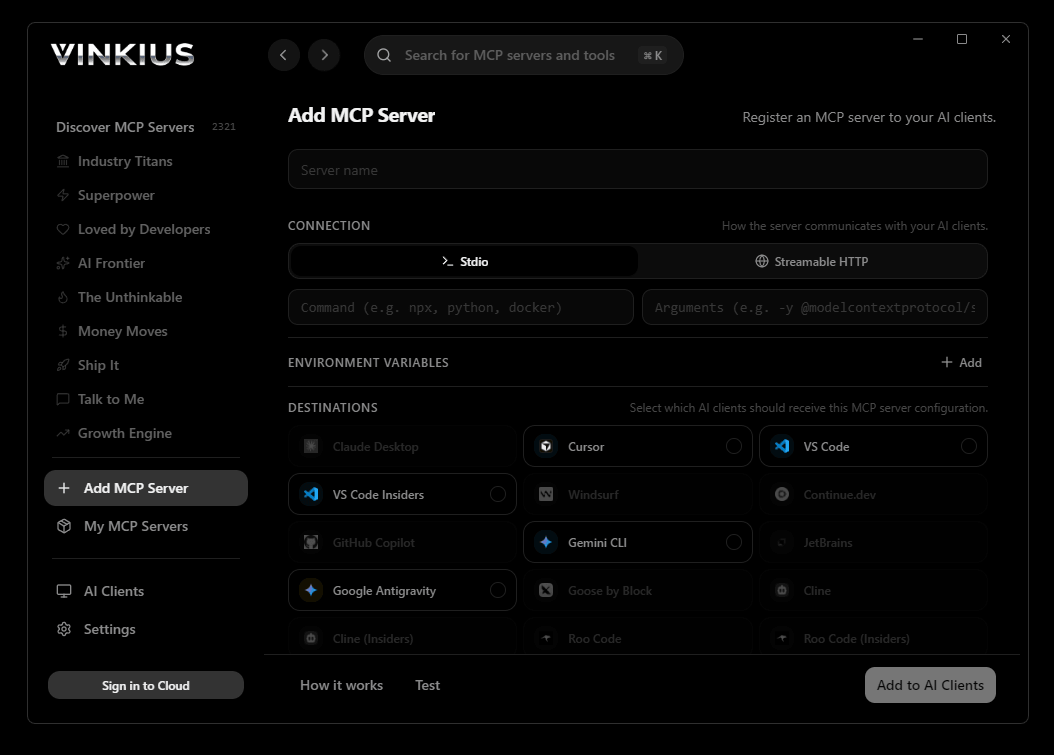
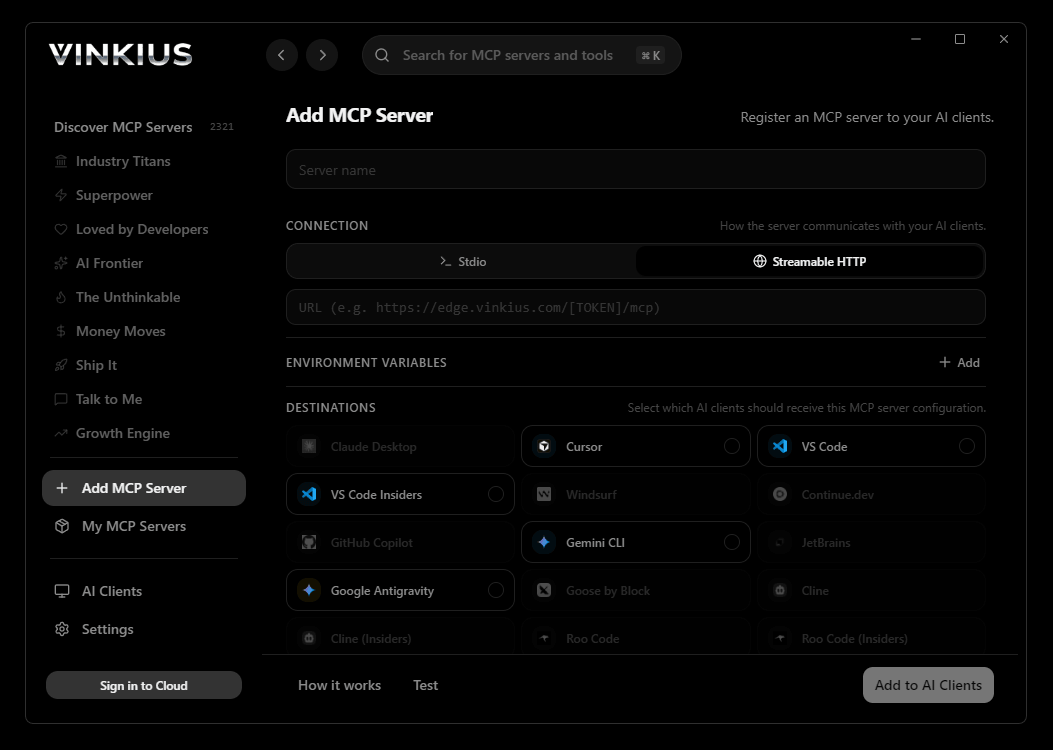
Vinkius Desktop App
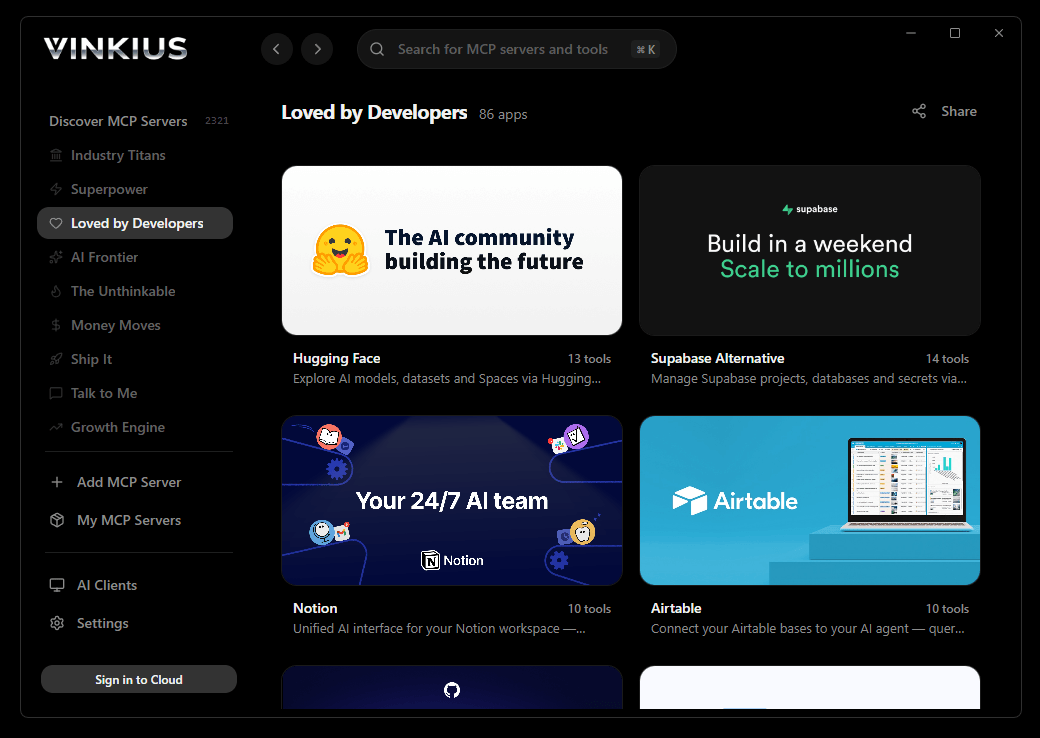
The modern way to manage MCP Servers — no config files, no terminal commands. Install Particle IoT and 2,500+ MCP Servers from a single visual interface.

# Your Vinkius token. get it at cloud.vinkius.com
claude mcp add particle-iot --transport http "https://edge.vinkius.com/[YOUR_TOKEN_HERE]/mcp"
* Every MCP server runs on Vinkius-managed infrastructure inside AWS - a purpose-built runtime with per-request V8 isolates, Ed25519 signed audit chains, and sub-40ms cold starts optimized for native MCP execution. See our infrastructure
About Particle IoT MCP Server
Connect your Particle IoT API to any AI agent and take full control of your IoT device fleet, sensor monitoring, remote actuator control, and event management through natural conversation.
Claude Code registers Particle IoT as an MCP server in a single terminal command. Once connected, Claude Code discovers all 8 tools at runtime and can call them headlessly. ideal for CI/CD pipelines, cron jobs, and automated workflows where Particle IoT data drives decisions without human intervention.
What you can do
- Device Management — List all connected devices, check online status, rename devices, and manage ownership
- Sensor Monitoring — Read real-time sensor data from cloud variables (temperature, humidity, soil moisture, etc.)
- Remote Control — Execute cloud functions to control actuators, trigger calibrations, and change device modes
- Event Publishing — Broadcast custom events to the cloud for logging, alerting, and webhook integration
- Health Monitoring — Ping devices to verify connectivity and troubleshoot communication issues
- Fleet Overview — Get comprehensive views of your entire IoT deployment and device status
The Particle IoT MCP Server exposes 8 tools through the Vinkius. Connect it to Claude Code in under two minutes — no API keys to rotate, no infrastructure to provision, no vendor lock-in. Your configuration, your data, your control.
How to Connect Particle IoT to Claude Code via MCP
Follow these steps to integrate the Particle IoT MCP Server with Claude Code.
Install Claude Code
Run npm install -g @anthropic-ai/claude-code if not already installed
Add the MCP Server
Run the command above in your terminal
Verify the connection
Run claude mcp to list connected servers, or type /mcp inside a session
Start using Particle IoT
Ask Claude: "Using Particle IoT, show me...". 8 tools are ready
Why Use Claude Code with the Particle IoT MCP Server
Claude Code provides unique advantages when paired with Particle IoT through the Model Context Protocol.
Single-command setup: `claude mcp add` registers the server instantly. no config files to edit or applications to restart
Terminal-native workflow means MCP tools integrate seamlessly into shell scripts, CI/CD pipelines, and automated DevOps tasks
Claude Code runs headlessly, enabling unattended batch processing using Particle IoT tools in cron jobs or deployment scripts
Built by the same team that created the MCP protocol, ensuring first-class compatibility and the fastest adoption of new protocol features
Particle IoT + Claude Code Use Cases
Practical scenarios where Claude Code combined with the Particle IoT MCP Server delivers measurable value.
CI/CD integration: embed Particle IoT tool calls in your deployment pipeline to validate configurations or fetch secrets before shipping
Headless batch processing: schedule Claude Code to query Particle IoT nightly and generate reports without human intervention
Shell scripting: pipe Particle IoT outputs into other CLI tools for data transformation, filtering, and aggregation
Infrastructure monitoring: run Claude Code in a cron job to query Particle IoT status endpoints and alert on anomalies
Particle IoT MCP Tools for Claude Code (8)
These 8 tools become available when you connect Particle IoT to Claude Code via MCP:
call_function
Functions are defined in the device firmware and can control actuators (turn on pump, open valve), trigger calibrations, change device modes, or perform system tasks. Accepts a single string argument (max 63 characters) to pass to the function. Returns the function execution result code. Essential for remote device control, automation, and actuator management. AI agents should use this when users ask "turn on the water pump on device X", "trigger calibration on sensor Y", or need to remotely control any function exposed by a device. Execute a cloud function on a specific Particle IoT device
get_device_info
Essential for understanding device capabilities before interacting with it. AI agents should reference this when users ask "what variables does device X expose", "what functions can I call on device Y", or need to understand the specific interface of a device. Get detailed information about a specific Particle IoT device
get_devices
Returns device IDs, names, online status, firmware versions, and last connection times. Essential for device inventory management, monitoring connection health, and selecting specific devices for interaction. AI agents should use this when users ask "show me all my devices", "list connected sensors", or need to identify available devices before reading variables or calling functions. List all Particle IoT devices connected to your account
ping_device
Returns current online/offline status and last heard time. Essential for connectivity diagnostics, health monitoring, and verifying device availability before attempting to read variables or call functions. AI agents should reference this when users ask "is device X online", "check connectivity for sensor Y", or need to troubleshoot device communication issues. Check if a specific Particle IoT device is online and responsive
publish_event
Events are broadcast to all subscribed listeners and can be used for inter-device communication, logging, alerting, or triggering external workflows via webhooks. Requires an event name and optional data string (max 255 bytes for data). Essential for sending alerts, logging custom data, and integrating with external systems like IFTTT or custom dashboards. AI agents should use this when users ask "send a low moisture alert", "publish a system status event", or need to broadcast data from the cloud to devices or webhooks. Publish a custom event to the Particle Cloud
read_variable
Variables are defined in the device firmware and can represent sensor readings (temperature, humidity, soil moisture), system status, or configuration values. Returns the variable name, data type, and current value. Essential for real-time sensor monitoring, data collection, and system state verification. AI agents should use this when users ask "what is the temperature from sensor X", "read soil moisture from device Y", or need to get the current value of any sensor or status variable. Read the current value of a cloud variable from a specific device
rename_device
This name appears in the console and API responses, making it easier to identify devices. Essential for device organization, fleet management, and improving readability of device lists. AI agents should use this when users ask "rename device X to Greenhouse Sensor 1", "change the name of device Y to Pump Controller", or need to update device naming for better organization. Rename a specific Particle IoT device
unclaim_device
This action is irreversible for the current account and should be used when transferring device ownership or decommissioning devices. Essential for device lifecycle management, transferring devices, and account cleanup. AI agents should use this when users ask "remove device X from my account", "unclaim sensor Y so I can sell it", or need to manage device ownership. WARNING: This requires confirmation as it removes access to the device. Remove a Particle IoT device from your account
Example Prompts for Particle IoT in Claude Code
Ready-to-use prompts you can give your Claude Code agent to start working with Particle IoT immediately.
"Show me all my connected Particle devices and their online status."
"Read the current soil moisture from my greenhouse sensor."
"Turn on the irrigation pump for 15 minutes."
Troubleshooting Particle IoT MCP Server with Claude Code
Common issues when connecting Particle IoT to Claude Code through the Vinkius, and how to resolve them.
Command not found: claude
npm install -g @anthropic-ai/claude-codeConnection timeout
Particle IoT + Claude Code FAQ
Common questions about integrating Particle IoT MCP Server with Claude Code.
How do I add an MCP server to Claude Code?
claude mcp add --transport http "" in your terminal. Claude Code registers the server and discovers all tools immediately.Can Claude Code run MCP tools in headless mode?
How do I list all connected MCP servers?
claude mcp in your terminal to see all registered servers and their status, or type /mcp inside an active Claude Code session.Connect Particle IoT with your favorite client
Step-by-step setup guides for every MCP-compatible client and framework:
Anthropic's native desktop app for Claude with built-in MCP support.
AI-first code editor with integrated LLM-powered coding assistance.
GitHub Copilot in VS Code with Agent mode and MCP support.
Purpose-built IDE for agentic AI coding workflows.
Autonomous AI coding agent that runs inside VS Code.
Anthropic's agentic CLI for terminal-first development.
Python SDK for building production-grade OpenAI agent workflows.
Google's framework for building production AI agents.
Type-safe agent development for Python with first-class MCP support.
TypeScript toolkit for building AI-powered web applications.
TypeScript-native agent framework for modern web stacks.
Python framework for orchestrating collaborative AI agent crews.
Leading Python framework for composable LLM applications.
Data-aware AI agent framework for structured and unstructured sources.
Microsoft's framework for multi-agent collaborative conversations.
Connect Particle IoT to Claude Code
Get your token, paste the configuration, and start using 8 tools in under 2 minutes. No API key management needed.