
PitchBook MCP Server for CrewAI 13 tools — connect in under 2 minutes
Connect your CrewAI agents to PitchBook through Vinkius, pass the Edge URL in the `mcps` parameter and every PitchBook tool is auto-discovered at runtime. No credentials to manage, no infrastructure to maintain.
ASK AI ABOUT THIS MCP SERVER
Vinkius supports streamable HTTP and SSE.
from crewai import Agent, Task, Crew

agent = Agent(
    role="PitchBook Specialist",
    goal="Help users interact with PitchBook effectively",
    backstory=(
        "You are an expert at leveraging PitchBook tools "
        "for automation and data analysis."
    ),
    # Your Vinkius token. get it at cloud.vinkius.com
    mcps=["https://edge.vinkius.com/[YOUR_TOKEN_HERE]/mcp"],
)

task = Task(
    description=(
        "Explore all available tools in PitchBook "
        "and summarize their capabilities."
    ),
    agent=agent,
    expected_output=(
        "A detailed summary of 13 available tools "
        "and what they can do."
    ),
)

crew = Crew(agents=[agent], tasks=[task])
result = crew.kickoff()
print(result)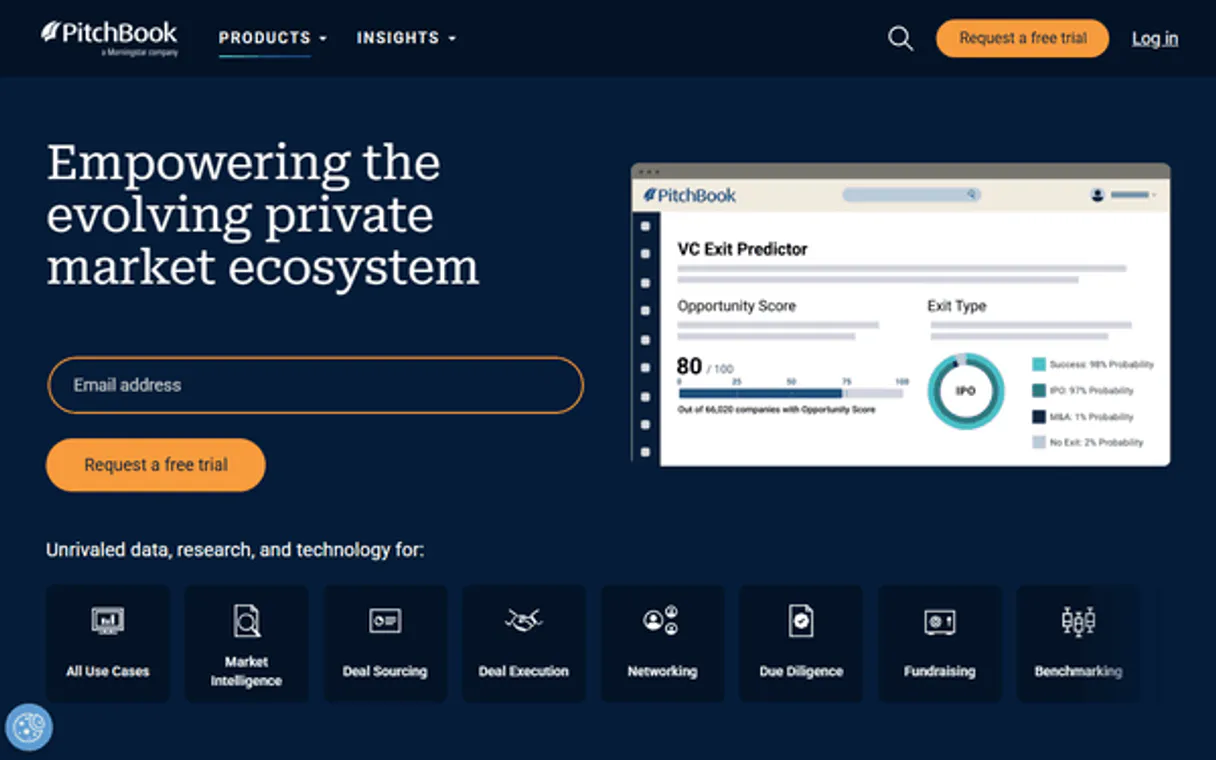
* Every MCP server runs on Vinkius-managed infrastructure inside AWS - a purpose-built runtime with per-request V8 isolates, Ed25519 signed audit chains, and sub-40ms cold starts optimized for native MCP execution. See our infrastructure
About PitchBook MCP Server
What you can do
Connect AI agents to the PitchBook Direct Data API for comprehensive private market intelligence:
When paired with CrewAI, PitchBook becomes a first-class tool in your multi-agent workflows. Each agent in the crew can call PitchBook tools autonomously, one agent queries data, another analyzes results, a third compiles reports, all orchestrated through Vinkius with zero configuration overhead.
- Search companies across global private and public markets with industry and status filters
- Get complete company profiles with founding dates, headquarters, employees, and industry classifications
- Track financing history from Seed to Series D+ with deal sizes, investor syndicates, and valuations
- Research deals including VC investments, M&A transactions, LBOs, and public offerings
- Analyze investors — VC firms, PE firms, angels, family offices, and corporate venture arms
- Explore investment funds with AUM, vintage years, stage preferences, and sector focus
- Find professionals — founders, executives, board members, and key decision-makers
- Identify limited partners — pension funds, endowments, sovereign wealth funds, and family offices
- Get AI-powered VC exit predictions for portfolio companies with IPO and acquisition probability scores
The PitchBook MCP Server exposes 13 tools through the Vinkius. Connect it to CrewAI in under two minutes — no API keys to rotate, no infrastructure to provision, no vendor lock-in. Your configuration, your data, your control.
How to Connect PitchBook to CrewAI via MCP
Follow these steps to integrate the PitchBook MCP Server with CrewAI.
Install CrewAI
Run pip install crewai
Replace the token
Replace [YOUR_TOKEN_HERE] with your Vinkius token from cloud.vinkius.com
Customize the agent
Adjust the role, goal, and backstory to fit your use case
Run the crew
Run python crew.py. CrewAI auto-discovers 13 tools from PitchBook
Why Use CrewAI with the PitchBook MCP Server
CrewAI Multi-Agent Orchestration Framework provides unique advantages when paired with PitchBook through the Model Context Protocol.
Multi-agent collaboration lets you decompose complex workflows into specialized roles, one agent researches, another analyzes, a third generates reports, each with access to MCP tools
CrewAI's native MCP integration requires zero adapter code: pass Vinkius Edge URL directly in the `mcps` parameter and agents auto-discover every available tool at runtime
Built-in task delegation and shared memory mean agents can pass context between steps without manual state management, enabling multi-hop reasoning across tool calls
Sequential and hierarchical crew patterns map naturally to real-world workflows: enumerate subdomains → analyze DNS history → check WHOIS records → compile findings into actionable reports
PitchBook + CrewAI Use Cases
Practical scenarios where CrewAI combined with the PitchBook MCP Server delivers measurable value.
Automated multi-step research: a reconnaissance agent queries PitchBook for raw data, then a second analyst agent cross-references findings and flags anomalies. all without human handoff
Scheduled intelligence reports: set up a crew that periodically queries PitchBook, analyzes trends over time, and generates executive briefings in markdown or PDF format
Multi-source enrichment pipelines: chain PitchBook tools with other MCP servers in the same crew, letting agents correlate data across multiple providers in a single workflow
Compliance and audit automation: a compliance agent queries PitchBook against predefined policy rules, generates deviation reports, and routes findings to the appropriate team
PitchBook MCP Tools for CrewAI (13)
These 13 tools become available when you connect PitchBook to CrewAI via MCP:
get_companies
Returns company names, statuses, industries, locations, and key identifiers. Use optional filters to narrow results by industry, location, company status (Active, Acquired, Closed, IPO), or other attributes. Results follow JSON:API format with pagination metadata. Use this to find startups, established companies, or emerging players in specific sectors. Search and list companies in the PitchBook private market database
get_company
Requires the company ID from get_companies results. Use this for comprehensive company due diligence and background research. Get detailed profile for a specific company in PitchBook
get_company_financing
Each round shows announced date, amount raised (USD), lead investors, participating investors, deal structure, and post-money valuation if disclosed. Requires the company ID from get_companies or get_company results. Use this to analyze a company's fundraising trajectory, total capital raised, and investor syndicate composition. Get complete funding/financing history for a specific company
get_deal
), announced date, deal size (if disclosed), all participating companies, investors, funds, and financial advisors, deal terms and structure, and any publicly available valuation data. Requires the deal ID from get_deals results. Use this for deep analysis of specific transactions, competitive deal intelligence, or investment thesis validation. Get detailed information about a specific deal/transaction
get_deals
Returns deal names, types (VC Deal, M&A, IPO, LBO, etc.), announced dates, deal sizes (if disclosed), and participating entities. Use optional filters to narrow by deal type, industry, location, or date range. Results follow JSON:API format with pagination metadata. Use this to track recent deal activity, identify active investors, or monitor M&A trends. Search and list deals (VC investments, M&A, offerings) in PitchBook
get_fund
Requires the fund ID from get_funds results. Use this for fund-level due diligence, LP allocation decisions, or understanding fund investment strategies. Get detailed information about a specific investment fund
get_funds
Returns fund names, types, sizes (if disclosed), vintages (year), investor/firm names, and key identifiers. Use optional filters to narrow by fund type, vintage year, fund size, or investor. Use this to analyze fund raising trends, identify active funds in a vintage, or research fund managers for LP due diligence. Search and list investment funds in PitchBook
get_investor
), sector focus areas, geographic focus, notable portfolio companies, and key personnel. Requires the investor ID from get_investors results. Use this for thorough investor due diligence, LP fundraising research, or understanding investment firm strategies. Get detailed profile for a specific investor/firm
get_investors
Returns investor names, types (VC, PE, Angel, Corporate VC, etc.), headquarters locations, fund counts, total AUM (if disclosed), and key identifiers. Use optional filters to narrow by investor type, location, or fund size. Use this to find potential investors, research competitor firms, or map the investment landscape. Search and list investors (VC firms, angels, PE firms) in PitchBook
get_limited_partners
Returns LP names, types, locations, total commitments (if disclosed), and key identifiers. Use optional filters to narrow by LP type, location, or commitment size. Use this for LP fundraising research, understanding LP allocation trends, or identifying potential fund investors. Search and list limited partners (LPs) in PitchBook
get_professional
Requires the professional ID from get_professionals results. Use this for thorough individual due diligence, founder background checks, or mapping professional deal flow networks. Get detailed profile for a specific professional
get_professionals
Returns names, current titles, organizational affiliations, locations, and key identifiers. Use optional filters to narrow by title, organization, or location. Use this to find key decision-makers, research founder backgrounds, or map professional networks in the startup ecosystem. Search and list professionals (founders, executives, investors) in PitchBook
get_vc_exit_predictor
Returns the predicted exit likelihood score, predicted exit type (IPO, Acquisition, Secondary), predicted exit timeframe, and comparable exits used in the model. Requires the company ID from get_companies results. Use this to assess exit probability for portfolio companies, identify likely IPO candidates, or evaluate acquisition potential of target companies. Note: This is a predictive model output, not a guaranteed outcome. Get AI-powered VC exit prediction for a specific company
Example Prompts for PitchBook in CrewAI
Ready-to-use prompts you can give your CrewAI agent to start working with PitchBook immediately.
"Search for artificial intelligence startups that raised a Series A round in the last 6 months."
Troubleshooting PitchBook MCP Server with CrewAI
Common issues when connecting PitchBook to CrewAI through the Vinkius, and how to resolve them.
MCP tools not discovered
Agent not using tools
Timeout errors
Rate limiting or 429 errors
PitchBook + CrewAI FAQ
Common questions about integrating PitchBook MCP Server with CrewAI.
How does CrewAI discover and connect to MCP tools?
tools/list method. This means tools are always fresh and reflect the server's current capabilities. No tool schemas need to be hardcoded.Can different agents in the same crew use different MCP servers?
mcps list, so you can assign specific servers to specific roles. For example, a reconnaissance agent might use a domain intelligence server while an analysis agent uses a vulnerability database server.What happens when an MCP tool call fails during a crew run?
Can CrewAI agents call multiple MCP tools in parallel?
process=Process.parallel, each calling different MCP tools concurrently. This is ideal for workflows where separate data sources need to be queried simultaneously.Can I run CrewAI crews on a schedule (cron)?
crew.kickoff() method runs synchronously by default, making it straightforward to integrate into existing pipelines.Connect PitchBook with your favorite client
Step-by-step setup guides for every MCP-compatible client and framework:
Anthropic's native desktop app for Claude with built-in MCP support.
AI-first code editor with integrated LLM-powered coding assistance.
GitHub Copilot in VS Code with Agent mode and MCP support.
Purpose-built IDE for agentic AI coding workflows.
Autonomous AI coding agent that runs inside VS Code.
Anthropic's agentic CLI for terminal-first development.
Python SDK for building production-grade OpenAI agent workflows.
Google's framework for building production AI agents.
Type-safe agent development for Python with first-class MCP support.
TypeScript toolkit for building AI-powered web applications.
TypeScript-native agent framework for modern web stacks.
Python framework for orchestrating collaborative AI agent crews.
Leading Python framework for composable LLM applications.
Data-aware AI agent framework for structured and unstructured sources.
Microsoft's framework for multi-agent collaborative conversations.
Connect PitchBook to CrewAI
Get your token, paste the configuration, and start using 13 tools in under 2 minutes. No API key management needed.