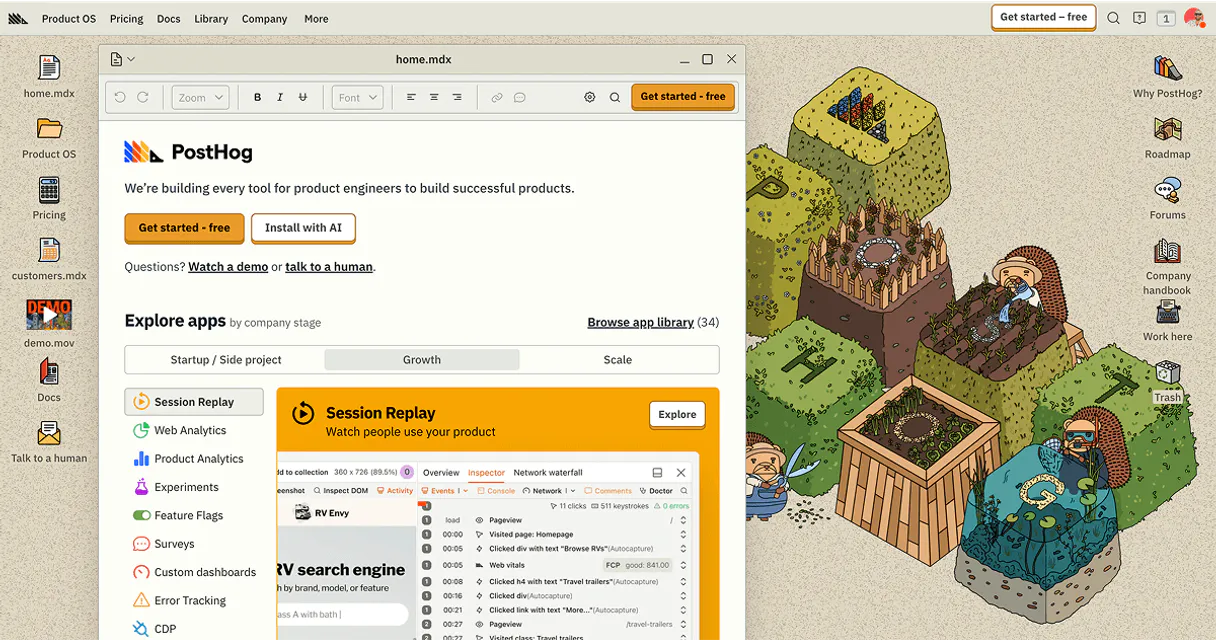
PostHog MCP. Analyze product data, flags, and user behavior in conversation.
Works with every AI agent you already use
…and any MCP-compatible client

Just plug in your AI agents and start using Vinkius.
PostHog connects product analytics and feature management directly into your AI agent. Use this server to list insights, inspect user properties, track events, and manage features flags—all from a single conversation with your client.
What your AI agents can do
Get event
Gets specific details for an event by its ID.
Get insight
Retrieves detailed metadata for a specific saved insight.
Get person
Fetches all properties and details for one identified person/user.
List, retrieve, and audit recent system events that happened in the PostHog project.
Retrieve metadata for saved product insights, including funnels and retention data.
Look up properties and behavior metrics for a distinct identified person/user.
Retrieve the full catalog of user-defined actions available in your project.
Get a list of every feature flag and its current configuration state.
Ask AI about this MCP
Supported MCP Clients
Waiting for input…
PostHog: 10 Tools for Data Analytics & Tracking
These tools let you list user IDs, check flag statuses, retrieve specific event logs, and pull analytics insights—all without leaving your agent terminal.
019d75f8get event
Gets specific details for an event by its ID.
019d75f8get insight
Retrieves detailed metadata for a specific saved insight.
019d75f8get person
Fetches all properties and details for one identified person/user.
019d75f8list actions
Lists every defined user action available in the project.
019d75f8list dashboards
Retrieves a list of all existing project dashboards.
019d75f8list events
Lists the most recent project events captured by your system.
019d75f8list experiments
Retrieves a list of all active and past product experiments.
019d75f8list feature flags
Lists every feature flag defined in the project, along with its status.
019d75f8list insights
Retrieves a list of all saved analytics insights for the project.
019d75f8list persons
Lists a collection of identified persons and unique user IDs.
Choose How to Get Started
Build a custom MCP for your own tools, or connect a ready-made integration from our catalog.
Build Your Own
Turn any API into an MCP. Import a spec, define Agent Skills, or deploy with MCPFusion.
- Import from OpenAPI, Swagger, or YAML specs
- Create Agent Skills with progressive disclosure
- Deploy to edge with MCPFusion framework
- Built in DLP, auth, and compliance on every call
- Real time usage dashboard and cost metering
- Publish to catalog or keep private
Make Your AI Do More
Start with PostHog, then connect any of our 4,700+ other servers whenever your AI needs more. One click, no limits.
- Use this MCP plus 4,700+ others, all in one place
- Add new capabilities to your AI anytime you want
- Every connection is secured and compliant automatically
- Track usage and costs across all your servers
- Works with Claude, ChatGPT, Cursor, and more
- New servers added to the catalog every week
What you can do with this MCP connector
You're hooking your PostHog project up to your AI agent so you can run product analytics and feature management straight through conversation. You don't need to jump between dashboards or write complex queries; you just talk to your client, and it handles the data retrieval.
When you need to dig into user behavior, you start by calling list_persons to get a full roster of unique identifiers across the project. This gives you a list of every person who's interacted with the product. From there, if you know an ID, you use get_person to pull up all their associated properties and behavior metrics.
That lets you see exactly what that specific user did—it’s like having a perfect audit trail on demand.
To check what users were doing moment-to-moment, you can list the most recent system events using list_events. This gives you an immediate overview of activity across the board. If you find an event ID and need the full story, calling get_event pulls every specific detail tied to that single occurrence.
It's how you audit data ingestion or verify a user action.
For deep product analysis, you’ve got tools for everything. You can list all saved analytics insights using list_insights, which shows you the high-level trends already identified in your project. Need the juicy details? Calling get_insight pulls specific metadata for that insight—that's where you find funnel data and retention metrics, making sure your conclusions are backed by hard numbers.
When managing product features, you can list every single feature flag defined in the project via list_feature_flags, which shows its current configuration state. If you need to know what actions users take—like clicking 'checkout' or 'save profile'—you use list_actions to get a full catalog of user-defined events available for tracking.
You can also check out the structure of your data by retrieving all existing project dashboards with list_dashboards. If you're running tests, calling list_experiments gives you a list of every active or completed product experiment. Finally, if you need to know what kinds of systems are tracking things, list_actions provides that full catalog.
This setup lets your AI client act like it’s sitting right next to you in the analytics department, giving you immediate access to user profiles, activity logs, feature status, and saved insights without ever leaving the chat window.
How PostHog MCP Works
- 1 Subscribe to the server, then enter your PostHog Personal API Key and Project ID.
- 2 If needed (e.g., for EU instances), provide the specific PostHog Host address.
- 3 Ask your AI client a question—like 'What's the status of the checkout flag?' — and get an immediate answer.
The bottom line is, you analyze product data directly from your agent without leaving your current workflow or opening the PostHog dashboard.
Who Is PostHog MCP For?
This is for Product Managers who get frustrated clicking through dashboards to check one flag; Data Analysts who need to audit logs without switching tabs; and Growth Engineers who constantly monitor active experiments. If you spend time translating data into action, this server saves you clicks.
Checks the status of a feature flag or reviews the results from an insight before signing off on a release.
Audits recent event logs and person metadata to validate data ingestion without leaving their primary terminal.
Monitors active experiments and user properties during a development sprint, needing real-time behavioral feedback.
What Changes When You Connect
- Check flag status instantly. Instead of navigating the UI to see if a feature is on or off, just ask your agent using
list_feature_flags. You get the current config state immediately. - Audit user actions without leaving your terminal. If you suspect data gaps, call
list_eventsto pull the most recent event logs and verify everything was captured correctly. - Understand individual users deeply. Don't just look at group totals; use
get_personto fetch specific properties for an identified user ID. This pinpoints unique behavior patterns. - Track product hypotheses efficiently. Call
list_experimentsto see a full history of tests run, letting you compare results from past A/B tests against current goals. - Get quick access to known funnels. Use
list_insightsto retrieve names and basic metadata for saved analytics insights like 'Signup Funnel' or 'Daily Active Users'.
Real-World Use Cases
Debugging a broken checkout flow
A user notices the checkout button isn't working. Instead of manually checking logs, they ask their agent to run list_events and filter by 'checkout_failure'. The agent returns the last five relevant events, showing exactly which step failed and for which person ID.
Checking a new feature's rollout status
The PM needs to know if the beta team has access to the new dashboard. They run list_feature_flags and check the 'new-dashboard-access' flag. The agent confirms it's active for the 'beta' segment, solving the problem instantly.
Investigating a high churn rate
The data team suspects users are dropping off after signup. They ask their agent to list_insights and focus on 'Signup Funnel'. The returned metadata highlights a drop-off at the payment screen, guiding the next engineering sprint.
Validating user identification
A developer is debugging an API call for a specific client. They use list_persons to find the correct unique ID and then pass that ID into get_person, retrieving all associated properties (email, signup date) needed for validation.
The Tradeoffs
Over-relying on UI dashboards
Spending twenty minutes clicking between the 'Events' tab, then the 'People' section, and finally opening a separate 'Insights' panel just to piece together one user journey.
→
Let your agent run multiple tools in sequence. Start by calling list_persons for an ID, then pass that ID to get_person, and finally use get_event with the person's context—all within a single prompt.
Guessing which data is available
Writing vague prompts like 'Tell me about user behavior.' The agent cannot guess what you want, resulting in generic or incomplete answers.
→
Be specific. Use the tools: 'List all active experiments' (list_experiments), then 'Get details for insight X' (get_insight). The more specific your tool calls, the better the answer.
Ignoring feature flag context
Assuming that because a dashboard exists, every user has access to all data shown on it. This leads to incorrect assumptions about product availability.
→
Always check list_feature_flags first. Knowing the exact status (on/off) of critical features prevents you from making faulty product decisions based on incomplete data.
When It Fits, When It Doesn't
Use this server if your primary need is correlation: linking what a user did (get_event) to who they are (get_person), and why that action matters (the defined list_insights). It's perfect for debugging product flows or validating data integrity across different systems.
Don't use this if you just need general market research or competitor analysis. If your question is 'How do I make my landing page better?'—this server can only answer based on your internal data. If you only care about knowing if a feature exists, list_feature_flags is enough; don't try to call every tool just because it exists.
Independent Platform Disclaimer: Vinkius is an independent platform and is not affiliated with, endorsed by, sponsored by, verified by, or otherwise authorized by PostHog. All third-party trademarks, logos, and brand names are the property of their respective owners. Their use on this website is strictly for informational purposes to identify service compatibility and interoperability.
VINKIUS INFRASTRUCTURE
Cloud Hosted
Managed infra
V8 Isolated
Sandboxed per request
Zero-Trust Proxy
No stored credentials
DLP Enforced
Policy on every call
GDPR Compliant
EU data residency
Token Compression
~60% cost reduction
Works with Claude, ChatGPT, Cursor, and more
The Model Context Protocol standardizes how applications expose capabilities to LLMs. Instead of operating in isolation, your AI gains direct access to external platforms, live data, and real-world actions through secure, standardized connections.
This server provides 10 capabilities that interface natively with Claude, ChatGPT, Cursor, and any MCP client. No middleware. No custom integration required.
Available Capabilities
Manual product analysis requires jumping between tabs and exporting CSVs.
Right now, analyzing a user journey means logging into PostHog, opening the 'People' section to find an ID; then switching to the 'Events' tab to see their actions; and finally going to 'Insights' to map that sequence to a funnel drop-off. It’s fragmentation—a painful cycle of copy/pasting IDs between three different screens.
With this MCP server, you just ask your agent: 'Show me the signup flow for user ID 123.' The agent calls `get_person` to validate the user, then runs `list_events` and cross-references that data against saved insights (`list_insights`). You get a clean, narrative answer—no dashboard hopping required.
List Insights: Get funnel metrics without opening the analytics tool.
Previously, to check how many users dropped off at step three of your onboarding flow, you had to manually navigate to the 'Funnels' dashboard and filter by date range and segment. If the data was stale or incomplete, you were stuck.
Now, just ask for insights. The agent calls `list_insights`, pulls the metadata, and tells you: 'The Signup Funnel showed a 15% drop-off rate last week.' It's instant, verifiable product knowledge.
Common Questions About PostHog MCP
How do I check if a feature flag is active using list_feature_flags? +
You ask your agent to run list_feature_flags. The response will give you the name of the flag and its current configuration status (e.g., 'active', 'disabled'), letting you know exactly who can access it.
Can I use get_person to find a user's email address? +
Yes, get_person retrieves all properties associated with an identified person. You simply ask for the details of the person ID, and the agent will return key properties like their email or signup date.
What is list_events used for in debugging? +
Use list_events to check data ingestion. If a user reports an issue, calling this tool retrieves the most recent events captured by your project, letting you verify if the action even registered.
Does list_insights show me all my funnels? +
No, list_insights lists saved insights (funnel definitions, trend charts). You must then prompt the agent to retrieve details for a specific insight name using get_insight.
When I use list_persons, what specific parameters should I pass to filter for a single person by their unique ID? +
You must provide the distinct user ID in the query parameters. If you include other criteria like email or signup date without the ID, the search returns a list of matches instead of the full record.
If I call get_event with an incorrect Event ID, what error response should my AI client expect? +
The system will return a 404 Not Found status code and include a specific message stating that the requested event identifier does not exist in your PostHog project.
How do I handle pagination or rate limits when listing many items using list_experiments? +
The tool supports standard cursor-based pagination. If you need more results than the default batch size, you must pass the next_cursor token received in the previous successful response.
Using list_actions, how does PostHog distinguish between a user action and a general event? +
A defined 'Action' is an explicit, recognized event type that you set up within PostHog for consistent tracking. A raw 'Event' is any data point recorded by the user without prior formal definition.
Where do I find my Project ID? +
You can find your Project ID in PostHog under Project Settings. It is a numeric ID usually found at the top of the settings page.
Does this support PostHog EU instances? +
Yes! Use the optional POSTHOG_HOST credential and set it to https://eu.posthog.com. By default, it uses the US host (https://app.posthog.com).
Can I see individual user properties? +
Absolutely. Use the get_person tool with a Person ID to retrieve all properties, tags, and identification metadata for a specific user.
Use it with your favorite AI tools
Connect this server to Cursor, Claude, VS Code, and more.
More in this category
Franchimp
Access franchise intelligence, lead gen data, and FDD metadata via AI agents with Franchimp.
IBGE Full Access — Dados Brasileiros
The ultimate Brazil data Mega-Server: 15 tools spanning census, cities, CNAE economy, name trends, survey indicators, IBGE news, and country comparisons — all of Brazil's official statistics in one zero-auth integration.
Mockaroo
Generate realistic dummy data — audit schemas and field types via AI.
You might also like
Gong
Analyze sales conversations with AI that reveals winning patterns, coach reps with data, and forecast revenue with precision.
Docparser
Equip your AI agent to extract data from documents, manage parsers, and track extraction results via the Docparser API.
Booqable
Manage your rentals via Booqable — track orders, check availability, and manage inventory directly from any AI agent.