
Road511 MCP Server for Cline 8 tools — connect in under 2 minutes
Cline is an autonomous AI coding agent inside VS Code that plans, executes, and iterates on tasks. Wire Road511 through the Vinkius and Cline gains direct access to every tool — from data retrieval to workflow automation — without leaving the terminal.
ASK AI ABOUT THIS MCP SERVER
Vinkius supports streamable HTTP and SSE.
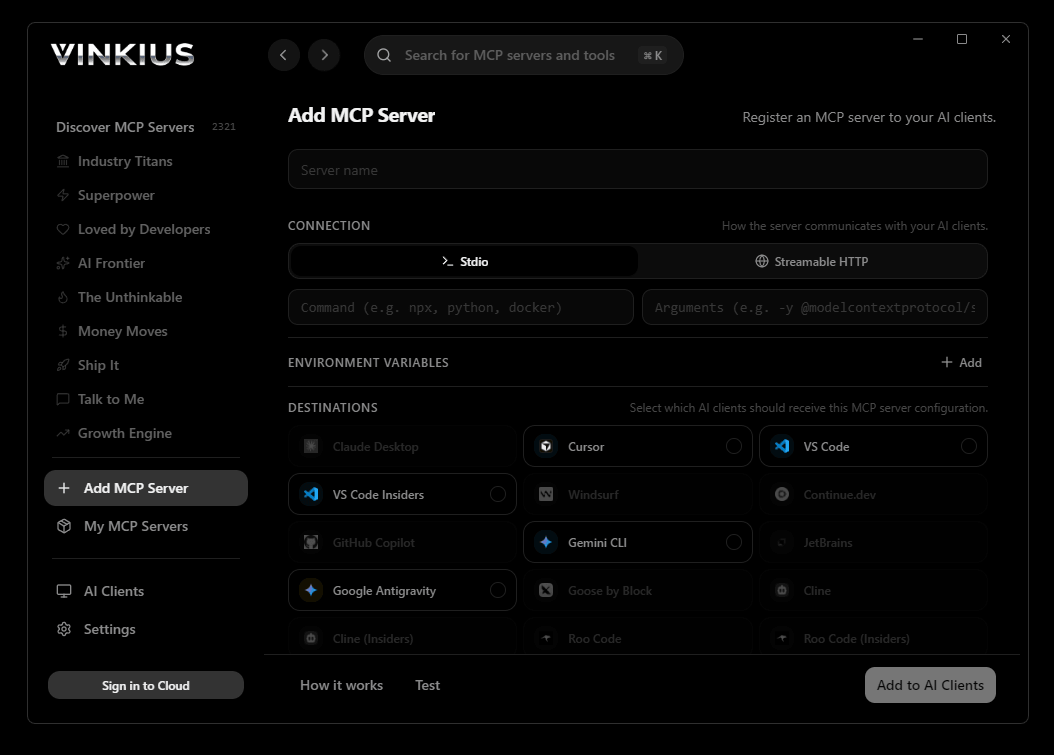
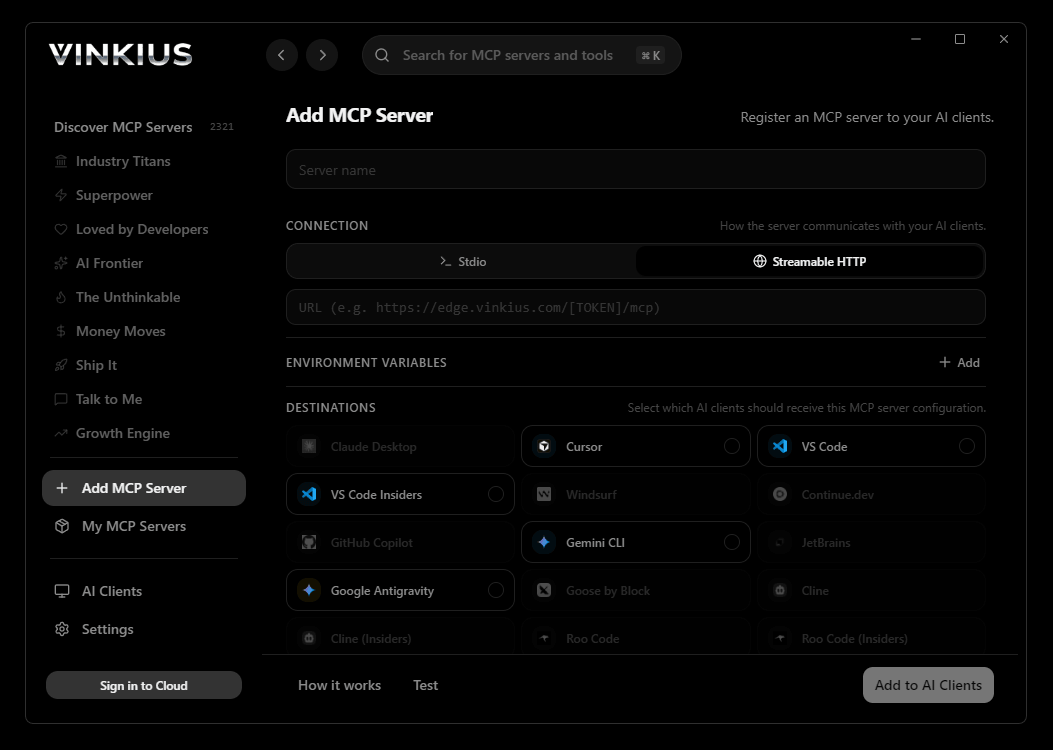
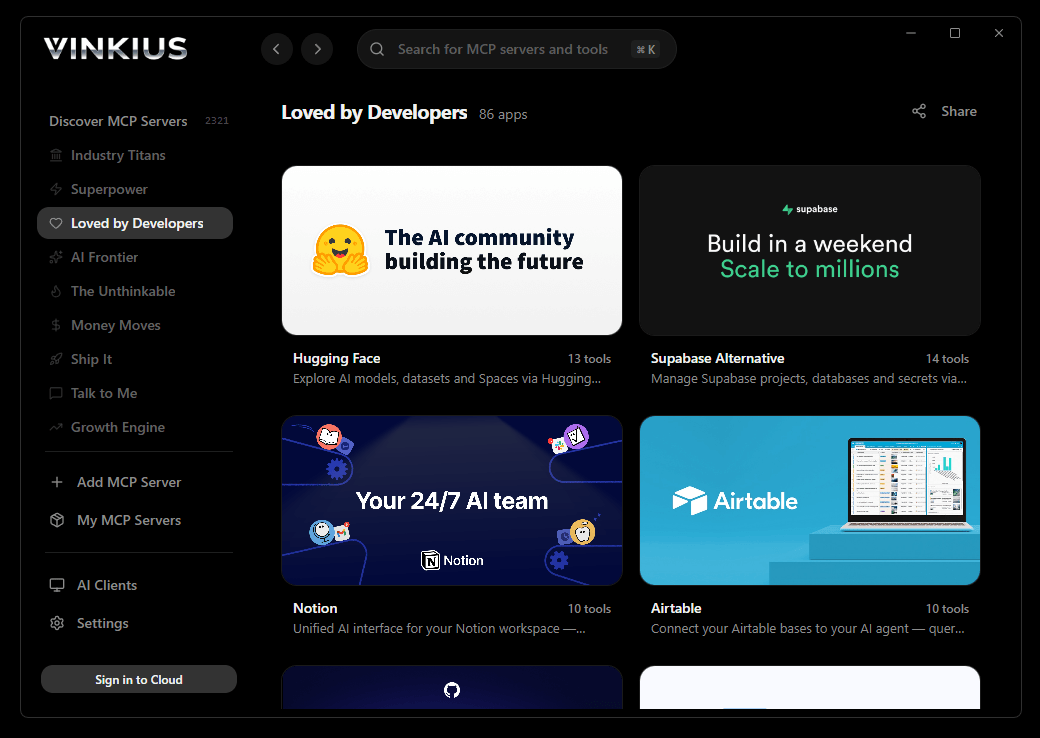
Vinkius Desktop App
The modern way to manage MCP Servers — no config files, no terminal commands. Install Road511 and 2,500+ MCP Servers from a single visual interface.

{
  "mcpServers": {
    "road511": {
      "url": "https://edge.vinkius.com/[YOUR_TOKEN_HERE]/mcp"
    }
  }
}
* Every MCP server runs on Vinkius-managed infrastructure inside AWS - a purpose-built runtime with per-request V8 isolates, Ed25519 signed audit chains, and sub-40ms cold starts optimized for native MCP execution. See our infrastructure
About Road511 MCP Server
Connect your Road511 real-time traffic data API to any AI agent and take full control of North American traffic monitoring, incident tracking, infrastructure awareness, and operational analytics through natural conversation.
Cline operates autonomously inside VS Code — it reads your codebase, plans a strategy, and executes multi-step tasks including Road511 tool calls without waiting for prompts between steps. Connect 8 tools through the Vinkius and Cline can fetch data, generate code, and commit changes in a single autonomous run.
What you can do
- Traffic Incidents — Track real-time incidents, construction, closures, special events, and weather advisories across all 50 US states and 13 Canadian provinces
- Traffic Cameras — Access live traffic camera feeds for visual traffic monitoring across North America
- Road Conditions — Check current road conditions, surface status, and weather impacts on roadways
- EV Charging — Find electric vehicle charging stations across the US and Canada for trip planning
- Rest Areas — Locate rest areas, weigh stations, and ferry terminals along major corridors
- Weather Stations — Access road-side weather station data for weather-aware routing
- Geospatial Mapping — Get all data in GeoJSON format for direct mapping and GIS integration
- Incident Analytics — Analyze traffic incident trends, resolution times, and operational metrics
- System Health — Monitor API health and data source status across 65 jurisdictions
The Road511 MCP Server exposes 8 tools through the Vinkius. Connect it to Cline in under two minutes — no API keys to rotate, no infrastructure to provision, no vendor lock-in. Your configuration, your data, your control.
How to Connect Road511 to Cline via MCP
Follow these steps to integrate the Road511 MCP Server with Cline.
Open Cline MCP Settings
Click the MCP Servers icon in the Cline sidebar panel
Add remote server
Click "Add MCP Server" and paste the configuration above
Enable the server
Toggle the server switch to ON
Start using Road511
Ask Cline: "Using Road511, help me..." — 8 tools available
Why Use Cline with the Road511 MCP Server
Cline provides unique advantages when paired with Road511 through the Model Context Protocol.
Cline operates autonomously — it reads your codebase, plans a strategy, and executes multi-step tasks including MCP tool calls without step-by-step prompts
Runs inside VS Code, so you get MCP tool access alongside your existing extensions, terminal, and version control in a single window
Cline can create, edit, and delete files based on MCP tool responses, enabling end-to-end automation from data retrieval to code generation
Transparent execution: every tool call and file change is shown in Cline's activity log for full visibility and approval before committing
Road511 + Cline Use Cases
Practical scenarios where Cline combined with the Road511 MCP Server delivers measurable value.
Autonomous feature building: tell Cline to fetch data from Road511 and scaffold a complete module with types, handlers, and tests
Codebase refactoring: use Road511 tools to validate live data while Cline restructures your code to match updated schemas
Automated testing: Cline fetches real responses from Road511 and generates snapshot tests or mocks based on actual payloads
Incident response: query Road511 for real-time status and let Cline generate hotfix patches based on the findings
Road511 MCP Tools for Cline (8)
These 8 tools become available when you connect Road511 to Cline via MCP:
get_clearance
Returns average resolution times by incident type, severity, jurisdiction, and time period. Essential for operational efficiency analysis, resource planning, performance benchmarking, and understanding how quickly traffic incidents are resolved in different regions. AI agents should use this when users ask "what is the median resolution time for incidents in California", "how long do major incidents take to clear in Texas", or need performance metrics for traffic incident management analysis. Get incident resolution time metrics (P50/P95) for operational analysis
get_events
Returns event type, severity (minor, moderate, major, critical, info), jurisdiction, road affected, start and end times, lifecycle status, geometry (line/point), and detailed descriptions. Supports filtering by jurisdiction (e.g., CA), type (incidents, construction, closures, events, advisories), severity, road name, status, and geographic area (bbox, lat/lon/radius). Essential for real-time traffic awareness, route planning, delivery logistics, and commuter decision-making. AI agents should use this when users ask "what incidents are on I-405", "show construction in California", or need traffic event data for route optimization. Get traffic incidents, construction, closures, and events across US and Canada
get_events_geojson
Each feature contains event properties (type, severity, jurisdiction, road, times, status, descriptions) in the properties object and point/line geometry in the geometry object. Supports all the same filtering parameters as get_events. Essential for mapping applications, spatial analysis, GIS integration, and visualization dashboards. AI agents should use this when users need to plot traffic events on a map, perform spatial queries, or integrate with GeoJSON-based mapping tools. Get traffic events in GeoJSON format for mapping and spatial analysis
get_features
Returns type, jurisdiction, coordinates, status, and feature-specific details. Use when users ask about traffic cameras, EV chargers, rest areas, road conditions, or need infrastructure data for mapping. Get road infrastructure features including cameras, road conditions, weather stations, and more
get_features_geojson
Each feature includes properties (type, jurisdiction, status, camera URL, road condition, weather data, EV charger info) and point geometry. Supports all the same filtering parameters. Essential for mapping applications, GIS workflows, spatial databases, and visualization dashboards. AI agents should reference this when users need to plot infrastructure features on a map, integrate with GeoJSON tools, or perform spatial analysis on road infrastructure. Get road infrastructure features in GeoJSON format for mapping and GIS integration
get_health
Returns API availability, response times, data source connectivity (per jurisdiction), last update timestamps, and system alerts. Essential for monitoring API reliability, verifying data freshness, troubleshooting integration issues, and ensuring production system uptime. AI agents should use this as a diagnostic tool when users report missing data, when debugging integration issues, or as a periodic health check before making complex traffic data queries. Check API health and data source status
get_summary
Returns event counts by type and severity, active camera counts, data source status (healthy, degraded, down), refresh rates, and data freshness indicators. Essential for data quality monitoring, system health checks, understanding data coverage by region, and verifying API reliability before production use. AI agents should use this when users ask "how many active incidents are there nationwide", "is the California data source healthy", or need a system-wide overview of Road511 data quality and coverage. Get summary statistics and data source health across all jurisdictions
get_trends
Returns incident counts over time, severity distributions, trend directions (increasing, decreasing, stable), peak incident times, and comparative analysis between regions. Essential for traffic pattern analysis, operational planning, resource allocation, and understanding temporal traffic safety trends. AI agents should use this when users ask "are incidents increasing in Texas this week", "show me traffic incident trends for the past month", or need analytical data for traffic safety reporting. Get traffic incident trends and time-series analytics
Example Prompts for Road511 in Cline
Ready-to-use prompts you can give your Cline agent to start working with Road511 immediately.
"Show me all active traffic incidents on I-5 in California."
"Find traffic cameras near downtown Seattle."
"What is the overall traffic health across all states right now?"
Troubleshooting Road511 MCP Server with Cline
Common issues when connecting Road511 to Cline through the Vinkius, and how to resolve them.
Server shows error in sidebar
Road511 + Cline FAQ
Common questions about integrating Road511 MCP Server with Cline.
How does Cline connect to MCP servers?
Can Cline run MCP tools without approval?
Does Cline support multiple MCP servers at once?
Connect Road511 with your favorite client
Step-by-step setup guides for every MCP-compatible client and framework:
Anthropic's native desktop app for Claude with built-in MCP support.
AI-first code editor with integrated LLM-powered coding assistance.
GitHub Copilot in VS Code with Agent mode and MCP support.
Purpose-built IDE for agentic AI coding workflows.
Autonomous AI coding agent that runs inside VS Code.
Anthropic's agentic CLI for terminal-first development.
Python SDK for building production-grade OpenAI agent workflows.
Google's framework for building production AI agents.
Type-safe agent development for Python with first-class MCP support.
TypeScript toolkit for building AI-powered web applications.
TypeScript-native agent framework for modern web stacks.
Python framework for orchestrating collaborative AI agent crews.
Leading Python framework for composable LLM applications.
Data-aware AI agent framework for structured and unstructured sources.
Microsoft's framework for multi-agent collaborative conversations.
Connect Road511 to Cline
Get your token, paste the configuration, and start using 8 tools in under 2 minutes. No API key management needed.