
Solcast Solar MCP Server for VS Code Copilot 11 tools — connect in under 2 minutes
GitHub Copilot in VS Code is the most widely adopted AI coding assistant, embedded directly into the world's most popular code editor. With MCP support in Agent mode, Copilot can access external data and APIs to generate context-aware code grounded in real-time information.
ASK AI ABOUT THIS MCP SERVER
Vinkius supports streamable HTTP and SSE.
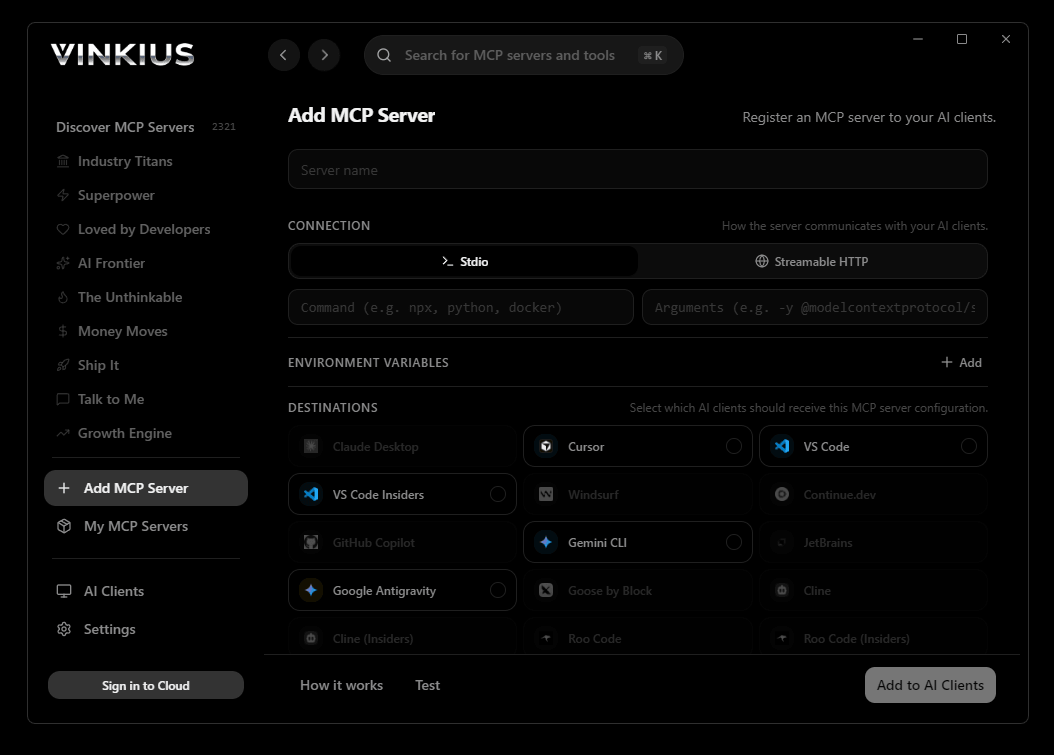
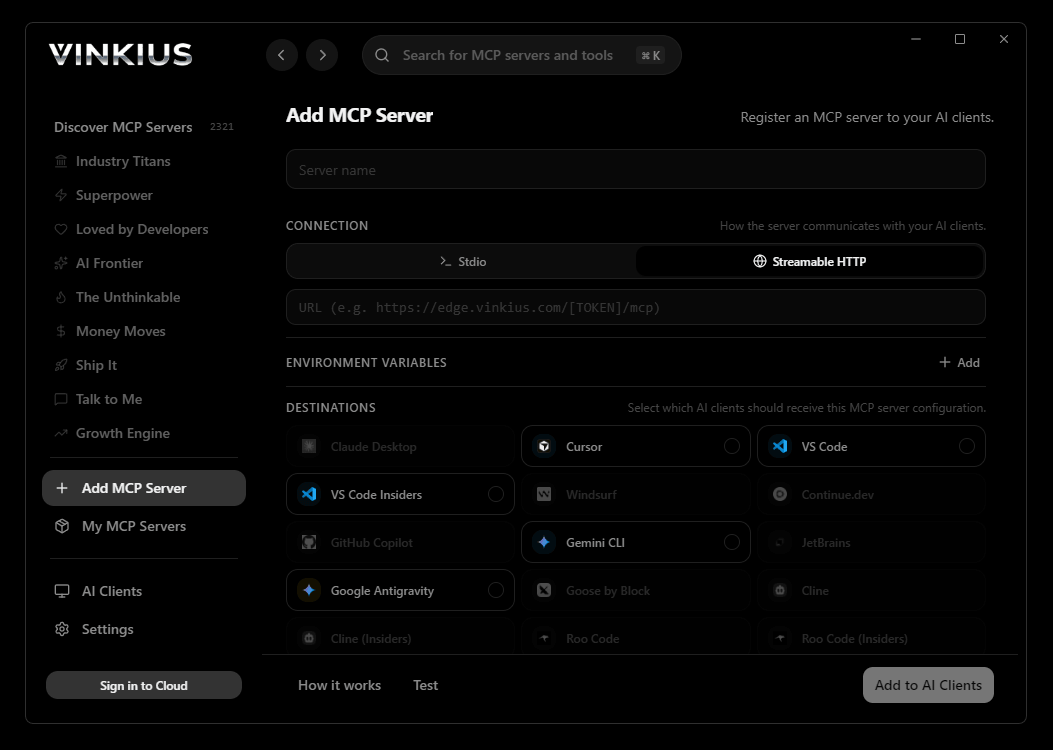
Vinkius Desktop App
The modern way to manage MCP Servers — no config files, no terminal commands. Install Solcast Solar and 2,500+ MCP Servers from a single visual interface.

{
  "mcpServers": {
    "solcast-solar": {
      "url": "https://edge.vinkius.com/[YOUR_TOKEN_HERE]/mcp"
    }
  }
}
* Every MCP server runs on Vinkius-managed infrastructure inside AWS - a purpose-built runtime with per-request V8 isolates, Ed25519 signed audit chains, and sub-40ms cold starts optimized for native MCP execution. See our infrastructure
About Solcast Solar MCP Server
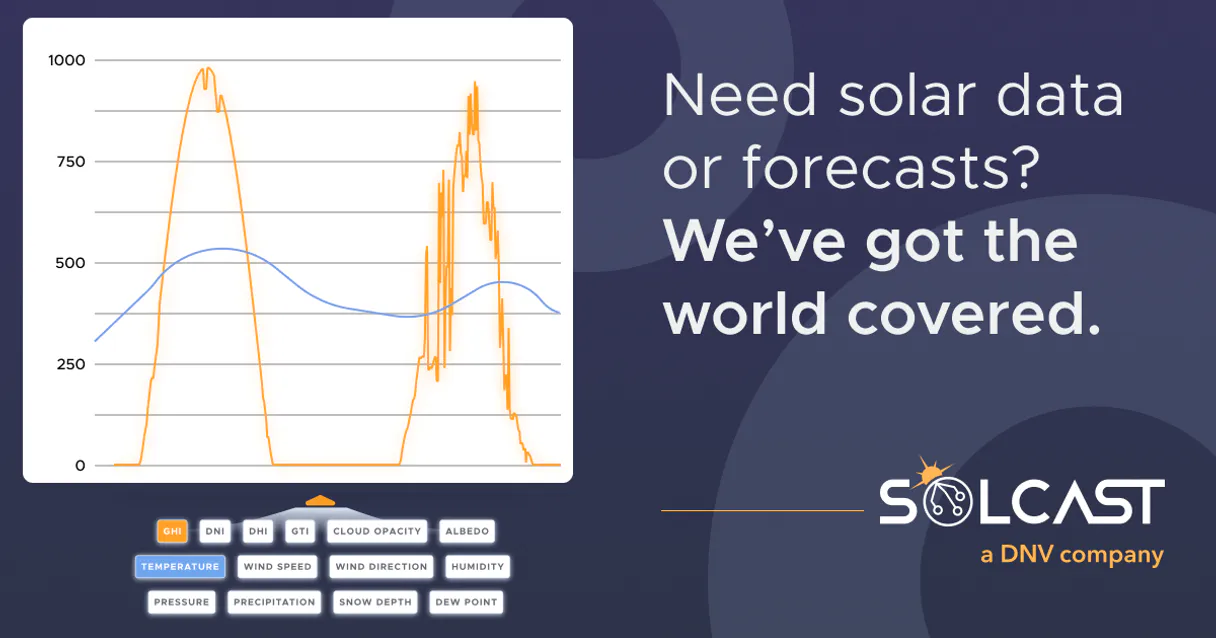
Connect to Solcast API and bring high-resolution solar forecasting intelligence to any AI agent. Access rooftop PV power forecasts, solar irradiance data (GHI, DNI, DHI), and weather conditions derived from satellite cloud tracking worldwide.
GitHub Copilot Agent mode brings Solcast Solar data directly into your VS Code workflow. With a project-scoped config, the entire team shares access to 11 tools — Copilot queries live data, generates typed code, and writes tests from actual API responses, all without leaving the editor.
What you can do
- Rooftop PV Forecasts — Get PV power output forecasts (kW) for any rooftop solar system from present up to 14 days ahead
- Detailed PV Modeling — Forecast with exact system parameters (tilt, azimuth, capacity, loss factor) for maximum accuracy
- Solar Irradiance — Access GHI (Global Horizontal Irradiance), DNI (Direct Normal Irradiance), and DHI (Diffuse Horizontal Irradiance)
- Historical Radiation — Retrieve historical solar irradiance data for model validation and analysis
- Weather Forecasts — Get air temperature, cloud opacity, and snow depth data affecting solar production
- Site Management — List registered rooftop sites, get forecasts, estimated actuals, and measured production
- Quick Estimates — Get fast solar forecasts with minimal parameters (lat, lon, capacity only)
- Comprehensive Solar Summary — Combine irradiance, weather, and PV data in a single overview
The Solcast Solar MCP Server exposes 11 tools through the Vinkius. Connect it to VS Code Copilot in under two minutes — no API keys to rotate, no infrastructure to provision, no vendor lock-in. Your configuration, your data, your control.
How to Connect Solcast Solar to VS Code Copilot via MCP
Follow these steps to integrate the Solcast Solar MCP Server with VS Code Copilot.
Create MCP config
Create a .vscode/mcp.json file in your project root
Add the server config
Paste the JSON configuration above
Enable Agent mode
Open GitHub Copilot Chat and switch to Agent mode using the dropdown
Start using Solcast Solar
Ask Copilot: "Using Solcast Solar, help me..." — 11 tools available
Why Use VS Code Copilot with the Solcast Solar MCP Server
GitHub Copilot for Visual Studio Code provides unique advantages when paired with Solcast Solar through the Model Context Protocol.
VS Code is used by over 70% of developers — adding MCP tools to Copilot means your team can leverage external data without leaving their primary editor
Project-scoped MCP configs (`.vscode/mcp.json`) let you commit server configurations to your repository, ensuring the entire team shares the same tool access
Copilot's Agent mode integrates MCP tools seamlessly with file editing, terminal commands, and workspace search in a single agentic loop
GitHub's enterprise compliance and audit features extend to MCP tool usage, providing visibility into how AI interacts with external services
Solcast Solar + VS Code Copilot Use Cases
Practical scenarios where VS Code Copilot combined with the Solcast Solar MCP Server delivers measurable value.
Live API integration: Copilot can query an MCP server, inspect the response schema, and generate typed API client code in the same step
DevSecOps workflows: security teams can give developers access to domain intelligence tools directly in their editor for real-time vulnerability assessment during code review
Data pipeline development: Copilot fetches sample data via MCP and generates transformation scripts, validators, and test fixtures from actual API responses
Documentation generation: Copilot queries available tools and auto-generates README sections, API reference docs, and usage examples
Solcast Solar MCP Tools for VS Code Copilot (11)
These 11 tools become available when you connect Solcast Solar to VS Code Copilot via MCP:
get_detailed_pv_forecast
Use when you know your system's exact configuration for maximum forecast accuracy. USE WHEN: - User knows exact panel tilt and azimuth angles - User needs highly accurate forecasts for a specific system - User has detailed PV system specifications - User asks for precise solar output estimates PARAMETERS: - latitude (REQUIRED): Location latitude - longitude (REQUIRED): Location longitude - capacity (REQUIRED): System capacity in kW - tilt (REQUIRED): Panel tilt angle in degrees - azimuth (REQUIRED): Panel azimuth in degrees - loss_factor (OPTIONAL): System loss factor (0-1, default: 0.9) EXAMPLES: - "Detailed forecast for 6kW system, tilt 30°, azimuth 0° (north facing)" → call with latitude, longitude, capacity=6, tilt=30, azimuth=0 - "Precise PV estimate for my 8kW array at 25° tilt, 180° azimuth (south)" → call with capacity=8, tilt=25, azimuth=180 Get detailed PV power forecast with full system specifications
get_historical_radiation
Requires Pro/Enterprise plan for full historical access. USE WHEN: - User asks about historical solar radiation data - User needs past solar irradiance values for analysis - User wants to validate solar models with historical data - User asks "what was the solar irradiance last week" PARAMETERS: - latitude (REQUIRED): Location latitude - longitude (REQUIRED): Location longitude - start (REQUIRED): Start date/time (ISO 8601 format) - end (OPTIONAL): End date/time (ISO 8601 format) EXAMPLES: - "Historical solar radiation for Sydney last week" → call with latitude=-33.87, longitude=151.21, start="2026-03-31" - "GHI data for my location for March 2026" → call with latitude, longitude, start="2026-03-01", end="2026-03-31" Get historical solar irradiance data for a location
get_pv_power_forecasts
Forecasts are derived from satellite cloud tracking and irradiance data. USE WHEN: - User asks about solar power generation forecasts - User needs PV output estimates for a specific location - User wants to know expected solar energy production - User asks "how much solar power will my panels generate" PARAMETERS: - latitude (REQUIRED): Location latitude (-90 to 90) - longitude (REQUIRED): Location longitude (-180 to 180) - capacity (REQUIRED): System capacity in kW (DC rating) - tilt (OPTIONAL): Panel tilt angle in degrees (0=flat, 90=vertical) - azimuth (OPTIONAL): Panel azimuth in degrees (0=north, 180=south) - hours (OPTIONAL): Number of hours to forecast (default: 48, max: 336 for 14 days) EXAMPLES: - "Solar forecast for my 5kW system in Sydney -33.87, 151.21" → call with latitude=-33.87, longitude=151.21, capacity=5 - "PV forecast for 10kW rooftop in LA 34.05, -118.24" → call with latitude=34.05, longitude=-118.24, capacity=10 - "How much solar will my 3kW system generate tomorrow?" → call with latitude, longitude, capacity=3, hours=24 Get rooftop PV power forecasts for a location
get_radiation_forecasts
Essential for solar resource assessment. USE WHEN: - User asks about solar irradiance or solar radiation - User needs GHI, DNI, or DHI data for solar analysis - User is evaluating solar potential for a location - User asks "how much sunlight will there be" PARAMETERS: - latitude (REQUIRED): Location latitude - longitude (REQUIRED): Location longitude - hours (OPTIONAL): Number of hours to forecast (default: 48) EXAMPLES: - "Solar irradiance forecast for Sydney -33.87, 151.21" → call with latitude=-33.87, longitude=151.21 - "GHI and DNI forecast for my location 34.05, -118.24" → call with latitude=34.05, longitude=-118.24 - "How much solar radiation tomorrow?" → call with latitude, longitude, hours=24 Get solar irradiance forecasts (GHI, DNI, DHI) for a location
get_simple_pv_forecast
The API auto-estimates tilt and azimuth for reasonable default values. Perfect for quick estimates. USE WHEN: - User wants a quick solar estimate without exact system details - User doesn't know their panel tilt or azimuth - User needs a fast solar output estimate - User asks "roughly how much solar will I generate" PARAMETERS: - latitude (REQUIRED): Location latitude - longitude (REQUIRED): Location longitude - capacity (REQUIRED): System capacity in kW EXAMPLES: - "Quick solar estimate for -33.87, 151.21 with 5kW" → call with latitude=-33.87, longitude=151.21, capacity=5 - "Rough estimate for my 3kW system in LA" → call with latitude=34.05, longitude=-118.24, capacity=3 - "How much solar for a 10kW system here?" → call with latitude, longitude, capacity=10 Get quick PV power forecast with minimal parameters
get_site_estimated_actuals
Shows what your system likely produced recently. USE WHEN: - User wants to know what their solar system actually generated - User needs recent production estimates vs forecasts - User is analyzing system performance - User asks "how much did my solar panels actually produce" PARAMETERS: - site_id (REQUIRED): The site ID from your Solcast account - hours (OPTIONAL): Number of hours of historical data (default: 24) EXAMPLES: - "Estimated actuals for site abc-123 last 24 hours" → call with site_id="abc-123" - "What did my system produce yesterday?" → call with site_id="abc-123", hours=48 - "Recent solar production for my site" → call with site_id="your-site-id" Get estimated actual PV power output for a registered rooftop site
get_site_forecasts
Uses the site's configured parameters (capacity, tilt, azimuth) for accurate forecasts. USE WHEN: - User asks about forecasts for a specific registered site - User has a site ID and wants forecasts for that system - User needs predictions for a known rooftop installation - User asks "what will my registered solar site generate" PARAMETERS: - site_id (REQUIRED): The site ID from your Solcast account EXAMPLES: - "Forecast for site abc-123" → call with site_id="abc-123" - "What will my registered system def-456 generate?" → call with site_id="def-456" - "Solar forecast for my home system" → call with site_id="your-site-id" Get PV power forecasts for a specific registered rooftop site
get_site_measured_actuals
Requires the site to have real measurement integration. Shows exact production data. USE WHEN: - User has telemetry-enabled sites with real measurements - User needs exact measured production data (not estimates) - User is validating forecast accuracy - User asks "what was the exact measured output from my system" PARAMETERS: - site_id (REQUIRED): The site ID with telemetry enabled - hours (OPTIONAL): Number of hours of historical data EXAMPLES: - "Measured actuals for telemetry site xyz-789" → call with site_id="xyz-789" - "Exact production from my monitored system" → call with site_id="your-telemetry-site-id" - "Real production data last week" → call with site_id="xyz-789", hours=168 Get measured PV power output from a registered rooftop site with telemetry
get_solar_summary
Provides a complete picture of solar resources. USE WHEN: - User wants a complete solar overview for a location - User needs both irradiance and PV forecasts together - User asks for a solar resource assessment - User wants "complete solar data for my area" PARAMETERS: - latitude (REQUIRED): Location latitude - longitude (REQUIRED): Location longitude - capacity (OPTIONAL): System capacity in kW (for PV estimates) EXAMPLES: - "Complete solar summary for Sydney -33.87, 151.21" → call with latitude=-33.87, longitude=151.21 - "Solar resource assessment for my location 34.05, -118.24" → call with latitude=34.05, longitude=-118.24 - "Full solar data with 5kW system estimate" → call with latitude, longitude, capacity=5 Get a comprehensive solar summary including irradiance, weather, and PV forecasts
get_weather_forecasts
Useful for understanding conditions affecting solar output. USE WHEN: - User asks about weather conditions affecting solar panels - User needs temperature or cloud cover forecasts - User wants to understand weather impact on solar generation - User asks "what's the weather forecast for solar" PARAMETERS: - latitude (REQUIRED): Location latitude - longitude (REQUIRED): Location longitude - hours (OPTIONAL): Number of hours to forecast EXAMPLES: - "Weather forecast for solar panels in Sydney -33.87, 151.21" → call with latitude=-33.87, longitude=151.21 - "Cloud cover forecast for my location 34.05, -118.24" → call with latitude=34.05, longitude=-118.24 - "Temperature forecast for next week" → call with latitude, longitude, hours=168 Get weather forecasts including temperature, cloud opacity, and snow depth
list_rooftop_sites
Shows site IDs, capacities, and locations for managing multiple solar installations. USE WHEN: - User wants to see all their registered solar sites - User needs to find site IDs for other queries - User is managing multiple rooftop installations - User asks "what solar sites do I have configured" EXAMPLES: - "List all my solar sites" → call with no params - "Show my registered rooftop PV systems" → call with no params - "What sites do I have in Solcast?" → call with no params List all configured rooftop PV sites in your Solcast account
Example Prompts for Solcast Solar in VS Code Copilot
Ready-to-use prompts you can give your VS Code Copilot agent to start working with Solcast Solar immediately.
"What is the solar forecast for my 5kW rooftop system in Sydney at -33.87, 151.21?"
"Show me the solar irradiance (GHI and DNI) forecast for my location at 34.05, -118.24."
"How much solar energy will a 10kW system with south-facing panels (azimuth 180°, tilt 30°) generate tomorrow at latitude -37.81, longitude 144.96?"
Troubleshooting Solcast Solar MCP Server with VS Code Copilot
Common issues when connecting Solcast Solar to VS Code Copilot through the Vinkius, and how to resolve them.
MCP tools not available
Solcast Solar + VS Code Copilot FAQ
Common questions about integrating Solcast Solar MCP Server with VS Code Copilot.
Which VS Code version supports MCP?
How do I switch to Agent mode?
Can I restrict which MCP tools Copilot can access?
Does MCP work in VS Code Remote or Codespaces?
.vscode/mcp.json work in Remote SSH, WSL, and GitHub Codespaces environments. The MCP connection is established from the remote host, so ensure the server URL is accessible from that environment.Connect Solcast Solar with your favorite client
Step-by-step setup guides for every MCP-compatible client and framework:
Anthropic's native desktop app for Claude with built-in MCP support.
AI-first code editor with integrated LLM-powered coding assistance.
GitHub Copilot in VS Code with Agent mode and MCP support.
Purpose-built IDE for agentic AI coding workflows.
Autonomous AI coding agent that runs inside VS Code.
Anthropic's agentic CLI for terminal-first development.
Python SDK for building production-grade OpenAI agent workflows.
Google's framework for building production AI agents.
Type-safe agent development for Python with first-class MCP support.
TypeScript toolkit for building AI-powered web applications.
TypeScript-native agent framework for modern web stacks.
Python framework for orchestrating collaborative AI agent crews.
Leading Python framework for composable LLM applications.
Data-aware AI agent framework for structured and unstructured sources.
Microsoft's framework for multi-agent collaborative conversations.
Connect Solcast Solar to VS Code Copilot
Get your token, paste the configuration, and start using 11 tools in under 2 minutes. No API key management needed.