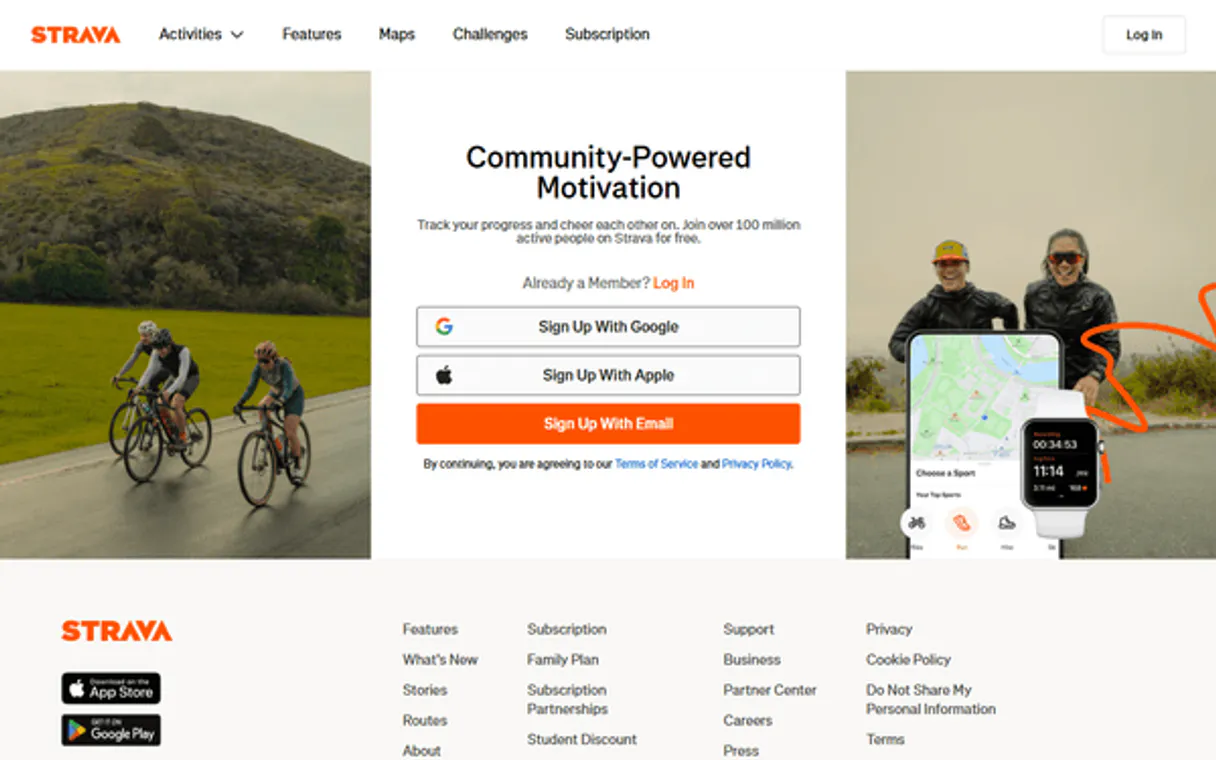
Strava Planning MCP. Manage your entire training data pipeline with AI.
Works with every AI agent you already use
…and any MCP-compatible client

Just plug in your AI agents and start using Vinkius.
Strava Planning gives your AI agent full control over your athletic training life cycle. Plan routes, export GPX/TCX files for any GPS device (Garmin, Wahoo), log non-tracked activities like gym sessions, and manage all gear mileage directly from your chat client.
It handles everything—from viewing elevation profiles with `get_route_streams` to updating your weight via `update_athlete`. Stop juggling apps; start training.
What your AI agents can do
Create activity
Logs manual activities—like gym workouts, yoga, or cross-training—that did not happen during a tracked Strava session.
Export route gpx
Gets the URL to export a selected Strava route as a GPX file for use with GPS navigation devices like Garmin or Wahoo.
Export route tcx
Gets the URL to export a selected Strava route in TCX format, which includes extra training metadata useful for specific fitness platforms.
The agent retrieves route data, provides elevation profiles via get_route_streams, and exports the finished track as GPX or TCX files for your physical GPS device.
You can create manual activity records using create_activity even if you trained indoors, at a gym, or in the pool and didn't use Strava during the session.
The agent lets you check and update critical profile data, like your current weight (update_athlete), which keeps performance ratios accurate for analysis.
You can check the mileage and details of specific equipment (bikes, shoes) using get_gear to plan maintenance or rotation.
Upload raw FIT, TCX, or GPX files via upload_activity, then check the progress and completion status with get_upload_status.
Ask AI about this MCP
Supported MCP Clients
Waiting for input…
Strava Planning: 14 Tools for Training Data Management
Use these tools to manage every aspect of athletic data—from logging workouts and tracking gear mileage to exporting structured routes.
019d760dcreate activity
Logs manual activities—like gym workouts, yoga, or cross-training—that did not happen during a tracked Strava session.
019d760dexport route gpx
Gets the URL to export a selected Strava route as a GPX file for use with GPS navigation devices like Garmin or Wahoo.
019d760dexport route tcx
Gets the URL to export a selected Strava route in TCX format, which includes extra training metadata useful for specific fitness platforms.
019d760dget athlete
Retrieves your basic profile details and current equipment assignments from Strava.
019d760dget athlete zones
Gets your custom heart rate and power zones configured in Strava for specific training analysis.
019d760dget gear
Checks the current mileage, model details, and primary assignments for any piece of equipment (bike, shoes) you track on Strava.
019d760dget route
Fetches detailed information about a specific Strava route, including its distance, elevation, and description.
019d760dget route streams
Retrieves GPS coordinates, altitude profiles, and distance data for a route to analyze the terrain before training.
019d760dget upload status
Checks if Strava has finished processing an activity file you previously uploaded by providing a status message (ready or still processing).
019d760dlist routes
Lists all saved routes associated with your account, showing distance, elevation gain, and type.
019d760dstar segment
Marks a specific segment on a route as a favorite (or unfavorite) for quick access during training.
019d760dupdate activity
Edits an existing Strava activity, allowing you to change the name, description, assign gear, or mark it as indoor/commute.
019d760dupdate athlete
Updates your profile information on Strava, primarily supporting changes to weight (in kg) for accurate ratio calculations.
019d760dupload activity
Starts the process of sending a raw activity file (FIT, TCX, GPX) to Strava for processing and returns an ID for status checking.
Choose How to Get Started
Build a custom MCP for your own tools, or connect a ready-made integration from our catalog.
Build Your Own
Turn any API into an MCP. Import a spec, define Agent Skills, or deploy with MCPFusion.
- Import from OpenAPI, Swagger, or YAML specs
- Create Agent Skills with progressive disclosure
- Deploy to edge with MCPFusion framework
- Built in DLP, auth, and compliance on every call
- Real time usage dashboard and cost metering
- Publish to catalog or keep private
Make Your AI Do More
Start with Strava Planning, then connect any of our 4,700+ other servers whenever your AI needs more. One click, no limits.
- Use this MCP plus 4,700+ others, all in one place
- Add new capabilities to your AI anytime you want
- Every connection is secured and compliant automatically
- Track usage and costs across all your servers
- Works with Claude, ChatGPT, Cursor, and more
- New servers added to the catalog every week
What you can do with this MCP connector
Look, you don't need to jump between half a dozen apps just to plan and log your run. Strava Planning gives your AI client total control over your whole athletic life cycle. You can handle everything—from plotting out the perfect training day to logging those late-night gym sessions where you weren't even on a bike.
Planning & Exporting Your Routes
When you wanna map out a run, you start by seeing what's available. Running list_routes lets you see every saved route, showing the distance and elevation gain for each one. If you want deep details on a specific track, running get_route pulls up all that info, including the description.
Before you hit the road, you gotta check the terrain. You'll use get_route_streams to pull GPS coordinates and altitude profiles; this lets your agent analyze the whole climb before you even step out the door. Once you've picked a route, remember you can mark key parts of it as favorites (or un-favorite them) using star_segment.
When it’s time for your physical GPS device—like a Garmin or Wahoo—you need the right file format. You just ask the agent to export it: run export_route_gpx for the standard GPX file, or use export_route_tcx if you know that specific training metadata will help another platform process it better.
Logging Every Activity
Strava isn't just about GPS tracking. You can log workouts that happen somewhere else—like a deep stretch session at the gym, pool laps, or yoga class—by running create_activity. These manual records let you keep your training log accurate even when Strava didn’t track it.
If you got raw activity files (FIT, TCX, GPX) from somewhere else, don't sweat it. You send 'em over first using upload_activity, and the system gives you an ID to check on. Then, if you wanna know if Strava finished processing that file, just run get_upload_status with that ID.
Got a record already in Strava that needs tweaking? You can use update_activity to change things after the fact—you can adjust the name, write a better description, assign specific gear to it, or flag it as an indoor workout.
Managing Your Profile and Gear
Keeping your data clean is huge for accurate analysis. The agent handles your profile details with get_athlete, letting you view basic stats and what equipment's assigned to you. You can keep those numbers current by running update_athlete to change things like your weight in kilograms, which keeps all your performance ratios right.
For training specificity, the system pulls up your custom heart rate and power zones using get_athlete_zones. When it comes to gear—whether it's a bike or a pair of shoes—you check its current status and mileage with get_gear to plan maintenance cycles. It’s got you covered.
How Strava Planning MCP Works
- 1 First, subscribe to the Strava Planning server and provide your Strava Access Token (OAuth2).
- 2 Second, tell your AI agent what you need—for example: 'Find all my routes over 50km' or 'Log a 60-minute swim'.
- 3 Third, the agent uses the appropriate tool (
list_routes,create_activity, etc.) and executes the action using your connected Strava account.
The bottom line is: you give your AI client access to your Strava data, and it handles all the complex API calls needed to manage your training logs.
Who Is Strava Planning MCP For?
This server is built for serious athletes and fitness professionals who need centralized control over their performance data. If you're tired of logging into Strava, then opening a separate GPS app, and manually updating spreadsheets, this handles the whole pipeline. It’s for people whose training schedule depends on accurate historical records.
Uses get_route to review long-distance race profiles and then uses export_route_gpx to load the final course onto a dedicated navigation watch.
Employs create_activity to manually log rehabilitation or cross-training sessions (like physical therapy walks) that aren't tracked by standard gear.
Retrieves historical data using list_routes and then calls get_athlete_zones to pull structured metrics for analysis in a spreadsheet or model.
What Changes When You Connect
- Plan workouts precisely. Instead of just seeing a route name, use
get_route_streamsto preview the exact elevation profile and terrain difficulty before you even leave the house. - Never lose an activity record. Use
create_activityto log those crucial gym or cross-training sessions that don't happen on the bike. They count toward your stats. - Keep records clean with
update_activity. If you forget to assign your race shoes to a specific workout, use this tool to fix it later and keep your data accurate. - Manage hardware performance easily. Check your gear status using
get_gearso you know exactly when those cycling shoes are nearing the mileage limit for rotation. - Streamline transfers. Get standardized GPX or TCX files using
export_route_gpx/export_route_tcx. This works with every major GPS device, period.
Real-World Use Cases
The Race Week Prep
A coach wants to build a race simulation. They ask their agent to list_routes for all past long rides. The agent compiles the top three, then uses get_route_streams on each one so the coach can review the exact elevation gain and identify which profile is best for training.
The Non-Cyclist Training Day
An athlete has a day off from cycling but does a 90-minute swim. They ask their agent to log it, so the agent uses create_activity with 'Swim' as the type and logs the session details, keeping all activities visible in one place.
The Data Audit
A data analyst needs to verify performance metrics. They instruct their agent to first use update_athlete to ensure the most current weight is recorded, then call get_athlete_zones to pull the latest power/heart rate thresholds for comparison.
The Race Day Export
An athlete has a race route stored in Strava. They ask their agent to export it as GPX. The agent uses export_route_gpx and provides the direct download link, ready for loading onto their Wahoo unit.
The Tradeoffs
Treating Strava like a simple calendar.
Just manually adding 'Gym Session' to your notes. This loses vital data about duration, type, and if you used specific gear for that workout.
→
Use create_activity instead. You specify the activity name, type ('Workout'), start date, and total elapsed time (in seconds). It logs it correctly in Strava's database.
Relying on screenshots for data.
Taking a screenshot of your route profile to remember the elevation gain or distance. Screenshots are useless for calculations and cannot be exported.
→
Use get_route or get_route_streams. These tools pull the raw, structured numbers you need—distance, elevation, etc.—which you can use in formulas.
Assuming all data is instantly available.
Uploading a large activity file and expecting Strava to process it immediately. The API will fail or give bad data because the upload hasn't finished processing.
→
First, use upload_activity to start the transfer. Then, you must poll the status using get_upload_status until it confirms 'Your activity is ready'.
When It Fits, When It Doesn't
Use Strava Planning if your goal involves managing structured athletic data that originated or must sync with Strava (routes, activities, gear). This includes planning workouts (list_routes), logging non-Strava events (create_activity), and exporting for physical devices (export_route_gpx). Don't use this if you just need to manage general fitness notes—there are better note-taking apps. Also, don't rely on it as a primary source of truth for all your metrics; always cross-reference critical numbers (like race results) with the official platform data.
It’s perfect when you need interoperability: getting structured data out in GPX/TCX format, or pulling clean metrics like get_athlete_zones to feed into a calculation. You won't use it if your core task is basic text drafting or general productivity—that's for a messaging tool. But if the task is 'Manage my training data,' this is the spot.
Independent Platform Disclaimer: Vinkius is an independent platform and is not affiliated with, endorsed by, sponsored by, verified by, or otherwise authorized by Strava Planning. All third-party trademarks, logos, and brand names are the property of their respective owners. Their use on this website is strictly for informational purposes to identify service compatibility and interoperability.
VINKIUS INFRASTRUCTURE
Cloud Hosted
Managed infra
V8 Isolated
Sandboxed per request
Zero-Trust Proxy
No stored credentials
DLP Enforced
Policy on every call
GDPR Compliant
EU data residency
Token Compression
~60% cost reduction
Works with Claude, ChatGPT, Cursor, and more
The Model Context Protocol standardizes how applications expose capabilities to LLMs. Instead of operating in isolation, your AI gains direct access to external platforms, live data, and real-world actions through secure, standardized connections.
This server provides 14 capabilities that interface natively with Claude, ChatGPT, Cursor, and any MCP client. No middleware. No custom integration required.
Available Capabilities
Manual workout planning means jumping between apps and exporting files.
Right now, planning a complex multi-sport workout feels like a job for an intern. You download the route from one place, check the elevation on another app, manually calculate the projected time in a spreadsheet, then convert that data into a format your GPS watch will accept. It's clicking, downloading, and copy-pasting across four or five different screens.
With this MCP server, you ask your agent to plan it all out. You tell it the goal, and the agent uses tools like `list_routes` and `get_route_streams` to pull the raw data instantly. You get a single, actionable output that's ready for export or review—no more switching tabs.
Strava Planning MCP Server: Exporting your structured training data.
The most tedious part is getting the data into a format another system can use. If you just save the route on Strava, it's locked in that web view. You can’t take it to your friend's specialized mapping software or load it onto a custom training rig without manual conversion.
This server solves that by providing direct export tools. Using `export_route_gpx` and `export_route_tcx`, you get industry-standard files immediately. It's not just viewing the data; it's taking control of its physical movement.
Common Questions About Strava Planning MCP
How do I export a route for my Garmin using Strava Planning? +
You use the export_route_gpx tool. You just need to provide the specific route ID, and the server returns the direct download URL for the GPX file. This is what you load onto your Garmin device.
Can I log a pool workout with create_activity? +
Yes. Use create_activity. You specify 'Swim' as the type, enter the start date, and provide an estimate for elapsed time. This logs it accurately even though Strava didn't track it.
What is the difference between get_route and list_routes? +
list_routes shows you a summary of all saved routes (name, distance, type). You use get_route when you need deep details about one specific route, like its full description or detailed segment breakdown.
I uploaded my run file; how do I know if it processed? +
You check the status using get_upload_status. You call this tool periodically after running upload_activity until the status message confirms that your activity is ready.
When should I use `update_athlete`? Does it require a specific format? +
You must run update_athlete whenever your weight changes. This keeps the data accurate for calculating power-to-weight ratios and other performance metrics.
What file formats are supported when I call `upload_activity`? Is there a preference? +
We support FIT, TCX, GPX, and their compressed versions (.gz). Any of these files will initiate the upload process for processing by Strava.
Can `get_route_streams` provide elevation data? How does it work? +
Yes, calling get_route_streams allows you to get GPS coordinates, altitude, and distance. This lets you review the exact terrain profile for a planned route.
How do I use `get_gear` beyond just checking current mileage? +
You check the model, mileage, and assigned gear details returned here. Use this information to schedule maintenance or plan equipment rotation cycles.
How do I export a route to my GPS device? +
First, use list_routes to find your route ID. Then use export_route_gpx or export_route_tcx with that route ID. The GPX file can be downloaded and loaded onto Garmin, Wahoo, or other GPS devices for turn-by-turn navigation during your workout.
Can I log activities that Strava doesn't automatically track? +
Yes! Use create_activity to manually log any workout — gym sessions, yoga, swimming, hiking, cross-training. Provide the name, type (e.g., "Workout", "Yoga", "Swim"), start date, elapsed time, and optionally distance and description. This keeps all your training in one place.
How do I track my bike and shoe mileage? +
Use get_gear with the gear ID to see total accumulated distance. Gear IDs are found in your athlete profile or assigned to activities. You can assign gear to activities using update_activity with the gear_id parameter. Track mileage to know when to replace chains, tires, or running shoes.
Use it with your favorite AI tools
Connect this server to Cursor, Claude, VS Code, and more.
More in this category
Copy.ai
Equip your AI agent to automate content production and business processes using Copy.ai Workflows.
Coda
Combine docs, spreadsheets, and apps into powerful all-in-one documents that grow with your team and automate routine work.
People Management Prover
A hiring plan listed 'culture fit' as the primary criterion. That's not a criterion — that's a bias proxy. People Management Prover forces job-related criteria, adverse impact analysis, and validated assessment methods grounded in I-O psychology.
You might also like
Okendo Reviews
Manage customer reviews and social proof via Okendo — track ratings, questions, and product feedback directly from your AI agent.
BulkSMS.com
Reach customers worldwide with reliable bulk SMS delivery, contact list management, and real-time message status tracking.
Hubilo
Manage virtual and hybrid events via Hubilo API.