
Supabase Vector MCP Server for VS Code Copilot 7 tools — connect in under 2 minutes
GitHub Copilot in VS Code is the most widely adopted AI coding assistant, embedded directly into the world's most popular code editor. With MCP support in Agent mode, Copilot can access external data and APIs to generate context-aware code grounded in real-time information.
ASK AI ABOUT THIS MCP SERVER
Vinkius supports streamable HTTP and SSE.
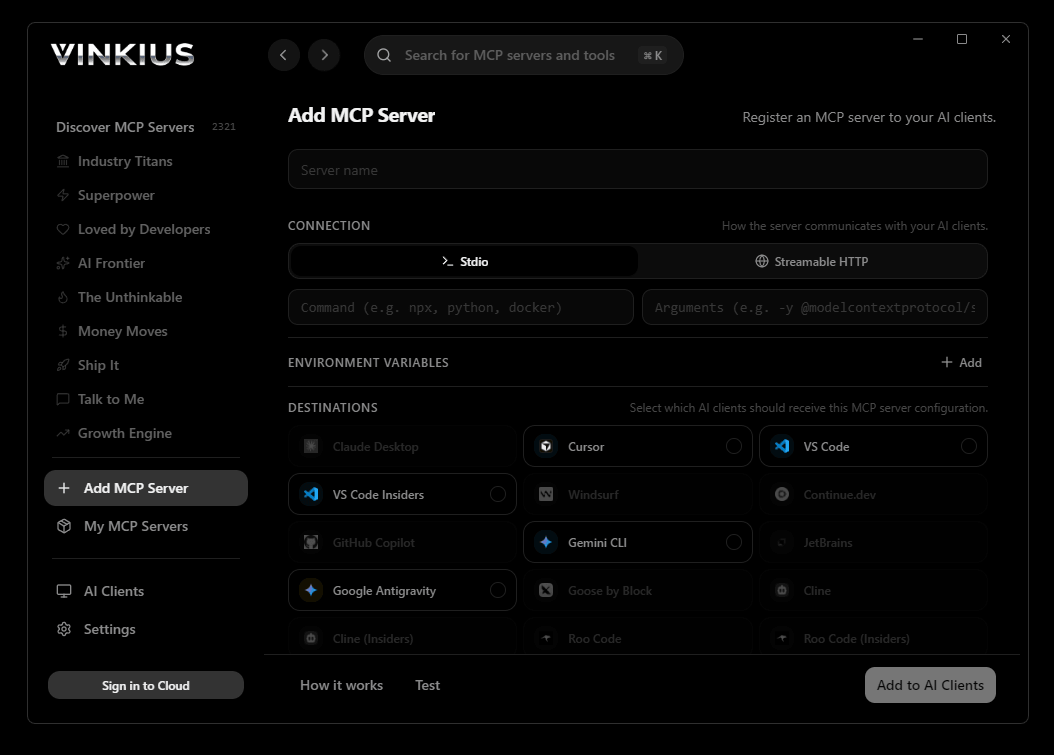
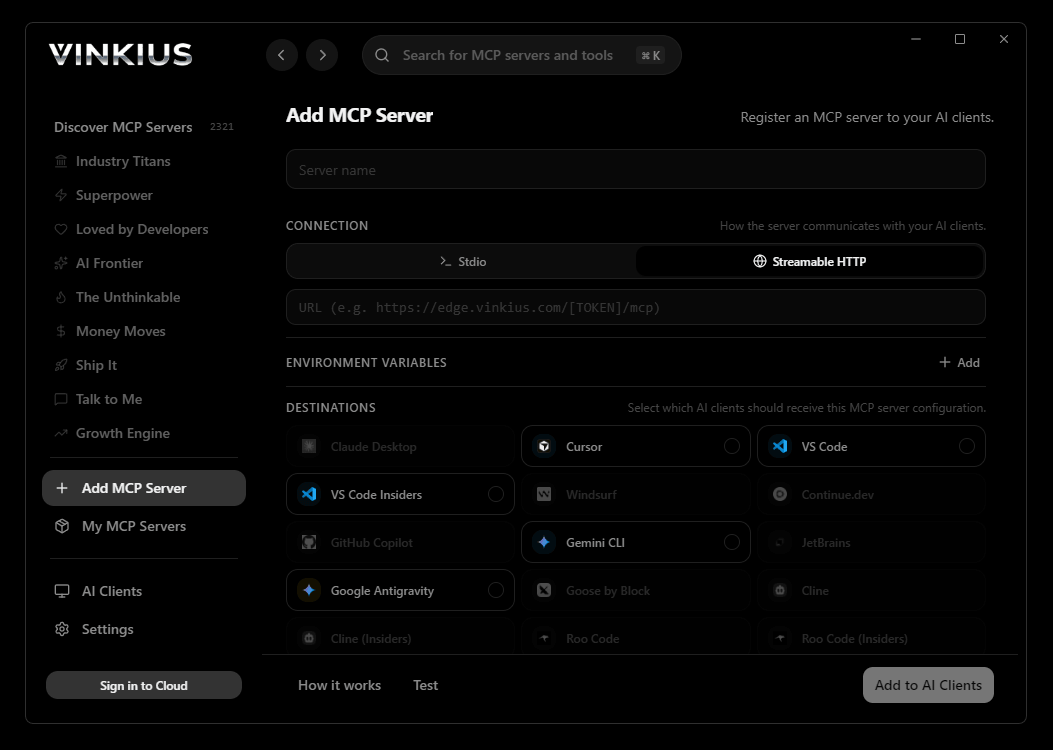
Vinkius Desktop App
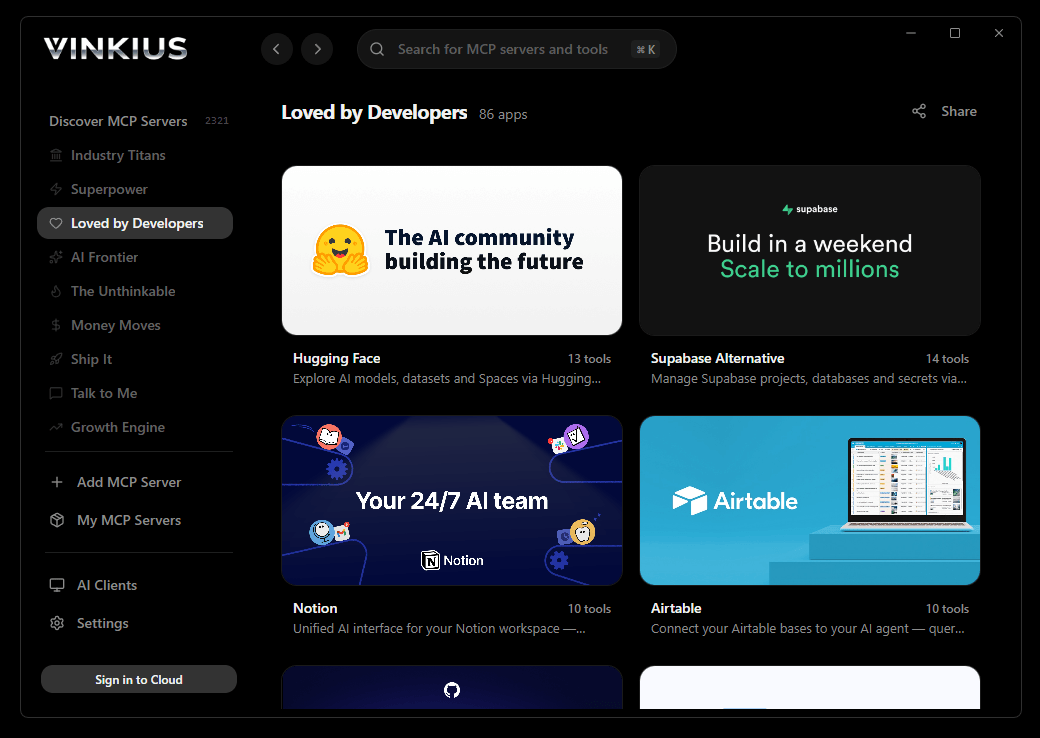
The modern way to manage MCP Servers — no config files, no terminal commands. Install Supabase Vector and 2,500+ MCP Servers from a single visual interface.

{
  "mcpServers": {
    "supabase-vector": {
      "url": "https://edge.vinkius.com/[YOUR_TOKEN_HERE]/mcp"
    }
  }
}
* Every MCP server runs on Vinkius-managed infrastructure inside AWS - a purpose-built runtime with per-request V8 isolates, Ed25519 signed audit chains, and sub-40ms cold starts optimized for native MCP execution. See our infrastructure
About Supabase Vector MCP Server
Integrate the powerful AI-native PostgreSQL extensions of Supabase Vector straight into your conversational LLM workflows. By authenticating your environment natively with the service_role key, your AI assistant bypasses row-level security constraints to operate as an unrestricted database administrator. Perform advanced similarity searches using the pgvector extension, parse and manipulate multi-dimensional embeddings, and execute foundational CRUD operations via simple natural language commands. Streamline RAG (Retrieval-Augmented Generation) setups and semantic engineering directly, avoiding the need for external dashboards or manual SQL querying.
GitHub Copilot Agent mode brings Supabase Vector data directly into your VS Code workflow. With a project-scoped config, the entire team shares access to 7 tools. Copilot queries live data, generates typed code, and writes tests from actual API responses, all without leaving the editor.
What you can do
- Semantic Vector Matching — Seamlessly query unstructured contextual similarities performing embedding comparisons by executing
match_vectorsutilizing custom postgres RPC parameters locally. - Database Structural Interaction — Systematically browse schema availability utilizing
list_tablesand extract specific data arrays effortlessly throughquery_table_rows. - Content State Manipulations — Seamlessly orchestrate data inputs invoking
insert_table_rowsor explicitly clear legacy assignments logically mapping identifiers withdelete_table_rows. - Custom Functional Logic — Launch sophisticated PL/pgSQL algorithms statically configured in your Supabase backend directly with
call_postgres_function.
The Supabase Vector MCP Server exposes 7 tools through the Vinkius. Connect it to VS Code Copilot in under two minutes — no API keys to rotate, no infrastructure to provision, no vendor lock-in. Your configuration, your data, your control.
How to Connect Supabase Vector to VS Code Copilot via MCP
Follow these steps to integrate the Supabase Vector MCP Server with VS Code Copilot.
Create MCP config
Create a .vscode/mcp.json file in your project root
Add the server config
Paste the JSON configuration above
Enable Agent mode
Open GitHub Copilot Chat and switch to Agent mode using the dropdown
Start using Supabase Vector
Ask Copilot: "Using Supabase Vector, help me...". 7 tools available
Why Use VS Code Copilot with the Supabase Vector MCP Server
GitHub Copilot for Visual Studio Code provides unique advantages when paired with Supabase Vector through the Model Context Protocol.
VS Code is used by over 70% of developers. adding MCP tools to Copilot means your team can leverage external data without leaving their primary editor
Project-scoped MCP configs (`.vscode/mcp.json`) let you commit server configurations to your repository, ensuring the entire team shares the same tool access
Copilot's Agent mode integrates MCP tools seamlessly with file editing, terminal commands, and workspace search in a single agentic loop
GitHub's enterprise compliance and audit features extend to MCP tool usage, providing visibility into how AI interacts with external services
Supabase Vector + VS Code Copilot Use Cases
Practical scenarios where VS Code Copilot combined with the Supabase Vector MCP Server delivers measurable value.
Live API integration: Copilot can query an MCP server, inspect the response schema, and generate typed API client code in the same step
DevSecOps workflows: security teams can give developers access to domain intelligence tools directly in their editor for real-time vulnerability assessment during code review
Data pipeline development: Copilot fetches sample data via MCP and generates transformation scripts, validators, and test fixtures from actual API responses
Documentation generation: Copilot queries available tools and auto-generates README sections, API reference docs, and usage examples
Supabase Vector MCP Tools for VS Code Copilot (7)
These 7 tools become available when you connect Supabase Vector to VS Code Copilot via MCP:
call_postgres_function
Calls a custom Postgres function (RPC) with parameters
delete_table_rows
This action is irreversible. Deletes rows from a table based on a column value
get_table_row
Retrieves a specific row by matching a column value
insert_table_rows
Provide a JSON array of row objects. Inserts new rows into a specific table
list_tables
Lists all tables in the Supabase project
match_vectors
Requires a valid RPC function name and an embedding array. Performs a vector similarity search via Postgres RPC
query_table_rows
Provide table name and optional select/limit. Queries rows from a specific table
Example Prompts for Supabase Vector in VS Code Copilot
Ready-to-use prompts you can give your VS Code Copilot agent to start working with Supabase Vector immediately.
"Using the 'match_docs' vector RPC natively, analyze my embedding representation returning seamlessly the top 5 matches."
"Browse my schema directly to identify active vector tables and delete any legacy testing embeddings from 'test_docs' securely."
"Insert a new embedding natively calling `insert_table_rows` with the corresponding context efficiently."
Troubleshooting Supabase Vector MCP Server with VS Code Copilot
Common issues when connecting Supabase Vector to VS Code Copilot through the Vinkius, and how to resolve them.
MCP tools not available
Supabase Vector + VS Code Copilot FAQ
Common questions about integrating Supabase Vector MCP Server with VS Code Copilot.
Which VS Code version supports MCP?
How do I switch to Agent mode?
Can I restrict which MCP tools Copilot can access?
Does MCP work in VS Code Remote or Codespaces?
.vscode/mcp.json work in Remote SSH, WSL, and GitHub Codespaces environments. The MCP connection is established from the remote host, so ensure the server URL is accessible from that environment.Connect Supabase Vector with your favorite client
Step-by-step setup guides for every MCP-compatible client and framework:
Anthropic's native desktop app for Claude with built-in MCP support.
AI-first code editor with integrated LLM-powered coding assistance.
GitHub Copilot in VS Code with Agent mode and MCP support.
Purpose-built IDE for agentic AI coding workflows.
Autonomous AI coding agent that runs inside VS Code.
Anthropic's agentic CLI for terminal-first development.
Python SDK for building production-grade OpenAI agent workflows.
Google's framework for building production AI agents.
Type-safe agent development for Python with first-class MCP support.
TypeScript toolkit for building AI-powered web applications.
TypeScript-native agent framework for modern web stacks.
Python framework for orchestrating collaborative AI agent crews.
Leading Python framework for composable LLM applications.
Data-aware AI agent framework for structured and unstructured sources.
Microsoft's framework for multi-agent collaborative conversations.
Connect Supabase Vector to VS Code Copilot
Get your token, paste the configuration, and start using 7 tools in under 2 minutes. No API key management needed.