
USDA FoodData Central Alternative MCP. Audit food records and nutrient data via natural conversation.
 Gemini
 Works with every AI agent you already use
…and any MCP-compatible client









Just plug in your AI agents and start using Vinkius.
USDA FoodData Central Alternative MCP Server lets your AI agent audit food records and nutrient data using public USDA sources.
Instead of querying technical databases, you ask natural language questions to pull detailed composition reports, discover specific nutrients, or compare multiple foods instantly.
The agent searches by keyword and returns detailed metadata, including FDC IDs, for thousands of food items.
You ask for a specific food's nutrient breakdown (like calories or vitamins) and get the full composition report.
The agent accepts a list of foods and provides side-by-side comparisons of their nutritional values.
You run deep searches using specialized survey data or foundation records for targeted food science research.
The agent scans the catalog and returns a list of all recognized nutrients, helping you pinpoint specific dietary markers.
Ask AI about this MCP
Supported MCP Clients
Gemini Waiting for input…
Choose How to Get Started
Build a custom MCP for your own tools, or connect a ready-made integration from our catalog.
Build Your Own
Turn any API into an MCP. Import a spec, define Agent Skills, or deploy with MCPFusion.
- Import from OpenAPI, Swagger, or YAML specs
- Create Agent Skills with progressive disclosure
- Deploy to edge with MCPFusion framework
- Built in DLP, auth, and compliance on every call
- Real time usage dashboard and cost metering
- Publish to catalog or keep private
Make Your AI Do More
Start with USDA FoodData Central Alternative, then connect any of our 4,700+ other servers whenever your AI needs more. One click, no limits.
- Use this MCP plus 4,700+ others, all in one place
- Add new capabilities to your AI anytime you want
- Every connection is secured and compliant automatically
- Track usage and costs across all your servers
- Works with Claude, ChatGPT, Cursor, and more
- New servers added to the catalog every week
What you can do with this MCP connector
This server connects your AI client to authoritative USDA food composition data, letting your agent run complex nutrient audits without you ever having to touch a messy technical database. You just ask natural language questions, and it pulls the details.
Search Food Items: This tool lets your AI agent search through keywords, instantly giving you detailed metadata—including FDC IDs—for thousands of different food items. Instead of manually cross-referencing codes, you get a solid list of options right away.
Retrieve Full Nutrient Profiles: When you need to know the full composition report for any specific food, your AI agent executes this tool. It pulls every nutrient breakdown you want—whether it's calories, mineral levels, or vitamin content—and presents it clearly.
Compare Multiple Foods: If you gotta compare nutritional values across different categories, the agent handles that side-by-side for ya. You give it a list of foods, and it generates a direct comparison report showing how they stack up against each other.
Query Specialized Records: For deep food science research, this tool lets you run specialized searches using foundation records or specific survey data sets. This isn't just surface-level querying; it’s for targeted, academic-grade investigation.
List Available Nutrients: You can scan the entire USDA catalog to generate a list of every recognized nutrient marker. If you need to pinpoint exactly which dietary components are tracked, this tool shows you what's available.
You don't gotta mess with proprietary databases or technical endpoints. Your agent just takes your prompt—like 'What's the protein content in apples versus almonds?'—and handles the whole data retrieval process using established public sources.
How USDA FoodData Central Alternative MCP Works
- 1 Subscribe to this server and enter your USDA API Key credentials.
- 2 Tell your AI client what data you need (e.g., 'Compare spinach and kale for Vitamin K').
- 3 Your agent runs the necessary tools, pulling structured food composition reports directly into your chat window.
The bottom line is: You talk to it like a person, and it handles all the complex database calls in the background.
Who Is USDA FoodData Central Alternative MCP For?
This is for people who spend too much time exporting data into spreadsheets. If your job involves verifying food facts or building health-tech apps, this saves hours of manual cross-referencing. It's built for rigorous data validation.
Uses the agent to monitor complex food composition and nutrient values directly from their workflow when advising patients.
Verifies detailed mineral, vitamin, or chemical profiles without having to manually export data from multiple government databases.
Automates food data querying for their health applications, ensuring the code uses accurate and up-to-date nutritional metrics.
What Changes When You Connect
- Stop manually compiling spreadsheets. With this server, you can list multiple foods and compare their nutritional values instantly using the
batch_discoverytool. It handles the cross-referencing for you. - Get immediate accuracy on dietary needs. Instead of guessing nutrient levels, use
nutrient_oversightto pull detailed composition reports for specific items per 100g. - Speed up research dramatically. The
food_auditingtool lets you search by keyword and get back crucial metadata (like FDC IDs) in a single prompt, skipping manual database navigation. - Target niche data points. Need to know every marker? Use the
metadata_discoverytool to list all available nutrients in the catalog—no searching through hundreds of PDFs needed. - Build better apps faster. App developers use this server's tools to automate food data queries, ensuring their health-tech projects are always fed accurate USDA metrics.
Real-World Use Cases
Creating a cross-dietary comparison
A nutritionist needs to compare the Vitamin C and calcium content of three different plant sources. Instead of pulling three separate reports, they ask their agent via batch_discovery to list all three foods. The agent immediately generates a side-by-side nutrient breakdown for easy review.
Verifying research data on specialized compounds
A food scientist is working on a specific foundation record that isn't in the main tables. They use composition_intelligence to query the specialized survey data, ensuring they maintain strict control over their foundational research and get targeted results.
Auditing ingredient lists from product photos
A health enthusiast takes a picture of packaged food ingredients. They use food_auditing to search for the main keywords, retrieving detailed metadata like FDC IDs and brand name potential matches, turning vague labels into structured data.
Building a comprehensive nutrient index
A developer needs to ensure their app tracks every possible dietary marker. They start by running metadata_discovery to list all available nutrients in the USDA catalog. This gives them the full scope of data they need to model.
The Tradeoffs
Searching for general topics
Asking the agent, 'What's good for my heart?' or 'How do I eat better?' The server can’t give life advice; it only reads data.
→
Instead, ask specific questions. Use nutrient_oversight to check the potassium levels of spinach per 100g. Keep it data-specific.
Assuming real-time pricing
Asking, 'How much does a box of granola cost at Walmart today?' This server uses historical and fixed USDA composition data, not current retail prices.
→
Only ask for nutritional details. Use nutrient_oversight to confirm the fat content per serving size.
Trying to combine unrelated datasets
Asking the agent to compare food data with local weather patterns or stock market trends. The server's scope is limited strictly to USDA-sourced composition records.
→
Focus the prompt on food and nutrition facts. Use batch_discovery only for comparing foods against each other.
When It Fits, When It Doesn't
Use this server if your workflow requires validating or auditing detailed, public food composition data—think nutrient profiles, vitamin levels, or mineral content. If you need to compare multiple items (using batch_discovery) or confirm specific chemical markers (using metadata_discovery), this is your tool.
Don't use it if you are dealing with private company supply chain data, current retail pricing, or dynamic, real-time global metrics. For those things, you need a different type of dedicated API connection. This server is purely for USDA-grade nutritional intelligence.
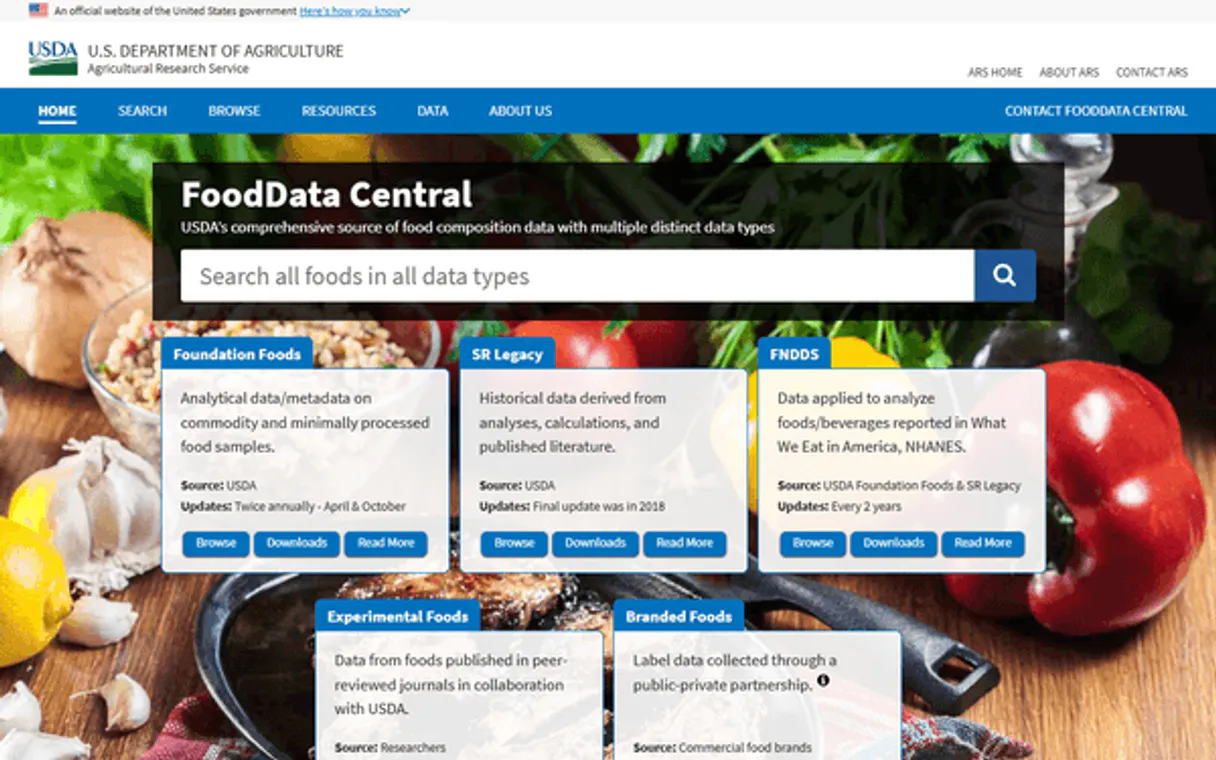
Independent Platform Disclaimer: Vinkius is an independent platform and is not affiliated with, endorsed by, sponsored by, verified by, or otherwise authorized by USDA FoodData Central. All third-party trademarks, logos, and brand names are the property of their respective owners. Their use on this website is strictly for informational purposes to identify service compatibility and interoperability.
VINKIUS INFRASTRUCTURE
Cloud Hosted
Managed infra
V8 Isolated
Sandboxed per request
Zero-Trust Proxy
No stored credentials
DLP Enforced
Policy on every call
GDPR Compliant
EU data residency
Token Compression
~60% cost reduction
Works with Claude, ChatGPT, Cursor, and more
The Model Context Protocol standardizes how applications expose capabilities to LLMs. Instead of operating in isolation, your AI gains direct access to external platforms, live data, and real-world actions through secure, standardized connections.
This server provides capabilities that interface natively with Claude, ChatGPT, Cursor, and any MCP client. No middleware. No custom integration required.
Manual food data research takes hours of cross-referencing spreadsheets.
Today's process means jumping between multiple databases, exporting raw CSV files, and then spending time cleaning up inconsistent nutrient naming conventions or figuring out which ID belongs to which brand. You spend the morning compiling what should be a simple report.
With this MCP server, you just ask your agent: 'Show me the Vitamin K profile for spinach vs. kale.' The system runs `batch_discovery`, and you get one clean, structured comparison instantly. No exporting, no cleaning up—just data.
USDA FoodData Central Alternative MCP Server: Get precise nutrient reports.
Manual checks often miss specialized markers or force you to check one food at a time. You're limited by the database export format, and you risk missing subtle differences in mineral content across brands.
Now, your agent uses `nutrient_oversight` on demand. It handles the complexity of querying specific foundation records for precise data points—like selenium or magnesium—in seconds. The level of detail is unmatched.
Common Questions About USDA FoodData Central Alternative MCP
How do I find my USDA API Key? +
Sign up at the USDA API portal, and you will receive your API Key via email. Copy and paste it below.
Can the agent search for branded food items? +
Yes. Use the search_foods tool and set the dataType to 'Branded'. Your agent will retrieve specific products from various manufacturers instantly.
Is it possible to retrieve a full nutritional breakdown? +
Yes. The get_food tool provides a comprehensive list of nutrients, including vitamins, minerals, and caloric data for any specific FDC ID.
What are the rate limits for using the USDA FoodData Central Alternative tool? +
The API enforces specific rate limits based on your subscription tier. If you exceed those quotas, the agent will return an explicit HTTP error code. Always check the official documentation for current usage guidelines.
How can I perform specialized queries using the USDA FoodData Central Alternative to find niche dietary markers? +
You first list all available nutrients in the catalog. This lets you filter results efficiently for specific minerals or vitamins outside of standard searches. It keeps your research focused.
What happens if I input an unrecognized FDC ID when using USDA FoodData Central Alternative? +
The agent returns a structured error code and the item's status immediately. This lets your workflow catch bad IDs instantly instead of failing silently, which is crucial for data pipelines.
Can I connect USDA FoodData Central Alternative to my internal database or other services? +
The tool outputs standardized JSON structures that are easy to ingest into any modern database. Remember, your client code handles the actual writing and storage of this retrieved data.
How efficiently does USDA FoodData Central Alternative handle batch discovery compared to single lookups? +
It processes multiple food items in a single request structure for comparison. This method is significantly faster than running individual queries, provided your list stays within the allowed item count.
Use it with your favorite AI tools
Connect this server to Cursor, Claude, VS Code, and more.
More in this category
FRED Series — U.S. Economic Time Series
Search and retrieve data from 816,000+ official U.S. economic time series: GDP, inflation, unemployment, interest rates, money supply — with built-in transformations, frequency aggregation, and vintage analysis.

Gobierno Abierto Valencia
Access Valencia's Open Data portal to query datasets, resources, and public records directly from your AI agent.

Eurostat Discovery — Dataset Catalog Explorer
Explore Eurostat's catalog of 7,000+ official datasets: search by keyword, inspect dataset dimensions and code lists, and query any dataset with flexible filters — the master key to all European Union statistics.
You might also like

Pixabay Alternative
Search and retrieve millions of royalty-free images and videos directly from Pixabay's massive creative library.

TAPD
Agile product development and collaboration platform by Tencent — manage stories, bugs, and iterations via AI.
Survalyzer
Manage professional surveys, panels, and distribution on Survalyzer with AI agents.