
Zuplo MCP Server for Cursor 10 tools — connect in under 2 minutes
Cursor is an AI-first code editor built on VS Code that integrates LLM-powered coding assistance directly into the development workflow. Its Agent mode enables autonomous multi-step coding tasks, and MCP support lets agents access external data sources and APIs during code generation.
ASK AI ABOUT THIS MCP SERVER
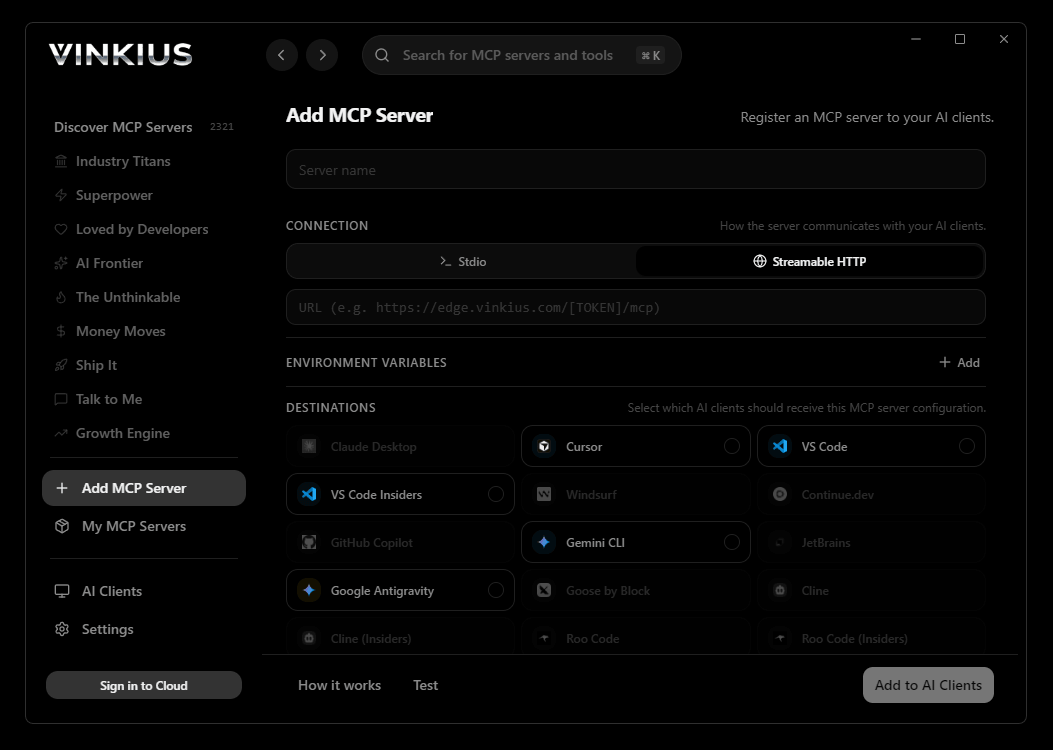
Vinkius supports streamable HTTP and SSE.
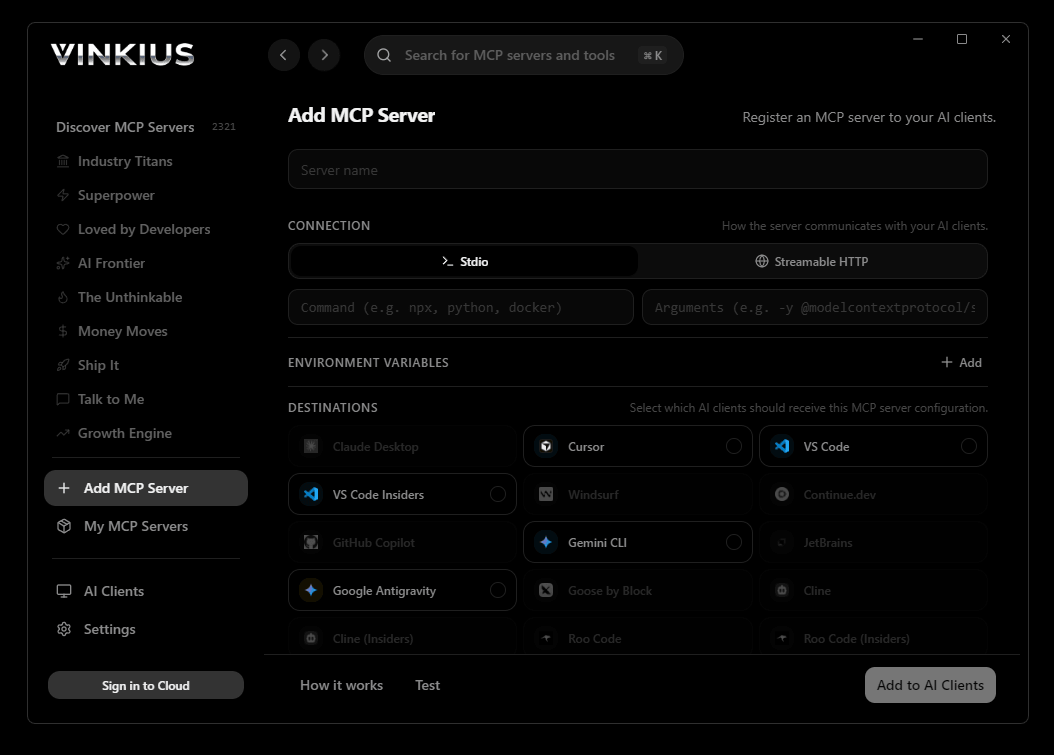
Vinkius Desktop App
The modern way to manage MCP Servers — no config files, no terminal commands. Install Zuplo and 2,500+ MCP Servers from a single visual interface.

{
  "mcpServers": {
    "zuplo": {
      "url": "https://edge.vinkius.com/[YOUR_TOKEN_HERE]/mcp"
    }
  }
}
* Every MCP server runs on Vinkius-managed infrastructure inside AWS - a purpose-built runtime with per-request V8 isolates, Ed25519 signed audit chains, and sub-40ms cold starts optimized for native MCP execution. See our infrastructure
About Zuplo MCP Server
Connect your Zuplo account to any AI agent and manage your programmable API infrastructure through natural conversation.
Cursor's Agent mode turns Zuplo into an in-editor superpower. Ask Cursor to generate code using live data from Zuplo and it fetches, processes, and writes — all in a single agentic loop. 10 tools appear alongside file editing and terminal access, creating a unified development environment grounded in real-time information.
What you can do
- Project Management — List all Zuplo projects and API gateways in your account to monitor your integration landscape
- Edge Deployments — Trigger new configuration deployments to the global edge network or audit previous deployment history
- Consumer Governance — Create, manage, and revoke API key consumers to control who has access to your gateway authentication
- Environment Auditing — List available project environments (e.g., working, production) and verify their current operational status
- DNS & Domains — Retrieve and manage configured custom DNS domains for each of your API projects directly from your agent
- Real-Time Metrics — Monitor gateway traffic, latency, and throughput metrics directly from Zuplo's edge analytics network
- Declarative Config — Browse and list the configuration files that define your gateway's routing and policy logic
The Zuplo MCP Server exposes 10 tools through the Vinkius. Connect it to Cursor in under two minutes — no API keys to rotate, no infrastructure to provision, no vendor lock-in. Your configuration, your data, your control.
How to Connect Zuplo to Cursor via MCP
Follow these steps to integrate the Zuplo MCP Server with Cursor.
Open MCP Settings
Press Cmd+Shift+P (macOS) or Ctrl+Shift+P (Windows/Linux) → search "MCP Settings"
Add the server config
Paste the JSON configuration above into the mcp.json file that opens
Save the file
Cursor will automatically detect the new MCP server
Start using Zuplo
Open Agent mode in chat and ask: "Using Zuplo, help me..." — 10 tools available
Why Use Cursor with the Zuplo MCP Server
Cursor AI Code Editor provides unique advantages when paired with Zuplo through the Model Context Protocol.
Agent mode turns Cursor into an autonomous coding assistant that can read files, run commands, and call MCP tools without switching context
Cursor's Composer feature can generate entire files using real-time data fetched through MCP — no copy-pasting from external dashboards
MCP tools appear alongside built-in tools like file reading and terminal access, creating a unified agentic environment
VS Code extension compatibility means your existing workflow, keybindings, and extensions all work alongside MCP tools
Zuplo + Cursor Use Cases
Practical scenarios where Cursor combined with the Zuplo MCP Server delivers measurable value.
Code generation with live data: ask Cursor to generate a security report module using live DNS and subdomain data fetched through MCP
Automated documentation: have Cursor query your API's tool schemas and generate TypeScript interfaces or OpenAPI specs automatically
Infrastructure-as-code: Cursor can fetch domain configurations and generate corresponding Terraform or CloudFormation templates
Test scaffolding: ask Cursor to pull real API responses via MCP and generate unit test fixtures from actual data
Zuplo MCP Tools for Cursor (10)
These 10 tools become available when you connect Zuplo to Cursor via MCP:
create_consumer
Create API key consumer
create_deployment
Create a new deployment
delete_consumer
Delete API key consumer
get_metrics
Get edge metrics
list_consumers
List API key consumers
list_custom_domains
List custom domains
list_deployments
List deployments
list_environments
g., working, production) for a Project. List project environments
list_files
List configuration files
list_projects
List Zuplo projects
Example Prompts for Zuplo in Cursor
Ready-to-use prompts you can give your Cursor agent to start working with Zuplo immediately.
"List all my Zuplo projects."
"Check the latency metrics for 'proj-101'."
"Create a new consumer for 'Acme Partner' in project 'proj-101'."
Troubleshooting Zuplo MCP Server with Cursor
Common issues when connecting Zuplo to Cursor through the Vinkius, and how to resolve them.
Tools not appearing in Cursor
Server shows as disconnected
Zuplo + Cursor FAQ
Common questions about integrating Zuplo MCP Server with Cursor.
What is Agent mode and why does it matter for MCP?
Where does Cursor store MCP configuration?
mcp.json file. You can configure servers at the project level (.cursor/mcp.json in your project root) or globally (~/.cursor/mcp.json). Project-level configs take precedence.Can Cursor use MCP tools in inline edits?
How do I verify MCP tools are loaded?
Connect Zuplo with your favorite client
Step-by-step setup guides for every MCP-compatible client and framework:
Anthropic's native desktop app for Claude with built-in MCP support.
AI-first code editor with integrated LLM-powered coding assistance.
GitHub Copilot in VS Code with Agent mode and MCP support.
Purpose-built IDE for agentic AI coding workflows.
Autonomous AI coding agent that runs inside VS Code.
Anthropic's agentic CLI for terminal-first development.
Python SDK for building production-grade OpenAI agent workflows.
Google's framework for building production AI agents.
Type-safe agent development for Python with first-class MCP support.
TypeScript toolkit for building AI-powered web applications.
TypeScript-native agent framework for modern web stacks.
Python framework for orchestrating collaborative AI agent crews.
Leading Python framework for composable LLM applications.
Data-aware AI agent framework for structured and unstructured sources.
Microsoft's framework for multi-agent collaborative conversations.
Connect Zuplo to Cursor
Get your token, paste the configuration, and start using 10 tools in under 2 minutes. No API key management needed.