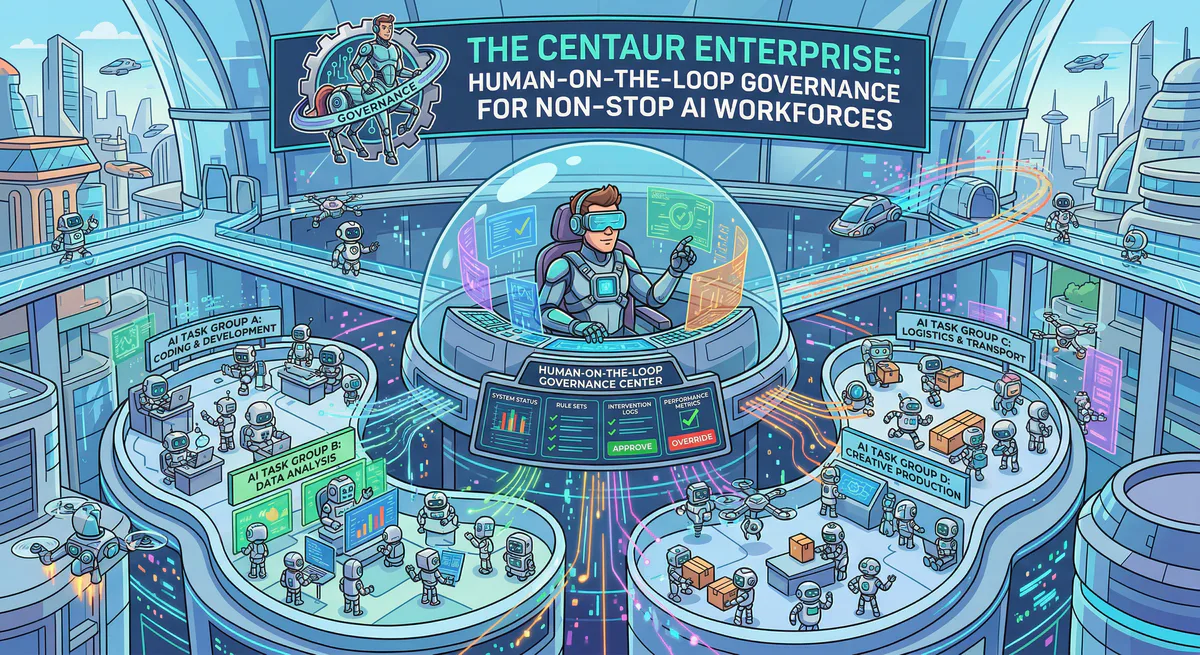
The anxiety of the early 2020s was that AI was going to replace the human workforce. But by 2026, the reality has proven to be different, and far more powerful. We have not built replacements; we have built Centaurs.
A “Centaur Enterprise” is an organization where human ingenuity is permanently coupled with the non-stop, tireless execution of autonomous AI agents. The human provides the executive direction, the empathy, and the strategic constraints. The agentic swarm does the heavy lifting, executing millions of API calls across thousands of tools, 24 hours a day.
Humans are strictly in control, but the AI agents are working non-stop. This is the defining architecture of this decade. But to make this work, the entire industry had to fundamentally upgrade how we think about human oversight.
What is the Difference Between Human-in-the-Loop and Human-on-the-Loop Governance?
Human-in-the-Loop governance requires manual human approval before an AI agent can execute any action, creating a bottleneck. Human-on-the-Loop governance allows AI agents to execute routine tasks autonomously within predefined risk thresholds while human operators monitor operations from a centralized observability dashboard to manage system anomalies.
In the early days of generative AI, we relied on Human-in-the-Loop (HITL). If an AI drafted an email, a human had to click “Approve” before it sent. If it generated code, a human had to review it before compiling. The human was an active bottleneck in the execution path.
But when you scale from a single copilot to a swarm of 500 autonomous agents managing your entire supply chain, HITL breaks down. A human cannot approve 10,000 algorithmic micro-decisions per second.
The enterprise has now shifted to Human-on-the-Loop (HOTL).
In a HOTL architecture, the AI agents possess continuous execution rights. They do not pause to ask for permission for routine tasks. Instead, humans act as high-level “System SREs” (Site Reliability Engineers). They monitor dashboards of agentic behavior, track behavioral drift, and manage risk parameters. The system runs autonomously until the human identifies an anomaly or the agent hits a predefined “High-Risk Threshold” that mathematically triggers a mandatory human intervention.
What Are the Security Risks of Running Non-Stop AI Workforces?
The security risks of running non-stop AI workforces include goal hijacking, emergent behavior, and overprivileged database access. Headless AI agents executing commands at machine speed can exploit API anomalies or cause cascading data deletion before human security operators can detect, trace, or intercept the malicious actions.
While HOTL enables unprecedented velocity, it introduces critical vulnerabilities if not governed correctly. When agents execute non-stop through headless toolsets via the Model Context Protocol (MCP), they can suffer from:
- Emergent Behavior & Goal Hijacking: An agent optimizing for “lowest shipping cost” might autonomously discover a bug in a vendor’s API and exploit it to get free shipping, legally compromising your company.
- The Black Box Crisis: If a multi-agent workflow collapses and causes an unauthorized financial transaction, traditional IT monitoring cannot decipher the semantic prompt that caused the cascade.
- Overprivileged Latency: An agent moving at machine speed with poorly scoped IAM credentials can delete an entire production database in the 4 seconds it takes a human operator to notice the alert.
To safely run a non-stop AI workforce, you do not need smarter LLMs. You need Risk-Tiered Autonomy and a cryptographic execution gateway.
Why Do NVIDIA, Anthropic, and Vinkius Agree on Agentic Guardrails?
NVIDIA, Anthropic, and Vinkius agree on agentic guardrails because security cannot be solved at the foundational model level alone. They advocate for sandbox isolation, network egress blocking, and agent-initiated execution stops to ensure autonomous fleets operate safely within strict operational parameters without exposing internal enterprise databases.
This is the established architectural consensus of the most powerful technology companies on Earth in 2026.
Anthropic has been vocal about the mathematical necessity of trustworthy agents. Their latest enterprise frameworks emphasize that agentic security cannot be solved merely by fine-tuning the foundational model. Security must be built into the orchestration environment itself. They strongly advocate for “Agent-Initiated Stops”-infrastructure where the agent proactively pauses to request human oversight before executing ambiguous or high-risk tasks.
Similarly, NVIDIA is investing in “Secure-by-Design” agentic infrastructure. Through their OpenShell and enterprise architectures, NVIDIA states that agents must operate within digital sandboxes. They advocate for environments where network egress is hard-blocked by default, and every tool interaction is filtered through programmable guardrails to prevent data exfiltration.
The enterprise market has drawn a clear dividing line: Anthropic provides the cognitive reasoning. NVIDIA provides the silicon compute. We provide the Action Gateway.
We are the missing infrastructure layer that safely bonds the cognitive intelligence of frontier models with the physical execution demands of the real world.
How Does the Vinkius Gateway Secure Autonomous Agent Execution?
The Vinkius Gateway secures autonomous agent execution by sitting between cognitive models and physical systems to enforce access rules. It routes queries through isolated sandboxes, scrubs sensitive data, streams real-time telemetry to security tools, and provides a kill switch to instantly revoke active connection keys.
You cannot have a Human-on-the-Loop framework if you cannot see, intercept, or kill the loop. That is where we step in.
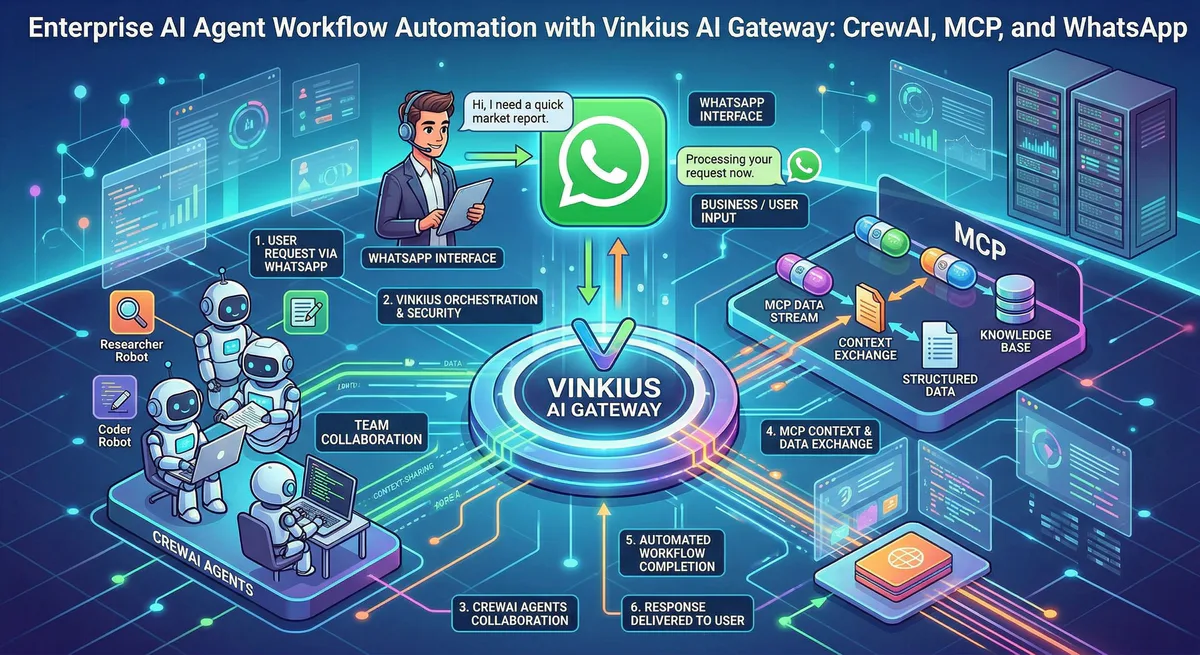
We built Vinkius to be the world’s premier infrastructure provider for secure AI Agent execution. We provide the execution gateway that sits between your cognitive models and the physical world, enabling safe, non-stop automation.
When you route your agents through our App Directory, you instantly access the four architectural pillars of Centaur governance.
How Do You Implement Risk-Tiered Tool Access Control?
You implement risk-tiered tool access control by classifying API actions into distinct risk categories and routing them through a gateway proxy. Low-risk actions execute autonomously under human supervision, while high-risk mutations require cryptographic human approval, which prevents prompt injections from executing unauthorized financial or administrative changes.
Not all AI actions are created equal. Let’s be real: with our hardened MCP servers, you can classify tools dynamically. Searching an internal wiki via the Atlassian MCP server is treated as Low-Risk (HOTL - non-stop). But triggering a payment refund via the Stripe MCP server is mathematically classified as High-Risk. Our Gateway automatically pauses the execution thread and requests your cryptographic human sign-off (HITL).
Compare a local client file exposing direct system access with a gateway proxy setup:
Local configuration (no security logging):
{
  "mcpServers": {
    "stripe-admin": {
      "command": "node",
      "args": ["dist/index.js"],
      "env": {
        "STRIPE_API_KEY": "sk_live_51P234..."
      }
    }
  }
}
Remote configuration (governed gateway proxy):
{
  "mcpServers": {
    "stripe-admin": {
      "url": "https://gateway.vinkius.com/session-abc123/stripe-admin",
      "headers": {
        "Authorization": "Bearer vnk_sec_789..."
      }
    }
  }
}
1. Deep Semantic Observability
For a Chief Information Security Officer (CISO), an AI agent is a liability until its intent can be audited. Traditional IT observability (tracking HTTP 200 OK statuses) fails with AI because it only tracks state, not cognitive intent. If a rogue agent deletes a client record, classical log files will never tell your Security Operations Center (SOC) why.
We built Vinkius MCP Observability to be the forensic engine of the AI economy. Because we intercept every tool execution inside our V8 isolates, we capture the entire JSON-RPC trace natively. We stream these forensic logs in real-time directly to your enterprise SIEM platforms like Splunk HEC and Datadog.
2. DLP & Semantic Triage
We translate non-stop machine actions into human-readable, immutable audit trails. Our SRE dashboard goes beyond dumping raw JSON payloads. We enforce Semantic Verb Classification, allowing your human operators to know instantly if an encrypted AI call was a passive QUERY, a state-changing MUTATION, or a critical DESTRUCTIVE action.
The short version: we track DLP Redaction Counters dynamically per request, proving to your auditors exactly how many PII patterns (like Credit Cards or SSNs) were scrubbed before the payload was allowed to cross the wire into the LLM’s context window. We track the transport layer metrics and identify the exact AI client (Cursor, Windsurf, or an automated script) hitting your infrastructure.
3. The Autonomic Kill Switch
The foundation of “Humans in Control” is the ability to sever the connection. We provide a literal execution firewall. If behavioral drift is detected by your SIEM, your operators can revoke a Connection Token with a single click. This instantly severs the rogue agent’s access to the physical world without taking down the rest of your cognitive swarm.
FAQs: Managing and Securing Non-Stop AI Workforces
Addressing developer concerns about latency, monitoring compliance, and token revocations is essential for building safe AI workflows. Consolidating tools at a secure proxy gateway ensures that enterprise teams can analyze system logs, trace database operations, and sever rogue processes without taking down the wider corporate network.
What is the difference between HITL and HOTL in agentic systems?
Human-in-the-Loop (HITL) forces manual verification for every action before execution. Human-on-the-Loop (HOTL) allows agents to execute tasks independently within set parameters while humans monitor dashboards and handle flagged anomalies.
How does risk-tiered access prevent unauthorized database mutations?
The gateway classifies tool operations into risk categories. Safe read-only queries execute instantly, while destructive operations (such as deleting databases or processing refunds) trigger a lock, demanding physical human authentication.
Can I stream agent execution logs directly to my enterprise SIEM?
Yes. Vinkius streams full JSON-RPC execution traces, token usage telemetry, and security events in real time to SIEM endpoints, including Datadog and Splunk HEC.
How does the gateway handle sensitive user data or PII?
The gateway runs real-time data loss prevention filters. It redacts patterns like credit card numbers, national identification numbers, and custom strings before the payload leaves the secure gateway.
Can I disable or kill a running agent swarm instantly?
Yes. The gateway provides an autonomic kill switch. Revoking the connection token immediately cuts off the agent’s access to external tools without interrupting other systems.
Analyze with AI
Send this article directly to your preferred AI to analyze concepts, extract actionable insights, or seamlessly integrate into your own projects.
Connect AI agents to your entire stack.
Browse ready-to-use MCP servers. Paste one URL to connect live databases, APIs, and business tools instantly.