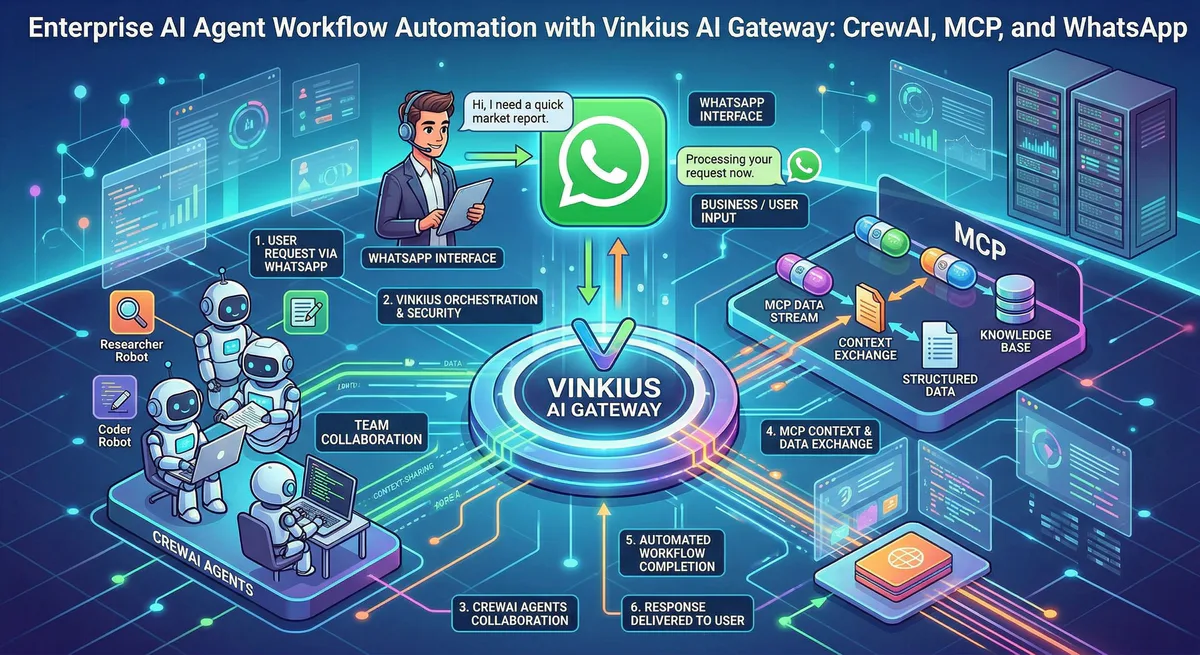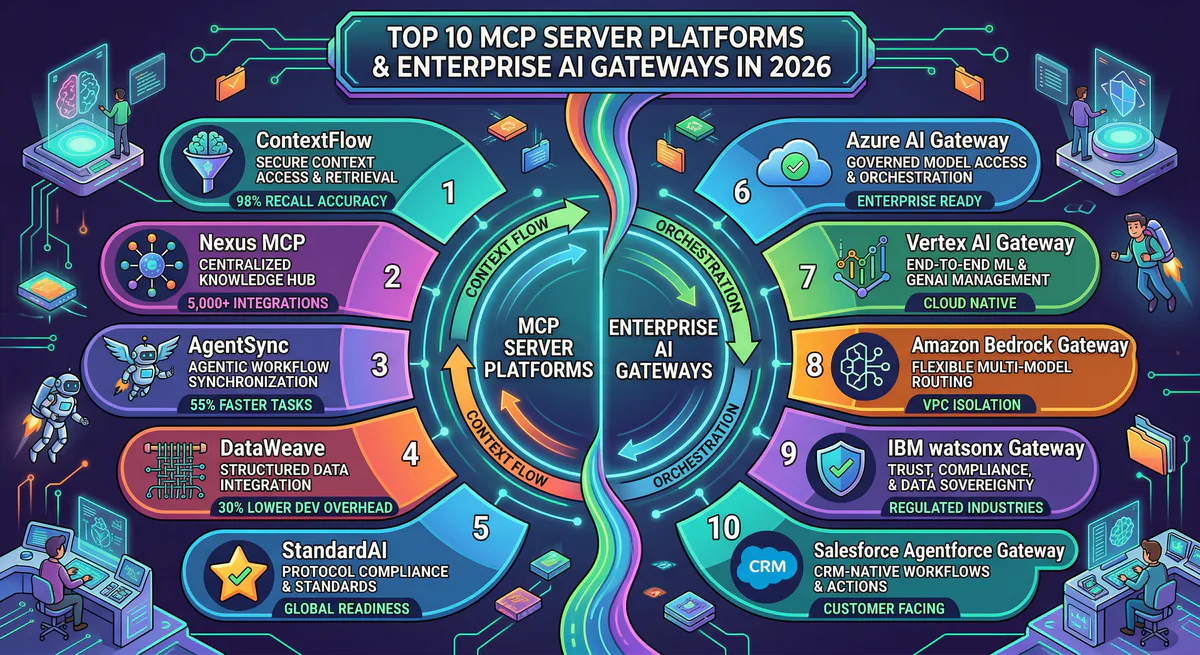
The standardization of the Model Context Protocol (MCP) has triggered a rapid expansion of infrastructure providers. The market is currently saturated with platforms offering varied approaches to AI routing, integration, and orchestration.
For technical leadership navigating this ecosystem, distinguishing between generic API proxies and purpose-built execution environments is critical.
This document provides a strictly architectural comparison of the Vinkius Execution Gateway against 10 prominent platforms in the AI infrastructure ecosystem, focusing primarily on security constraints, isolation mechanics, and forensic compliance.
What Are the Core Categories of MCP Server Platforms?
The core categories of MCP server platforms include tool integrators for SaaS connectivity, registries for developer discovery, inference gateways for prompt caching, and framework platforms for cognitive orchestration. Each category serves a specific role in managing how AI agents process information and execute actions across enterprise networks.
Category 1: The Tool Integrators
These platforms specialize in providing massive libraries of pre-built integrations to connect AI agents to hundreds of SaaS apps.
1. Composio
- Core Strength: Composio provides extensive SaaS connectivity. For teams requiring rapid LLM integration with 150+ applications via managed OAuth, their ecosystem simplifies the initial deployment layer.
- Architectural Comparison: The primary divergence lies in Forensics and Credential Integrity. Standard integration architectures often rely on traditional database logging, which lacks immutability guarantees. We require a Cryptographic Audit Fabric. Every MCP tool call is cryptographically hash-chained and signed using ephemeral Session Keys, providing mathematical tamper-evidence to the execution trace. Additionally, where standard platforms utilize generic managed auth, we enforce a Test-Then-Save Credential Lifecycle with Atomic Rollback-probing credentials via an ephemeral token before database persistence to prevent cache poisoning on failure.
2. Superface
- Core Strength: Superface operates as an efficient middleware layer, translating LLM intent into API execution to minimize token consumption within the model’s context window.
- Architectural Comparison: Superface utilizes standard stateless middleware routing. We implement isolation at the edge via a Stateful Hibernation Engine. The architecture extracts the exact V8 heap state to cold storage during idle periods, releasing process memory, and injects the state back near-instantaneously upon the next request. This mitigates the cold-start latencies inherent to stateless serverless functions while enforcing strict memory isolation per connection.
Why Do Tool Integrators and Registries Require Cryptographic Audit Trails?
Tool integrators and registries require cryptographic audit trails because standard logs are vulnerable to tampering and cannot prove which agent triggered a destructive action. Cryptographic hash-chaining and session-key signatures ensure every tool execution is tamper-evident, preventing unauthorized credential exfiltration or prompt injections.
Category 2: The MCP Registries
These platforms organize the ecosystem of open-source MCP servers.
3. Smithery.ai
- Core Strength: Smithery functions as an accessible registry for the MCP ecosystem, allowing developers using Claude Desktop or Cursor to discover and install community-built tools for local development.
- Architectural Comparison: Registries that rely on standard container hosting expose different attack surfaces, such as path-traversal vulnerabilities. We address execution security through programmatic defense-in-depth mechanisms. To mitigate DNS Rebinding (TOCTOU) vectors, our platform enforces a Dual-Stack SSRF Guard featuring active DNS pinning across multiple execution boundaries. Additional runtime constraints include streaming byte counters to neutralize memory expansion attacks and HTTP Timer Guillotines to terminate stalled execution threads autonomously.
Compare a local unmonitored setup exposing direct credentials with a gateway configuration:
Local integration setup (direct access, unmonitored and unpinned DNS):
{
  "mcpServers": {
    "salesforce": {
      "command": "npx",
      "args": ["-y", "salesforce-mcp-server"],
      "env": {
        "SF_CLIENT_ID": "consumer_key_123",
        "SF_CLIENT_SECRET": "consumer_secret_456"
      }
    }
  }
}
Vinkius Gateway integration setup (vaulted, DNS-pinned, cryptographically signed):
{
  "mcpServers": {
    "salesforce": {
      "url": "https://gateway.vinkius.com/session-def456/salesforce",
      "headers": {
        "Authorization": "Bearer vnk_sec_ghi789..."
      }
    }
  }
}
How Do Inference Gateways Differ From Execution Gateways for AI Security?
Inference gateways optimize data routing and prompt caching before queries reach large language models, while execution gateways protect internal systems from the actions those models trigger. Execution gateways run tool calls inside isolated sandboxes to enforce strict memory limits, DNS pinning, and real-time data loss prevention.
Category 3: The Inference Gateways
These are network providers offering AI protection, but their focus is entirely on the model layer.
4. Cloudflare AI Gateway
- Core Strength: Cloudflare provides scalable infrastructure for inference protection. Their position between the application and foundation models enables efficient rate-limiting, prompt caching, and access to raw V8 isolate environments.
- Architectural Comparison: While Cloudflare offers foundational V8 isolates, engineers must manually construct the security and auditing protocols required for MCP logic. We provide an embedded sandbox that enforces 34+ strict engineering rules natively. The runtime automatically implements life-support polyfills, dynamic streaming Response OOM protections, strict process memory constraints, and a SIEM Streaming Pipeline that routes Redis streams directly to Splunk and Datadog using Fast Checkpointing.
5. Cequence / TrueFoundry (Enterprise AI Security)
- Core Strength: These platforms operate as enterprise security proxies, specializing in the detection of general AI vulnerabilities, OWASP threats, and API endpoint abuse using layer-7 traffic metrics.
- Architectural Comparison: Standard traffic proxies often overlook the economic risks associated with probabilistic AI execution, specifically runaway tool consumption. We mitigate this via a Financial Circuit Breaker requiring Human-in-the-Loop overrides. Using deterministic sliding windows bound to subscription UUIDs, the system trips open when quotas are breached, halting all execution statefully. Resumption requires an explicit administrative reset via the console, preventing autonomous agents from bypassing limits through token rotation.
6. Kong AI Gateway
- Core Strength: Kong is an established leader in API management. Their AI Gateway provides sophisticated routing for LLM requests, handling load balancing across models and standardizing token telemetry.
- Architectural Comparison: Kong optimizes the traffic flowing toward the foundation models. Conversely, we designed the Vinkius platform exclusively to secure the actions triggered by those models. Standard API plugins often lack the semantic context of MCP executions. We operate natively within the JSON-RPC structure of the Model Context Protocol, bridging the gap between payload inspection and underlying agent intent.
What is the Role of Orchestration Frameworks in Secure Execution?
Orchestration frameworks manage the cognitive reasoning and state transitions of AI agent swarms, while execution gateways handle the physical API calls. Decoupling reasoning from execution separates model planning from tool connection, ensuring agents only operate within sandboxed boundaries using secure connection tokens.
Category 4: The Framework Platforms
These are the libraries used to write the cognitive logic of the AI Agents.
7. LangChain (LangGraph) & LangSmith
- Core Strength: LangChain and LangGraph serve as orchestrators for defining multi-agent workflows, managing context, and executing state machines.
- Architectural Pattern: These frameworks handle cognitive orchestration, while we target secure execution. By injecting a Vinkius Connection Token into a LangChain toolkit, the framework delegates the physical execution of APIs to our sandboxed environment, separating reasoning from execution.
8. LlamaIndex (LlamaCloud)
- Core Strength: LlamaIndex specializes in data ingestion, providing advanced parsing and chunking mechanisms for Retrieval-Augmented Generation (RAG) pipelines.
- Architectural Pattern: RAG architectures optimize data retrieval (read operations). We optimize agentic state changes (write/mutation operations). A typical deployment utilizes LlamaIndex to query internal policies, and passes the intent to our gateway to subsequently execute the resulting downstream actions safely.
How Does Vinkius Compare to Legacy Workflow Automation Giants?
Vinkius compares to legacy workflow automation giants by replacing deterministic trigger trees with semantic verb classification. This allows security gates to dynamically identify and intercept destructive database modifications rather than executing actions blindly, while simplifying legacy system integrations through automated OpenAPI to MCP conversions.
Category 5: Workflow Automation Giants
The legacy automation platforms trying to pivot to AI.
9. Zapier (AI Actions) / Make.com
- Core Strength: These platforms excel at workplace automation, executing pre-defined logic trees and offering extensive marketplaces for connectivity.
- Architectural Comparison: Classic automation relies on deterministic state gating, whereas autonomous agents introduce probabilistic routing. To address this, we inject Semantic Verb Classification into the execution trace. This allows security policies to dynamically distinguish between passive state reads (
QUERY) and critical data modifications (DESTRUCTIVE), rather than relying strictly on pre-configured trigger paths.
10. MuleSoft (Agentic Automation)
- Core Strength: MuleSoft handles deep enterprise integration, connecting complex, legacy architectures ensuring compliance and high availability.
- Architectural Comparison: Traditional ESB solutions require extensive integration overhead. We provide an infrastructure abstraction tailored for the MCP standard. Through the OpenAPI pipeline, teams can convert standard Swagger specifications into deployed, globally distributed MCP servers instantly, decoupling the agentic tool access from the underlying legacy bus.
FAQs: Comparing Enterprise MCP Platforms and Gateways
Comparing enterprise MCP platforms and gateways helps security teams identify gaps in data loss prevention, execution timeouts, and credential storage. Selecting a dedicated execution gateway ensures that database mutations remain isolated, tokens are protected, and all non-human agent activities are cryptographically signed.
Why do tool integrators need cryptographic audits?
Without cryptographic signatures and hash-chaining, standard database logs can be mutated, leaving security teams unable to prove that a specific agent was responsible for an unauthorized API call.
How does Vinkius isolate third-party MCP code?
Vinkius routes execution through ephemeral V8 isolates. The code is isolated from local system processes and the host filesystem, preventing path-traversal attacks and malicious resource hijacking.
What is the difference between an inference gateway and an execution gateway?
An inference gateway handles prompts, token limits, and LLM availability on the inbound path. An execution gateway handles stateful JSON-RPC commands, data loss prevention, sandboxing, and access controls on the outbound path.
How does Vinkius handle agentic budget overruns?
Vinkius utilizes a sliding-window financial circuit breaker linked to client accounts. If an agent swarm runs into an execution loop and exceeds a set budget, the circuit trips and requires manual administrative reset.
Can Vinkius convert OpenAPI specs into MCP servers?
Yes. Vinkius provides an automated OpenAPI import utility that translates standard Swagger and OpenAPI JSON manifests into functional, sandboxed MCP servers instantly.
Analyze with AI
Send this article directly to your preferred AI to analyze concepts, extract actionable insights, or seamlessly integrate into your own projects.
Connect AI agents to your entire stack.
Browse ready-to-use MCP servers. Paste one URL to connect live databases, APIs, and business tools instantly.