We built Vinkius because none of the existing platforms did what we needed. Not because they were bad — some of them are genuinely good at what they do. But none of them solved the full problem.
This is an honest comparison. We’ll tell you exactly where each platform excels and where it falls short. We’ll include ourselves in the same analysis. If another platform is a better fit for your use case, we’d rather you know that upfront.
What is the Difference Between Registry, Integration, and Execution MCP Platforms?
Registry platforms catalog community tools for local agent prototyping, integration platforms manage OAuth authentication for SaaS APIs, and execution gateways isolate code execution while auditing semantic actions. Understanding these architectural differences ensures you choose the appropriate security layer for your production agent deployments.
Every team building AI agents eventually hits the same wall: the agent needs to interact with real tools — Stripe, GitHub, Jira, Salesforce — and the integration layer is either fragile, insecure, or both.
The market has responded with several platforms, but they approach the problem from fundamentally different angles. Understanding those angles is the key to making the right choice.
How Do Composio and Vinkius Compare on Enterprise MCP Security?
Composio simplifies SaaS connectivity by managing authentication and token rotation across pre-built integrations, but focuses data loss prevention on prompt-level masking. Vinkius operates as a native MCP execution gateway, intercepting tool payloads to prevent outbound data exfiltration while building cryptographic audit trails of all agent actions.
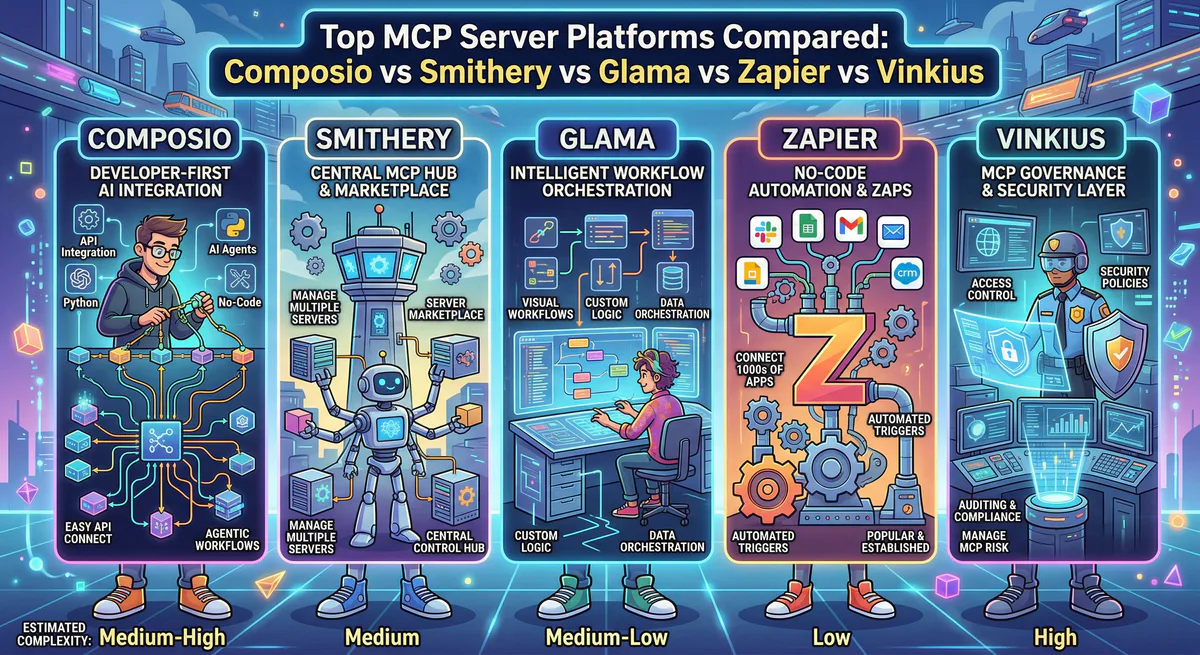
Composio
- What they do well. Composio offers a large library of pre-built integrations. They handle OAuth flows, token refresh, and credential rotation, which eliminates one of the most painful parts of agent development. They achieved SOC 2 Type II and ISO 27001 certification, which matters for enterprise procurement. Their MCP Gateway provides centralized routing and API key enforcement.
- Where they fall short. Composio built a tool-calling platform first and added MCP support later. The protocol is a transport layer for an existing integration engine, not a first-principles MCP runtime. Their DLP capabilities focus on prompt-level PII masking — anonymizing data before it hits the LLM. This protects the model from seeing sensitive data, but it does not prevent a compromised agent from exfiltrating data through a tool call to an external endpoint. Outbound data exfiltration — the most dangerous vector in 2026 — is an architectural blind spot when your DLP only operates on the prompt path.
Composio also does not offer a public marketplace where third-party developers can publish and monetize MCP servers. Their catalog is internally curated, which means you’re limited to the integrations their team has built.
Best for: Teams with existing Composio deployments that need broad SaaS connectivity and are comfortable delegating governance to a single vendor.
Why Do Smithery and Glama Serve Prototyping Better Than Production?
Smithery and Glama provide discovery and basic connection proxying for local developers, but lack runtime security controls. They do not isolate credentials, redact sensitive egress payloads, enforce semantic execution bounds, or offer the immutable forensic logging required for enterprise compliance and security compliance audits.
Smithery
- What they do well. The discovery experience is excellent. You can search by function, browse categories, and read community ratings before installing a server. Smithery supports both local (stdio) and remote (HTTP) transport, and their CLI tools make installation frictionless. For developers exploring the MCP ecosystem for the first time, Smithery is the natural starting point.
- Where they fall short. Smithery is a registry, not an execution layer. It helps you find and install MCP servers, but it does not govern what those servers do once they’re running. There is no centralized credential isolation — API keys are stored locally on your machine. There is no DLP pipeline scanning outbound data. There is no audit trail beyond what the individual server implementation provides. There is no semantic classification of tool calls. And there is no marketplace with commercial licensing — developers can list servers, but cannot sell access.
For prototyping and personal use, this is fine. For production deployments where compliance, data governance, and auditability matter, Smithery leaves those responsibilities entirely to you.
Best for: Individual developers exploring MCP, prototyping agent workflows, and discovering community-built tools.
Glama
- What they do well. Glama indexes a large number of MCP servers and provides quality and security scoring to help developers evaluate options. Their managed gateway proxies tool calls through their infrastructure, which gives them a centralized point for logging, access control, and credential management. This is a meaningful step up from raw local installations.
- Where they fall short. Glama’s governance capabilities are lighter than what production enterprise deployments typically require. Their gateway provides access control at the connection level, but does not offer the granular semantic classification that differentiates read-only queries from destructive mutations. They do not provide a real-time DLP pipeline that scans outbound payloads for sensitive data before they leave the perimeter. And they do not offer an open marketplace where third-party developers can publish, price, and sell MCP servers.
Best for: Teams that want a discovery experience with basic gateway governance and centralized credential management.
Comparing local raw execution configs with a secure gateway setup:
Local stdin/stdout server connection (credentials saved in plain text locally):
{
  "mcpServers": {
    "github": {
      "command": "npx",
      "args": ["-y", "@modelcontextprotocol/server-github"],
      "env": {
        "GITHUB_PERSONAL_ACCESS_TOKEN": "ghp_securekey123..."
      }
    }
  }
}
Governed gateway connection (token-masked, semantic classification, isolated V8 sandbox):
{
  "mcpServers": {
    "github": {
      "url": "https://gateway.vinkius.com/session-abc123/github",
      "headers": {
        "Authorization": "Bearer vnk_sec_xyz456..."
      }
    }
  }
}
What Are the Tradeoffs of Deploying Zapier as an MCP Wrapper?
Deploying Zapier as an MCP wrapper offers access to thousands of SaaS applications instantly, but introduces high latency and task-based execution costs. The non-native architecture inherits trigger-based automation limits, preventing teams from self-hosting gateways or enforcing customized data loss prevention rules in real time.
Zapier MCP
- What they do well. The breadth is unmatched. Zapier connects to thousands of applications through their existing workflow engine. If you need your agent to interact with an obscure SaaS tool that nobody has built an MCP server for, Zapier probably supports it. The no-code setup is friendly for non-developers.
- Where they fall short. The MCP layer is a wrapper on top of Zapier’s existing architecture, not a native MCP runtime. Tool calls are mediated through Zapier’s infrastructure, which introduces latency and adds Zapier’s per-task pricing to every interaction. This makes high-frequency agent workflows expensive. The governance model is Zapier’s — not yours. You cannot self-host, deploy your own DLP rules, or inspect the raw execution pipeline. And the MCP interface inherits the limitations of Zapier’s action model, which was designed for short-lived, trigger-based automations rather than the stateful, multi-step workflows that modern agents require.
Best for: Teams already using Zapier that want to expose their existing automations to an AI agent without rebuilding integrations.
How Do You Select the Right MCP Platform Using a Decision Framework?
You select the right MCP platform by aligning your security, latency, and integration demands with each provider’s capabilities. Prototyping tasks benefit from local registries, broad SaaS automation needs align with integration platforms, and regulated production environments handling sensitive user data require dedicated execution gateways.
Vinkius
-
What we do well. We built Vinkius as an MCP-first platform from the ground up. Every tool call — regardless of which agent makes it or which server it targets — passes through our managed gateway. This gives us a unique execution layer that no other platform in this comparison provides:
-
Semantic Intent Classification: We inspect every tool call and categorize it by verb type —
QUERY,MODIFY, orDESTRUCTIVE— before execution. If your compliance policy says agents cannot perform destructive mutations without explicit approval, we enforce that at the edge. Not at the prompt level. At the execution level. -
DLP Pipeline: Our data loss prevention operates on outbound payloads, not just inbound prompts. If a compromised agent attempts to exfiltrate a
.envfile, an SSH key, or PII through a tool call to any downstream server, our DLP catches it and kills the request before the data leaves the perimeter. This is the critical difference between prompt-level anonymization and true data exfiltration prevention. -
Cryptographic Audit Trail: Our audit trail hash-chains every execution record, creating an immutable, forensic-grade log that cannot be altered after the fact. For SOC 2 auditors and compliance teams, this is the difference between “we log agent actions” and “we can cryptographically prove exactly what happened.”
-
Open Marketplace: Our marketplace is open. Third-party developers can publish, price, and sell MCP servers directly on the platform. This means our catalog grows organically — and the developers building servers have economic incentive to maintain them.
-
Emergency Kill Switch: We provide an emergency kill switch that revokes all active tokens, terminates all connections, and locks any server to inactive state with one click. When an incident happens at 3 AM, you need a single button, not a terminal session.
-
Where we fall short. We are newer to market than Composio. Their SOC 2 Type II certification predates ours. Their integration library was built over a longer period, which means some niche SaaS connectors exist on Composio that have not yet been published on our marketplace. We are smaller, which means our support response times can be slower during peak periods. And our pricing model — while competitive — does not offer a permanent free tier for high-volume usage.
Best for: Teams that need a production-grade MCP gateway with real DLP, semantic governance, cryptographic audit logging, and an open marketplace — particularly those deploying agents in regulated industries or handling sensitive data.
FAQs: Choosing the Best MCP Server Platform for Your Team
Choosing the best MCP server platform requires evaluating data exfiltration protections, execution sandboxing, and compliance logging. Dedicated gateways ensure that database interactions are classified, credentials remain hidden from models, and security teams can immediately terminate rogue agent connections using centralized kill switches.
Why do tool integrators need cryptographic audits?
Without cryptographic signatures and hash-chaining, standard database logs can be mutated, leaving security teams unable to prove that a specific agent was responsible for an unauthorized API call.
How does Vinkius isolate third-party MCP code?
Vinkius routes execution through ephemeral V8 isolates. The code is isolated from local system processes and the host filesystem, preventing path-traversal attacks and malicious resource hijacking.
What is the difference between an inference gateway and an execution gateway?
An inference gateway handles prompts, token limits, and LLM availability on the inbound path. An execution gateway handles stateful JSON-RPC commands, data loss prevention, sandboxing, and access controls on the outbound path.
How does Vinkius handle agentic budget overruns?
Vinkius utilizes a sliding-window financial circuit breaker linked to client accounts. If an agent swarm runs into an execution loop and exceeds a set budget, the circuit trips and requires manual administrative reset.
Can Vinkius convert OpenAPI specs into MCP servers?
Yes. Vinkius provides an automated OpenAPI import utility that translates standard Swagger and OpenAPI JSON manifests into functional, sandboxed MCP servers instantly.
See Vinkius in action. Browse the App Catalog to explore governed MCP servers, or create a free account and connect your first server in under two minutes.
Analyze with AI
Send this article directly to your preferred AI to analyze concepts, extract actionable insights, or seamlessly integrate into your own projects.
Connect AI agents to your entire stack.
Browse ready-to-use MCP servers. Paste one URL to connect live databases, APIs, and business tools instantly.