
Bring Uptime Monitoring
to Google ADK
Learn how to connect Dotcom-Monitor to Google ADK and start using 6 AI agent tools in minutes. Fully managed, enterprise secure, and ready to use without writing a single line of code.
What is the Dotcom-Monitor MCP Server?
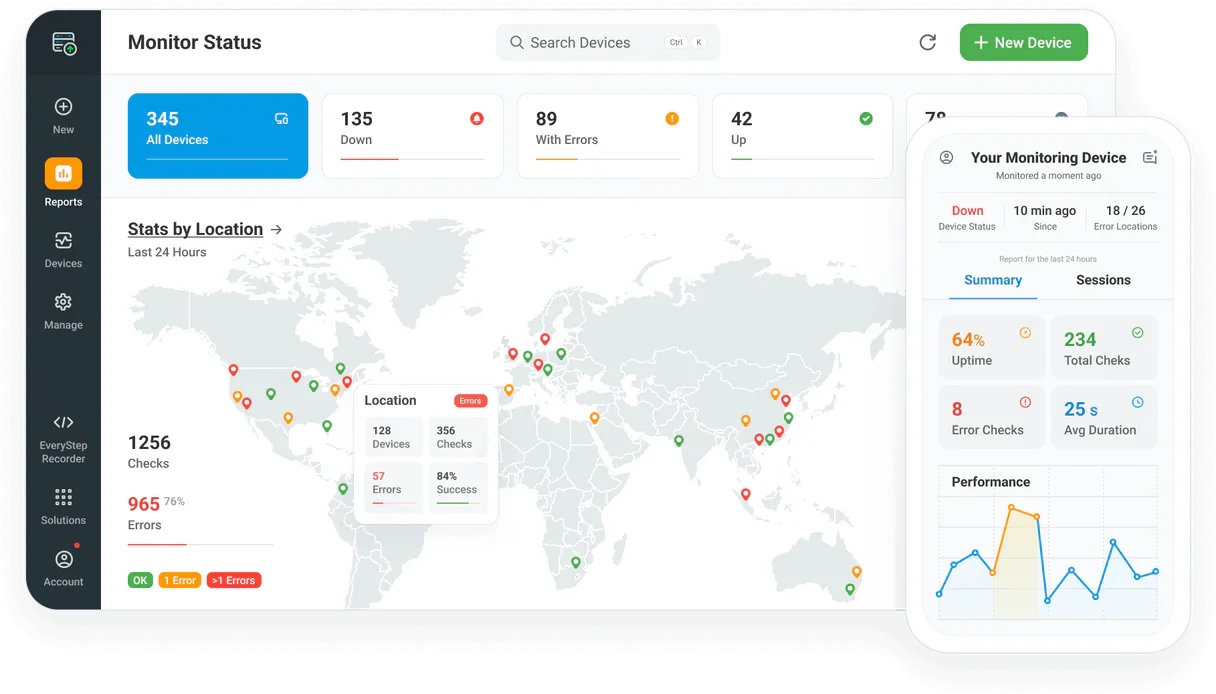
Connect your Dotcom-Monitor monitoring account to any AI agent and simplify how you oversee your website uptime, server performance, and global monitoring locations through natural conversation.
What you can do
- Device Oversight — List all configured monitoring devices (uptime, speed, API) and retrieve detailed configuration metadata.
- Performance Tracking — Query historical status data and response times to identify latency trends via AI.
- Global Monitoring — List available geographic locations and verify where your checks are running from.
- Alert Management — Query configured alert groups and notification teams to ensure your incident response is ready.
- Platform Analysis — List available monitoring platforms (ServerView, UserView, WebAPI) to coordinate your checks.
- Operational Monitoring — Check real-time device health and verify system connectivity directly from the agent.
How it works
1. Subscribe to this server
2. Enter your Dotcom-Monitor API Key (found in your account settings)
3. Start monitoring your digital assets from Claude, Cursor, or any MCP client
Who is this for?
- DevOps & SREs — quickly retrieve historical performance logs and verify device statuses via simple AI commands.
- IT Managers — monitor global uptime and verify alert group configurations directly from the workspace.
- Web Developers — check response times and verify platform availability via the AI assistant.
Built-in capabilities (6)
Get details for a specific device
Get historical status for a device
List configured alert groups
). List monitoring platforms
List monitoring devices
List geographic monitoring locations
Why Google ADK?
Google ADK natively supports Dotcom-Monitor as an MCP tool provider. declare Vinkius Edge URL and the framework handles discovery, validation, and execution automatically. Combine 6 tools with Gemini's long-context reasoning for complex multi-tool workflows, with production-ready session management and evaluation built in.
- —
Google ADK natively supports MCP tool servers. declare a tool provider and the framework handles discovery, validation, and execution
- —
Built on Gemini models, ADK provides long-context reasoning ideal for complex multi-tool workflows with Dotcom-Monitor
- —
Production-ready features like session management, evaluation, and deployment come built-in. not bolted on
- —
Seamless integration with Google Cloud services means you can combine Dotcom-Monitor tools with BigQuery, Vertex AI, and Cloud Functions
Dotcom-Monitor in Google ADK
Dotcom-Monitor and 3,400+ other MCP servers. One platform. One governance layer.
Teams that connect Dotcom-Monitor to Google ADK through Vinkius don't need to source, host, or maintain individual MCP servers. Every tool call runs inside a hardened runtime with credential isolation, DLP, and a signed audit chain.
Raw MCP | Vinkius | |
|---|---|---|
| Server catalog | Find and host yourself | 3,400+ managed |
| Infrastructure | Self-hosted | Sandboxed V8 isolates |
| Credential handling | Plaintext in config | Vault + runtime injection |
| Data loss prevention | None | Configurable DLP policies |
| Kill switch | None | Global instant shutdown |
| Financial circuit breakers | None | Per-server limits + alerts |
| Audit trail | None | Ed25519 signed logs |
| SIEM log streaming | None | Splunk, Datadog, Webhook |
| Honeytokens | None | Canary alerts on leak |
| Custom domains | Not applicable | DNS challenge verified |
| GDPR compliance | Manual effort | Automated purge + export |
Why teams choose Vinkius for Dotcom-Monitor in Google ADK
The Dotcom-Monitor MCP Server runs on Vinkius-managed infrastructure inside AWS — a purpose-built runtime with per-request V8 isolates, Ed25519 signed audit chains, and sub-40ms cold starts. All 6 tools execute in hardened sandboxes optimized for native MCP execution.
Your AI agents in Google ADK only access the data you authorize, with DLP that blocks sensitive information from ever reaching the model, kill switch for instant shutdown, and up to 60% token savings. Enterprise-grade infrastructure, zero maintenance.
* Every MCP server runs on Vinkius-managed infrastructure inside AWS - a purpose-built runtime with per-request V8 isolates, Ed25519 signed audit chains, and sub-40ms cold starts optimized for native MCP execution. See our infrastructure
How Vinkius secures
Dotcom-Monitor for Google ADK
Every tool call from Google ADK to the Dotcom-Monitor MCP Server is protected by DLP redaction, cryptographic audit chains, V8 sandbox isolation, kill switch, and financial circuit breakers.
Frequently asked questions
Can I check the uptime status of a specific device via AI?
Yes! Use the get_device_details tool and provide the Device ID. Your agent will retrieve the current operational status and basic performance metrics.
How do I see the history of response times for a monitor?
Run the get_device_monitoring_history query with your Device ID. The agent will retrieve a historical log of success/failure states and latency data.
Is it possible to list all geographic monitoring locations via AI?
Absolutely. Use the list_monitoring_locations query. The agent will retrieve the complete list of worldwide regions where Dotcom-Monitor agents are available.
How does Google ADK connect to MCP servers?
Import the MCP toolset class and pass the server URL. ADK discovers and registers all tools automatically, making them available to your agent's tool-use loop.
Can ADK agents use multiple MCP servers?
Yes. Declare multiple MCP tool providers in your agent configuration. ADK merges all tool schemas and the agent can call tools from any server in a single turn.
Which Gemini models work best with MCP tools?
Gemini 2.0 Flash and Pro models both support function calling required for MCP tools. Flash is recommended for latency-sensitive use cases, Pro for complex reasoning.
McpToolset not found
Update: pip install --upgrade google-adk