
NASA Full — Ultimate Space Intelligence MCP, Ready to Go
Use NASA Full with your AI agents in Claude or Cursor to access Mars photos, exoplanet data, and solar flare alerts instantly for your research.
No credit card required. Experience the power of this integration risk-free.
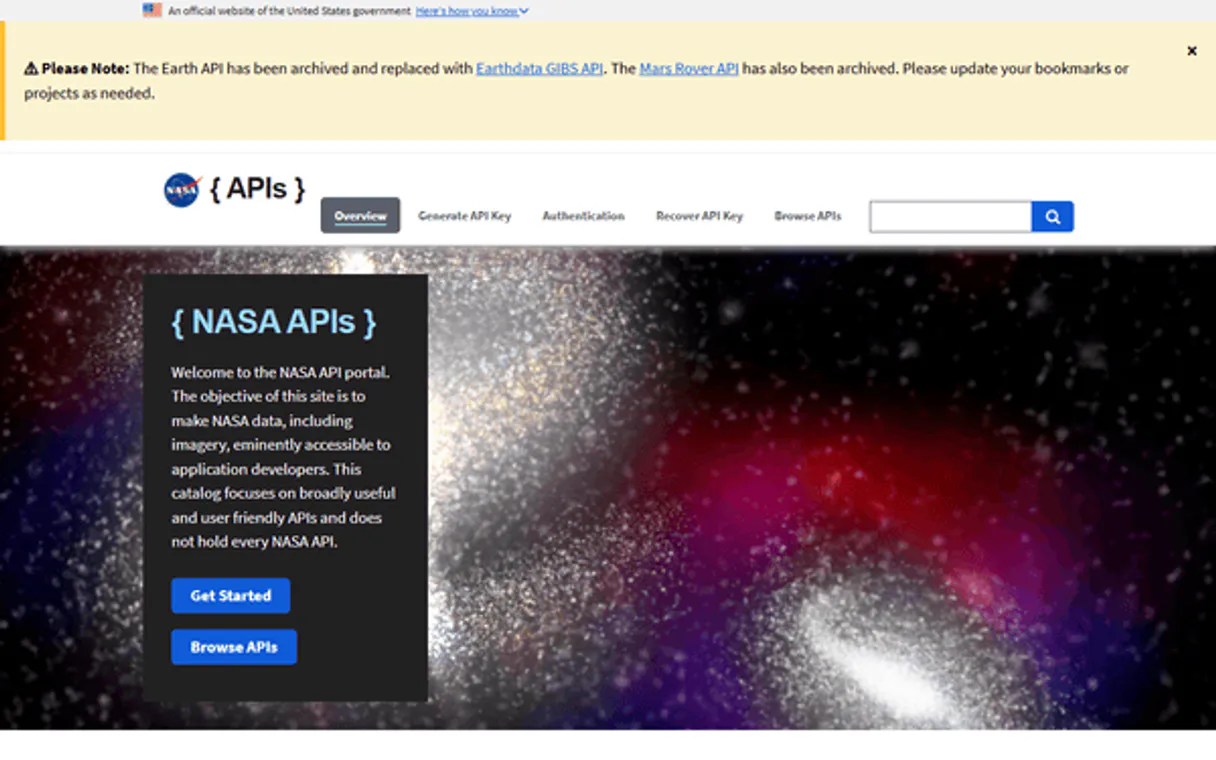
Access real-time Mars photos, exoplanet data, and solar flare alerts.
Works with every AI agent you already use
…and any MCP-compatible client









How fast is the NASA Full — Ultimate Space Intelligence Connector?
Average time for the server to become ready for requests over the last 14 days, measured until the initialize / tools/list handshake completes. Metrics are updated daily between 00:00 and 04:00 UTC. Create a free account, use this Connector on Vinkius Cloud, and connect it to your AI agent in seconds.
Waiting for input…
What AI agents can do with NASA Full 32+ Tools for Space Intelligence
Get real-time data on Mars, exoplanets, space weather, and NASA media via 32 specialized tools.
Get random apod
Pulls a random high-quality space image from a 30-year archive. Use this to discover amazing space imagery you might have missed.
Get apod
Fetches the specific Astronomy Picture of the Day including its description and image URL. This is one of the most popular NASA data feeds.
Get apod range
Retrieves a batch of space images for a specific date range of up to 30 days. Use this to explore a week or month of astronomical imagery.
Get neo feed
Lists near-Earth asteroids with their diameter, velocity, and hazard status. It provides a feed of objects approaching within a date range.
Get neo lookup
Provides deep details on a specific asteroid using its unique NASA SPK-ID. Use this to get specific measurements for a known object.
Get neo browse
Lets you scroll through the entire catalog of known near-Earth objects. This is useful for exploring the complete known catalog.
Get close approaches
Finds upcoming asteroid flybys based on distance and size for planetary defense. This is critical for monitoring close Earth approaches.
Get fireballs
Pulls data on atmospheric bolide events detected by government sensors. It includes location, velocity, and energy equivalents.
Get epic images
Grabs the latest full-disk images of Earth from the DSCOVR satellite. You can choose between natural or enhanced color versions.
Get epic by date
Finds Earth imagery for a specific date including coordinates and sun position. Use this to construct full image URLs for specific dates.
Get epic dates
Lists all available dates for EPIC Earth images. This helps you find specific dates of interest before requesting the images.
Get natural events
Pulls a list of active wildfires, volcanoes, and storms with coordinates. It includes source links for each event.
Get event categories
Lists all the different types of natural events tracked by EONET. This is useful for understanding the scope of the data.
Query confirmed planets
Searches the exoplanet database by discovery method, facility, or orbital stats. This returns radius, mass, and temperature.
Get transit planets
Filters for exoplanets discovered using the transit method by Kepler or TESS. This is the most productive discovery method.
Get habitable zone
Finds planets where liquid water might exist on the surface. Use this to find the most promising candidates for life.
Get planet stats
Shows global statistics on exoplanet discoveries and yearly trends. This highlights how much exoplanet science has exploded since 2009.
Get mars photos
Pulls photos from specific rover cameras like the hazard cameras or mast cams. This is great for viewing specific rover perspectives.
Get mars photos by date
Finds Mars rover images based on a specific Earth date instead of a sol number. This is easier for users to use than sol numbers.
Get mars manifest
Retrieves the list of available data and photos for a specific Mars rover mission. This is essential for understanding what data is available.
Get mars latest
Gets the most recent photos available from Curiosity, Opportunity, and Spirit. This keeps you updated on the latest rover activity.
Search media
Searches a library of over 140,000 images and videos from various NASA missions. You can filter by media type and year range.
Get media asset
Gets the direct download URL for a specific NASA media asset using its ID. Use this to grab high-resolution files for your projects.
Get media metadata
Pulls the full technical metadata for a specific image or video in the NASA library. This is useful for detailed research.
Search patents
Finds NASA technology spinoffs and patents available for licensing. This helps you find commercial products based on NASA tech.
Get cme
Retrieves Coronal Mass Ejection events from the DONKI database. These are massive bursts of solar wind and magnetic fields.
Get solar flares
Gets solar flare data including class, active region, and detection instruments. This is vital for monitoring satellite disruption.
Get geomagnetic storms
Pulls geomagnetic storm data including Kp index and linked CME data. These storms affect power grids, GPS, and satellites.
Get interplanetary shocks
Finds shock wave events in the solar wind that often precede storms. These are caused by CME-driven disturbances.
Get solar energetic particles
Retrieves data on particles that can damage satellites or affect astronauts. These are dangerous to space missions.
Get radiation belt
Monitors radiation belt enhancements in medium Earth orbit. These can pose risks to satellites during geomagnetic storms.
Get donki notifications
Provides a unified feed of all recent space weather events and solar activity. Use this for a quick overview of recent activity.
A Connector is a URL. Vinkius runs it: hosting, security, governance, observability.
You're looking at one of 5,800+ managed Connectors. The real value isn't the catalog. It's the control plane that secures, governs, audits, and manages every interaction between your agents and the tools they use.
No Shadow AI
Every agent action is visible, approved, and auditable. Nothing runs outside your governance.
Absolute agent control
Fine-grained permissions for every agent, MCP, and tool. Instantly revoke access and audit every execution.
Cost control per token
Spend broken down to the token, tool, and agent. Budgets and hard limits. No surprise invoices.
Managed & monitored infra
We operate the runtime, authentication, scaling, retries, and monitoring. Your team manages AI, not infrastructure.
Data protection, DLP by design
Sensitive data is filtered before reaching the model. Access is governed so agents receive only the information they're allowed to use.
Token optimization, real savings
Lower AI costs by delivering the right context instead of unnecessary tools. Better accuracy, faster responses, and fewer wasted tokens.
NASA Full MCP for Real-Time Space Weather Monitoring
This is for space researchers, amateur astronomers, and data journalists who need fast access to NASA's massive data archives without the headache of manual searching.
Space Tech Researcher
They use this to investigate NASA patents and commercial spinoffs for market analysis and tech trends.
Data Journalist
They pull facts on solar flares or natural disasters for real-time reporting without manual site hopping.
Astronomy Hobbyist
They track celestial events and find high-resolution images for personal projects or educational content.
Frequently Asked Questions
Can I use NASA Full to track asteroids? +
Yes, it pulls from NeoWs to show near-Earth objects and close approaches. This allows your agent to monitor potential hazards in real-time.
Does this include images from the James Webb telescope? +
Yes, the media search covers many major missions including Webb. You can search the library for specific mission assets or year ranges.
Can I get Earth imagery for a specific date? +
Yes, the EPIC tools let you find full-disk images for specific dates. This is great for historical research or monitoring specific events.
Is this for professional astronomers? +
It is a great tool for anyone needing official NASA data, from hobbyists to professional researchers. It handles the data retrieval so you can focus on the analysis.
How do I get the latest Mars photos? +
Your agent can pull the most recent images from Curiosity, Opportunity, and Spirit instantly. It even lets you filter by specific rover cameras.
Can I find NASA patents for my business? +
Yes, it allows you to search for technology spinoffs available for licensing. You can find everything from memory foam to water purification systems.
Why Full instead of individual servers? +
The Full server has all 32+ tools from 10 NASA data sources. Query APOD AND asteroids AND Mars AND solar flares AND exoplanets in a single session. One API key covers everything.
How many exoplanets does the API track? +
The Exoplanet Archive API tracks over 5,700 confirmed exoplanets, including their detailed physical characteristics, orbital data, and habitable zone status.
Does this include the Astronomy Picture of the Day (APOD)? +
Yes, the Full server includes complete access to APOD, allowing you to get today's image, search by specific dates, or retrieve a random selection of breathtaking astronomy pictures.
Your AI, connected to everything.









No credit card required · Free tier available












Other Connectors in this category
U.S. Census Full — Complete Demographic & Economic Intelligence Connector
U.S. Census Full MCP gives your AI agent direct access to the American Community Survey and County Business Patterns. It lets you pull population, income, housing, and business data for all 50 states and over 3,000 counties. You can analyze demographics, poverty rates, home values, and educational attainment across specific cities or entire regions in one go.
GBIF Connector
Search 2.4 billion biodiversity records. Find any species on Earth with full taxonomy, observation locations, and geographic distribution from the Global Biodiversity Information Facility.
FRED Series — U.S. Economic Time Series Connector
Search and retrieve data from 816,000+ official U.S. economic time series: GDP, inflation, unemployment, interest rates, money supply. With built-in transformations, frequency aggregation, and vintage analysis.
Related Connectors

Subscription Cashflow Aligner Connector
Find the safest day of the month to set subscription billing dates and minimize overdrafts.
Wiktionary Connector
Wiktionary gives your AI agent a direct line to one of the world's most detailed collaborative dictionaries. It pulls precise definitions, parts of speech, and real-world usage examples instantly. If you need to know the nuance of a word or its historical root, this Connector handles the heavy lifting of linguistic research for you.
Smartsheet Connector
Empower your AI to read Smartsheet rows, list workspaces, and manage your spreadsheets effortlessly from your code editor.