
Alpic MCP Server for Claude Code 18 tools — connect in under 2 minutes
Claude Code is Anthropic's agentic CLI for terminal-first development. Add Alpic as an MCP server in one command and Claude Code will discover every tool at runtime. ideal for automation pipelines, CI/CD integration, and headless workflows via Vinkius.
ASK AI ABOUT THIS MCP SERVER
Vinkius supports streamable HTTP and SSE.
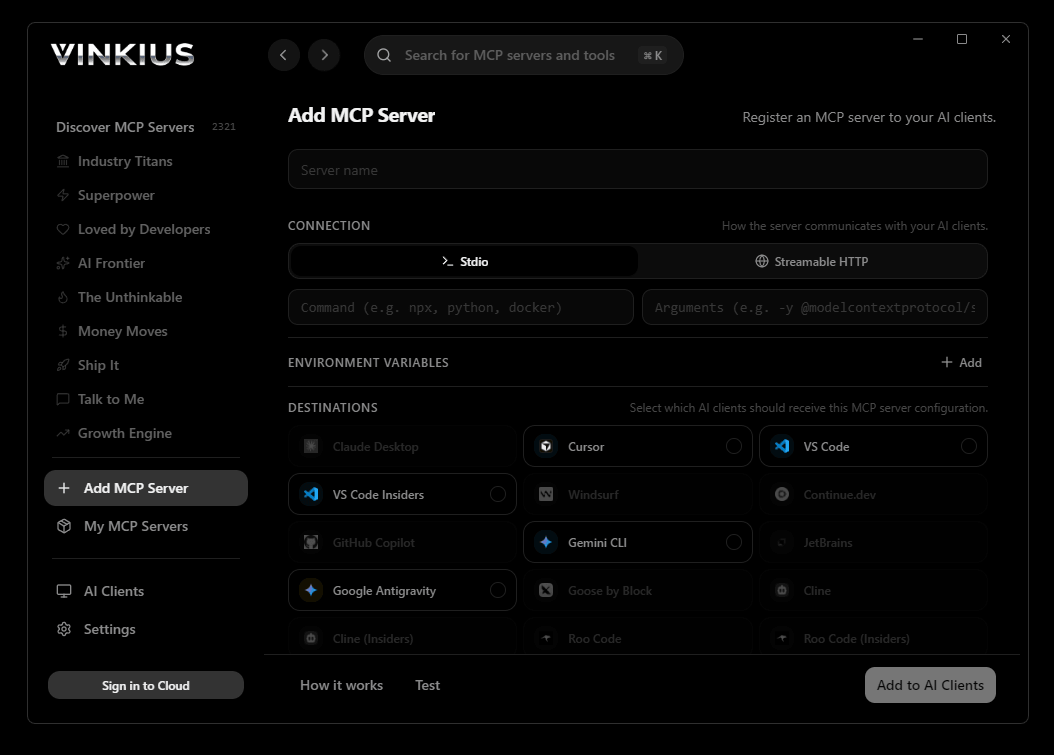
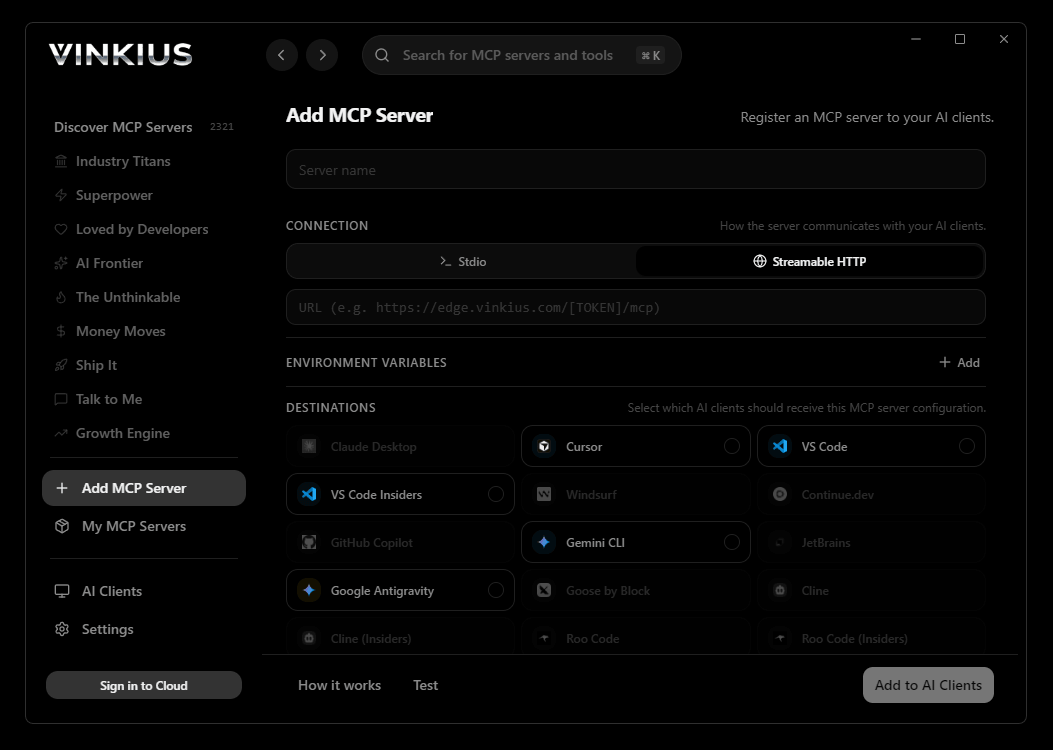
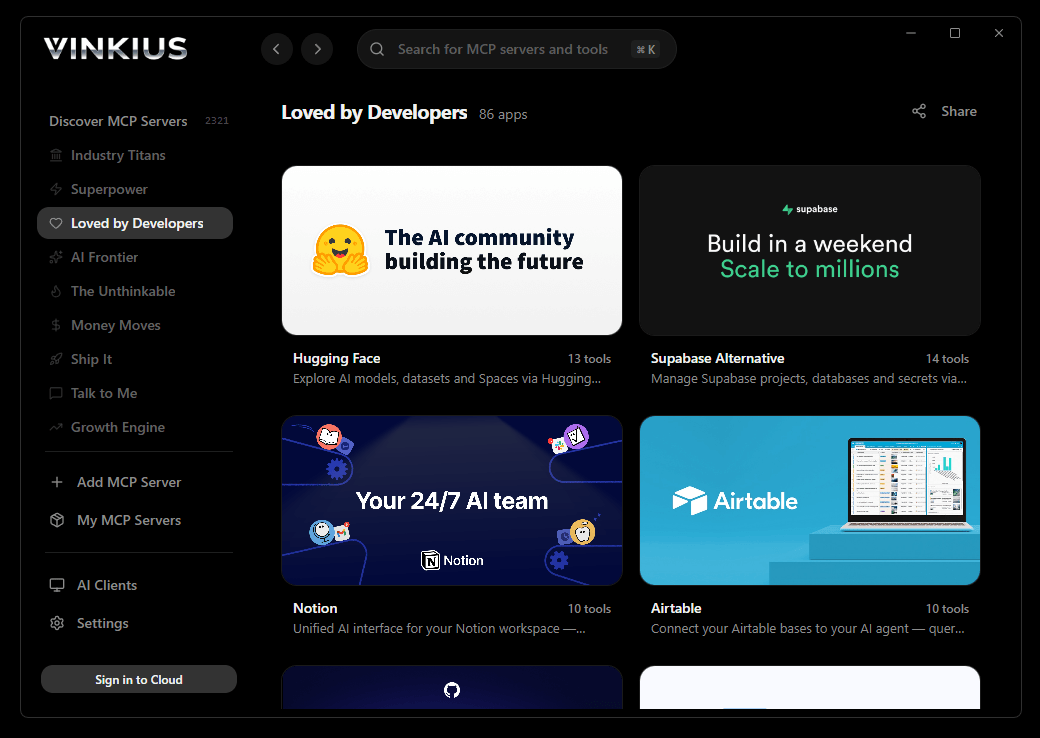
Vinkius Desktop App
The modern way to manage MCP Servers — no config files, no terminal commands. Install Alpic and 2,500+ MCP Servers from a single visual interface.

# Your Vinkius token. get it at cloud.vinkius.com
claude mcp add alpic --transport http "https://edge.vinkius.com/[YOUR_TOKEN_HERE]/mcp"
* Every MCP server runs on Vinkius-managed infrastructure inside AWS - a purpose-built runtime with per-request V8 isolates, Ed25519 signed audit chains, and sub-40ms cold starts optimized for native MCP execution. See our infrastructure
About Alpic MCP Server
What you can do
Connect AI agents to the Alpic platform for complete MCP server lifecycle management:
Claude Code registers Alpic as an MCP server in a single terminal command. Once connected, Claude Code discovers all 18 tools at runtime and can call them headlessly. ideal for CI/CD pipelines, cron jobs, and automated workflows where Alpic data drives decisions without human intervention.
- List and manage teams with member access controls
- Create, update, and delete MCP server projects with git repository linking
- Deploy to multiple environments (dev, staging, production) with one command
- Monitor deployments with real-time status, logs, and analytics
- Manage environment variables securely for each deployment target
- View analytics including request counts, latency, error rates, and usage patterns
- Publish to the MCP registry to make your servers discoverable
- Create development tunnels for local testing before production deployment
The Alpic MCP Server exposes 18 tools through the Vinkius. Connect it to Claude Code in under two minutes — no API keys to rotate, no infrastructure to provision, no vendor lock-in. Your configuration, your data, your control.
How to Connect Alpic to Claude Code via MCP
Follow these steps to integrate the Alpic MCP Server with Claude Code.
Install Claude Code
Run npm install -g @anthropic-ai/claude-code if not already installed
Add the MCP Server
Run the command above in your terminal
Verify the connection
Run claude mcp to list connected servers, or type /mcp inside a session
Start using Alpic
Ask Claude: "Using Alpic, show me...". 18 tools are ready
Why Use Claude Code with the Alpic MCP Server
Claude Code provides unique advantages when paired with Alpic through the Model Context Protocol.
Single-command setup: `claude mcp add` registers the server instantly. no config files to edit or applications to restart
Terminal-native workflow means MCP tools integrate seamlessly into shell scripts, CI/CD pipelines, and automated DevOps tasks
Claude Code runs headlessly, enabling unattended batch processing using Alpic tools in cron jobs or deployment scripts
Built by the same team that created the MCP protocol, ensuring first-class compatibility and the fastest adoption of new protocol features
Alpic + Claude Code Use Cases
Practical scenarios where Claude Code combined with the Alpic MCP Server delivers measurable value.
CI/CD integration: embed Alpic tool calls in your deployment pipeline to validate configurations or fetch secrets before shipping
Headless batch processing: schedule Claude Code to query Alpic nightly and generate reports without human intervention
Shell scripting: pipe Alpic outputs into other CLI tools for data transformation, filtering, and aggregation
Infrastructure monitoring: run Claude Code in a cron job to query Alpic status endpoints and alert on anomalies
Alpic MCP Tools for Claude Code (18)
These 18 tools become available when you connect Alpic to Claude Code via MCP:
add_variable
Use this to set API keys, database URLs, feature flags, or any configuration needed by your MCP server. Requires project ID, environment ID, variable key, and value. Variable values are stored securely. Add a new environment variable to an Alpic environment
create_environment
Requires environment name and project ID. Optionally set initial variables and configuration. Each environment gets a unique URL for MCP client connections. Returns the created environment details. Create a new deployment environment (dev, staging, prod) for an Alpic project
create_project
Requires project name and team ID. Optionally set description, repository URL, and initial configuration. Returns the created project details including the new project ID needed for subsequent operations. Create a new MCP server project in Alpic
delete_project
This action cannot be undone. Use with caution. Requires the project ID. Confirm with the user before proceeding. Delete an Alpic MCP server project
delete_variable
Use this to clean up unused configuration keys. Requires project ID, environment ID, and variable key. Delete an environment variable from an Alpic environment
deploy_environment
The deployment runs asynchronously. Returns the deployment ID which can be used with get_deployment to check status. Use this to push new MCP server versions to dev, staging, or production environments. Trigger a new deployment for a specific Alpic environment
get_deployment
Requires the deployment ID. Use this to check if a deployment succeeded, review deployment history, or debug failed deployments. Get detailed status and metadata for a specific Alpic deployment
get_deployment_logs
Useful for debugging failed deployments, understanding build output, or verifying successful startup of the MCP server. Requires project ID and environment ID. Get deployment logs for a specific Alpic environment
get_project
Requires the project ID from list_projects results. Use this to review project settings before making updates or triggering deployments. Get detailed information about a specific Alpic MCP server project
get_project_analytics
Requires the project ID. Use this to monitor MCP server health, identify performance trends, and troubleshoot issues. Get analytics and usage data for a specific Alpic project
get_server_info
Use this to verify which MCP tools are exposed and confirm the server is running correctly. Get server information and status for a specific Alpic project
get_tunnel_ticket
Returns the tunnel URL and ticket token. Use this during development to test your MCP server before deploying to a production environment. Get a tunnel ticket for local development and testing of an MCP server
list_environments
Each environment has its own URL, variables, and deployment status. Returns environment IDs, names, URLs, and current deployment state. Use this to identify which environment to deploy to or manage variables for. List all environments (dev, staging, prod) for a specific Alpic project
list_projects
Returns project IDs, names, descriptions, associated teams, deployment status, and environment counts. Use this to overview your entire MCP infrastructure before managing specific projects or triggering deployments. List all MCP server projects in your Alpic account
list_teams
Each team contains projects and environments for deploying MCP servers. Returns team IDs, names, and member counts. Use this first to identify which team to manage projects under. List all teams associated with your Alpic account
list_variables
Variable values are masked for security. Returns variable keys and metadata. Use this to audit environment configuration before deploying or adding new variables. List all environment variables configured for an Alpic environment
publish_to_registry
Requires project ID and optionally a server description and category. Use this to make your MCP server publicly available. Publish an MCP server to the official MCP registry via Alpic
update_project
Only pass the fields you want to change. Requires the project ID from list_projects results. Use this to rename projects, update descriptions, or point to a new repository branch. Update an existing Alpic MCP server project configuration
Example Prompts for Alpic in Claude Code
Ready-to-use prompts you can give your Claude Code agent to start working with Alpic immediately.
"List all active Alpic projects running on my account natively, then check the error rate metric for the first one listed."
"Deploy the staging environment for our main enterprise project mapped on isolated branches."
"Audit the credentials in our production environment. Provide exact details of variable schemas missing from active lists."
Troubleshooting Alpic MCP Server with Claude Code
Common issues when connecting Alpic to Claude Code through the Vinkius, and how to resolve them.
Command not found: claude
npm install -g @anthropic-ai/claude-codeConnection timeout
Alpic + Claude Code FAQ
Common questions about integrating Alpic MCP Server with Claude Code.
How do I add an MCP server to Claude Code?
claude mcp add --transport http "" in your terminal. Claude Code registers the server and discovers all tools immediately.Can Claude Code run MCP tools in headless mode?
How do I list all connected MCP servers?
claude mcp in your terminal to see all registered servers and their status, or type /mcp inside an active Claude Code session.Connect Alpic with your favorite client
Step-by-step setup guides for every MCP-compatible client and framework:
Anthropic's native desktop app for Claude with built-in MCP support.
AI-first code editor with integrated LLM-powered coding assistance.
GitHub Copilot in VS Code with Agent mode and MCP support.
Purpose-built IDE for agentic AI coding workflows.
Autonomous AI coding agent that runs inside VS Code.
Anthropic's agentic CLI for terminal-first development.
Python SDK for building production-grade OpenAI agent workflows.
Google's framework for building production AI agents.
Type-safe agent development for Python with first-class MCP support.
TypeScript toolkit for building AI-powered web applications.
TypeScript-native agent framework for modern web stacks.
Python framework for orchestrating collaborative AI agent crews.
Leading Python framework for composable LLM applications.
Data-aware AI agent framework for structured and unstructured sources.
Microsoft's framework for multi-agent collaborative conversations.
Connect Alpic to Claude Code
Get your token, paste the configuration, and start using 18 tools in under 2 minutes. No API key management needed.