
AT&T 5G MCP. Run full network operations from your agent.
 Gemini
 Works with every AI agent you already use
…and any MCP-compatible client









Just plug in your AI agents and start using Vinkius.
AT&T 5G MCP Server gives your AI client full access to Open Gateway 5G network APIs. Use it to verify phone numbers without SMS codes, detect SIM swaps for fraud prevention, manage dedicated network slices, or check device location via cell tower triangulation.
It's a console for network operations, giving you visibility into device state and network performance.
What your AI agents can do
Check roaming status
Checks if a device is currently operating on a foreign network, which helps calculate correct billing or adjust routing.
Check sim swap
Determines if a SIM card has been recently swapped, which is used to prevent account takeovers and verify user identity.
Create network slice
Provisions a new, dedicated 5G network slice for specific enterprise or private network use cases.
Use verify_number to confirm a phone number's active status without needing an SMS code, and use check_sim_swap to detect recent SIM card changes.
Provision and decommission dedicated 5G network slices using create_network_slice and delete_network_slice for private enterprise networks.
Get approximate location via get_device_location, check roaming status with check_roaming_status, or audit usage via list_network_sessions.
Request specific network profiles (like low latency or high throughput) using request_quality_on_demand for mission-critical applications.
Ask AI about this MCP
Supported MCP Clients
Gemini Waiting for input…
019d7554check roaming status
Checks if a device is currently operating on a foreign network, which helps calculate correct billing or adjust routing.
019d7554check sim swap
Determines if a SIM card has been recently swapped, which is used to prevent account takeovers and verify user identity.
019d7554create network slice
Provisions a new, dedicated 5G network slice for specific enterprise or private network use cases.
019d7554delete network slice
Decommissions and removes an existing 5G network slice, freeing up resources and reducing costs.
019d7554get device location
Gets the approximate geographic location (lat/long) of an AT&T 5G device using cell tower data, requiring user consent.
019d7554get network slice info
Retrieves the detailed parameters and connected devices for a specific 5G network slice ID.
019d7554list network sessions
Lists all active and historical Quality of Demand (QoD) sessions for auditing network usage.
019d7554request quality on demand
Requests guaranteed network quality (e.g., low latency or high bandwidth) for a specific session duration.
019d7554verify number
Silently confirms a user's phone number matches their device without needing an SMS code.
Choose How to Get Started
Build a custom MCP for your own tools, or connect a ready-made integration from our catalog.
Build Your Own
Turn any API into an MCP. Import a spec, define Agent Skills, or deploy with MCPFusion.
- Import from OpenAPI, Swagger, or YAML specs
- Create Agent Skills with progressive disclosure
- Deploy to edge with MCPFusion framework
- Built in DLP, auth, and compliance on every call
- Real time usage dashboard and cost metering
- Publish to catalog or keep private
Make Your AI Do More
Start with AT&T 5G, then connect any of our 4,700+ other servers whenever your AI needs more. One click, no limits.
- Use this MCP plus 4,700+ others, all in one place
- Add new capabilities to your AI anytime you want
- Every connection is secured and compliant automatically
- Track usage and costs across all your servers
- Works with Claude, ChatGPT, Cursor, and more
- New servers added to the catalog every week
What you can do with this MCP connector
Yo, this AT&T 5G MCP Server gives your agent full access to Open Gateway 5G network APIs. You use it like a network ops console. You can run deep network checks and manage slices right through your AI client.
Fraud and Identity Checks
Use verify_number to confirm a phone number's active status without needing an SMS code. Use check_sim_swap to detect if a SIM card was recently swapped, which stops account takeovers and helps verify identity.
Managing Network Infrastructure
You can provision a dedicated 5G network slice using create_network_slice for private enterprise use, and then use delete_network_slice to take it offline and free up resources.
Monitoring Device and Network State
Get the approximate geographic location (lat/long) of an AT&T 5G device using cell tower data when you get user consent via get_device_location. You can check if a device is operating on a foreign network using check_roaming_status, which helps with correct billing or routing. You'll also find list_network_sessions to audit all active and historical Quality of Demand (QoD) sessions.
Guaranteeing Service Performance
For mission-critical apps, you can request guaranteed network quality—like low latency or high throughput—for specific sessions using request_quality_on_demand. You can also get detailed parameters and connected devices for a specific 5G network slice ID by calling get_network_slice_info.
How AT&T 5G MCP Works
- 1 Subscribe to the server and provide your AT&T 5G API Access Token.
- 2 Your AI client calls the tool (e.g.,
check_sim_swap) through the MCP standard. - 3 The server executes the API call and returns the structured data directly to your agent.
The bottom line is, your AI agent talks directly to the 5G network APIs, so you don't write any custom HTTP clients.
Who Is AT&T 5G MCP For?
Security engineers need this to block fraud and verify identities without SMS. Network architects use it to provision and monitor dedicated network slices for enterprise clients. Product teams rely on it to integrate location-aware features and optimize real-time app performance. IoT operators depend on it to guarantee connectivity for critical deployments.
Runs check_sim_swap to block potential account takeovers and uses verify_number to enforce geo-fencing policies without SMS.
Calls create_network_slice and get_network_slice_info to provision and verify SLA compliance for private enterprise networks.
Uses get_device_location to test location-aware features or calls check_roaming_status to model international billing rules.
Calls request_quality_on_demand to ensure guaranteed connectivity for remote sensors or critical infrastructure.
What Changes When You Connect
- Detect fraud before it happens.
check_sim_swapalerts you to recent SIM changes, stopping account takeovers before the user even notices. - Guarantee performance when it matters. Use
request_quality_on_demandto provision low-latency profiles for real-time apps or high throughput for video streaming. - Manage complex networks easily. Provision, monitor, and delete entire network segments using
create_network_sliceanddelete_network_slice. Your agent handles the lifecycle. - Simplify identity checks.
verify_numberconfirms a user's phone number matches their device instantly. It cuts out the friction and delay of sending an SMS OTP. - Improve operational visibility.
list_network_sessionsprovides an audit log of all QoD usage, letting you track service consumption and troubleshoot past issues. - Optimize global deployments.
check_roaming_statusdetermines if a device is abroad, ensuring the correct billing rules or routing logic applies automatically.
Real-World Use Cases
Onboarding a new enterprise client
The Network Architect needs a private network for a major client. They ask their agent to 'Set up a dedicated, low-latency slice for the manufacturing floor.' The agent calls create_network_slice with the right SLA parameters, gets the ID, and then uses get_network_slice_info to confirm it's active and ready.
Handling a suspicious login attempt
A user tries to reset their password. The Security Engineer asks the agent to 'Check if this account has been targeted by SIM swap fraud.' The agent calls check_sim_swap. If suspicious activity is found, the system blocks the reset, preventing an account takeover.
Optimizing a remote fieldwork app
The Product Team needs to know if a field worker's app needs special bandwidth. They ask the agent to 'Check the current location and required network quality.' The agent uses get_device_location and then calls request_quality_on_demand to guarantee a high-throughput session.
Auditing high-cost network usage
The billing team needs to audit all premium services. They ask the agent to 'List all active and historical QoD sessions.' The agent uses list_network_sessions to pull the audit log, identifying exactly when and where high-cost services were used.
The Tradeoffs
Treating the API calls as linear steps
Manually running get_device_location, then create_network_slice, and then list_network_sessions in a single script. This fails because the location data might be stale by the time the slice creation runs, leading to incorrect resource allocation.
→
Always verify the current state first. Use get_network_slice_info to check the existing slice details before calling create_network_slice. Then, use get_device_location to get the most current coordinates for the new slice's scope.
Ignoring roaming status
Assuming all connections are domestic when routing a user in a foreign country. This leads to incorrect billing charges or failed connections because the system doesn't know the device is roaming.
→
Always run check_roaming_status first. If the status indicates a foreign network, the agent knows to apply international billing rules or use specialized international routing logic.
Relying only on SMS verification
Forcing users to enter an SMS code for every login, creating poor user experience and high friction, especially when the user is on a different network.
→
Use verify_number instead. It silently confirms the user's phone number matches the active device on the 5G network, making the login process seamless.
When It Fits, When It Doesn't
Use this MCP Server if your process requires real-time, granular control over the entire 5G network lifecycle—from identity verification to resource provisioning. You need to know why a connection failed, not just that it failed. Use it if you must coordinate location data (get_device_location) with resource allocation (create_network_slice) or if you need to audit billing (list_network_sessions).
Don't use this if you just need to check a simple, single piece of data, like a device's basic IP address. For that, a simple network monitoring tool is enough. If your primary need is just location tracking without network state awareness, you might need a dedicated GIS service. The complexity here is intentional: it's for full network stack control.
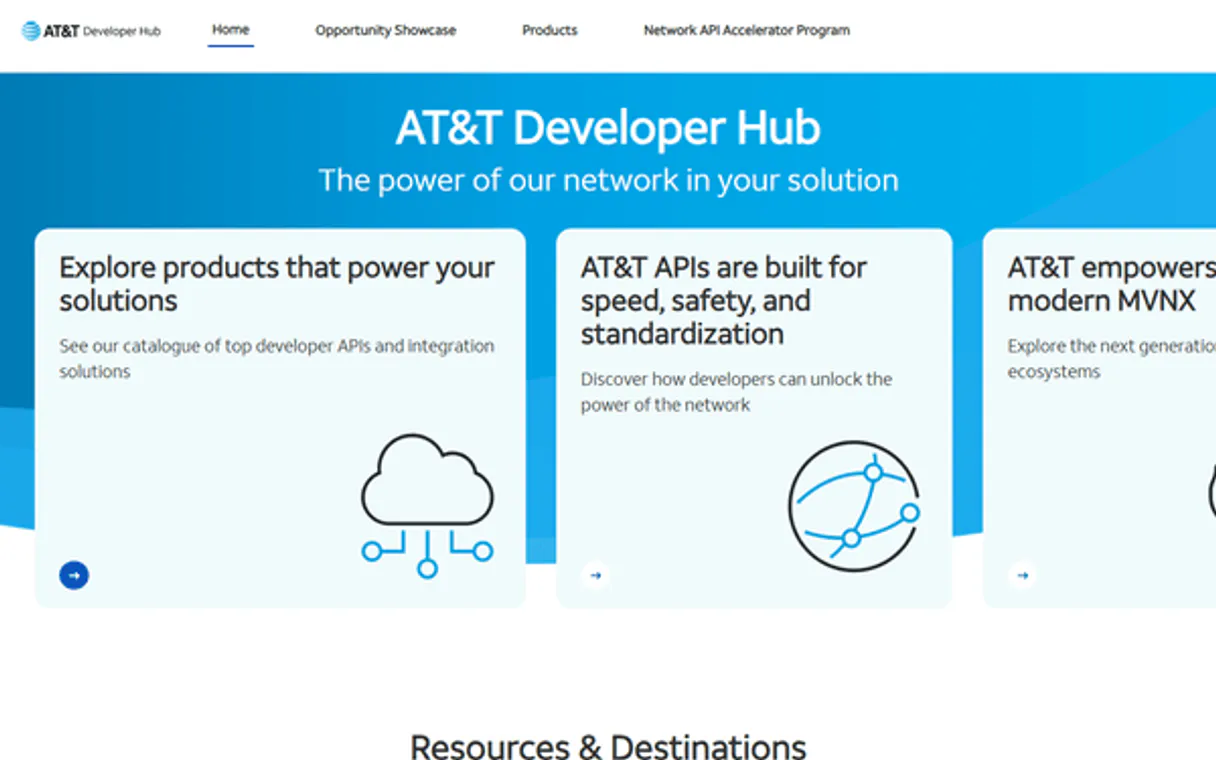
Independent Platform Disclaimer: Vinkius is an independent platform and is not affiliated with, endorsed by, sponsored by, verified by, or otherwise authorized by AT&T 5G. All third-party trademarks, logos, and brand names are the property of their respective owners. Their use on this website is strictly for informational purposes to identify service compatibility and interoperability.
VINKIUS INFRASTRUCTURE
Cloud Hosted
Managed infra
V8 Isolated
Sandboxed per request
Zero-Trust Proxy
No stored credentials
DLP Enforced
Policy on every call
GDPR Compliant
EU data residency
Token Compression
~60% cost reduction
Works with Claude, ChatGPT, Cursor, and more
The Model Context Protocol standardizes how applications expose capabilities to LLMs. Instead of operating in isolation, your AI gains direct access to external platforms, live data, and real-world actions through secure, standardized connections.
This server provides 9 capabilities that interface natively with Claude, ChatGPT, Cursor, and any MCP client. No middleware. No custom integration required.
Available Capabilities
Managing 5G Network State is a Messy, Multi-Step Process.
Right now, running a full network check—say, for a new enterprise deployment—means jumping between the billing portal, the network dashboard, and the security console. You check the location in one tab, manually copy the coordinates, then switch to a different portal to create a slice, and finally, you check the status in a third dashboard. It’s slow, and data gets stale between tabs.
With this MCP server, your AI agent handles the entire sequence. You just ask, 'Provision a low-latency slice for these coordinates.' The agent runs `get_device_location`, feeds those results into `create_network_slice`, and reports the final, confirmed slice ID. You get the full workflow, not just disconnected data points.
AT&T 5G MCP Server: Seamlessly Handle Network Identity.
Before, verifying a user's phone number meant sending an SMS, which often failed or was delayed. If the user was on a roaming network or the service was temporarily down, the whole login process stalled. You had to manually check if the user was actually using that number.
Now, your agent runs `verify_number`. It silently confirms the phone number matches the active device on the network, eliminating SMS friction. It's instant, reliable, and doesn't depend on carrier messaging services. That's a massive difference.
Common Questions About AT&T 5G MCP
How does the AT&T 5G MCP Server handle location data using `get_device_location`? +
It gets approximate geographic positioning using network-based cell tower triangulation. It does not provide precise GPS tracking, but it gives latitude, longitude, and an accuracy radius in meters, provided the user consents.
Can I use `check_sim_swap` to prevent fraud on my platform? +
Yes. The tool detects if a SIM card has been recently swapped. You can use this boolean result to block account takeovers or trigger step-up authentication before a user can access sensitive functions.
What is the difference between `list_network_sessions` and `get_network_slice_info`? +
get_network_slice_info gives static details about a slice (SLA, resources, connected devices). list_network_sessions lists the dynamic, real-time usage logs for premium services (QoD) for auditing purposes.
Is `verify_number` reliable if the user is traveling abroad? +
Yes. It verifies the number against the active network device, regardless of whether the user is roaming. It bypasses the need for SMS OTP entirely.
How do I use `request_quality_on_demand` to guarantee performance for critical apps? +
You specify the required profile (e.g., 'low_latency' or 'high_throughput'). The tool returns a session ID and active duration, ensuring the network meets those parameters for your critical sessions.
What is the best way to use `create_network_slice` for an enterprise client? +
You need to provide the slice name, the desired SLA profile, and the target device group. This process provisions a dedicated 5G slice, allowing for guaranteed performance isolation for your enterprise users.
Is there a way to check if my device is roaming using `check_roaming_status`? +
Yes, check_roaming_status determines if the device is connected to a foreign network. This status helps you apply the correct billing rates or reroute traffic appropriately.
How does `delete_network_slice` help manage costs? +
Using delete_network_slice removes unused or temporary slices by providing the necessary slice ID. Decommissioning these resources prevents ongoing charges and helps you keep costs down.
What are Open Gateway / CAMARA APIs and why do they matter? +
Open Gateway is a global initiative by GSMA and the Linux Foundation that standardizes telecom network APIs across carriers. CAMARA is the open-source project defining these API specifications. Instead of carrier-specific integrations, developers get universal, consistent endpoints for Number Verify, Device Location, SIM Swap, Quality on Demand, and more. AT&T is a founding participant, meaning these APIs work the same way across compatible networks worldwide.
Does Device Location require user consent? +
Yes. Per CAMARA standards, the Device Location API requires explicit user consent before returning any positioning data. The API will fail with an authentication error if consent has not been granted. This is a security and privacy safeguard -- network-level location cannot be retrieved silently without the user's knowledge.
What is Network Slicing and when should I use it? +
Network Slicing creates logically isolated 5G network segments with guaranteed SLA parameters (latency, bandwidth, reliability). Use it for IoT deployments requiring guaranteed connectivity, private enterprise networks, mission-critical applications like remote surgery or autonomous vehicles, and any scenario where best-effort public network performance is insufficient. You can create, monitor, and delete slices directly through your AI agent.
Use it with your favorite AI tools
Connect this server to Cursor, Claude, VS Code, and more.
More in this category

Shopify
Manage your Shopify store via AI — list products, process orders, search customers, track inventory, and manage discounts from any agent.

Facebook Ads
Manage your Facebook and Meta Ads via AI — list campaigns, track performance insights, and update ad status directly through your agent.

Coze
Orchestrate Coze bots — manage conversations, handle RAG datasets, and trigger bot actions directly from any AI agent.
You might also like

BrightMove
Manage your hiring pipeline via BrightMove — track jobs, applicants, and references directly from any AI agent.
Zinrelo
Manage loyalty programs, reward points, and customer engagement via the Zinrelo API.
Redis Vector
Equip your AI to autonomously manage embeddings, run KNN similarity searches, and administrate vector indexes natively inside your Redis stack.