
CARTO MCP Server for Claude Code 10 tools — connect in under 2 minutes
Claude Code is Anthropic's agentic CLI for terminal-first development. Add CARTO as an MCP server in one command and Claude Code will discover every tool at runtime. ideal for automation pipelines, CI/CD integration, and headless workflows via Vinkius.
ASK AI ABOUT THIS MCP SERVER
Vinkius supports streamable HTTP and SSE.
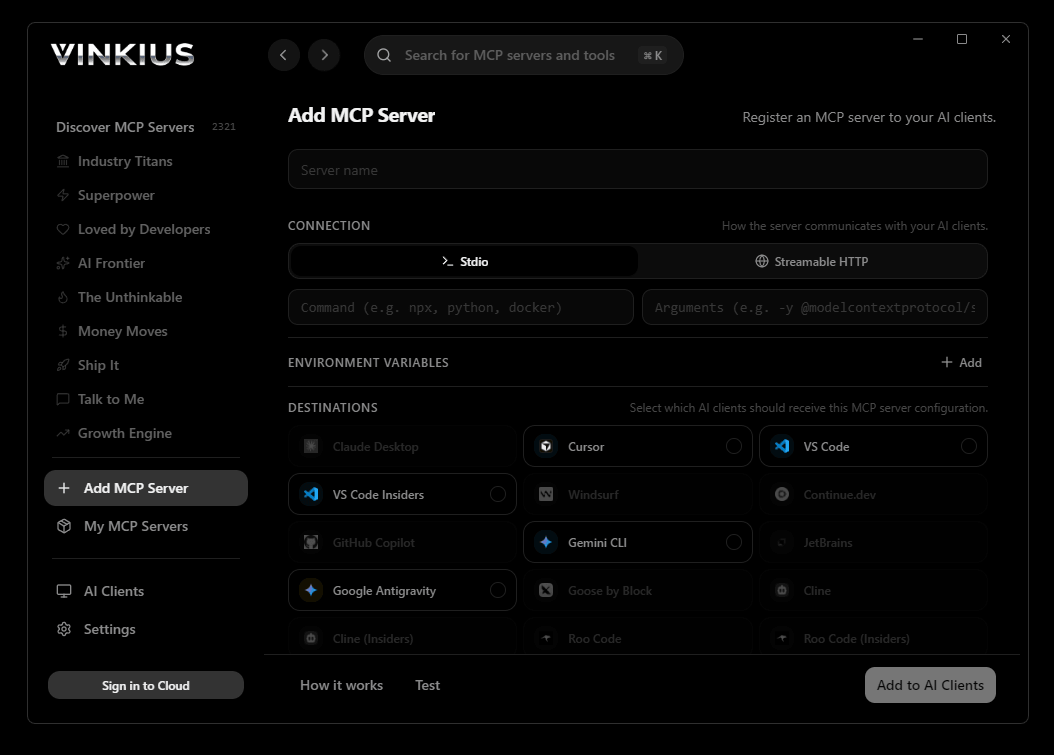
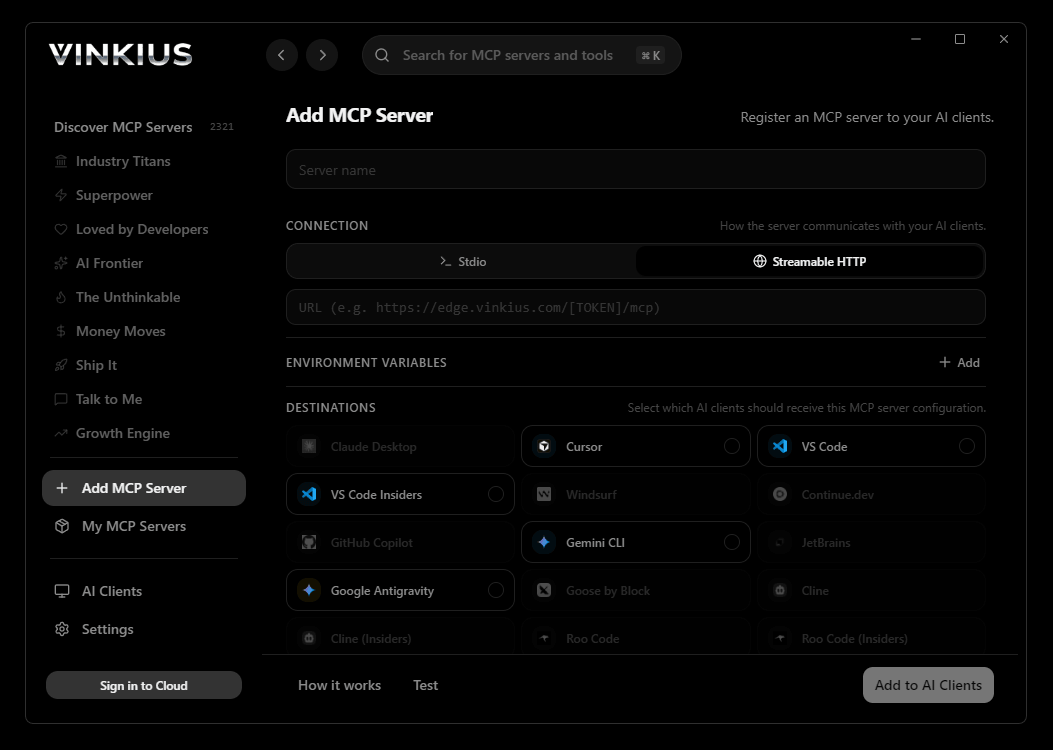
Vinkius Desktop App
The modern way to manage MCP Servers — no config files, no terminal commands. Install CARTO and 2,500+ MCP Servers from a single visual interface.

# Your Vinkius token. get it at cloud.vinkius.com
claude mcp add carto --transport http "https://edge.vinkius.com/[YOUR_TOKEN_HERE]/mcp"
* Every MCP server runs on Vinkius-managed infrastructure inside AWS - a purpose-built runtime with per-request V8 isolates, Ed25519 signed audit chains, and sub-40ms cold starts optimized for native MCP execution. See our infrastructure
About CARTO MCP Server
Connect your CARTO platform to any AI agent and take full control of your cloud-native spatial analytics without touching the GIS interface.
Claude Code registers CARTO as an MCP server in a single terminal command. Once connected, Claude Code discovers all 10 tools at runtime and can call them headlessly. ideal for CI/CD pipelines, cron jobs, and automated workflows where CARTO data drives decisions without human intervention.
What you can do
- Spatial SQL & Jobs — Command explicit SQL queries running directly against your BigQuery, Snowflake, or Redshift warehouse. Execute quick reads or spawn long-running, asynchronous batch transformations.
- Geocoding & Batching — Convert unstructured strings into precise lat/lon points. Bulk-process 100s of addresses using CARTO's native Location Data Services (LDS) gracefully.
- Isolines & Reachability — Calculate travel-time or distance polygons around origin points to instantly graph accessible zones via cars or walking.
- Routing — Generate optimal vector geometry paths connecting two points on the globe, measuring both physical distance and travel time securely.
- Data Management — Instruct your agent to list active mapping datasets or import massive external CSV/GeoJSON files directly via public URLs.
The CARTO MCP Server exposes 10 tools through the Vinkius. Connect it to Claude Code in under two minutes — no API keys to rotate, no infrastructure to provision, no vendor lock-in. Your configuration, your data, your control.
How to Connect CARTO to Claude Code via MCP
Follow these steps to integrate the CARTO MCP Server with Claude Code.
Install Claude Code
Run npm install -g @anthropic-ai/claude-code if not already installed
Add the MCP Server
Run the command above in your terminal
Verify the connection
Run claude mcp to list connected servers, or type /mcp inside a session
Start using CARTO
Ask Claude: "Using CARTO, show me...". 10 tools are ready
Why Use Claude Code with the CARTO MCP Server
Claude Code provides unique advantages when paired with CARTO through the Model Context Protocol.
Single-command setup: `claude mcp add` registers the server instantly. no config files to edit or applications to restart
Terminal-native workflow means MCP tools integrate seamlessly into shell scripts, CI/CD pipelines, and automated DevOps tasks
Claude Code runs headlessly, enabling unattended batch processing using CARTO tools in cron jobs or deployment scripts
Built by the same team that created the MCP protocol, ensuring first-class compatibility and the fastest adoption of new protocol features
CARTO + Claude Code Use Cases
Practical scenarios where Claude Code combined with the CARTO MCP Server delivers measurable value.
CI/CD integration: embed CARTO tool calls in your deployment pipeline to validate configurations or fetch secrets before shipping
Headless batch processing: schedule Claude Code to query CARTO nightly and generate reports without human intervention
Shell scripting: pipe CARTO outputs into other CLI tools for data transformation, filtering, and aggregation
Infrastructure monitoring: run Claude Code in a cron job to query CARTO status endpoints and alert on anomalies
CARTO MCP Tools for Claude Code (10)
These 10 tools become available when you connect CARTO to Claude Code via MCP:
calculate_isoline
The range parameter is in seconds for time-based isolines. Returns a GeoJSON polygon representing the reachable area. Use for service area analysis, store catchment zones, and logistics planning. Generate travel-time or travel-distance isoline polygons from a center point using the CARTO LDS Isolines API, producing reachability contours showing areas accessible within a specified time or distance threshold
calculate_route
Returns the route as GeoJSON with total distance (meters) and duration (seconds). Consumes LDS routing credits. Calculate the optimal driving route between two points using the CARTO LDS Routing API, returning distance, duration, and route geometry suitable for visualization on CARTO maps
create_async_sql_job
"}`. Returns a job_id that can be polled for completion status. Use for ETL operations, materialized view refreshes, and heavy geospatial computations. The job runs in your data warehouse and results are stored there. Submit a long-running SQL query as an asynchronous batch job via the CARTO SQL Job API, suitable for heavy spatial analytics, large table transformations, and complex multi-join operations that exceed the 60-second synchronous timeout
execute_sql_query
carto.com/api/v2/sql?q=`. The query runs synchronously with a 1-minute timeout. Use for quick analytical queries, spatial joins, and data exploration. For long-running queries exceeding 60 seconds, use the async job endpoint instead. Supports PostGIS/BigQuery spatial functions natively. Execute an arbitrary SQL query against your CARTO data warehouse connection using the SQL API v2, returning results as JSON rows directly from BigQuery, Snowflake, Redshift, or PostgreSQL
geocode_address
Returns latitude, longitude, and formatted address. Consumes LDS geocoding credits from your CARTO plan. Use sparingly for individual lookups; for bulk operations use the batch endpoint instead. Forward-geocode a single address string into geographic coordinates using the CARTO Location Data Services (LDS) geocoding endpoint, powered by TomTom or HERE depending on your CARTO plan configuration
geocode_batch_addresses
Designed for bulk processing of customer lists, store locators, and CRM datasets. Consumes LDS credits per address. Returns an array of geocoded results with match quality indicators. Batch-geocode multiple addresses in a single request using the CARTO LDS batch geocoding API, efficiently converting large address lists into coordinates without making individual API calls per address
get_import_status
Poll periodically until state becomes "complete" or "failure". On success, the response includes the table_name of the newly created dataset in your warehouse. Check the status of a previously initiated CARTO data import job, returning progress percentage, current state (uploading, importing, complete, failure), and any error details if the import encountered issues
import_external_file
"}`. Supports CSV, GeoJSON, Shapefile (zipped), KML, GPX, and Excel files. Returns an import_id for status tracking. The file is downloaded, parsed, and loaded into your connected data warehouse. Import an external data file (CSV, GeoJSON, Shapefile, KML) into your CARTO data warehouse by providing a publicly accessible URL, creating a new managed table that can be used for spatial analysis and visualization
list_map_datasets
Returns an array of dataset/visualization objects. Use to discover available data layers, check dataset freshness, and audit organization assets. List all visualization datasets (maps and tables) available in your CARTO organization, returning metadata including creation dates, privacy settings, table names, and row counts
poll_async_job_status
Poll periodically (every 5-10 seconds) until status changes to "done" or "failed". The response includes created_at, updated_at, and the original query for audit purposes. Check the execution status of a previously submitted CARTO async SQL job, returning the current state (pending, running, done, failed) and any error messages if the job encountered issues
Example Prompts for CARTO in Claude Code
Ready-to-use prompts you can give your Claude Code agent to start working with CARTO immediately.
"Execute a SQL query limiting to 10 rows on my 'retail_stores' dataset to check the schema."
"Take these 5 addresses in Madrid and bulk geocode them to lat/lon coordinates."
"Generate a 15-minute drive-time isoline around Times Square, New York."
Troubleshooting CARTO MCP Server with Claude Code
Common issues when connecting CARTO to Claude Code through the Vinkius, and how to resolve them.
Command not found: claude
npm install -g @anthropic-ai/claude-codeConnection timeout
CARTO + Claude Code FAQ
Common questions about integrating CARTO MCP Server with Claude Code.
How do I add an MCP server to Claude Code?
claude mcp add --transport http "" in your terminal. Claude Code registers the server and discovers all tools immediately.Can Claude Code run MCP tools in headless mode?
How do I list all connected MCP servers?
claude mcp in your terminal to see all registered servers and their status, or type /mcp inside an active Claude Code session.Connect CARTO with your favorite client
Step-by-step setup guides for every MCP-compatible client and framework:
Anthropic's native desktop app for Claude with built-in MCP support.
AI-first code editor with integrated LLM-powered coding assistance.
GitHub Copilot in VS Code with Agent mode and MCP support.
Purpose-built IDE for agentic AI coding workflows.
Autonomous AI coding agent that runs inside VS Code.
Anthropic's agentic CLI for terminal-first development.
Python SDK for building production-grade OpenAI agent workflows.
Google's framework for building production AI agents.
Type-safe agent development for Python with first-class MCP support.
TypeScript toolkit for building AI-powered web applications.
TypeScript-native agent framework for modern web stacks.
Python framework for orchestrating collaborative AI agent crews.
Leading Python framework for composable LLM applications.
Data-aware AI agent framework for structured and unstructured sources.
Microsoft's framework for multi-agent collaborative conversations.
Connect CARTO to Claude Code
Get your token, paste the configuration, and start using 10 tools in under 2 minutes. No API key management needed.