
Dokku MCP Server for Cursor 10 tools — connect in under 2 minutes
Cursor is an AI-first code editor built on VS Code that integrates LLM-powered coding assistance directly into the development workflow. Its Agent mode enables autonomous multi-step coding tasks, and MCP support lets agents access external data sources and APIs during code generation.
ASK AI ABOUT THIS MCP SERVER
Vinkius supports streamable HTTP and SSE.
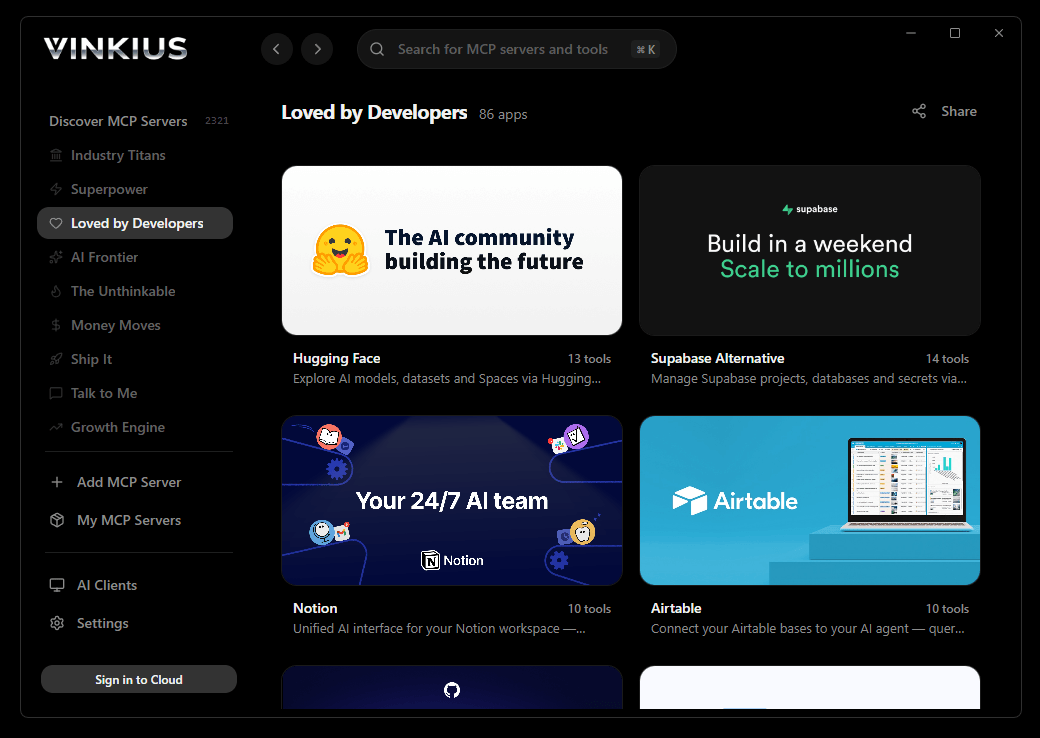
Vinkius Desktop App
The modern way to manage MCP Servers — no config files, no terminal commands. Install Dokku and 2,500+ MCP Servers from a single visual interface.
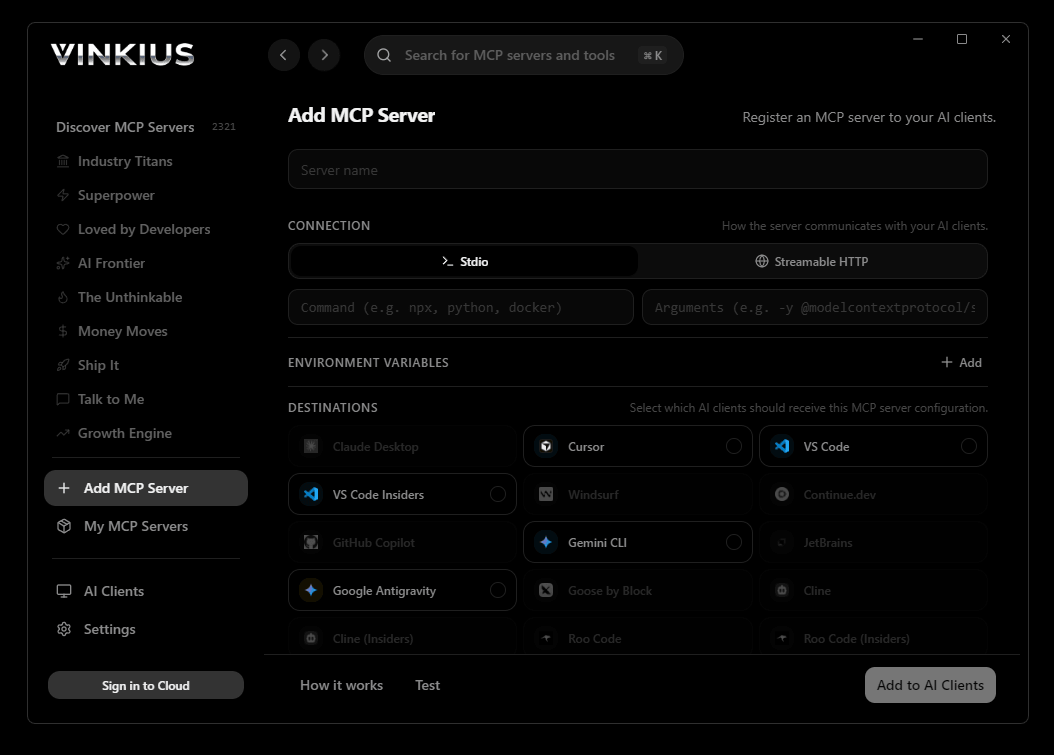

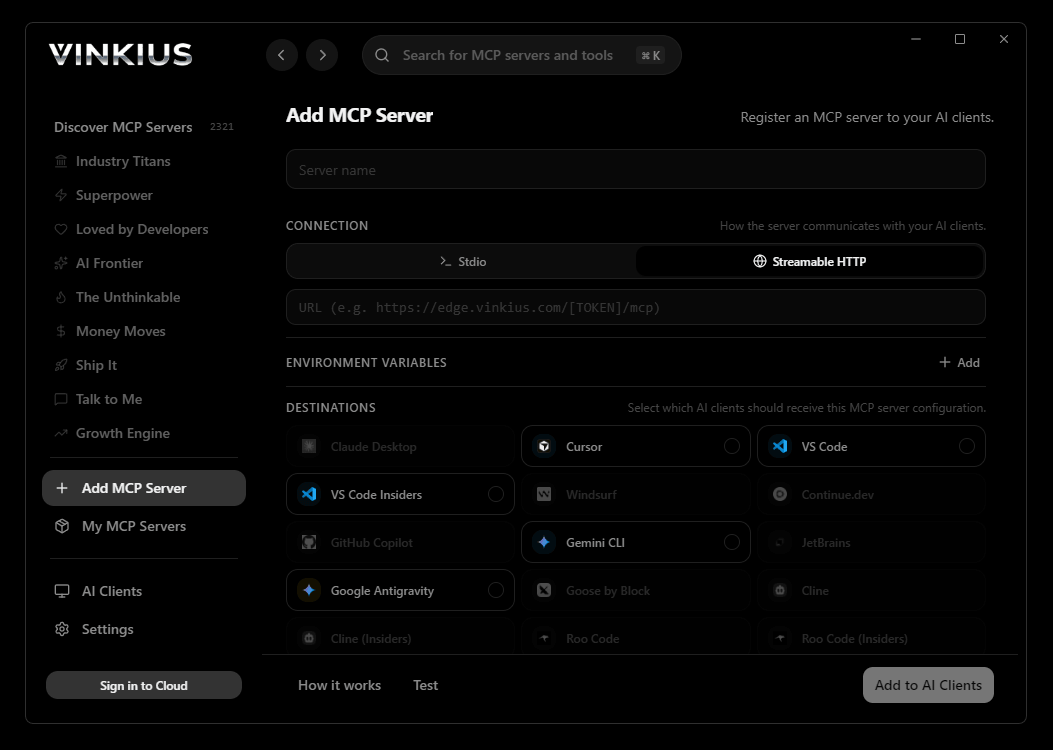
{
  "mcpServers": {
    "dokku": {
      "url": "https://edge.vinkius.com/[YOUR_TOKEN_HERE]/mcp"
    }
  }
}
* Every MCP server runs on Vinkius-managed infrastructure inside AWS - a purpose-built runtime with per-request V8 isolates, Ed25519 signed audit chains, and sub-40ms cold starts optimized for native MCP execution. See our infrastructure
About Dokku MCP Server
Connect your Dokku instance to any AI agent and take full control of your self-hosted PaaS and container orchestration through natural conversation.
Cursor's Agent mode turns Dokku into an in-editor superpower. Ask Cursor to generate code using live data from Dokku and it fetches, processes, and writes. all in a single agentic loop. 10 tools appear alongside file editing and terminal access, creating a unified development environment grounded in real-time information.
What you can do
- Application Lifecycle — List all managed apps and retrieve the overarching directory of deployments on your own infrastructure bypassing standard PaaS fees
- Provisioning & Deallocation — Barely instantiate new application repositories or irreversibly dismantle all bound containers and DNS routing records
- Environment Auditing — Retrieve the exact
.envdictionary bound dynamically via the config plugin to observe runtime inputs and SQL credentials - Configuration Mutation — Inject or remove sensitive environment variables securely, triggering rolling app deployments natively across your cluster
- Process Scaling — Manipulate explicit replica counts dynamically, determining whether web or worker containers spool up to meet demand
- Live Log Streaming — Pull precise system execution tails to investigate explicit request stack traces and crashing node backtraces without SSH
- One-off Executions — Launch raw commands inside ephemeral isolated containers for maintenance tasks like DB migrations or custom scripts
The Dokku MCP Server exposes 10 tools through the Vinkius. Connect it to Cursor in under two minutes — no API keys to rotate, no infrastructure to provision, no vendor lock-in. Your configuration, your data, your control.
How to Connect Dokku to Cursor via MCP
Follow these steps to integrate the Dokku MCP Server with Cursor.
Open MCP Settings
Press Cmd+Shift+P (macOS) or Ctrl+Shift+P (Windows/Linux) → search "MCP Settings"
Add the server config
Paste the JSON configuration above into the mcp.json file that opens
Save the file
Cursor will automatically detect the new MCP server
Start using Dokku
Open Agent mode in chat and ask: "Using Dokku, help me...". 10 tools available
Why Use Cursor with the Dokku MCP Server
Cursor AI Code Editor provides unique advantages when paired with Dokku through the Model Context Protocol.
Agent mode turns Cursor into an autonomous coding assistant that can read files, run commands, and call MCP tools without switching context
Cursor's Composer feature can generate entire files using real-time data fetched through MCP. no copy-pasting from external dashboards
MCP tools appear alongside built-in tools like file reading and terminal access, creating a unified agentic environment
VS Code extension compatibility means your existing workflow, keybindings, and extensions all work alongside MCP tools
Dokku + Cursor Use Cases
Practical scenarios where Cursor combined with the Dokku MCP Server delivers measurable value.
Code generation with live data: ask Cursor to generate a security report module using live DNS and subdomain data fetched through MCP
Automated documentation: have Cursor query your API's tool schemas and generate TypeScript interfaces or OpenAPI specs automatically
Infrastructure-as-code: Cursor can fetch domain configurations and generate corresponding Terraform or CloudFormation templates
Test scaffolding: ask Cursor to pull real API responses via MCP and generate unit test fixtures from actual data
Dokku MCP Tools for Cursor (10)
These 10 tools become available when you connect Dokku to Cursor via MCP:
create_app
Performs the structural network allocations setting up reverse-proxy hooks (Nginx/Traefik) preceding the actual codebase transfer. Provision a root App boundary wrapper on the Dokku VM
destroy_app
Instantly shuts down bound running docker containers orchestrating web/worker traffic, detaches volumes seamlessly, and removes explicit DNS routing records from the local VHOST mappings. Deallocate an App and dismantle all bound containers completely
get_logs
Bypasses SSH to investigate explicit request stack traces, crashing node backtraces, or slow SQL queries happening inside the closed containers. Stream Dokku Application Docker stdout and stderr logs
list_apps
Determines exactly which Docker containers are orchestrated internally by Dokku Core scaling plugins. List self-hosted Git-push Apps deployed via Dokku
list_config
env` or `ENV` dictionary bound dynamically via the `dokku config` plugin. Used strictly to observe runtime inputs (SQL credentials, external REST API tokens, Node_ENV bindings) governing app execution. Extract internal Environment variables loaded into the App
ps_restart
Dokku tears down old running docker processes spanning the App UUID, allocating updated dynamic ports tied via standard proxies (Nginx), ensuring zero downtime deploys if multiple replicas are alive. Bounce the application container dynamically
ps_scale
Determines whether the "web" container spins zero replicas (suspension), or if "worker" background tasks spool up to 10 endpoints. Scale structural internal application containers
run_command
Boots a brand new isolated Docker container cloning the production image layers for a single execution cycle. Useful for running `rake db:migrate`, `npm run script` safely disconnected from web traffic. Launch a raw one-off command inside an ephemeral container
set_config
Triggers a mandatory rolling app deployment unless the `--no-restart` daemon flag applies natively to the process. Critical for updating expired API auth tokens. Inject Environment Variables into a running Dokku Application
unset_config
Immediately triggers the executing Docker cluster to orchestrate a rapid replacement cycle to strip out the revoked value. Removes stale credentials safely. Remove sensitive Environment Variables disrupting App config
Example Prompts for Dokku in Cursor
Ready-to-use prompts you can give your Cursor agent to start working with Dokku immediately.
"List all apps on my Dokku host"
"Scale the 'web' process of app 'api-server' to 3 replicas"
"Get the last 50 lines of logs for 'frontend-web'"
Troubleshooting Dokku MCP Server with Cursor
Common issues when connecting Dokku to Cursor through the Vinkius, and how to resolve them.
Tools not appearing in Cursor
Server shows as disconnected
Dokku + Cursor FAQ
Common questions about integrating Dokku MCP Server with Cursor.
What is Agent mode and why does it matter for MCP?
Where does Cursor store MCP configuration?
mcp.json file. You can configure servers at the project level (.cursor/mcp.json in your project root) or globally (~/.cursor/mcp.json). Project-level configs take precedence.Can Cursor use MCP tools in inline edits?
How do I verify MCP tools are loaded?
Connect Dokku with your favorite client
Step-by-step setup guides for every MCP-compatible client and framework:
Anthropic's native desktop app for Claude with built-in MCP support.
AI-first code editor with integrated LLM-powered coding assistance.
GitHub Copilot in VS Code with Agent mode and MCP support.
Purpose-built IDE for agentic AI coding workflows.
Autonomous AI coding agent that runs inside VS Code.
Anthropic's agentic CLI for terminal-first development.
Python SDK for building production-grade OpenAI agent workflows.
Google's framework for building production AI agents.
Type-safe agent development for Python with first-class MCP support.
TypeScript toolkit for building AI-powered web applications.
TypeScript-native agent framework for modern web stacks.
Python framework for orchestrating collaborative AI agent crews.
Leading Python framework for composable LLM applications.
Data-aware AI agent framework for structured and unstructured sources.
Microsoft's framework for multi-agent collaborative conversations.
Connect Dokku to Cursor
Get your token, paste the configuration, and start using 10 tools in under 2 minutes. No API key management needed.