
FDA (openFDA) MCP. Track safety signals across drugs, devices, and food.
 Gemini
 Works with every AI agent you already use
…and any MCP-compatible client









Just plug in your AI agents and start using Vinkius.
FDA (openFDA) MCP Server gives you instant access to U.S. public health data. Search drug labels, track adverse events for drugs, devices, and food, and monitor recalls.
Your agent handles the complex queries to pull structured data on drug shortages, approvals, and enforcement actions directly into your workflow.
What your AI agents can do
Get drug shortages
Checks the current status and history of drug shortages.
Get usage
Retrieves your current API usage and rate limit information.
Search device adverse events
Searches for reported adverse events related to medical devices.
Checks for current and resolved drug shortages using get_drug_shortages.
Retrieves adverse event reports specifically tied to pharmaceutical drugs via search_drug_adverse_events.
Finds adverse event reports and enforcement actions for medical devices using tools like search_device_adverse_events and search_device_enforcement.
Retrieves data on food recalls and adverse events for consumed food items via search_food_enforcement and search_food_adverse_events.
Searches official lists of FDA-approved drugs (search_drug_approvals) and medical device classifications (search_device_classification).
Ask AI about this MCP
Supported MCP Clients
Gemini Waiting for input…
019d7597get drug shortages
Checks the current status and history of drug shortages.
019d7597get usage
Retrieves your current API usage and rate limit information.
019d7597search device adverse events
Searches for reported adverse events related to medical devices.
019d7597search device classification
Finds the official classification details for medical devices.
019d7597search device enforcement
Looks up recall and enforcement reports for medical devices.
019d7597search drug adverse events
Searches public records for adverse event reports linked to drugs.
019d7597search drug approvals
Retrieves data on FDA-approved brand name and generic drugs.
019d7597search drug enforcement
Finds recall and enforcement reports for pharmaceutical drugs.
019d7597search drug labels
Searches for official FDA drug product labeling information.
019d7597search food adverse events
Searches public records for adverse events linked to food items.
019d7597search food enforcement
Retrieves recall and enforcement reports for food products.
019d7597search ndc
Searches the National Drug Code directory for product identification.
Choose How to Get Started
Build a custom MCP for your own tools, or connect a ready-made integration from our catalog.
Build Your Own
Turn any API into an MCP. Import a spec, define Agent Skills, or deploy with MCPFusion.
- Import from OpenAPI, Swagger, or YAML specs
- Create Agent Skills with progressive disclosure
- Deploy to edge with MCPFusion framework
- Built in DLP, auth, and compliance on every call
- Real time usage dashboard and cost metering
- Publish to catalog or keep private
Make Your AI Do More
Start with FDA (openFDA), then connect any of our 4,700+ other servers whenever your AI needs more. One click, no limits.
- Use this MCP plus 4,700+ others, all in one place
- Add new capabilities to your AI anytime you want
- Every connection is secured and compliant automatically
- Track usage and costs across all your servers
- Works with Claude, ChatGPT, Cursor, and more
- New servers added to the catalog every week
What you can do with this MCP connector
FDA (openFDA) MCP Server gives your agent instant access to U.S. public health data. You can search drug labels, track adverse events for drugs, devices, and food, and monitor recalls. Your agent handles the complex queries to pull structured data on drug shortages, approvals, and enforcement actions directly into your workflow. get_drug_shortages checks the current status and history of drug shortages. search_drug_adverse_events searches public records for adverse event reports linked to drugs. search_drug_labels searches for official FDA drug product labeling information. search_drug_approvals retrieves data on FDA-approved brand name and generic drugs. search_device_adverse_events searches for reported adverse events related to medical devices. search_device_classification finds the official classification details for medical devices. search_device_enforcement looks up recall and enforcement reports for medical devices. search_food_adverse_events searches public records for adverse events linked to food items. search_food_enforcement retrieves recall and enforcement reports for food products. search_ndc searches the National Drug Code directory for product identification. get_usage retrieves your current API usage and rate limit information.
How FDA (openFDA) MCP Works
- 1 Subscribe to the FDA (openFDA) MCP Server and input your optional API Key in the settings.
- 2 Ask your AI agent a complex query, such as 'What are the adverse events for Drug X and Device Y?'.
- 3 The agent runs the necessary tools (
search_drug_adverse_events,search_device_adverse_events, etc.) and returns the combined, structured dataset.
The bottom line is that your agent handles the messy API calls, giving you clean, correlated public health data right where you're working.
Who Is FDA (openFDA) MCP For?
This is for clinical researchers, compliance officers, and pharmacovigilance specialists. If your job involves tracking product safety—whether it's a medication, a piece of hardware, or a food item—this server saves hours of manual database querying.
Runs cross-domain queries to correlate drug adverse events with potential device interactions or food contamination reports.
Monitors specific regions for drug or food recall reports using search_drug_enforcement and search_food_enforcement.
Pulls official drug labels and approval data (search_drug_labels, search_drug_approvals) to support literature reviews and study protocols.
What Changes When You Connect
- See drug shortages and approvals instantly. The
get_drug_shortagestool tells you if a drug is unavailable, whilesearch_drug_approvalsverifies its official status. This prevents using outdated or unsupported product information. - Pinpoint safety issues across product types. You can run adverse event searches for drugs (
search_drug_adverse_events), medical devices (search_device_adverse_events), or food (search_food_adverse_events)—all from one place. - Verify regulatory actions immediately. Use
search_device_enforcementorsearch_drug_enforcementto check if a product is currently under recall or regulatory action, saving time when assessing risk. - Access comprehensive product details. Instead of guessing, use
search_drug_labelsto pull the official FDA labeling, orsearch_device_classificationto confirm a device's intended use. - Pull structured data without manual exports. The server handles the complex data retrieval for recalls and adverse events, giving you clean, usable JSON instead of messy PDF documents.
- Manage workflow efficiency. By consolidating searches for NDC codes (
search_ndc), drug labels, and adverse events, your agent builds a complete safety profile in a single session.
Real-World Use Cases
Investigating a Patient's Complication
A clinician learns a patient had an adverse reaction. They ask their agent to run search_drug_adverse_events on the medication and then cross-reference that data with search_device_adverse_events for the implanted hardware. The agent provides a synthesized report detailing potential interactions.
Checking a Food Recall
A restaurant group receives a complaint about contaminated spinach. They ask the agent to run search_food_enforcement for that state and then run search_food_adverse_events to see if others reported illness. This provides immediate compliance data.
Due Diligence on a New Drug
A researcher needs to vet a new drug for a paper. They prompt the agent to run search_drug_labels for the product, check search_drug_approvals for its history, and use get_drug_shortages to see if it's currently available on the market.
Auditing a MedTech Product Line
A compliance officer needs to audit a device. They use search_device_classification to verify the proper category, then search_device_enforcement to confirm no recalls exist, and finally search_device_adverse_events to check user reports.
The Tradeoffs
Doing separate API calls
Manually visiting the openFDA website, running a drug search, copying the results, then switching tabs to run a food search, and finally compiling the two reports in Excel. This is slow and prone to version mismatch.
→
Tell your agent to check the safety profile. It will automatically execute search_drug_adverse_events and search_food_adverse_events and combine the results into one document.
Forgetting the NDC code
Only searching by drug name ('Tylenol') when the official code is required. The search may fail or return incomplete data if the proper identifier is missing.
→
Always start by asking your agent to use search_ndc to confirm the correct National Drug Code before running any specific safety search.
Overlooking enforcement actions
Running a drug adverse event search, but forgetting to check if the drug itself was recalled or modified by the FDA. You risk basing decisions on obsolete data.
→
After any safety search, ask the agent to run search_drug_enforcement to confirm the drug's current regulatory standing.
When It Fits, When It Doesn't
Use this server if your job requires correlating data across multiple regulatory domains: drugs, medical devices, and food products. If you need to check just one thing—say, only food recalls—you can still use it, but you're paying for the cross-domain capability. Don't use this if you only need a simple, single-source data query (e.g., a single company's internal database). The strength here is the breadth of coverage; it's designed to link adverse events from different product types together. If you only need to know the current stock level of a drug, use a dedicated inventory management tool; this is for public safety data.
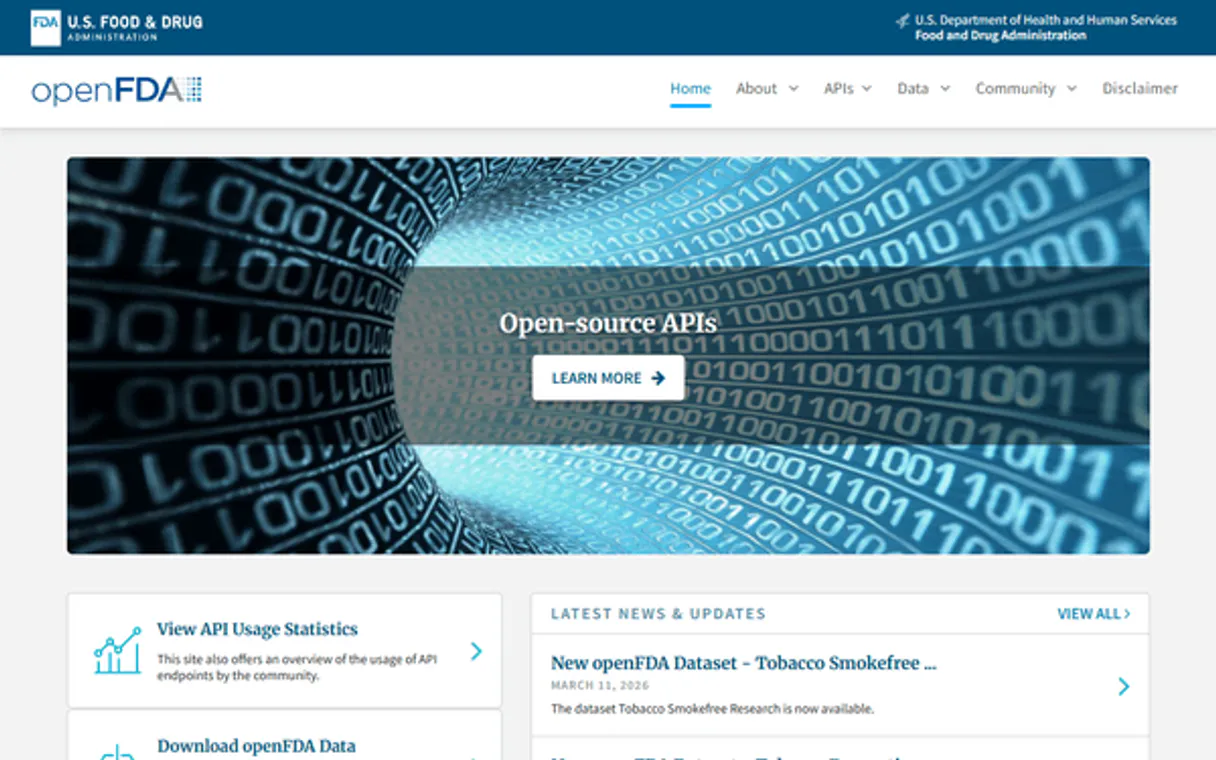
Independent Platform Disclaimer: Vinkius is an independent platform and is not affiliated with, endorsed by, sponsored by, verified by, or otherwise authorized by FDA (openFDA). All third-party trademarks, logos, and brand names are the property of their respective owners. Their use on this website is strictly for informational purposes to identify service compatibility and interoperability.
VINKIUS INFRASTRUCTURE
Cloud Hosted
Managed infra
V8 Isolated
Sandboxed per request
Zero-Trust Proxy
No stored credentials
DLP Enforced
Policy on every call
GDPR Compliant
EU data residency
Token Compression
~60% cost reduction
Works with Claude, ChatGPT, Cursor, and more
The Model Context Protocol standardizes how applications expose capabilities to LLMs. Instead of operating in isolation, your AI gains direct access to external platforms, live data, and real-world actions through secure, standardized connections.
This server provides 12 capabilities that interface natively with Claude, ChatGPT, Cursor, and any MCP client. No middleware. No custom integration required.
Available Capabilities
Tracking product safety shouldn't require jumping between five different government websites.
Today, checking a product's safety involves a scavenger hunt. You start at the drug labeling database, then switch to the device registry for device failures, and finally navigate to the food recall portal. You spend hours copying IDs, cross-referencing dates, and manually compiling the findings into a single, coherent report.
With the FDA (openFDA) MCP Server, your agent runs all these checks automatically. You ask, 'What's the safety profile for X?' and it runs `search_drug_labels`, `search_device_adverse_events`, and `search_food_enforcement`—giving you a single, comprehensive data output.
FDA (openFDA) MCP Server: Find Adverse Events Across Domains
You eliminate the need to manually run `search_drug_adverse_events`, then pivot to `search_food_adverse_events`, and then check `search_device_adverse_events` with different parameters. The agent manages the complex input logic for all three data types.
The result is a single, correlated data set. You get the answers, not the API endpoints. This changes how you build safety reports—it moves from manual assembly to direct intelligence extraction.
Common Questions About FDA (openFDA) MCP
How do I use the `search_drug_adverse_events` tool? +
You tell your agent the drug and the adverse event. The agent executes the tool and returns records of reported incidents. You can then ask it to filter by severity or date range.
Can I check for device recalls using `search_device_enforcement`? +
Yes. This tool queries the official records for medical device recalls and enforcement actions. You simply provide the device name or identifier.
Does the FDA (openFDA) MCP Server handle food data? +
Yes. Use search_food_adverse_events and search_food_enforcement to monitor food safety reports and recall status.
What is the difference between `search_drug_adverse_events` and `search_food_adverse_events`? +
The tools target different domains. One focuses on pharmaceutical drugs, and the other focuses on consumed food items. The process is the same: searching for reported negative outcomes.
How do I find drug labels using `search_drug_labels`? +
You provide the drug name or identifier, and the tool retrieves the official, detailed FDA product labeling. This includes usage instructions and warnings.
How do I find drug shortages using the `get_drug_shortages` tool? +
The get_drug_shortages tool fetches current and resolved drug shortages directly. You pass parameters like drug name or category, and the tool returns a list of affected products and the expected resolution date.
What information does `search_ndc` provide about drugs? +
The search_ndc tool accesses the National Drug Code directory. It returns specific identification numbers, manufacturer details, and therapeutic classifications for drugs, helping you pinpoint exact product lines.
Can I check for drug approvals using `search_drug_approvals`? +
Yes, the search_drug_approvals tool searches for both brand name and generic drug approvals. It lists FDA-approved drugs and provides metadata on their status and therapeutic equivalents.
Do I need an API Key to use openFDA? +
No, openFDA allows testing without a key (1,000 requests/day). However, registering for a free key increases your limits to 240 requests/minute and 120,000 requests/day.
Can I search for side effects of specific drugs? +
Yes! Use the search_drug_adverse_events tool. For example, query openfda.generic_name:"aspirin" to see reported adverse events for Aspirin.
How can I track food recalls through this agent? +
The search_food_enforcement tool allows you to query the CFSAN enforcement reports database. You can search by product description, state, or manufacturer.
Use it with your favorite AI tools
Connect this server to Cursor, Claude, VS Code, and more.
More in this category
Bureau of Labor Statistics Full — The Mega Server
The ultimate BLS Mega-Server: Access all 6 major datasets including CPI (Inflation), CES (Jobs), CPS (Unemployment), JOLTS (Turnover), LAUS (Local metrics), and OEWS (Wages by Profession).

AirLabs
Access global aviation data via AirLabs — track real-time flights, search airports and airlines, check schedules, and analyze routes from any AI agent.
Open-Meteo Full Access
The ultimate weather Mega-Server: 15 tools covering forecast, historical (84 years), marine, air quality, pollen, climate projections (to 2100), flood, geocoding, and elevation — all in one zero-auth integration.
You might also like
Salesforce Analytics & SOQL
Run SOQL queries, execute reports, view dashboards, and analyze CRM data in real-time through natural conversation.
Veeqo
Manage multi-channel e-commerce inventory, shipping, and order fulfillment from one platform that syncs with Amazon and beyond.
Canix ERP
Manage your cannabis operations via Canix — track inventory, plants, and sales orders directly from any AI agent.