
Lacework (Cloud Security & CNAPP) MCP Server for Cursor 10 tools — connect in under 2 minutes
Cursor is an AI-first code editor built on VS Code that integrates LLM-powered coding assistance directly into the development workflow. Its Agent mode enables autonomous multi-step coding tasks, and MCP support lets agents access external data sources and APIs during code generation.
ASK AI ABOUT THIS MCP SERVER
Vinkius supports streamable HTTP and SSE.
Vinkius Desktop App
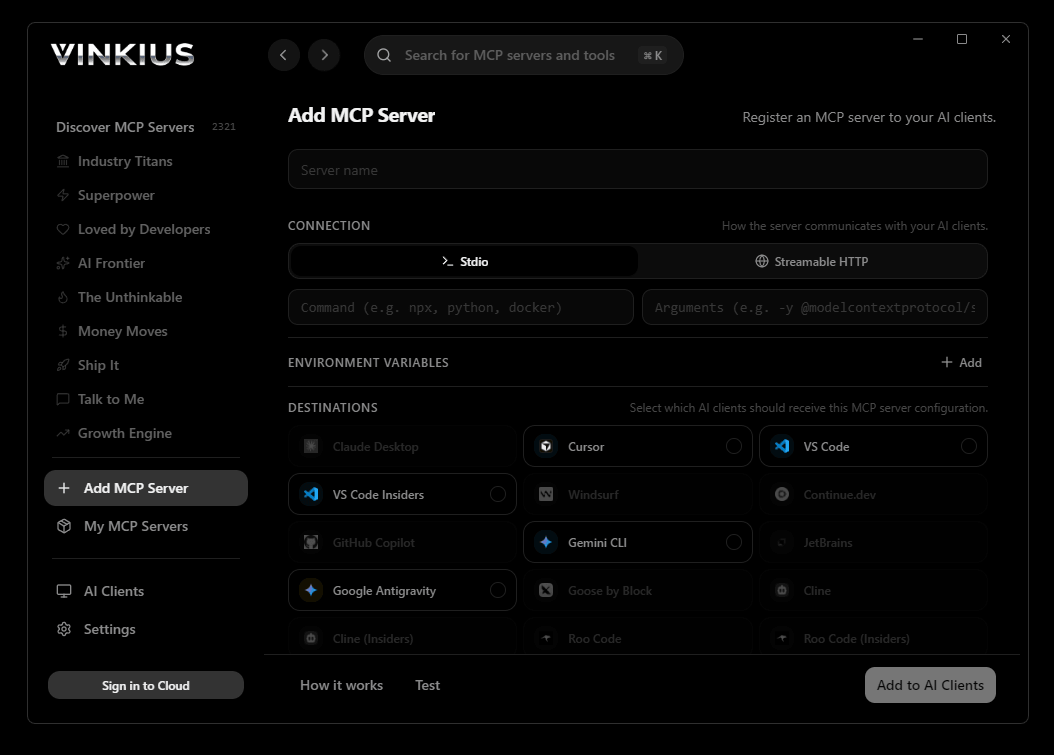
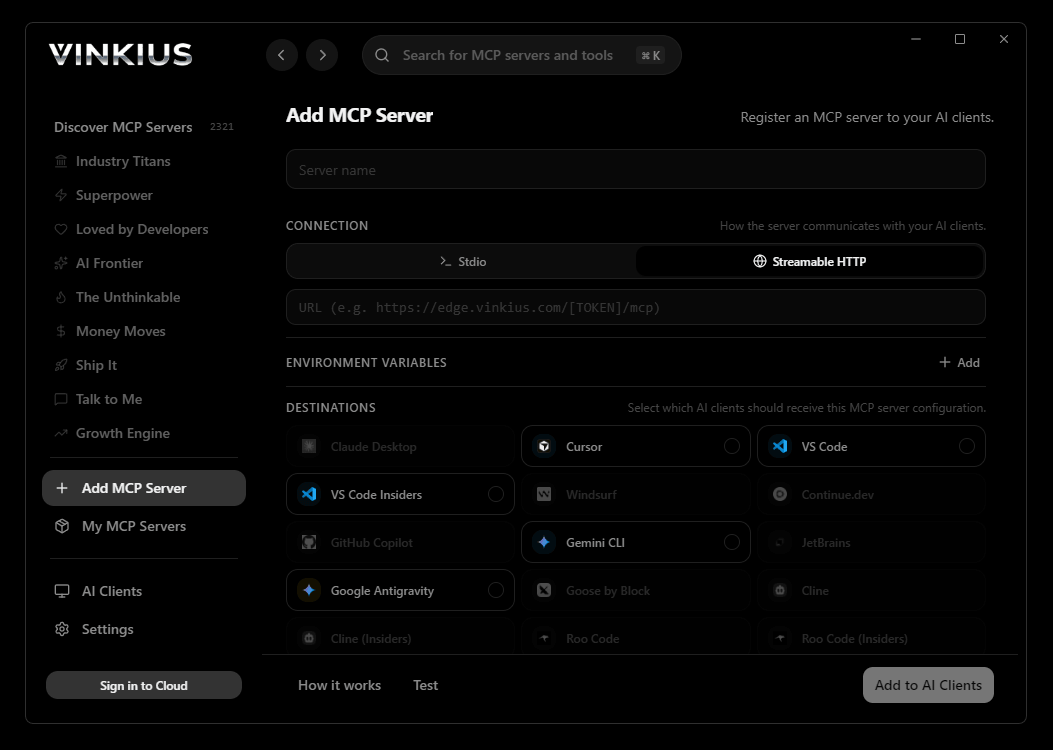
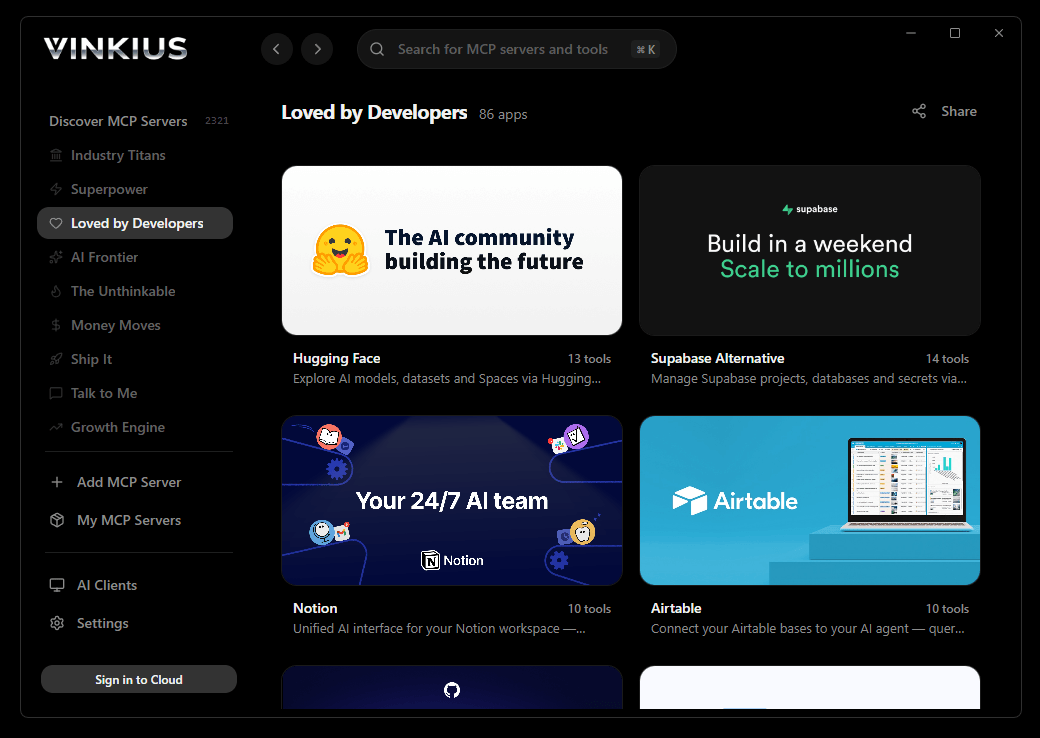
The modern way to manage MCP Servers — no config files, no terminal commands. Install Lacework (Cloud Security & CNAPP) and 2,500+ MCP Servers from a single visual interface.

{
  "mcpServers": {
    "lacework-cloud-security-cnapp": {
      "url": "https://edge.vinkius.com/[YOUR_TOKEN_HERE]/mcp"
    }
  }
}
* Every MCP server runs on Vinkius-managed infrastructure inside AWS - a purpose-built runtime with per-request V8 isolates, Ed25519 signed audit chains, and sub-40ms cold starts optimized for native MCP execution. See our infrastructure
About Lacework (Cloud Security & CNAPP) MCP Server
Connect your Lacework (FortiCNAPP) account to any AI agent and take full control of your cloud security posture and threat hunting through natural conversation.
Cursor's Agent mode turns Lacework (Cloud Security & CNAPP) into an in-editor superpower. Ask Cursor to generate code using live data from Lacework (Cloud Security & CNAPP) and it fetches, processes, and writes. all in a single agentic loop. 10 tools appear alongside file editing and terminal access, creating a unified development environment grounded in real-time information.
What you can do
- Alert Orchestration — Search and retrieve deep behavioral telemetry for security alerts, identifying anomalous Kubernetes executions or AWS IAM brute-forcing attempts directly from your agent
- Vulnerability Management — List critical CVEs executing on cloud hosts and monitor static image vulnerabilities in your container registries (ECR, DockerHub)
- Emergency Incident Response — Instantly search your entire infrastructure for specific CVE exposure (e.g., Log4j) to identify vulnerable nodes during zero-day events
- Asset Inventory Audit — Query the real-time cloud control-plane to enumerate running instances, unrestricted S3 buckets, and active networking perimeters
- Threat Hunting (LQL) — Execute specialized Lacework Query Language (LQL) requests to analyze vast datasets for anomalous login patterns or API key abuse
- Compliance Monitoring — List and audit global cloud security policies to ensure your infrastructure remains within regulatory and organizational norms
The Lacework (Cloud Security & CNAPP) MCP Server exposes 10 tools through the Vinkius. Connect it to Cursor in under two minutes — no API keys to rotate, no infrastructure to provision, no vendor lock-in. Your configuration, your data, your control.
How to Connect Lacework (Cloud Security & CNAPP) to Cursor via MCP
Follow these steps to integrate the Lacework (Cloud Security & CNAPP) MCP Server with Cursor.
Open MCP Settings
Press Cmd+Shift+P (macOS) or Ctrl+Shift+P (Windows/Linux) → search "MCP Settings"
Add the server config
Paste the JSON configuration above into the mcp.json file that opens
Save the file
Cursor will automatically detect the new MCP server
Start using Lacework (Cloud Security & CNAPP)
Open Agent mode in chat and ask: "Using Lacework (Cloud Security & CNAPP), help me...". 10 tools available
Why Use Cursor with the Lacework (Cloud Security & CNAPP) MCP Server
Cursor AI Code Editor provides unique advantages when paired with Lacework (Cloud Security & CNAPP) through the Model Context Protocol.
Agent mode turns Cursor into an autonomous coding assistant that can read files, run commands, and call MCP tools without switching context
Cursor's Composer feature can generate entire files using real-time data fetched through MCP. no copy-pasting from external dashboards
MCP tools appear alongside built-in tools like file reading and terminal access, creating a unified agentic environment
VS Code extension compatibility means your existing workflow, keybindings, and extensions all work alongside MCP tools
Lacework (Cloud Security & CNAPP) + Cursor Use Cases
Practical scenarios where Cursor combined with the Lacework (Cloud Security & CNAPP) MCP Server delivers measurable value.
Code generation with live data: ask Cursor to generate a security report module using live DNS and subdomain data fetched through MCP
Automated documentation: have Cursor query your API's tool schemas and generate TypeScript interfaces or OpenAPI specs automatically
Infrastructure-as-code: Cursor can fetch domain configurations and generate corresponding Terraform or CloudFormation templates
Test scaffolding: ask Cursor to pull real API responses via MCP and generate unit test fixtures from actual data
Lacework (Cloud Security & CNAPP) MCP Tools for Cursor (10)
These 10 tools become available when you connect Lacework (Cloud Security & CNAPP) to Cursor via MCP:
execute_query
Produces bespoke output matrices tracking API keys bypassing IAM logic, anomalous login patterns, or Kubernetes process spawn trees. Execute an LQL Threat Hunting Query on-demand
get_alert
Extracts precisely what baseline behavior was deviated from, providing deep contextual metadata such as explicit AWS Accounts involved, offending Container Image SHAs, and correlated external IP anomalies. Get exact behavioral payloads and telemetry for an Alert
list_container_vulnerabilities
Examines ECR/DockerHub registries or direct cluster deployments for images carrying critical inherited CVEs at the filesystem level before CI/CD promotion blocks. List static image vulnerabilities detected in Container Registries
list_host_vulnerabilities
Identifies running processes strictly matched against Critical or High CVEs (e.g., Log4j, Polkit) directly active inside EC2 or GCE instances. List known vulnerabilities executing natively on Cloud Hosts/VMs
list_lql_queries
These extract precise cloud telemetry fields mapping user-defined compliance checks directly against the underlying dataset. List all Lacework Query Language (LQL) structures
list_resource_groups
Helps define what constitutes "Production" vs "Staging" in Policy evaluation engines. List logical Resource Groups managing Lacework architectures
list_security_policies
Confirms whether Lacework will alert directly if an engineer violates structural norms (e.g., exposing port 22 directly to 0.0.0.0/0). List all global Cloud Security Policies enforced by Lacework
search_alerts
Fetches events mapping to anomalous Kubernetes executions, AWS IAM brute-forcing attempts, and massive container network exfiltrations spanning the specified time filter. Search Cloud Security alerts dynamically across Lacework
search_cloud_inventory
Used to dynamically enumerate running instances, active networking perimeters, or unrestricted S3 buckets discovered by cross-account role polling. Query the real-time Lacework Cloud Control-Plane Asset Inventory
search_cve_exposure
Directly filters the entire cloud infrastructure footprint determining exactly which specific nodes (Machines) are currently vulnerable to the designated CVE (e.g. "CVE-2026-0001"). Search all integrated Machines/Instances for a specific CVE
Example Prompts for Lacework (Cloud Security & CNAPP) in Cursor
Ready-to-use prompts you can give your Cursor agent to start working with Lacework (Cloud Security & CNAPP) immediately.
"Search for all Critical alerts from the last 24 hours"
"List all host vulnerabilities for our Production resource group"
"Are there any unrestricted S3 buckets currently visible in our inventory?"
Troubleshooting Lacework (Cloud Security & CNAPP) MCP Server with Cursor
Common issues when connecting Lacework (Cloud Security & CNAPP) to Cursor through the Vinkius, and how to resolve them.
Tools not appearing in Cursor
Server shows as disconnected
Lacework (Cloud Security & CNAPP) + Cursor FAQ
Common questions about integrating Lacework (Cloud Security & CNAPP) MCP Server with Cursor.
What is Agent mode and why does it matter for MCP?
Where does Cursor store MCP configuration?
mcp.json file. You can configure servers at the project level (.cursor/mcp.json in your project root) or globally (~/.cursor/mcp.json). Project-level configs take precedence.Can Cursor use MCP tools in inline edits?
How do I verify MCP tools are loaded?
Connect Lacework (Cloud Security & CNAPP) with your favorite client
Step-by-step setup guides for every MCP-compatible client and framework:
Anthropic's native desktop app for Claude with built-in MCP support.
AI-first code editor with integrated LLM-powered coding assistance.
GitHub Copilot in VS Code with Agent mode and MCP support.
Purpose-built IDE for agentic AI coding workflows.
Autonomous AI coding agent that runs inside VS Code.
Anthropic's agentic CLI for terminal-first development.
Python SDK for building production-grade OpenAI agent workflows.
Google's framework for building production AI agents.
Type-safe agent development for Python with first-class MCP support.
TypeScript toolkit for building AI-powered web applications.
TypeScript-native agent framework for modern web stacks.
Python framework for orchestrating collaborative AI agent crews.
Leading Python framework for composable LLM applications.
Data-aware AI agent framework for structured and unstructured sources.
Microsoft's framework for multi-agent collaborative conversations.
Connect Lacework (Cloud Security & CNAPP) to Cursor
Get your token, paste the configuration, and start using 10 tools in under 2 minutes. No API key management needed.