
Lunatask MCP Server for Pydantic AI 8 tools — connect in under 2 minutes
Pydantic AI brings type-safe agent development to Python with first-class MCP support. Connect Lunatask through Vinkius and every tool is automatically validated against Pydantic schemas. catch errors at build time, not in production.
ASK AI ABOUT THIS MCP SERVER
Vinkius supports streamable HTTP and SSE.
import asyncio
from pydantic_ai import Agent
from pydantic_ai.mcp import MCPServerHTTP

async def main():
    # Your Vinkius token. get it at cloud.vinkius.com
    server = MCPServerHTTP(url="https://edge.vinkius.com/[YOUR_TOKEN_HERE]/mcp")

    agent = Agent(
        model="openai:gpt-4o",
        mcp_servers=[server],
        system_prompt=(
            "You are an assistant with access to Lunatask "
            "(8 tools)."
        ),
    )

    result = await agent.run(
        "What tools are available in Lunatask?"
    )
    print(result.data)

asyncio.run(main())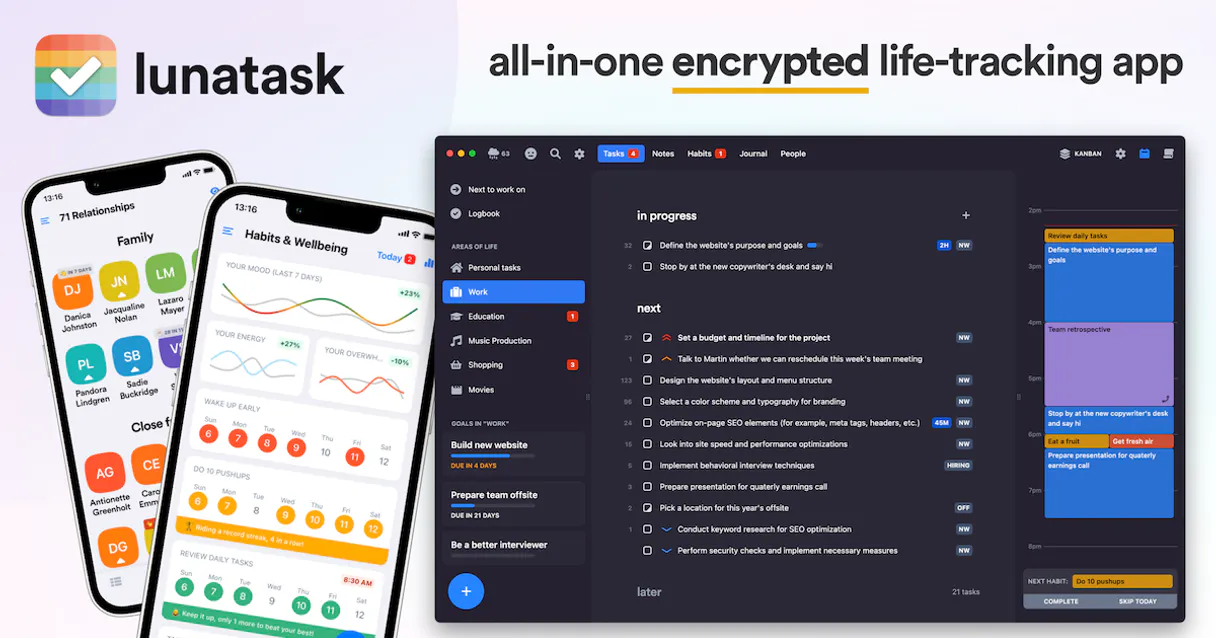
* Every MCP server runs on Vinkius-managed infrastructure inside AWS - a purpose-built runtime with per-request V8 isolates, Ed25519 signed audit chains, and sub-40ms cold starts optimized for native MCP execution. See our infrastructure
About Lunatask MCP Server
Connect your Lunatask account to any AI agent to streamline your privacy-focused productivity. This MCP server enables your agent to create, update, and manage tasks, track habits, and log journal entries directly from natural language interfaces.
Pydantic AI validates every Lunatask tool response against typed schemas, catching data inconsistencies at build time. Connect 8 tools through Vinkius and switch between OpenAI, Anthropic, or Gemini without changing your integration code. full type safety, structured output guarantees, and dependency injection for testable agents.
What you can do
- Task Creation — Add new tasks to specific Areas of Life with statuses like 'next' or 'later'
- Habit Tracking — Log completions for your daily habits to stay consistent with your goals
- Encrypted Journaling — Create secure, end-to-end encrypted journal entries directly from your conversation
- Metadata Inspection — List all tasks and notes to monitor your productivity structure and statuses
- Workflow Management — Update task priorities and move them through your personal workflow stages
Important Note on Privacy
Lunatask uses end-to-end encryption. While this API allows creating and updating content, it cannot read back the names or notes of your tasks once they are stored. The agent will only see technical metadata (IDs, dates, statuses).
The Lunatask MCP Server exposes 8 tools through the Vinkius. Connect it to Pydantic AI in under two minutes — no API keys to rotate, no infrastructure to provision, no vendor lock-in. Your configuration, your data, your control.
How to Connect Lunatask to Pydantic AI via MCP
Follow these steps to integrate the Lunatask MCP Server with Pydantic AI.
Install Pydantic AI
Run pip install pydantic-ai
Replace the token
Replace [YOUR_TOKEN_HERE] with your Vinkius token
Run the agent
Save to agent.py and run: python agent.py
Explore tools
The agent discovers 8 tools from Lunatask with type-safe schemas
Why Use Pydantic AI with the Lunatask MCP Server
Pydantic AI provides unique advantages when paired with Lunatask through the Model Context Protocol.
Full type safety: every MCP tool response is validated against Pydantic models, catching data inconsistencies before they reach your application
Model-agnostic architecture. switch between OpenAI, Anthropic, or Gemini without changing your Lunatask integration code
Structured output guarantee: Pydantic AI ensures tool results conform to defined schemas, eliminating runtime type errors
Dependency injection system cleanly separates your Lunatask connection logic from agent behavior for testable, maintainable code
Lunatask + Pydantic AI Use Cases
Practical scenarios where Pydantic AI combined with the Lunatask MCP Server delivers measurable value.
Type-safe data pipelines: query Lunatask with guaranteed response schemas, feeding validated data into downstream processing
API orchestration: chain multiple Lunatask tool calls with Pydantic validation at each step to ensure data integrity end-to-end
Production monitoring: build validated alert agents that query Lunatask and output structured, schema-compliant notifications
Testing and QA: use Pydantic AI's dependency injection to mock Lunatask responses and write comprehensive agent tests
Lunatask MCP Tools for Pydantic AI (8)
These 8 tools become available when you connect Lunatask to Pydantic AI via MCP:
create_journal_entry
Add a new journal entry
create_new_task
Requires a name and an area_id. Create a new task
delete_task
Delete a task
get_task_metadata
Get metadata for a specific task
list_notes_metadata
List metadata for all notes
list_tasks_metadata
Note: Due to encryption, names and notes are not available via API. List metadata for all tasks
track_habit_completion
Log a completion for a habit
update_existing_task
Update an existing task
Example Prompts for Lunatask in Pydantic AI
Ready-to-use prompts you can give your Pydantic AI agent to start working with Lunatask immediately.
"List metadata for all my tasks in Lunatask."
"Track a completion for habit ID 'habit-123'."
"Create a new task named 'Review quarterly report' in area 'area-abc'."
Troubleshooting Lunatask MCP Server with Pydantic AI
Common issues when connecting Lunatask to Pydantic AI through the Vinkius, and how to resolve them.
MCPServerHTTP not found
pip install --upgrade pydantic-aiLunatask + Pydantic AI FAQ
Common questions about integrating Lunatask MCP Server with Pydantic AI.
How does Pydantic AI discover MCP tools?
MCPServerHTTP instance with the server URL. Pydantic AI connects, discovers all tools, and generates typed Python interfaces automatically.Does Pydantic AI validate MCP tool responses?
Can I switch LLM providers without changing MCP code?
Connect Lunatask with your favorite client
Step-by-step setup guides for every MCP-compatible client and framework:
Anthropic's native desktop app for Claude with built-in MCP support.
AI-first code editor with integrated LLM-powered coding assistance.
GitHub Copilot in VS Code with Agent mode and MCP support.
Purpose-built IDE for agentic AI coding workflows.
Autonomous AI coding agent that runs inside VS Code.
Anthropic's agentic CLI for terminal-first development.
Python SDK for building production-grade OpenAI agent workflows.
Google's framework for building production AI agents.
Type-safe agent development for Python with first-class MCP support.
TypeScript toolkit for building AI-powered web applications.
TypeScript-native agent framework for modern web stacks.
Python framework for orchestrating collaborative AI agent crews.
Leading Python framework for composable LLM applications.
Data-aware AI agent framework for structured and unstructured sources.
Microsoft's framework for multi-agent collaborative conversations.
Connect Lunatask to Pydantic AI
Get your token, paste the configuration, and start using 8 tools in under 2 minutes. No API key management needed.