
Mastercard MCP Server for Claude Code 12 tools — connect in under 2 minutes
Claude Code is Anthropic's agentic CLI for terminal-first development. Add Mastercard as an MCP server in one command and Claude Code will discover every tool at runtime. ideal for automation pipelines, CI/CD integration, and headless workflows via Vinkius.
ASK AI ABOUT THIS MCP SERVER
Vinkius supports streamable HTTP and SSE.
Vinkius Desktop App
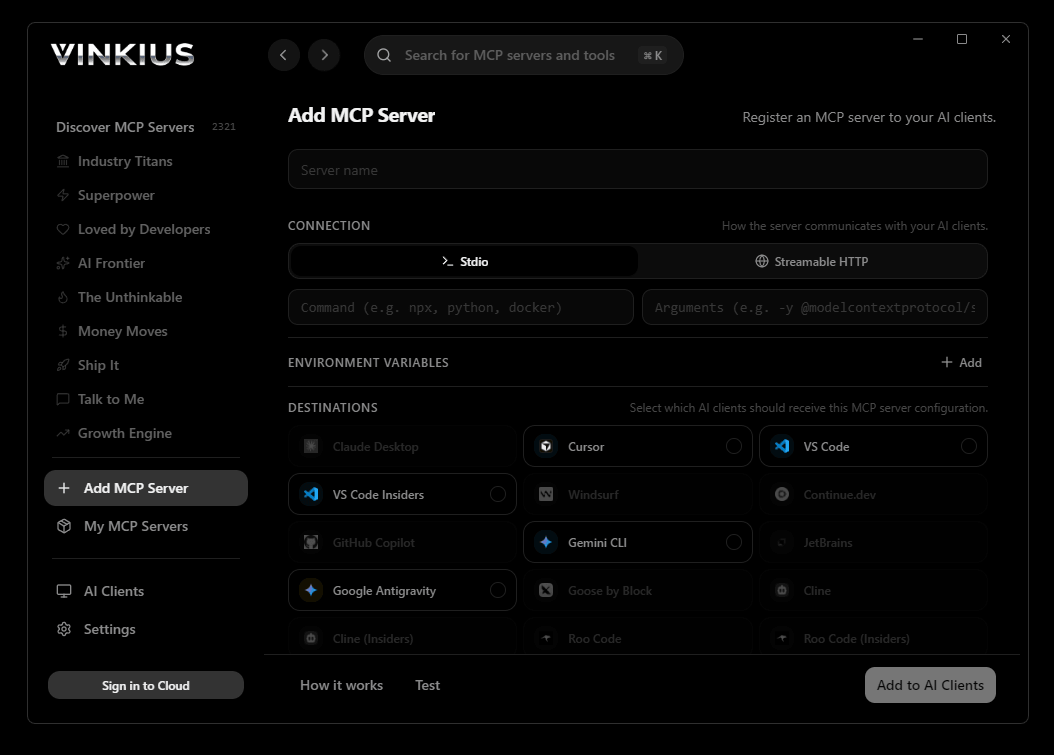
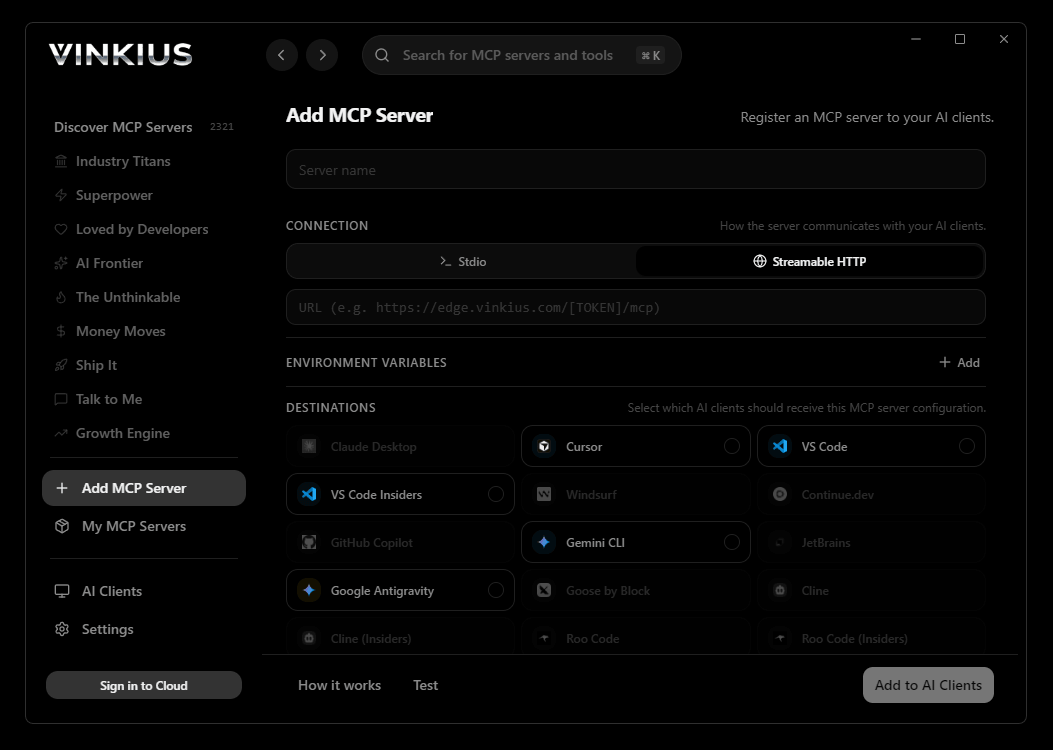
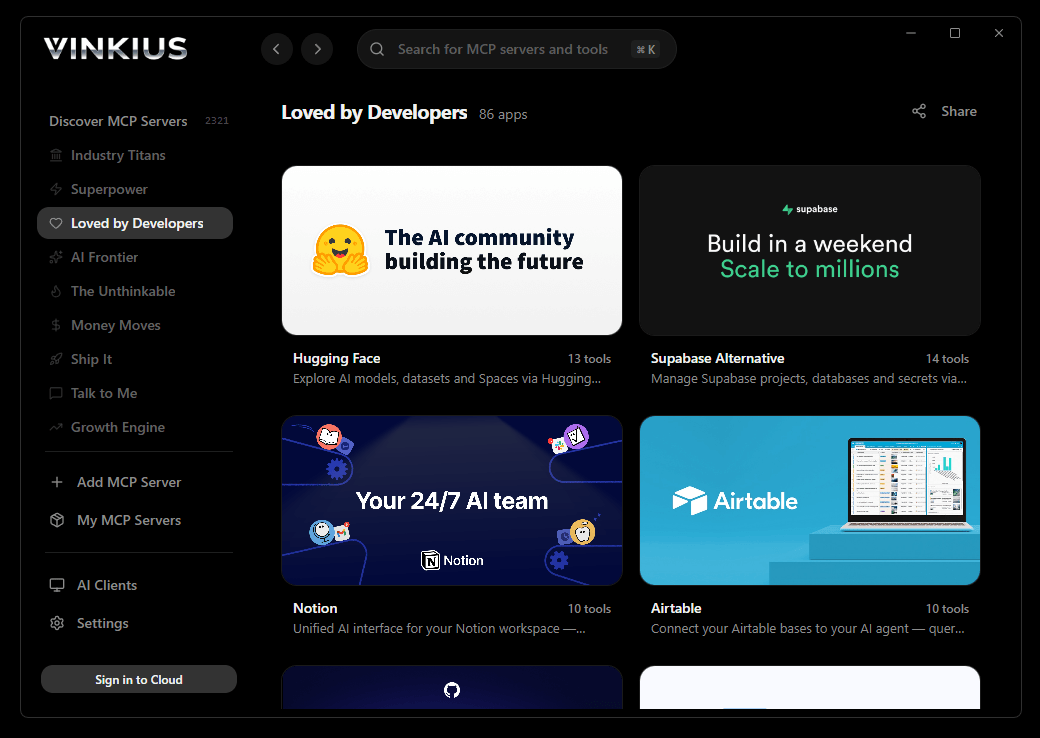
The modern way to manage MCP Servers — no config files, no terminal commands. Install Mastercard and 2,500+ MCP Servers from a single visual interface.

# Your Vinkius token. get it at cloud.vinkius.com
claude mcp add mastercard --transport http "https://edge.vinkius.com/[YOUR_TOKEN_HERE]/mcp"
* Every MCP server runs on Vinkius-managed infrastructure inside AWS - a purpose-built runtime with per-request V8 isolates, Ed25519 signed audit chains, and sub-40ms cold starts optimized for native MCP execution. See our infrastructure
About Mastercard MCP Server
Connect Mastercard payment infrastructure to any AI agent and unlock powerful payment intelligence, fraud detection, merchant discovery, and card validation capabilities through natural conversation.
Claude Code registers Mastercard as an MCP server in a single terminal command. Once connected, Claude Code discovers all 12 tools at runtime and can call them headlessly. ideal for CI/CD pipelines, cron jobs, and automated workflows where Mastercard data drives decisions without human intervention.
What you can do
- BIN Lookup — Identify any payment card's issuer bank, card type (credit/debit/prepaid/commercial), category (Standard/Gold/Platinum/World/World Elite), issuing country, and special flags from just the first 6-8 digits
- Account Validation — Verify if a payment card number is active and valid before processing transactions, reducing declined payments and fraud risk
- Merchant Search — Find Mastercard-accepting merchants near any GPS coordinates, filterable by business category (MCC codes)
- Places Discovery — Discover nearby payment-accepting locations with digital wallet support (Apple Pay, Google Pay, contactless)
- Address-Based Search — Search for merchants by street address instead of coordinates for user-friendly location queries
- Merchant Details — Retrieve complete information about specific merchants including addresses, MCC codes, and accepted payment methods
- MCC Code Reference — Access the complete Merchant Category Code database to understand business classifications
- Fraud Reporting — Submit confirmed fraudulent transactions to Mastercard's Fraud and Loss Database to protect the network
- Nearby Locations — Discover ATMs, merchants, and points of interest around any geographic location
The Mastercard MCP Server exposes 12 tools through the Vinkius. Connect it to Claude Code in under two minutes — no API keys to rotate, no infrastructure to provision, no vendor lock-in. Your configuration, your data, your control.
How to Connect Mastercard to Claude Code via MCP
Follow these steps to integrate the Mastercard MCP Server with Claude Code.
Install Claude Code
Run npm install -g @anthropic-ai/claude-code if not already installed
Add the MCP Server
Run the command above in your terminal
Verify the connection
Run claude mcp to list connected servers, or type /mcp inside a session
Start using Mastercard
Ask Claude: "Using Mastercard, show me...". 12 tools are ready
Why Use Claude Code with the Mastercard MCP Server
Claude Code provides unique advantages when paired with Mastercard through the Model Context Protocol.
Single-command setup: `claude mcp add` registers the server instantly. no config files to edit or applications to restart
Terminal-native workflow means MCP tools integrate seamlessly into shell scripts, CI/CD pipelines, and automated DevOps tasks
Claude Code runs headlessly, enabling unattended batch processing using Mastercard tools in cron jobs or deployment scripts
Built by the same team that created the MCP protocol, ensuring first-class compatibility and the fastest adoption of new protocol features
Mastercard + Claude Code Use Cases
Practical scenarios where Claude Code combined with the Mastercard MCP Server delivers measurable value.
CI/CD integration: embed Mastercard tool calls in your deployment pipeline to validate configurations or fetch secrets before shipping
Headless batch processing: schedule Claude Code to query Mastercard nightly and generate reports without human intervention
Shell scripting: pipe Mastercard outputs into other CLI tools for data transformation, filtering, and aggregation
Infrastructure monitoring: run Claude Code in a cron job to query Mastercard status endpoints and alert on anomalies
Mastercard MCP Tools for Claude Code (12)
These 12 tools become available when you connect Mastercard to Claude Code via MCP:
bin_lookup
Returns comprehensive card information including: issuer bank name, card type (credit/debit/prepaid/commercial), card category (Standard/Gold/Platinum/World/World Elite), issuing country, currency, and special flags (healthcare, payroll, purchasing). Use this to identify unknown cards, validate card ranges before transactions, determine cross-border fees, or understand the cardholder profile. The accountNumberPrefix parameter must be 6-8 numeric digits. Optional parameters (currencyCode, paymentType, merchantCategoryCode) provide more precise results for specific transaction contexts. Identify card issuer, type, and details from the first 6-8 digits of a payment card number
bin_lookup_post
Returns identical card identification data: issuer bank, card type, category, country, and product flags. Use this method when handling sensitive payment data in compliance-focused applications. The accountNumberPrefix should be 6-8 digits. Optional context parameters (currency, payment type, MCC) refine results. Identify card issuer using POST method for enhanced security with sensitive card data
get_merchant
Returns full address, contact information, MCC code, operating hours, and accepted payment methods. Use this to get in-depth information about a specific merchant location after finding it via search. The merchant ID is a unique identifier returned by the search_merchants tool. Get detailed information about a specific Mastercard-accepting merchant
get_place_details
Returns full address, coordinates, MCC code, payment methods accepted, operating hours, and other merchant attributes. Use this after a places search to drill down into a specific location. The locationId is returned by search_places or search_places_by_address tools. Get complete details for a specific merchant place by its location ID
merchant_category_codes
MCC codes are 4-digit numbers that classify businesses by type (e.g., 5411 = Grocery Stores, 5812 = Restaurants, 4511 = Airlines). Use this to understand merchant classifications, filter searches by business type, or decode MCC values found in transaction data. Optional limit parameter controls how many codes to return. List all Merchant Category Codes (MCC) used to classify business types
merchant_industry_codes
Industry codes group related MCC codes into higher-level categories. Use this to understand the hierarchical classification of merchants, analyze industry-level spending patterns, or build category navigation interfaces. List all merchant industry codes for broader business classification
nearby_locations
Returns names, addresses, categories, and distances from the search point. Use this for "what is nearby" queries, travel planning, or finding payment infrastructure in an area. Latitude and longitude are required. Radius in meters defines the search area. Limit controls maximum results returned. Discover points of interest and payment locations near GPS coordinates
search_merchants
Returns merchant names, addresses, MCC codes, and precise coordinates. Use this to find nearby payment-accepting locations, analyze merchant density in an area, or build "find merchants near me" features. Latitude and longitude are required as strings (e.g., "-23.5505", "-46.6333"). Radius is in meters (e.g., 5000 for 5km). Optionally filter by MCC category code (e.g., "5411" for grocery stores, "5812" for restaurants). Limit controls result count (max 50). Find Mastercard-accepting merchants near specific GPS coordinates filtered by category
search_places
Returns detailed merchant information including whether they accept Apple Pay, Google Pay, contactless payments, and their MCC classification. Use this when users need to find payment-accepting locations with specific digital wallet support. Latitude and longitude are required as numbers. Distance is in kilometers. Optionally filter by country code (ISO 3166-1 alpha-2) and payment capabilities (hasApplePay, hasGooglePay). Search for merchant places using GPS coordinates with payment method filters
search_places_by_address
The API geocodes the address internally. Returns nearby merchants with payment capability details (Apple Pay, Google Pay, contactless). Use this when users provide an address rather than GPS coordinates. Required: address line 1, city, country code, and postal code. Optional: state/province code (countrySubdivisionCode) for more precise results. Example: addressLine1="1600 Amphitheatre Pkwy", city="Mountain View", countryCode="US", postalCode="94043". Search for merchant places using a street address instead of coordinates
submit_fraud_report
This is a critical tool for issuers and processors to flag fraudulent transactions in real-time. Required fields: accountNumber (card number), transactionAmount, transactionCurrency (ISO 4217), and fraudTypeCode. Fraud type codes: "01" = Stolen Card Fraud, "02" = Never Received Card, "03" = Fraudulent Application, "04" = Counterfeit Card Fraud. Optional: fraudAmount (if different from transaction amount), transactionDate (YYYY-MM-DD). Use this only for confirmed fraud cases — never for suspected or disputed transactions. This helps Mastercard improve fraud detection and reduce false positives across the network. IMPORTANT: This action should only be performed by authorized fraud management personnel. Report a confirmed fraudulent transaction to Mastercard Fraud and Loss Database
validate_account
Returns validation status (VALID/INVALID), account type, and issuer information. Use this to verify card validity before processing transactions, reduce declined transactions, or perform account verification during onboarding. Required: accountNumber (full card number). Optional: expiryDate (MMYY format), cardholderName for enhanced validation. Handle card numbers securely — never log or store full PANs. Validate a payment card account number to check if it is active and valid
Example Prompts for Mastercard in Claude Code
Ready-to-use prompts you can give your Claude Code agent to start working with Mastercard immediately.
"What type of card is 542418 and which bank issued it?"
"Find restaurants near São Paulo city center that accept Mastercard within 3km."
"Validate card number 5123456789012346 before I process this payment."
Troubleshooting Mastercard MCP Server with Claude Code
Common issues when connecting Mastercard to Claude Code through the Vinkius, and how to resolve them.
Command not found: claude
npm install -g @anthropic-ai/claude-codeConnection timeout
Mastercard + Claude Code FAQ
Common questions about integrating Mastercard MCP Server with Claude Code.
How do I add an MCP server to Claude Code?
claude mcp add --transport http "" in your terminal. Claude Code registers the server and discovers all tools immediately.Can Claude Code run MCP tools in headless mode?
How do I list all connected MCP servers?
claude mcp in your terminal to see all registered servers and their status, or type /mcp inside an active Claude Code session.Connect Mastercard with your favorite client
Step-by-step setup guides for every MCP-compatible client and framework:
Anthropic's native desktop app for Claude with built-in MCP support.
AI-first code editor with integrated LLM-powered coding assistance.
GitHub Copilot in VS Code with Agent mode and MCP support.
Purpose-built IDE for agentic AI coding workflows.
Autonomous AI coding agent that runs inside VS Code.
Anthropic's agentic CLI for terminal-first development.
Python SDK for building production-grade OpenAI agent workflows.
Google's framework for building production AI agents.
Type-safe agent development for Python with first-class MCP support.
TypeScript toolkit for building AI-powered web applications.
TypeScript-native agent framework for modern web stacks.
Python framework for orchestrating collaborative AI agent crews.
Leading Python framework for composable LLM applications.
Data-aware AI agent framework for structured and unstructured sources.
Microsoft's framework for multi-agent collaborative conversations.
Connect Mastercard to Claude Code
Get your token, paste the configuration, and start using 12 tools in under 2 minutes. No API key management needed.