
Motion MCP. Manage projects and schedule tasks via natural conversation.
 Gemini
 Works with every AI agent you already use
…and any MCP-compatible client









Just plug in your AI agents and start using Vinkius.
Motion MCP Server lets your AI client manage all scheduling, projects, and tasks using natural conversation. Create new tasks that automatically schedule themselves based on priority.
List projects across multiple workspaces or update due dates in real-time—all without opening a calendar.
What your AI agents can do
Create project
Creates a new, static container for grouping related tasks within your Motion workspace.
Create task
Generates a new task that the Motion AI engine will automatically schedule and place on your calendar.
Delete task
Permanently deletes a specified task, which also removes all associated blocks from your calendar.
Creates a task and assigns it an automatic time slot based on its specified priority.
Lists all project containers in your active workspace, helping you group related tasks.
Retrieves the AI-calculated schedule for a given workspace to show projected task completion times.
Modifies an existing task's configuration, like changing its due date or priority level.
Lists all tasks within a workspace, narrowing the view using lifecycle filters (e.g., 'pending review').
Ask AI about this MCP
Supported MCP Clients
Gemini Waiting for input…
Motion (AI Calendar & Task Management) MCP Server: 10 Tools for Scheduling
These tools let your agent manage the full lifecycle of project tasks—from listing workspaces to moving and updating specific deadlines.
019d75d8create project
Creates a new, static container for grouping related tasks within your Motion workspace.
019d75d8create task
Generates a new task that the Motion AI engine will automatically schedule and place on your calendar.
019d75d8delete task
Permanently deletes a specified task, which also removes all associated blocks from your calendar.
019d75d8get schedule
Retrieves the AI-optimized timeline schedule for a workspace, showing projected completion dates for tasks.
019d75d8get task
Pulls all current details for one specific task when you know its ID number.
019d75d8list projects
Shows a list of every project container available in your active Motion workspace.
019d75d8list tasks
Lists all tasks in a workspace, allowing you to filter the results by their current lifecycle status.
019d75d8list workspaces
Retrieves a list of every separate workspace container you have access to within Motion.
019d75d8move task
Moves a specific task from one organizational workspace to an entirely different target workspace.
019d75d8update task
Changes the configuration parameters of an existing task, such as its priority or due date.
Choose How to Get Started
Build a custom MCP for your own tools, or connect a ready-made integration from our catalog.
Build Your Own
Turn any API into an MCP. Import a spec, define Agent Skills, or deploy with MCPFusion.
- Import from OpenAPI, Swagger, or YAML specs
- Create Agent Skills with progressive disclosure
- Deploy to edge with MCPFusion framework
- Built in DLP, auth, and compliance on every call
- Real time usage dashboard and cost metering
- Publish to catalog or keep private
Make Your AI Do More
Start with Motion (AI Calendar & Task Management), then connect any of our 4,700+ other servers whenever your AI needs more. One click, no limits.
- Use this MCP plus 4,700+ others, all in one place
- Add new capabilities to your AI anytime you want
- Every connection is secured and compliant automatically
- Track usage and costs across all your servers
- Works with Claude, ChatGPT, Cursor, and more
- New servers added to the catalog every week
What you can do with this MCP connector
Motion lets your AI client manage every piece of scheduling and project work you got without making you open a single dashboard. You just talk to it—you tell Motion what needs to happen, and its engine handles the rest. Forget manually updating timelines or dragging tasks around; this thing uses natural conversation to make things move.
Project Setup & Organization
When you're getting set up, your agent can first check out everything by using list_workspaces, which pulls a list of every separate container you've got access to in Motion. You can then see exactly what projects are active within any given space by calling list_projects; this shows you all the project containers available in your current workspace.
If you need to group related tasks, use create_project to make a new, static container for those items right into your Motion workspace.
Task Management & Modification
The core of what this thing does is managing individual tasks. You can generate a whole new task using create_task; the Motion AI engine immediately takes that task and schedules it onto your calendar automatically. If you need to change something about an existing item, call update_task—you can modify any configuration parameter, like changing its due date or bumping up its priority level.
Need to clear out some clutter? You use delete_task to permanently delete a specific task; that action automatically removes all associated time blocks from your calendar too. To know the specifics of one item without searching, you run get_task, which pulls all current details for a single task once you feed it its unique ID number.
Workflow View & Movement
Your agent keeps tabs on everything moving around. You can list every task in a workspace using list_tasks; this function lets you narrow down the view by filtering tasks based on their current lifecycle status, like 'pending review.' If you need to see what else is going on, get_task helps pull all details for one specific item when you know its ID number.
You can also get a full picture of projected completion times across an entire work area by calling get_schedule, which retrieves the AI-optimized timeline schedule for your workspace.
You'll find that tasks don't have to stay put either. If an item needs to move from one organizational context to another, use move_task to transfer a specific task from its current workspace into a totally different target workspace.
How Motion MCP Works
- 1 Subscribe to this server and input your Motion API Key.
- 2 Instruct your agent via natural language: e.g., 'Create a high-priority task for X in the Engineering workspace.'
- 3 Your AI client calls the relevant tool (like
create_taskorupdate_task), and the schedule updates instantly.
The bottom line is you talk to your agent, and it runs the necessary Motion commands to update your project timeline automatically.
Who Is Motion MCP For?
This is for the Project Lead drowning in cross-platform dashboards or the Knowledge Worker who spends too much time manually shuffling calendar invites. If you deal with multiple moving parts—tasks, dependencies, and deadlines—and your current system feels like a series of clicks, this is for you.
Manages team tasks across many different workspaces. Uses list_workspaces to scope queries and ensures all projects remain correctly grouped via create_project.
Needs to verify project flows and task dependencies. Uses get_schedule constantly to see if the current set of tasks will actually finish on time.
Handles diverse client projects that require rapid status updates. Uses list_tasks with filters and update_task to reflect immediate changes in project scope.
What Changes When You Connect
- Automatically schedules time blocks. Instead of manually allocating time, use
create_taskwith a priority (HIGH/LOW), and Motion handles the calendar math for you. - See the big picture instantly. Run
get_scheduleto get an AI-optimized view that shows all tasks resolved into your free slots, revealing potential conflicts before they happen. - Keep things organized across teams. Use
list_workspacesand thencreate_projectto group related work in isolated containers, keeping project scopes clean. - Don't lose track of where stuff goes. If a task needs to move from 'Marketing' to 'Product', just use
move_task. It keeps the data model current without manual effort. - Quickly check status. Use
list_tasksand apply filters (like 'pending review') to narrow down your focus, instead of scrolling through hundreds of entries. - Keep it accurate. After a task is done, run
delete_task. This cleans up the log, preventing old, obsolete items from cluttering your project history.
Real-World Use Cases
The Daily Task Dump
A Project Manager wakes up with 15 random to-dos. Instead of opening 15 tabs and assigning time blocks, they tell their agent: 'Create a high-priority task for Q3 review in the Client A workspace.' The agent calls create_task, Motion schedules it immediately, and the PM sees the update on the day’s timeline.
Scope Creep Containment
A team project needs to transition from a 'Phase 1' workspace to a new 'Maintenance' workspace. Instead of manually copying tasks, the Project Lead uses move_task on all relevant items. This cleanly updates the task’s container and keeps the history accurate.
The Deadline Shift
A key deliverable date gets pushed back by a week. Instead of manually updating every related milestone, the Technical Lead uses update_task on that master item. The agent then recalculates all downstream dependencies and updates the whole schedule via get_schedule.
Auditing Project Components
The PM needs to know what's currently active in the 'Alpha Launch' container. They use list_projects first, then focus on a specific project ID and run list_tasks, filtering by 'In Progress.' This provides an instant status report without manual data gathering.
The Tradeoffs
Manually tracking dependencies
The user tries to manually track that Task B can't start until Task A is marked complete by copying dates into a spreadsheet and updating it every day.
→
You don't need spreadsheets. Use get_schedule to let Motion's AI engine resolve dependencies automatically. If Task A changes, the schedule updates instantly, removing manual tracking.
Ignoring task ownership
The user creates a task and forgets which project it belongs to, leaving it floating in the general 'To Do' list.
→
Always assign tasks using create_task within a specific context. If you need to change its parent container later, run move_task to properly re-scope it.
Over-documenting minor changes
The user feels they must create a new project just because the scope changed slightly, leading to dozens of nearly identical containers.
→
Don't over-create. Use update_task and move_task instead. These tools modify existing structure rather than creating redundant ones, keeping your workspace clean.
When It Fits, When It Doesn't
Use this MCP Server if your primary pain point is turning conversational instructions into concrete scheduling actions across many separate project containers. You need a single source of truth for task dependencies and timeline optimization.
Don't use it if you only need simple data retrieval (e.g., just listing tasks without worrying about their status) or if your project structure involves complex, custom state machines that require enforcing strict business rules outside of scheduling logic. For pure read-only reporting or highly granular dependency graphing, an external workflow engine might be better suited. But for general task life cycle management and calendar syncing, this is the right tool.
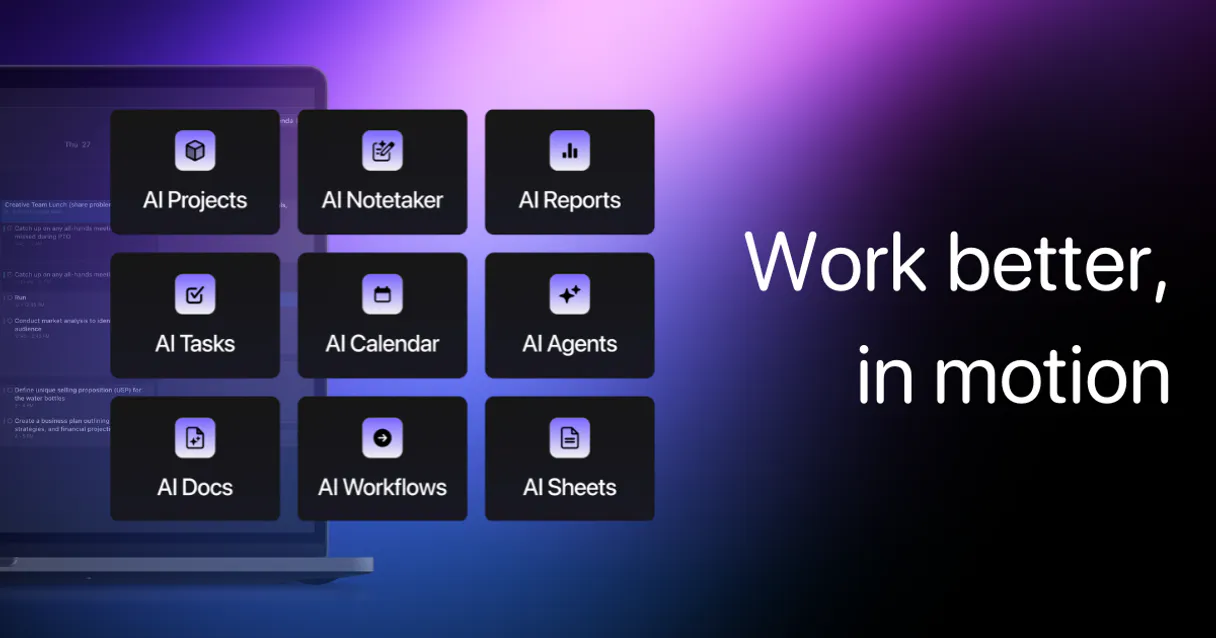
Independent Platform Disclaimer: Vinkius is an independent platform and is not affiliated with, endorsed by, sponsored by, verified by, or otherwise authorized by Motion. All third-party trademarks, logos, and brand names are the property of their respective owners. Their use on this website is strictly for informational purposes to identify service compatibility and interoperability.
VINKIUS INFRASTRUCTURE
Cloud Hosted
Managed infra
V8 Isolated
Sandboxed per request
Zero-Trust Proxy
No stored credentials
DLP Enforced
Policy on every call
GDPR Compliant
EU data residency
Token Compression
~60% cost reduction
Works with Claude, ChatGPT, Cursor, and more
The Model Context Protocol standardizes how applications expose capabilities to LLMs. Instead of operating in isolation, your AI gains direct access to external platforms, live data, and real-world actions through secure, standardized connections.
This server provides 10 capabilities that interface natively with Claude, ChatGPT, Cursor, and any MCP client. No middleware. No custom integration required.
Available Capabilities
Juggling projects means constantly cross-checking dates and statuses across different tools.
Today, managing a single complex project means jumping between your task list, your main calendar app, and then checking an external dashboard to see if the dependencies line up. You spend half your day copying IDs, pasting due dates, and manually confirming that 'Task B' actually has time after 'Task A.'
With Motion, you talk to your agent. You tell it: 'Move this task and update its priority.' The agent calls `move_task` and `update_task`. It recalculates the whole timeline and tells you what the new schedule looks like. Done.
Using Motion (AI Calendar & Task Management) MCP Server: Project & Task Ops
You no longer have to open three different interfaces—one for projects, one for tasks, and one for the calendar—just to get a status update. You just ask your agent to list all projects or check the optimized schedule.
It's immediate. The AI handles the coordination between task creation (`create_task`) and timeline adjustment (`get_schedule`). That’s the difference: it’s integrated, not sequential.
Common Questions About Motion MCP
How do I see all my separate work areas in Motion using list_workspaces? +
You call list_workspaces. This tool retrieves a complete list of every workspace container you have access to. It helps you know exactly which context your agent needs to run commands against.
Can I change a task's due date using the update_task tool? +
Yes, update_task changes parameters like priority or the due date. Critically, after you use this tool, Motion signals the AI engine to immediately recalculate your entire schedule.
What is the difference between list_projects and list_tasks? +
list_projects shows you the high-level containers (the grouping), while list_tasks shows the individual items within a specific container. You usually run them in sequence to map out scope.
If I delete a task, does it remove its scheduled time from my calendar? (delete_task) +
Yes, delete_task permanently deletes the task and removes all associated blocks from your calendar. Use this when you know for sure that the work is obsolete.
When I use the optional status filters with the `list_tasks` tool, what types of statuses can I narrow my results by? +
The list_tasks tool lets you filter tasks based on their current lifecycle state. You can specify statuses like 'Completed', 'In Progress', or 'Blocked' to pull a focused list. This is useful for auditing specific task batches, rather than listing everything in the workspace.
If I use `create_task` with tight deadlines, how does the system resolve scheduling conflicts using the AI engine? +
The Motion AI engine automatically resolves time overlaps and dependencies. When you run get_schedule, it shows the optimized timeline that accommodates your new task by adjusting surrounding blocks. You don't need to manually check for conflicts.
What exactly does the `move_task` tool do when I change a task's workspace container? +
The move_task tool changes the organizational context of the task. It doesn't change the content or due date; it just reassigns the task to a different project boundary, helping you group tasks under a new initiative.
What is the practical difference between listing projects using `list_projects` versus simply grouping tasks? +
Projects are containers. When you use create_project, you define a high-level scope for related work. Listing them shows these defined groups, which gives structure to the individual tasks within them.
How does Motion's AI auto-scheduling work through the agent? +
When you use the create_task tool, you specify a priority (ASAP to LOW). Your agent dispatches this to Motion, which immediately finds the best available blocks in your calendar, ensuring your high-priority items are scheduled first without manual intervention.
Can I move tasks between different workspaces through a conversation? +
Yes. Use the move_task tool by providing the Task ID and the Destination Workspace ID. Your agent will update the task's logic container, allowing you to organize your schedule across personal and professional boundaries seamlessly.
How do I see my projected completion times for all tasks in a workspace? +
The get_schedule tool retrieves the AI-optimized timeline for a specific Workspace ID. Your agent will report the projected time blocks for each task, showing you exactly how Motion's AI has resolved your daily priorities.
Use it with your favorite AI tools
Connect this server to Cursor, Claude, VS Code, and more.
More in this category
Capacities
Empower your AI agents to build knowledge graphs, append daily notes, and save weblinks directly into your Capacities spaces.

PDFMonkey
Generate dynamic PDF documents from JSON data and HTML templates with an API built for high-volume document automation.

Patreon (Creator Subscriptions)
Manage your Patreon creator account—list campaigns, track members, and monitor posts directly from your AI agent.
You might also like

Unleash (Feature Toggles)
Manage feature flags, strategies, and environments via Unleash — evaluate toggles, list projects, and monitor metrics directly from your AI agent.

DefiLlama (DeFi Analytics)
Access comprehensive DeFi data including TVL, token prices, yields, and volumes across multiple chains and protocols.

AskHandle
Integrate custom AI agents with AskHandle.