
NASA Full — Ultimate Space Intelligence MCP Server for Cursor 32 tools — connect in under 2 minutes
Cursor is an AI-first code editor built on VS Code that integrates LLM-powered coding assistance directly into the development workflow. Its Agent mode enables autonomous multi-step coding tasks, and MCP support lets agents access external data sources and APIs during code generation.
ASK AI ABOUT THIS MCP SERVER
Vinkius supports streamable HTTP and SSE.
Vinkius Desktop App
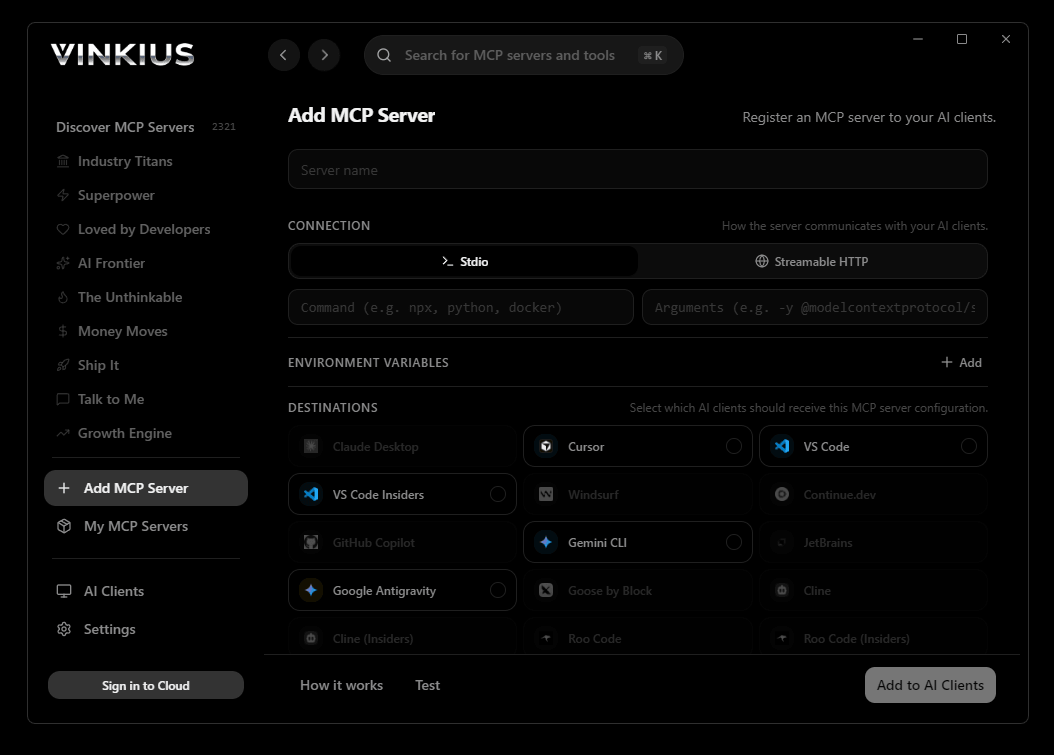
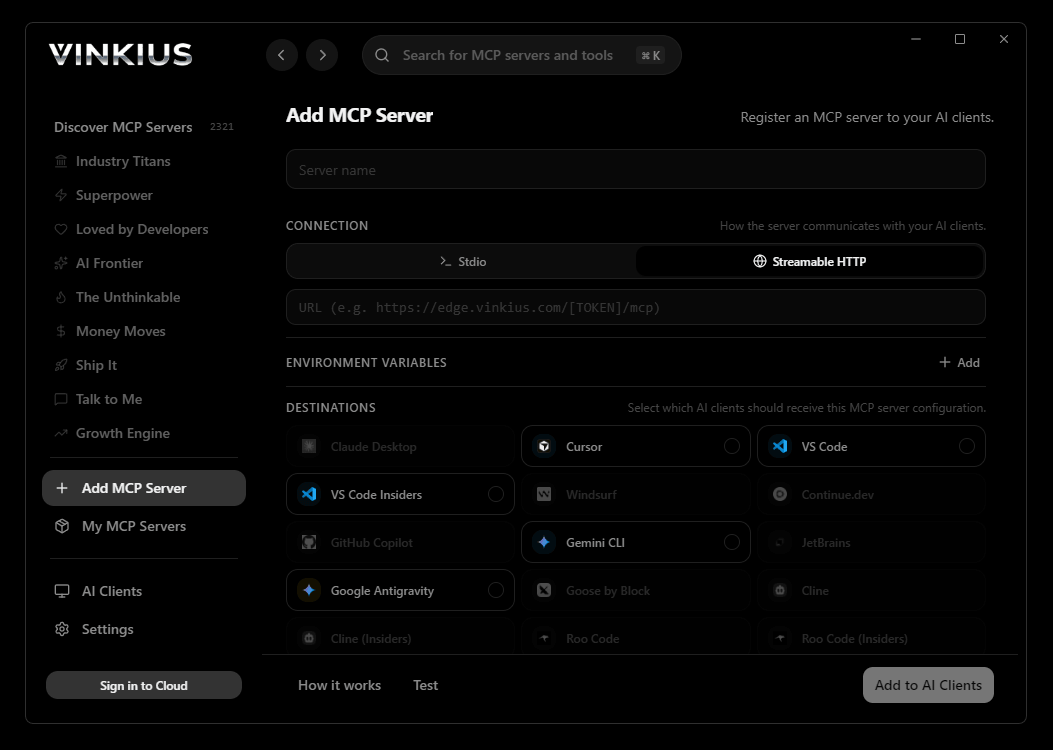
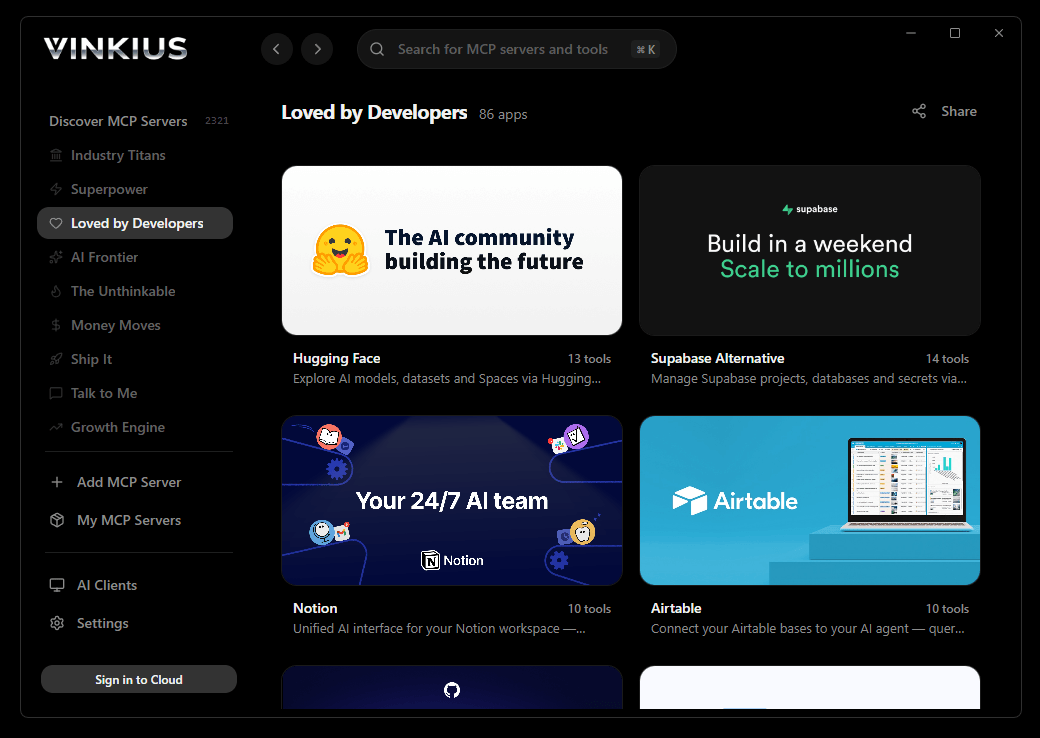
The modern way to manage MCP Servers — no config files, no terminal commands. Install NASA Full — Ultimate Space Intelligence and 2,500+ MCP Servers from a single visual interface.

{
  "mcpServers": {
    "nasa-full-ultimate-space-intelligence": {
      "url": "https://edge.vinkius.com/[YOUR_TOKEN_HERE]/mcp"
    }
  }
}
* Every MCP server runs on Vinkius-managed infrastructure inside AWS - a purpose-built runtime with per-request V8 isolates, Ed25519 signed audit chains, and sub-40ms cold starts optimized for native MCP execution. See our infrastructure
About NASA Full — Ultimate Space Intelligence MCP Server
The ultimate NASA Mega-Server — 32+ tools across 7 domains from 10 data sources.
Cursor's Agent mode turns NASA Full — Ultimate Space Intelligence into an in-editor superpower. Ask Cursor to generate code using live data from NASA Full — Ultimate Space Intelligence and it fetches, processes, and writes. all in a single agentic loop. 32 tools appear alongside file editing and terminal access, creating a unified development environment grounded in real-time information.
32+ Tools
- 🌌 APOD (3) — Today, date range, random
- ☄️ Asteroids (5) — NEOs, close approaches, fireballs
- 🔴 Mars (4) — Photos by sol/date, manifests, latest
- ☀️ Space Weather (7) — CME, flares, storms, shocks, particles
- 🌍 Earth (5) — EPIC imagery, EONET events
- 🪐 Exoplanets (4) — Confirmed, habitable zone, stats
- 📸 Media (4) — Images, videos, patents
One API Key for Everything
The NASA Full — Ultimate Space Intelligence MCP Server exposes 32 tools through the Vinkius. Connect it to Cursor in under two minutes — no API keys to rotate, no infrastructure to provision, no vendor lock-in. Your configuration, your data, your control.
How to Connect NASA Full — Ultimate Space Intelligence to Cursor via MCP
Follow these steps to integrate the NASA Full — Ultimate Space Intelligence MCP Server with Cursor.
Open MCP Settings
Press Cmd+Shift+P (macOS) or Ctrl+Shift+P (Windows/Linux) → search "MCP Settings"
Add the server config
Paste the JSON configuration above into the mcp.json file that opens
Save the file
Cursor will automatically detect the new MCP server
Start using NASA Full — Ultimate Space Intelligence
Open Agent mode in chat and ask: "Using NASA Full — Ultimate Space Intelligence, help me...". 32 tools available
Why Use Cursor with the NASA Full — Ultimate Space Intelligence MCP Server
Cursor AI Code Editor provides unique advantages when paired with NASA Full — Ultimate Space Intelligence through the Model Context Protocol.
Agent mode turns Cursor into an autonomous coding assistant that can read files, run commands, and call MCP tools without switching context
Cursor's Composer feature can generate entire files using real-time data fetched through MCP. no copy-pasting from external dashboards
MCP tools appear alongside built-in tools like file reading and terminal access, creating a unified agentic environment
VS Code extension compatibility means your existing workflow, keybindings, and extensions all work alongside MCP tools
NASA Full — Ultimate Space Intelligence + Cursor Use Cases
Practical scenarios where Cursor combined with the NASA Full — Ultimate Space Intelligence MCP Server delivers measurable value.
Code generation with live data: ask Cursor to generate a security report module using live DNS and subdomain data fetched through MCP
Automated documentation: have Cursor query your API's tool schemas and generate TypeScript interfaces or OpenAPI specs automatically
Infrastructure-as-code: Cursor can fetch domain configurations and generate corresponding Terraform or CloudFormation templates
Test scaffolding: ask Cursor to pull real API responses via MCP and generate unit test fixtures from actual data
NASA Full — Ultimate Space Intelligence MCP Tools for Cursor (32)
These 32 tools become available when you connect NASA Full — Ultimate Space Intelligence to Cursor via MCP:
get_apod
Includes title, explanation, image URL, copyright, and media type (image or video). Running since June 16, 1995 — one of the most popular websites across all federal agencies. Get the Astronomy Picture of the Day — NASA's most popular API
get_apod_range
Great for exploring a week or month of astronomical imagery. Maximum range is about 30 days per request. Get APOD images for a date range
get_close_approaches
Filter by distance threshold, date range, and minimum size. Critical for planetary defense monitoring. Get future close approaches of asteroids to Earth from JPL CNEOS
get_cme
CMEs are massive bursts of solar wind and magnetic fields from the Sun. Earth-directed CMEs cause geomagnetic storms and aurora. Default: last 30 days. Get Coronal Mass Ejection (CME) events from NASA DONKI
get_donki_notifications
A unified feed of all space weather events: CMEs, flares, storms, shocks, and radiation events. Good for a quick overview of recent solar activity. Get all recent DONKI space weather notifications
get_epic_by_date
Each entry includes coordinates, sun position, and image identifier for constructing the full image URL. Get EPIC Earth images for a specific date
get_epic_dates
Useful for finding specific dates of interest before requesting images. List all dates with available EPIC Earth images
get_epic_images
5 million km from Earth. Available in natural color or enhanced color. Get the latest full-disk images of Earth from the DSCOVR satellite
get_event_categories
List all EONET natural event categories
get_fireballs
Includes location, velocity, energy (kilotons of TNT equivalent), and altitude. Covers events worldwide. Get atmospheric fireball (bolide) events detected by US government sensors
get_geomagnetic_storms
Includes Kp index and linked CME/shock data. Storms above Kp=7 are severe, Kp=9 is extreme. Affects power grids, GPS, satellites, and enables aurora at low latitudes. Get geomagnetic storm events from NASA DONKI
get_habitable_zone
These are the most promising candidates for life. Get exoplanets in the habitable zone — where liquid water could exist
get_interplanetary_shocks
Shocks often precede geomagnetic storms and are caused by CME-driven disturbances in the solar wind. Get interplanetary shock wave events from NASA DONKI
get_mars_latest
Curiosity is still active and sending new photos. Opportunity and Spirit missions have ended but their full archives are available. Get the most recent photos from a Mars rover
get_mars_manifest
Essential for understanding what data is available. Get the mission manifest for a Mars rover
get_mars_photos
Filter by camera: FHAZ (front hazard), RHAZ (rear hazard), MAST (mast), CHEMCAM, MAHLI, MARDI, NAVCAM. Curiosity has 800K+ photos. Get Mars rover photos by sol number and camera
get_mars_photos_by_date
Easier than using sol numbers. Works with all three rovers. Get Mars rover photos by Earth date
get_media_asset
Use NASA IDs from search results. Get download URLs for a NASA media asset by its NASA ID
get_media_metadata
Get full metadata for a NASA media asset
get_natural_events
Categories include wildfires, volcanic eruptions, severe storms, sea ice, dust/haze, floods, and earthquakes. Includes coordinates and source links. Get active natural events worldwide: wildfires, volcanoes, storms, icebergs
get_neo_browse
Returns 20 asteroids per page. Use for exploring the complete known catalog of near-Earth objects. Browse the complete catalog of known near-Earth asteroids
get_neo_feed
Includes estimated diameter, velocity, miss distance, and whether potentially hazardous. Source: NASA NeoWs. Get near-Earth asteroids approaching within a date range
get_neo_lookup
Use SPK-IDs from the feed endpoint. Get detailed information about a specific asteroid by its NASA SPK-ID
get_planet_stats
Shows how exoplanet science has exploded since Kepler's launch in 2009. Get global exoplanet discovery statistics: totals, methods, yearly trends
get_radiation_belt
The Van Allen radiation belts can be energized during geomagnetic storms, posing risks to satellites in medium Earth orbit. Get radiation belt enhancement events from NASA DONKI
get_random_apod
Perfect for discovering amazing space imagery you might have missed. Default: 5 random images. Get random Astronomy Pictures of the Day from the 30-year archive
get_solar_energetic_particles
SEPs are dangerous to astronauts and can damage satellite electronics. Get Solar Energetic Particle (SEP) events from NASA DONKI
get_solar_flares
Classes: C (common), M (moderate), X (extreme). X-class flares cause radio blackouts and satellite disruption. Includes begin/peak/end times, active region, and instruments that detected it. Get solar flare events by class (C, M, X) from NASA DONKI
get_transit_planets
Transit is the most productive method (>75% of all discoveries). Kepler and TESS are the primary transit missions. Get exoplanets discovered via the transit method (Kepler/TESS)
query_confirmed_planets
Filter by planet name, discovery method (Transit, Radial Velocity, Imaging, Microlensing), discovery facility (Kepler, TESS, Keck), or year. Returns orbital period, radius, mass, equilibrium temperature. Search confirmed exoplanets by name, discovery method, facility, or year
search_media
Covers every mission: Apollo, Space Shuttle, ISS, Hubble, Webb, Mars rovers, and more. Filter by media type and year range. Search NASA's image and video library — 140,000+ assets
search_patents
NASA technologies have been adapted into thousands of commercial products — from memory foam to water purification systems. Search NASA patents and technology spinoffs available for licensing
Example Prompts for NASA Full — Ultimate Space Intelligence in Cursor
Ready-to-use prompts you can give your Cursor agent to start working with NASA Full — Ultimate Space Intelligence immediately.
"Full space briefing: APOD, asteroid threats, Mars photos, and solar activity"
"Tell me about the latest discoveries in the habitable zone."
"Find an astronomy picture showing the Andromeda galaxy."
Troubleshooting NASA Full — Ultimate Space Intelligence MCP Server with Cursor
Common issues when connecting NASA Full — Ultimate Space Intelligence to Cursor through the Vinkius, and how to resolve them.
Tools not appearing in Cursor
Server shows as disconnected
NASA Full — Ultimate Space Intelligence + Cursor FAQ
Common questions about integrating NASA Full — Ultimate Space Intelligence MCP Server with Cursor.
What is Agent mode and why does it matter for MCP?
Where does Cursor store MCP configuration?
mcp.json file. You can configure servers at the project level (.cursor/mcp.json in your project root) or globally (~/.cursor/mcp.json). Project-level configs take precedence.Can Cursor use MCP tools in inline edits?
How do I verify MCP tools are loaded?
Connect NASA Full — Ultimate Space Intelligence with your favorite client
Step-by-step setup guides for every MCP-compatible client and framework:
Anthropic's native desktop app for Claude with built-in MCP support.
AI-first code editor with integrated LLM-powered coding assistance.
GitHub Copilot in VS Code with Agent mode and MCP support.
Purpose-built IDE for agentic AI coding workflows.
Autonomous AI coding agent that runs inside VS Code.
Anthropic's agentic CLI for terminal-first development.
Python SDK for building production-grade OpenAI agent workflows.
Google's framework for building production AI agents.
Type-safe agent development for Python with first-class MCP support.
TypeScript toolkit for building AI-powered web applications.
TypeScript-native agent framework for modern web stacks.
Python framework for orchestrating collaborative AI agent crews.
Leading Python framework for composable LLM applications.
Data-aware AI agent framework for structured and unstructured sources.
Microsoft's framework for multi-agent collaborative conversations.
Connect NASA Full — Ultimate Space Intelligence to Cursor
Get your token, paste the configuration, and start using 32 tools in under 2 minutes. No API key management needed.