
OpenLaws MCP, Ready to Go
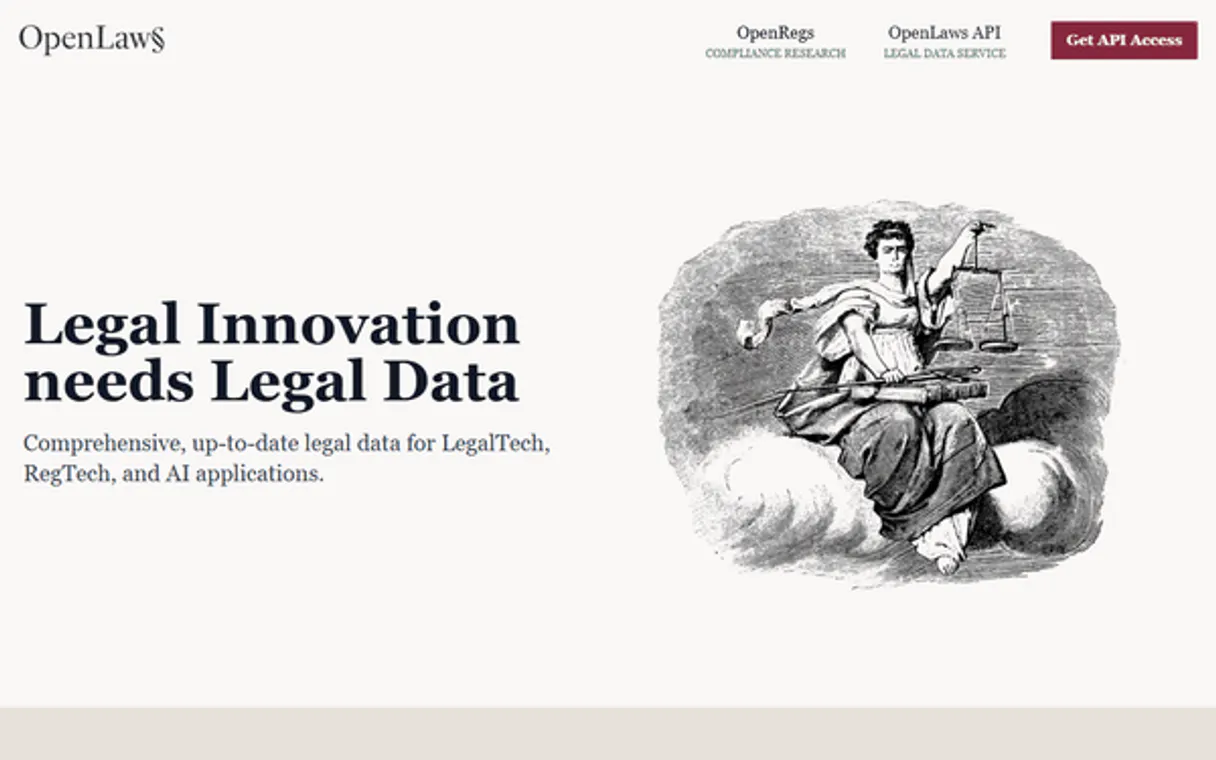
Use OpenLaws MCP with Claude or Cursor to search statutes, validate citations, and track legislative changes across 53 jurisdictions.
No credit card required. Experience the power of this integration risk-free.
Conduct deep legal research and citation validation across 53 jurisdictions.
Works with every AI agent you already use
…and any MCP-compatible client









How fast is the OpenLaws Connector?
Average time for the server to become ready for requests over the last 14 days, measured until the initialize / tools/list handshake completes. Metrics are updated daily between 00:00 and 04:00 UTC. Create a free account, use this Connector on Vinkius Cloud, and connect it to your AI agent in seconds.
Waiting for input…
What AI agents can do with OpenLaws MCP: 14 Tools for Legal Research
Access statutes, case law, and legislative updates through 14 specialized tools for your AI agent.
Get caselaw opinion
Fetches the full text of a court opinion, including court details and parties involved, after you find it via search.
Get constitution
Retrieves the full text and amendment history of a specific constitutional provision.
Get jurisdiction
Provides specific details for a jurisdiction to help you scope your legal searches accurately.
Get recent updates
Lists recent legal changes across all jurisdictions or within a specific state for compliance monitoring.
Get redline comparison
Shows the exact differences between two versions of a federal statute to highlight legislative changes.
Get regulation
Pulls the complete text and context of a specific regulation after you find it in a search.
Get statute history
Displays the legislative history and amendments for a federal statute over time.
Get statute
Retrieves the full text, citations, and effective dates of a specific statute.
List jurisdictions
Lists all available federal and state jurisdictions to help you define your search area.
Search caselaw
Searches millions of case opinions by keyword, filtered by jurisdiction, court, or circuit.
Search constitutions
Queries the US and all 50 state constitutions for specific provisions and amendments.
Search regulations
Searches for regulations across all jurisdictions or specific regions by keyword.
Search statutes
Queries federal and state statutes by keyword, allowing for 50-state surveys or local scoping.
Validate citation
Identifies malformed citations and locates the original government source document.
A Connector is a URL. Vinkius runs it: hosting, security, governance, observability.
You're looking at one of 5,800+ managed Connectors. The real value isn't the catalog. It's the control plane that secures, governs, audits, and manages every interaction between your agents and the tools they use.
No Shadow AI
Every agent action is visible, approved, and auditable. Nothing runs outside your governance.
Absolute agent control
Fine-grained permissions for every agent, MCP, and tool. Instantly revoke access and audit every execution.
Cost control per token
Spend broken down to the token, tool, and agent. Budgets and hard limits. No surprise invoices.
Managed & monitored infra
We operate the runtime, authentication, scaling, retries, and monitoring. Your team manages AI, not infrastructure.
Data protection, DLP by design
Sensitive data is filtered before reaching the model. Access is governed so agents receive only the information they're allowed to use.
Token optimization, real savings
Lower AI costs by delivering the right context instead of unnecessary tools. Better accuracy, faster responses, and fewer wasted tokens.
OpenLaws MCP for Precise Legal Research and Compliance
This is for the legal researcher who spends half their day clicking through government websites or the compliance officer trying to keep up with a moving target of state regulations. It's for people who need accuracy, not just best guesses.
Legal Researcher
Finds specific statutes and case law across multiple states without opening dozens of browser tabs.
Compliance Officer
Monitors legislative updates in specific jurisdictions to ensure company policies stay current.
LegalTech Developer
Pulls validated legal data into RAG pipelines or agentic workflows for internal tools.
Policy Analyst
Conducts 50-state surveys and analyzes legislative history to track changes over time.
Frequently Asked Questions
Can the OpenLaws MCP search laws in all 50 states? +
Yes, it allows you to query federal and state statutes across all 53 jurisdictions simultaneously.
How does OpenLaws MCP help with legal compliance? +
It lets you monitor recent legislative updates and get redline comparisons of federal statutes to track changes.
Can I use OpenLaws MCP to check if my legal citations are correct? +
Yes, the Connector can identify malformed citations and find the original government source for you.
Does OpenLaws MCP include case law? +
It provides access to millions of case opinions from sources like Harvard CAP and CourtListener.
Can the OpenLaws MCP provide historical versions of laws? +
It can retrieve historical versions and redline comparisons for federal statutes.
Is OpenLaws MCP good for 50-state surveys? +
Yes, it's designed to search all 50 states at once, making it ideal for broad jurisdictional research.
How do I get an OpenLaws API key and what authentication method is used? +
Visit openlaws.us/api and click Get API Access to register. Once approved, you'll receive a Bearer token. Include it in the Authorization header as Authorization: Bearer YOUR_TOKEN. The API uses standard Bearer token authentication for all v1 endpoints at https://api.openlaws.us/api/v1/.
Can I search statutes across all 50 states simultaneously? +
Yes! Use the search_statutes tool without specifying a jurisdiction parameter to search all 53 jurisdictions (50 states + DC + Puerto Rico + federal) at once. This is perfect for 50-state surveys. Alternatively, scope your search to a specific jurisdiction by providing its ID (e.g., 'ca' for California, 'ny' for New York, 'us' for federal).
How does citation validation work and what formats are supported? +
Use the validate_citation tool with any standard legal citation format. The API will identify the original government source, validate the citation accuracy, and flag malformed citations. It supports Bluebook format (e.g., '42 U.S.C. § 1983', '347 U.S. 483 (Brown v. Board)'), state citations for all 50 states, DC, and Puerto Rico. This is ideal for validating citations in legal documents, spreadsheets, and databases.
What legal data sources does OpenLaws cover? +
OpenLaws covers ~4.3 million tracked sections across 53 jurisdictions with 100% federal statutes and regulations coverage. Data includes: United States Code (USC), Code of Federal Regulations (CFR), all 50 state statutes and regulations, DC and Puerto Rico laws, ~5-6 million case opinions (from Harvard CAP and CourtListener), US Constitution and all 50 state constitutions, and legislative history for federal laws.
Your AI, connected to everything.











No credit card required · Free tier available













Other Connectors in this category
FRED Releases — Economic Calendar Connector
Track every U.S. economic data release: Employment Situation, GDP Advance, CPI, Federal Funds Rate, and hundreds more. With release schedules, historical dates, and the complete series within each release.
Braintrust Connector
Automate AI evaluations with Braintrust. Organize projects, test model datasets, run benchmarks, and manage prompts via any AI agent.
Integrate.io (ETL & Data Integration) Connector
Manage data pipelines via Integrate.io. List pipelines, monitor job runs, and audit data transformations.
Related Connectors
Hudu Connector
Document your IT infrastructure with password vaults, knowledge bases, and asset tracking built for managed service providers.

EU Late Payment Interest Calculator Connector
Calculate interest and fixed compensation for overdue commercial payments according to the EU Late/Late Payment Directive (2011/7/EU).
ECB Full — Complete Eurozone Financial Intelligence Connector
The definitive ECB Mega-Server: 14 tools for EUR exchange rates against 40+ currencies, key interest rates (MRO, DFR, MLFR), MFI bank rates, monetary aggregates (M1/M2/M3), government bond yield curves, euro banknotes, and a universal SDMX query engine for all ECB statistical data.