
OpenLaws MCP Server for Cursor 14 tools — connect in under 2 minutes
Cursor is an AI-first code editor built on VS Code that integrates LLM-powered coding assistance directly into the development workflow. Its Agent mode enables autonomous multi-step coding tasks, and MCP support lets agents access external data sources and APIs during code generation.
ASK AI ABOUT THIS MCP SERVER
Vinkius supports streamable HTTP and SSE.
Vinkius Desktop App
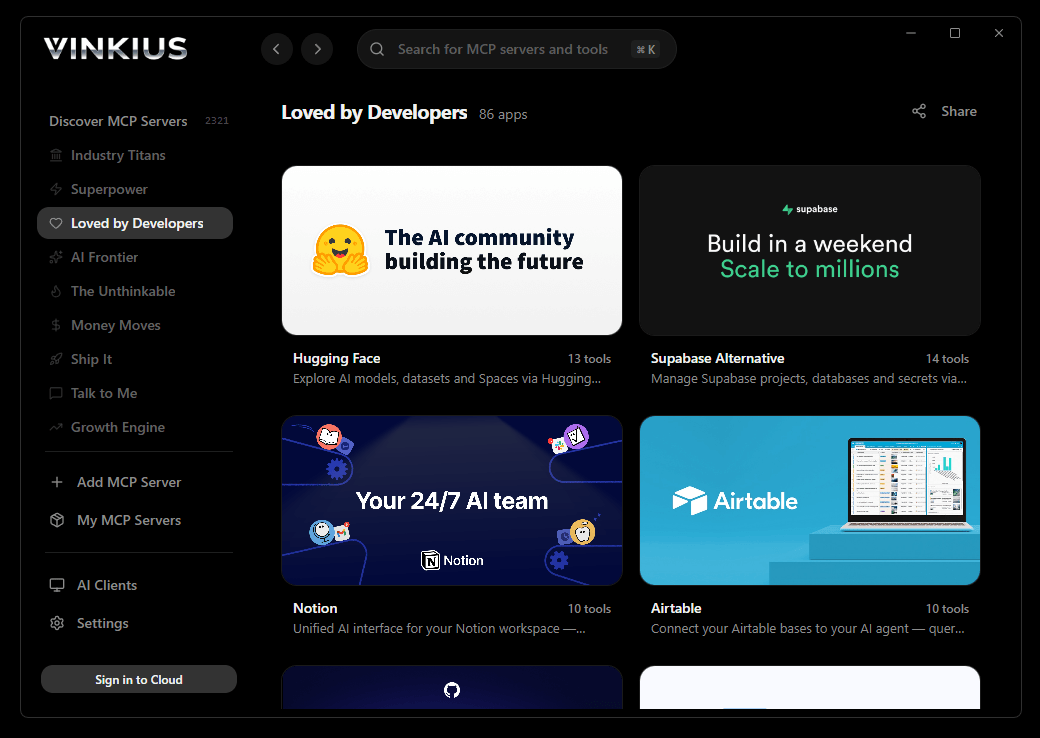
The modern way to manage MCP Servers — no config files, no terminal commands. Install OpenLaws and 2,500+ MCP Servers from a single visual interface.
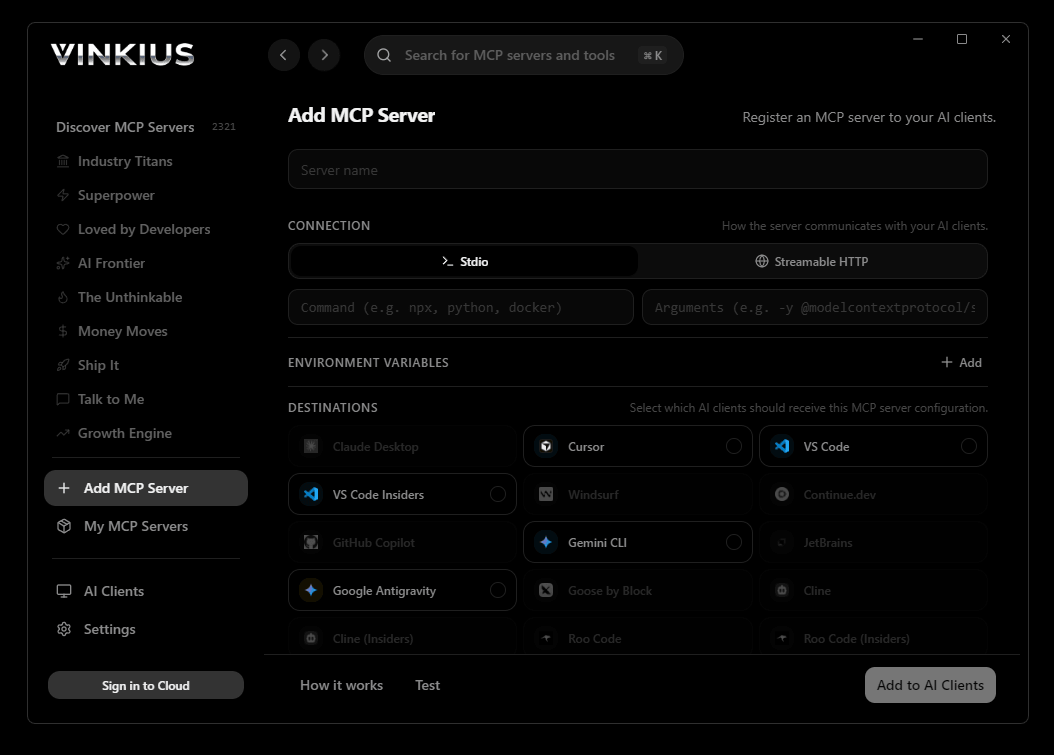

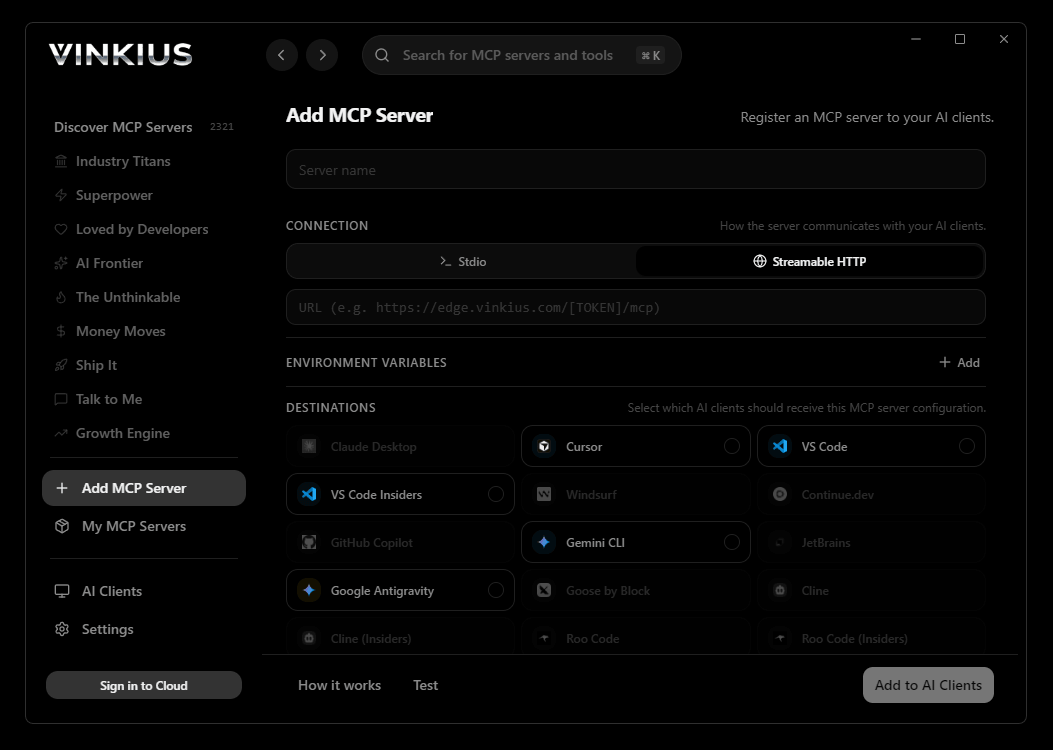
{
  "mcpServers": {
    "openlaws": {
      "url": "https://edge.vinkius.com/[YOUR_TOKEN_HERE]/mcp"
    }
  }
}
* Every MCP server runs on Vinkius-managed infrastructure inside AWS - a purpose-built runtime with per-request V8 isolates, Ed25519 signed audit chains, and sub-40ms cold starts optimized for native MCP execution. See our infrastructure
About OpenLaws MCP Server
Connect your OpenLaws API account to any AI agent and take full control of legal research, citation validation, and legislative monitoring workflows through natural conversation.
Cursor's Agent mode turns OpenLaws into an in-editor superpower. Ask Cursor to generate code using live data from OpenLaws and it fetches, processes, and writes. all in a single agentic loop. 14 tools appear alongside file editing and terminal access, creating a unified development environment grounded in real-time information.
What you can do
- Statute Search — Search federal and state statutes by keyword (BM25) across all 50 states simultaneously, or scope to specific jurisdictions
- Regulation Search — Query Code of Federal Regulations (CFR) and state regulations with fast keyword search and jurisdiction filtering
- Case Law Search — Search ~5-6 million case opinions from Harvard CAP and CourtListener, filtered by jurisdiction, court, or federal circuit
- Citation Validation — Validate and identify malformed legal citations, find original government sources for citations across 53 jurisdictions
- Constitutional Provisions — Search US Constitution and all 50 state constitutions for specific provisions and amendments
- Legislative History — Retrieve historical versions of federal statutes and generate redline comparisons between legislative sessions
- Recent Updates — Monitor recent legal updates and changes across jurisdictions for compliance tracking
The OpenLaws MCP Server exposes 14 tools through the Vinkius. Connect it to Cursor in under two minutes — no API keys to rotate, no infrastructure to provision, no vendor lock-in. Your configuration, your data, your control.
How to Connect OpenLaws to Cursor via MCP
Follow these steps to integrate the OpenLaws MCP Server with Cursor.
Open MCP Settings
Press Cmd+Shift+P (macOS) or Ctrl+Shift+P (Windows/Linux) → search "MCP Settings"
Add the server config
Paste the JSON configuration above into the mcp.json file that opens
Save the file
Cursor will automatically detect the new MCP server
Start using OpenLaws
Open Agent mode in chat and ask: "Using OpenLaws, help me...". 14 tools available
Why Use Cursor with the OpenLaws MCP Server
Cursor AI Code Editor provides unique advantages when paired with OpenLaws through the Model Context Protocol.
Agent mode turns Cursor into an autonomous coding assistant that can read files, run commands, and call MCP tools without switching context
Cursor's Composer feature can generate entire files using real-time data fetched through MCP. no copy-pasting from external dashboards
MCP tools appear alongside built-in tools like file reading and terminal access, creating a unified agentic environment
VS Code extension compatibility means your existing workflow, keybindings, and extensions all work alongside MCP tools
OpenLaws + Cursor Use Cases
Practical scenarios where Cursor combined with the OpenLaws MCP Server delivers measurable value.
Code generation with live data: ask Cursor to generate a security report module using live DNS and subdomain data fetched through MCP
Automated documentation: have Cursor query your API's tool schemas and generate TypeScript interfaces or OpenAPI specs automatically
Infrastructure-as-code: Cursor can fetch domain configurations and generate corresponding Terraform or CloudFormation templates
Test scaffolding: ask Cursor to pull real API responses via MCP and generate unit test fixtures from actual data
OpenLaws MCP Tools for Cursor (14)
These 14 tools become available when you connect OpenLaws to Cursor via MCP:
get_caselaw_opinion
Use this to get the complete court opinion after finding it via search_caselaw. The response includes the full opinion text, court details, date, citations, and parties involved. Get a specific case law opinion by its ID
get_constitution
Use this to get the complete provision content after finding it via search_constitutions. The response includes rich text content, article/section information, and amendments history. Get a specific constitution provision by its ID
get_jurisdiction
Use the jurisdiction_id from list_jurisdictions to inspect details before scoping searches. Get details of a specific jurisdiction
get_recent_updates
You can view updates across all jurisdictions or filter to a specific state/federal level. This is useful for compliance monitoring and staying current with legislative changes. Optionally specify jurisdiction ID and limit the number of results. Example: check what changed in California employment law this month, or monitor federal regulatory updates. Get recent legal updates across jurisdictions or in a specific jurisdiction
get_redline_comparison
This shows exactly what changed between legislative sessions or amendment cycles. Currently available for federal laws only (USC). Optionally specify from and to version dates. If not specified, compares the two most recent versions. Use this to understand legislative changes and their impact on compliance requirements. Get redline comparison between two versions of a federal statute
get_regulation
Use this to get the complete regulation content after finding it via search_regulations. The response includes rich text content, citations, and regulatory context. Get a specific regulation by its ID
get_statute
Use this to get the complete statute content after finding it via search_statutes. The response includes rich text content, citations, effective dates, and annotations. Get a specific statute by its ID
get_statute_history
This allows you to see how the law has changed over time. Currently available for federal laws only (USC - United States Code). Use the statute_id from search_statutes to view the legislative history and amendments. Get historical versions of a federal statute
list_jurisdictions
Jurisdictions include federal (US), all 50 states, District of Columbia, and Puerto Rico. Each jurisdiction has an ID that can be used to scope searches to specific regions. Use this to discover what jurisdictions are available before searching statutes, regulations, or caselaw. List all available legal jurisdictions in OpenLaws
search_caselaw
Data sourced from Harvard CAP project and CourtListener (~5-6 million cases). You can filter by jurisdiction, specific court, or federal circuit. The query parameter is required. Optionally filter by jurisdiction_id and court name. Results include case opinions, court information, dates, and citations. Example: search for " Fourth Amendment privacy" or "breach of contract" cases. Search case law opinions by keyword
search_constitutions
You can search the US Constitution and all 50 state constitutions simultaneously. The query parameter is required. Optionally filter by jurisdiction ID. Results include constitutional provisions, amendments, and relevant sections. Example: search for "free speech" or "right to privacy" across all constitutions. Search constitutions by keyword across jurisdictions
search_regulations
You can search all jurisdictions simultaneously or scope to a specific region. The query parameter is required and contains the search term. Optionally filter by jurisdiction ID. Results include regulation text, citations, and contextual information. Example: search for "environmental protection" or "workplace safety" regulations. Search regulations by keyword across jurisdictions
search_statutes
You can search all 50 states simultaneously for 50-state surveys, or scope to a specific jurisdiction. The query parameter is required and contains the search term. Optionally filter by jurisdiction ID. Results include statute text, citations, effective dates, and jurisdiction information. Example: search for "data privacy" across all jurisdictions, or "employment" in California only. Search statutes by keyword across jurisdictions
validate_citation
This tool helps identify malformed citations and find the authoritative source document. Supports citations from all 50 states, DC, Puerto Rico, and federal sources. The citation parameter should be a standard legal citation format (e.g., "42 U.S.C. § 1983", "Brown v. Board of Education, 347 U.S. 483"). Use this to validate citations in legal documents, spreadsheets, or databases before relying on them. Validate a legal citation and find its original source
Example Prompts for OpenLaws in Cursor
Ready-to-use prompts you can give your Cursor agent to start working with OpenLaws immediately.
"Search for data privacy statutes across all US states and summarize the key findings."
"Validate these citations: '42 U.S.C. § 1983' and 'Roe v. Wade, 410 U.S. 113' and tell me if they're correct."
"Show me recent legislative updates in California employment law and any changes this month."
Troubleshooting OpenLaws MCP Server with Cursor
Common issues when connecting OpenLaws to Cursor through the Vinkius, and how to resolve them.
Tools not appearing in Cursor
Server shows as disconnected
OpenLaws + Cursor FAQ
Common questions about integrating OpenLaws MCP Server with Cursor.
What is Agent mode and why does it matter for MCP?
Where does Cursor store MCP configuration?
mcp.json file. You can configure servers at the project level (.cursor/mcp.json in your project root) or globally (~/.cursor/mcp.json). Project-level configs take precedence.Can Cursor use MCP tools in inline edits?
How do I verify MCP tools are loaded?
Connect OpenLaws with your favorite client
Step-by-step setup guides for every MCP-compatible client and framework:
Anthropic's native desktop app for Claude with built-in MCP support.
AI-first code editor with integrated LLM-powered coding assistance.
GitHub Copilot in VS Code with Agent mode and MCP support.
Purpose-built IDE for agentic AI coding workflows.
Autonomous AI coding agent that runs inside VS Code.
Anthropic's agentic CLI for terminal-first development.
Python SDK for building production-grade OpenAI agent workflows.
Google's framework for building production AI agents.
Type-safe agent development for Python with first-class MCP support.
TypeScript toolkit for building AI-powered web applications.
TypeScript-native agent framework for modern web stacks.
Python framework for orchestrating collaborative AI agent crews.
Leading Python framework for composable LLM applications.
Data-aware AI agent framework for structured and unstructured sources.
Microsoft's framework for multi-agent collaborative conversations.
Connect OpenLaws to Cursor
Get your token, paste the configuration, and start using 14 tools in under 2 minutes. No API key management needed.