
PG&E Public Datasets MCP Server for OpenAI Agents SDK 8 tools — connect in under 2 minutes
The OpenAI Agents SDK enables production-grade agent workflows in Python. Connect PG&E Public Datasets through the Vinkius and your agents gain typed, auto-discovered tools with built-in guardrails — no manual schema definitions required.
ASK AI ABOUT THIS MCP SERVER
Vinkius supports streamable HTTP and SSE.
import asyncio
from agents import Agent, Runner
from agents.mcp import MCPServerStreamableHttp

async def main():
    # Your Vinkius token — get it at cloud.vinkius.com
    async with MCPServerStreamableHttp(
        url="https://edge.vinkius.com/[YOUR_TOKEN_HERE]/mcp"
    ) as mcp_server:

        agent = Agent(
            name="PG&E Public Datasets Assistant",
            instructions=(
                "You help users interact with PG&E Public Datasets. "
                "You have access to 8 tools."
            ),
            mcp_servers=[mcp_server],
        )

        result = await Runner.run(
            agent, "List all available tools from PG&E Public Datasets"
        )
        print(result.final_output)

asyncio.run(main())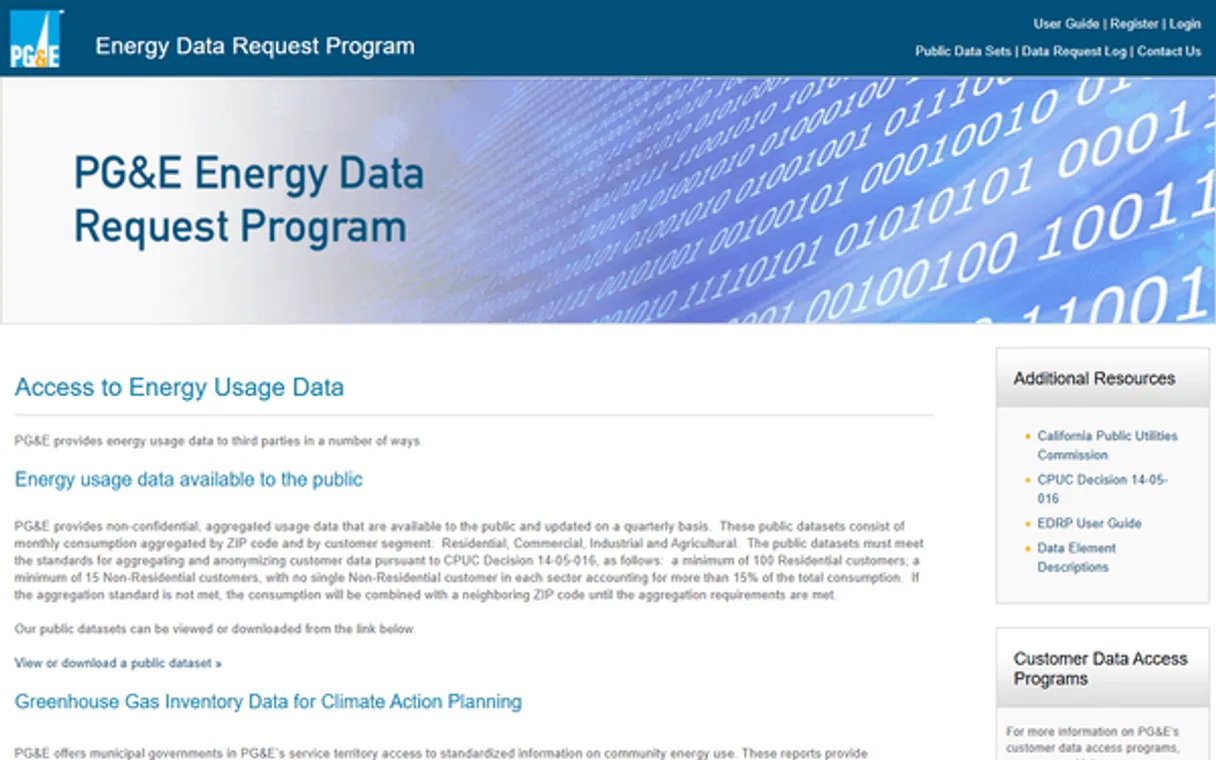
* Every MCP server runs on Vinkius-managed infrastructure inside AWS - a purpose-built runtime with per-request V8 isolates, Ed25519 signed audit chains, and sub-40ms cold starts optimized for native MCP execution. See our infrastructure
About PG&E Public Datasets MCP Server
Access PG&E Public Datasets directly from any AI agent and explore energy consumption, billing trends, efficiency savings, and regional comparisons without any authentication.
The OpenAI Agents SDK auto-discovers all 8 tools from PG&E Public Datasets through native MCP integration. Build agents with built-in guardrails, tracing, and handoff patterns — chain multiple agents where one queries PG&E Public Datasets, another analyzes results, and a third generates reports, all orchestrated through the Vinkius.
What you can do
- Monthly Usage — Get monthly electricity and gas consumption by ZIP code and customer segment
- Customer Segments — View energy usage breakdown across Residential, Commercial, Industrial, and Agricultural sectors
- Yearly Trends — Analyze year-over-year energy consumption trends
- Electricity by ZIP — Access ZIP code-level electricity consumption data
- Gas by ZIP — Access ZIP code-level natural gas consumption data
- Billing Data — Retrieve average bills and cost metrics by region
- Savings Data — Analyze energy efficiency program savings and cost-effectiveness
- Regional Comparisons — Compare energy usage across multiple ZIP codes side-by-side
The PG&E Public Datasets MCP Server exposes 8 tools through the Vinkius. Connect it to OpenAI Agents SDK in under two minutes — no API keys to rotate, no infrastructure to provision, no vendor lock-in. Your configuration, your data, your control.
How to Connect PG&E Public Datasets to OpenAI Agents SDK via MCP
Follow these steps to integrate the PG&E Public Datasets MCP Server with OpenAI Agents SDK.
Install the SDK
Run pip install openai-agents in your Python environment
Replace the token
Replace [YOUR_TOKEN_HERE] with your Vinkius token from cloud.vinkius.com
Run the script
Save the code above and run it: python agent.py
Explore tools
The agent will automatically discover 8 tools from PG&E Public Datasets
Why Use OpenAI Agents SDK with the PG&E Public Datasets MCP Server
OpenAI Agents SDK provides unique advantages when paired with PG&E Public Datasets through the Model Context Protocol.
Native MCP integration via `MCPServerSse` — pass the URL and the SDK auto-discovers all tools with full type safety
Built-in guardrails, tracing, and handoff patterns let you build production-grade agents without reinventing safety infrastructure
Lightweight and composable: chain multiple agents and MCP servers in a single pipeline with minimal boilerplate
First-party OpenAI support ensures optimal compatibility with GPT models for tool calling and structured output
PG&E Public Datasets + OpenAI Agents SDK Use Cases
Practical scenarios where OpenAI Agents SDK combined with the PG&E Public Datasets MCP Server delivers measurable value.
Automated workflows: build agents that query PG&E Public Datasets, process the data, and trigger follow-up actions autonomously
Multi-agent orchestration: create specialist agents — one queries PG&E Public Datasets, another analyzes results, a third generates reports
Data enrichment pipelines: stream data through PG&E Public Datasets tools and transform it with OpenAI models in a single async loop
Customer support bots: agents query PG&E Public Datasets to resolve tickets, look up records, and update statuses without human intervention
PG&E Public Datasets MCP Tools for OpenAI Agents SDK (8)
These 8 tools become available when you connect PG&E Public Datasets to OpenAI Agents SDK via MCP:
compare_regions
Returns side-by-side usage figures (kWh and therms), customer counts, and average bills for each region. Use this to identify regional differences in energy consumption, support geographic targeting for efficiency programs, or compare urban vs. rural usage patterns. ZIP codes are comma-separated (e.g., "94102,94103,94104"). Optional dataType and year filters. Compare energy usage data between multiple ZIP codes/regions
get_billing_data
Data is available by ZIP code and customer segment. Use this to analyze energy affordability, compare costs across regions, or identify rate impact on customers. Optional zipCode and year filters. Get billing data and average costs from PG&E public datasets
get_electricity_by_zip
Returns monthly or annual usage figures broken down by geographic area. Use this to compare electricity usage across neighborhoods, identify high-consumption areas, or support energy efficiency targeting. Optional year filter. Get electricity consumption data for specific ZIP codes in PG&E service area
get_gas_by_zip
Returns monthly or annual gas usage figures by geographic area. Use this to analyze heating demand patterns, compare gas usage across regions, or identify electrification opportunities. Optional year filter. Get natural gas consumption data for specific ZIP codes in PG&E service area
get_monthly_usage
Data is organized by ZIP code, month, year, and customer segment (Residential, Commercial, Industrial, Agricultural). Returns kWh for electric and therms for gas. Use this to analyze consumption patterns over time. Optional filters: dataType ("electric" or "gas"), customerType, zipCode (5-digit), and year (YYYY). Get monthly energy consumption data by ZIP code and customer segment from PG&E public datasets
get_savings_data
Includes program participation counts, kWh/therms saved, program costs, and cost-effectiveness metrics by program type. Use this to evaluate program ROI, compare effectiveness across initiatives, or identify high-impact efficiency strategies. Optional programType and year filters. Get energy efficiency program savings data from PG&E
get_usage_by_customer_type
Shows total consumption for Residential, Commercial, Industrial, and Agricultural sectors. Use this to understand the energy consumption distribution across different customer categories. Optional dataType ("electric"/"gas") and year filters. Get energy usage broken down by customer segment (residential, commercial, industrial, agricultural)
get_yearly_trends
Shows how electricity and gas usage has changed over multiple years. Use this to identify long-term patterns, growth/decline in energy demand, and seasonal variations. Optional dataType filter ("electric" or "gas"). Get yearly energy consumption trends from PG&E public data
Example Prompts for PG&E Public Datasets in OpenAI Agents SDK
Ready-to-use prompts you can give your OpenAI Agents SDK agent to start working with PG&E Public Datasets immediately.
"Show monthly electricity usage by customer type."
"Compare ZIP codes 94102, 94301, and 95054."
"Show yearly energy consumption trends."
Troubleshooting PG&E Public Datasets MCP Server with OpenAI Agents SDK
Common issues when connecting PG&E Public Datasets to OpenAI Agents SDK through the Vinkius, and how to resolve them.
MCPServerStreamableHttp not found
pip install --upgrade openai-agentsAgent not calling tools
PG&E Public Datasets + OpenAI Agents SDK FAQ
Common questions about integrating PG&E Public Datasets MCP Server with OpenAI Agents SDK.
How does the OpenAI Agents SDK connect to MCP?
MCPServerSse(url=...) to create a server connection. The SDK auto-discovers all tools and makes them available to your agent with full type information.Can I use multiple MCP servers in one agent?
MCPServerSse instances to the agent constructor. The agent can use tools from all connected servers within a single run.Does the SDK support streaming responses?
Connect PG&E Public Datasets with your favorite client
Step-by-step setup guides for every MCP-compatible client and framework:
Anthropic's native desktop app for Claude with built-in MCP support.
AI-first code editor with integrated LLM-powered coding assistance.
GitHub Copilot in VS Code with Agent mode and MCP support.
Purpose-built IDE for agentic AI coding workflows.
Autonomous AI coding agent that runs inside VS Code.
Anthropic's agentic CLI for terminal-first development.
Python SDK for building production-grade OpenAI agent workflows.
Google's framework for building production AI agents.
Type-safe agent development for Python with first-class MCP support.
TypeScript toolkit for building AI-powered web applications.
TypeScript-native agent framework for modern web stacks.
Python framework for orchestrating collaborative AI agent crews.
Leading Python framework for composable LLM applications.
Data-aware AI agent framework for structured and unstructured sources.
Microsoft's framework for multi-agent collaborative conversations.
Connect PG&E Public Datasets to OpenAI Agents SDK
Get your token, paste the configuration, and start using 8 tools in under 2 minutes. No API key management needed.