
Portkey MCP Server for Claude Desktop 10 tools — connect in under 2 minutes
Claude Desktop is Anthropic's native application for interacting with Claude AI models on macOS and Windows. It was the first consumer application to ship with built-in MCP support, making it the reference implementation for the Model Context Protocol standard.
ASK AI ABOUT THIS MCP SERVER
Vinkius supports streamable HTTP and SSE.
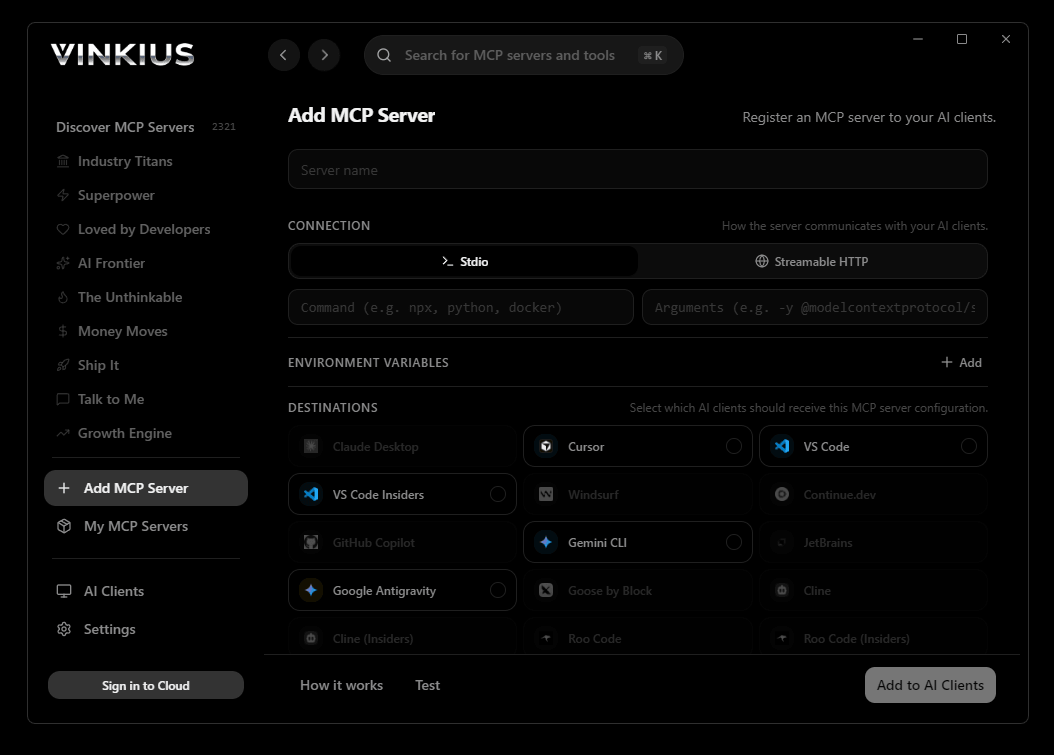
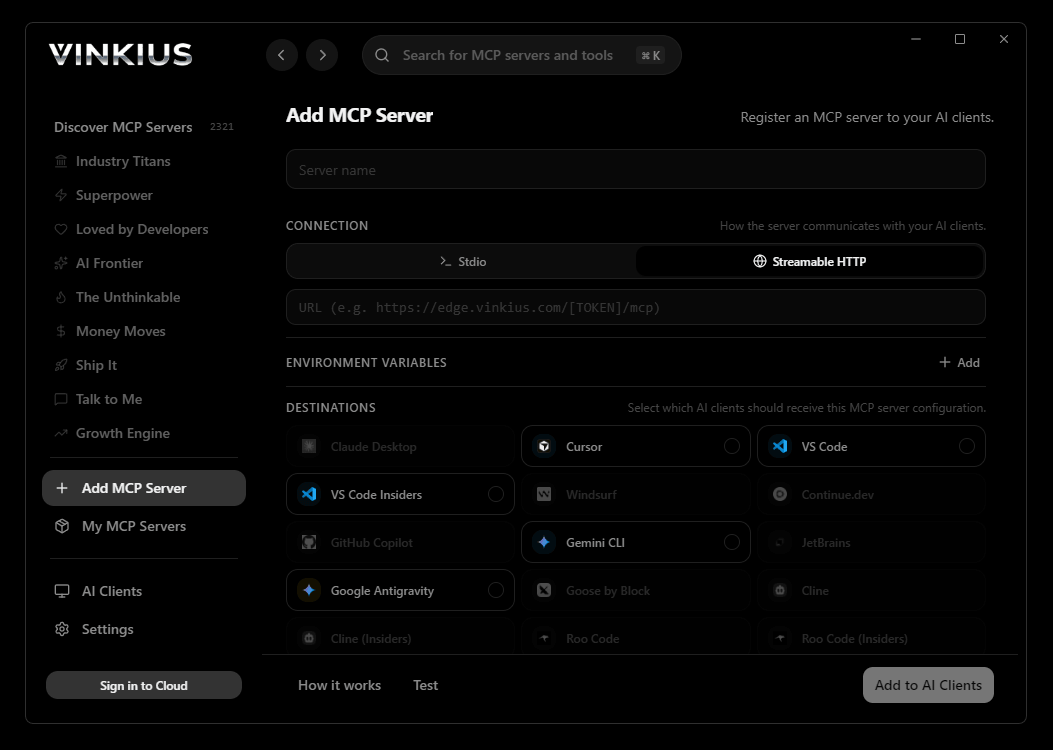
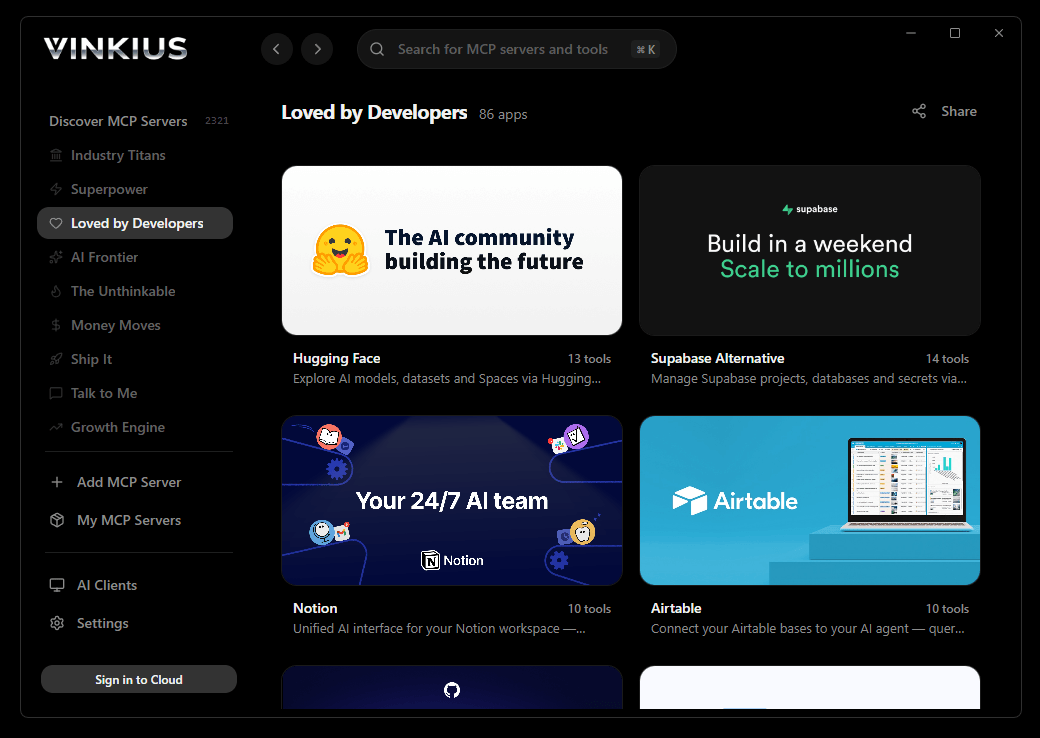
Vinkius Desktop App
The modern way to manage MCP Servers — no config files, no terminal commands. Install Portkey and 2,500+ MCP Servers from a single visual interface.

{
  "mcpServers": {
    "portkey": {
      // Your Vinkius token. get it at cloud.vinkius.com
      "url": "https://edge.vinkius.com/[YOUR_TOKEN_HERE]/mcp"
    }
  }
}
* Every MCP server runs on Vinkius-managed infrastructure inside AWS - a purpose-built runtime with per-request V8 isolates, Ed25519 signed audit chains, and sub-40ms cold starts optimized for native MCP execution. See our infrastructure
About Portkey MCP Server
What you can do
Connect AI agents to the Portkey AI Gateway for enterprise-grade observability and management:
Claude Desktop is the definitive way to connect Portkey to your AI workflow. Add Vinkius Edge URL to your config, restart the app, and Claude immediately exposes all 10 tools in the chat interface. ask a question, Claude calls the right tool, and you see the answer. Zero code, zero context switching.
- Monitor logs and traces of all LLM calls passing through your gateway
- Analyze token usage, latency, and costs across models and teams
- Submit feedback (Likes/Dislikes) to improve model quality and agent performance
- Export logs for audit trails, compliance, and offline cost analysis
- Review gateway configurations including retry policies, fallbacks, and cache settings
- Manage virtual keys to track provider API key usage and limits
- Discover supported models from 1,600+ LLMs available via Portkey
- Enforce budget policies to prevent runaway AI costs per team or project
The Portkey MCP Server exposes 10 tools through the Vinkius. Connect it to Claude Desktop in under two minutes — no API keys to rotate, no infrastructure to provision, no vendor lock-in. Your configuration, your data, your control.
How to Connect Portkey to Claude Desktop via MCP
Follow these steps to integrate the Portkey MCP Server with Claude Desktop.
Open Claude Desktop Settings
Go to Settings → Developer → Edit Config to open claude_desktop_config.json
Add the MCP Server
Paste the configuration above into the mcpServers section
Restart Claude Desktop
Close and reopen Claude Desktop to load the new server
Start using Portkey
Look for the 🔌 icon in the chat. your 10 tools are now available
Why Use Claude Desktop with the Portkey MCP Server
Claude Desktop by Anthropic provides unique advantages when paired with Portkey through the Model Context Protocol.
Claude Desktop is the reference MCP client. it was designed alongside the protocol itself, ensuring the most complete and stable MCP implementation available
Zero-code configuration: add a server URL to a JSON file and Claude instantly discovers and exposes all available tools in the chat interface
Claude's extended thinking capability lets it reason through multi-step tool usage, chaining multiple API calls to answer complex questions
Enterprise-grade security with local config storage. your tokens never leave your machine, and connections go directly to Vinkius Edge network
Portkey + Claude Desktop Use Cases
Practical scenarios where Claude Desktop combined with the Portkey MCP Server delivers measurable value.
Interactive data exploration: ask Claude to query DNS records, look up WHOIS data, and cross-reference results in a single conversation
Ad-hoc security audits: type a domain name and let Claude enumerate subdomains, check DNS history, and flag configuration anomalies. all through natural language
Executive briefings: generate comprehensive domain intelligence reports by asking Claude to compile findings into a formatted summary
Learning and training: new team members can explore API capabilities conversationally without needing to read documentation
Portkey MCP Tools for Claude Desktop (10)
These 10 tools become available when you connect Portkey to Claude Desktop via MCP:
create_policy
Requires policy name, budget limit (USD or token count), and optionally the target users or virtual keys to restrict. Returns the created policy details. Use this to enforce cost controls on specific teams or projects using the gateway. Create a new budget or usage policy for AI gateway access
delete_policy
Requires the policy ID. Use this when a project ends or budget constraints are no longer needed. Remove a budget or usage policy from Portkey
export_logs
Optionally filters by date range, model, or user. Returns an export ID or download URL. Use this for audit trails, cost reporting, or offline analysis of AI usage patterns. Export AI gateway logs for external analysis or compliance reporting
get_log_details
Requires the log ID from list_logs results. Use this for deep debugging of specific AI interactions. Get detailed information about a specific AI gateway log entry
get_virtual_keys
Virtual keys map to underlying provider keys (OpenAI, Anthropic, etc.) with metadata, usage limits, and policy associations. Returns key IDs, names, provider targets, current usage, and status. Use this to audit API key usage or identify keys approaching limits. List all virtual API keys managed by Portkey
list_configs
Returns config IDs, names, creation dates, and associated virtual keys. Use this to review how LLM requests are routed or to audit gateway behavior. List all gateway configurations stored in Portkey
list_logs
Returns log IDs, timestamps, model names, token usage, latency, costs, and status codes. Use this to monitor AI usage, identify expensive calls, or debug latency issues. Supports pagination via limit/offset. List recent AI gateway logs and traces from Portkey
list_models
). Returns model names, provider names, supported endpoints (chat, embeddings, etc.), and capabilities. Use this to discover which models are routable via your gateway. List all LLM models supported by the Portkey gateway
list_policies
Returns policy names, limits, current consumption, and affected users/keys. Use this to review guardrails preventing runaway AI costs. List all budget and usage policies defined in Portkey
submit_feedback
Requires the log ID, rating (LIKE, DISLIKE, or UNLIKE to remove), and optional text feedback. Use this to build RLHF datasets or monitor user satisfaction with AI outputs. Submit user feedback (Like/Dislike) for a specific AI response log
Example Prompts for Portkey in Claude Desktop
Ready-to-use prompts you can give your Claude Desktop agent to start working with Portkey immediately.
"Show me the most expensive LLM calls from the last 24 hours"
"Create a budget policy limiting the Marketing team to $500/month on LLM usage"
"Export all logs from last week for our compliance audit"
Troubleshooting Portkey MCP Server with Claude Desktop
Common issues when connecting Portkey to Claude Desktop through the Vinkius, and how to resolve them.
Server not appearing after restart
~/Library/Application Support/Claude/claude_desktop_config.json (macOS) or %APPDATA%\\Claude\\ (Windows).Authentication error
Tools not showing in chat
Portkey + Claude Desktop FAQ
Common questions about integrating Portkey MCP Server with Claude Desktop.
How does Claude Desktop discover MCP tools?
claude_desktop_config.json file and connects to each configured MCP server. It calls the tools/list endpoint to fetch the schema for every available tool, then surfaces them as clickable options in the chat interface via the 🔌 icon.What happens if the MCP server is temporarily unavailable?
Can I connect multiple MCP servers simultaneously?
mcpServers section of the config file. Each server appears as a separate tool provider, and Claude can use tools from multiple servers in a single conversation turn.Is there a limit on the number of tools per server?
Does Claude Desktop support Streamable HTTP transport?
Connect Portkey with your favorite client
Step-by-step setup guides for every MCP-compatible client and framework:
Anthropic's native desktop app for Claude with built-in MCP support.
AI-first code editor with integrated LLM-powered coding assistance.
GitHub Copilot in VS Code with Agent mode and MCP support.
Purpose-built IDE for agentic AI coding workflows.
Autonomous AI coding agent that runs inside VS Code.
Anthropic's agentic CLI for terminal-first development.
Python SDK for building production-grade OpenAI agent workflows.
Google's framework for building production AI agents.
Type-safe agent development for Python with first-class MCP support.
TypeScript toolkit for building AI-powered web applications.
TypeScript-native agent framework for modern web stacks.
Python framework for orchestrating collaborative AI agent crews.
Leading Python framework for composable LLM applications.
Data-aware AI agent framework for structured and unstructured sources.
Microsoft's framework for multi-agent collaborative conversations.
Connect Portkey to Claude Desktop
Get your token, paste the configuration, and start using 10 tools in under 2 minutes. No API key management needed.