
Scispot MCP Server for CrewAI 12 tools — connect in under 2 minutes
Connect your CrewAI agents to Scispot through Vinkius, pass the Edge URL in the `mcps` parameter and every Scispot tool is auto-discovered at runtime. No credentials to manage, no infrastructure to maintain.
ASK AI ABOUT THIS MCP SERVER
Vinkius supports streamable HTTP and SSE.
from crewai import Agent, Task, Crew

agent = Agent(
    role="Scispot Specialist",
    goal="Help users interact with Scispot effectively",
    backstory=(
        "You are an expert at leveraging Scispot tools "
        "for automation and data analysis."
    ),
    # Your Vinkius token. get it at cloud.vinkius.com
    mcps=["https://edge.vinkius.com/[YOUR_TOKEN_HERE]/mcp"],
)

task = Task(
    description=(
        "Explore all available tools in Scispot "
        "and summarize their capabilities."
    ),
    agent=agent,
    expected_output=(
        "A detailed summary of 12 available tools "
        "and what they can do."
    ),
)

crew = Crew(agents=[agent], tasks=[task])
result = crew.kickoff()
print(result)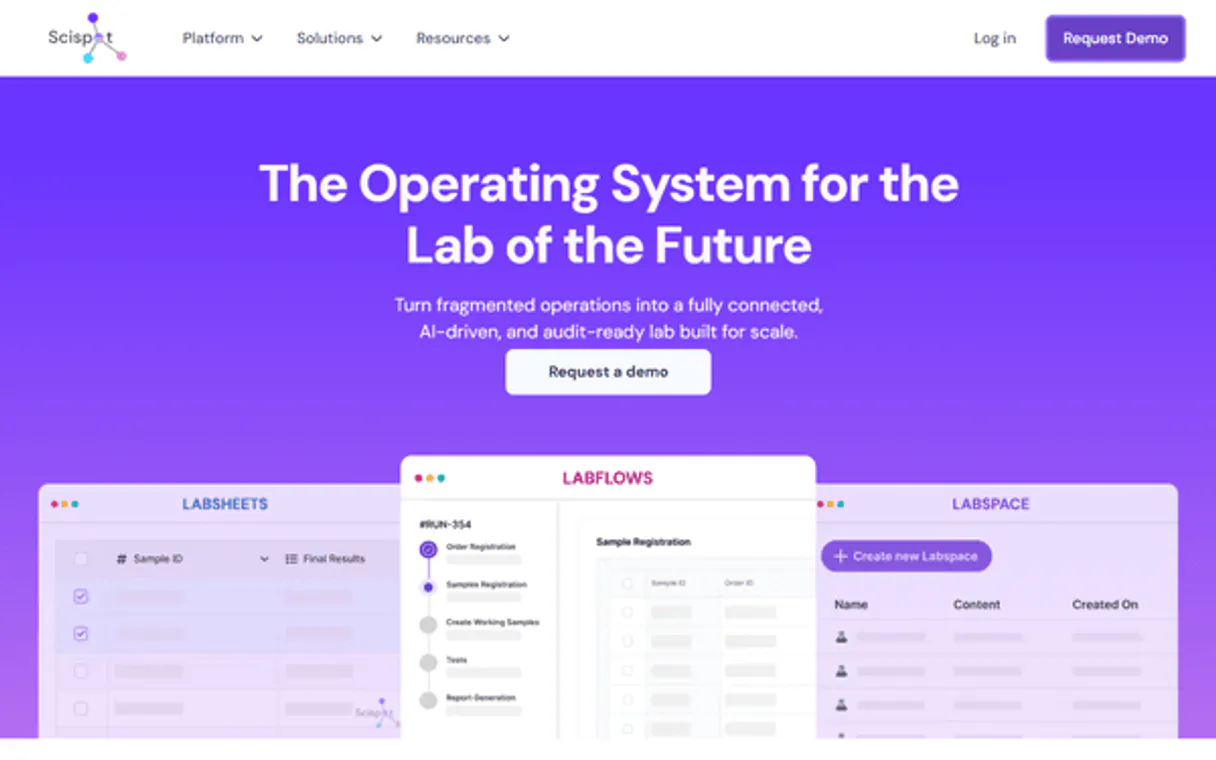
* Every MCP server runs on Vinkius-managed infrastructure inside AWS - a purpose-built runtime with per-request V8 isolates, Ed25519 signed audit chains, and sub-40ms cold starts optimized for native MCP execution. See our infrastructure
About Scispot MCP Server
Connect your Scispot API-first Cannabis Testing Laboratory LIMS to any AI agent and take full control of your laboratory operations, quality assurance workflows, and regulatory compliance through natural conversation.
When paired with CrewAI, Scispot becomes a first-class tool in your multi-agent workflows. Each agent in the crew can call Scispot tools autonomously, one agent queries data, another analyzes results, a third compiles reports, all orchestrated through Vinkius with zero configuration overhead.
What you can do
- Sample Management — Track all cannabis samples received with chain of custody, testing priority, and real-time status updates
- Test Panels — Browse available analytical methods including potency, terpenes, pesticides, heavy metals, mycotoxins, and microbials
- Analytical Results — Access complete test findings with pass/fail determinations against state-specific regulatory limits
- Certificates of Analysis — Retrieve all issued CoAs with QR codes for consumer verification and automatic Metrc submission
- Batch Traceability — Monitor production batches through laboratory testing with full seed-to-sale linkage
- Plate Management — Oversee high-throughput batch processing with 96-well and 384-well plate tracking
- Analytical Runs — Review instrument run data including QC metrics, system suitability, and analyst assignments
- Order Tracking — Monitor client testing orders from submission through invoicing with ETA predictions
- Instrument Health — Verify calibration status, maintenance schedules, and operational readiness for HPLC, GC-MS, ICP-MS systems
- Workflow Automation — Track standardized laboratory processes from sample intake to CoA approval with bottleneck identification
- Client Directory — Access complete client profiles including license types, testing history, and custom panel configurations
- Audit Trails — Retrieve comprehensive operation logs for FDA 21 CFR Part 11 compliance and ISO/IEC 17025 inspection readiness
The Scispot MCP Server exposes 12 tools through the Vinkius. Connect it to CrewAI in under two minutes — no API keys to rotate, no infrastructure to provision, no vendor lock-in. Your configuration, your data, your control.
How to Connect Scispot to CrewAI via MCP
Follow these steps to integrate the Scispot MCP Server with CrewAI.
Install CrewAI
Run pip install crewai
Replace the token
Replace [YOUR_TOKEN_HERE] with your Vinkius token from cloud.vinkius.com
Customize the agent
Adjust the role, goal, and backstory to fit your use case
Run the crew
Run python crew.py. CrewAI auto-discovers 12 tools from Scispot
Why Use CrewAI with the Scispot MCP Server
CrewAI Multi-Agent Orchestration Framework provides unique advantages when paired with Scispot through the Model Context Protocol.
Multi-agent collaboration lets you decompose complex workflows into specialized roles, one agent researches, another analyzes, a third generates reports, each with access to MCP tools
CrewAI's native MCP integration requires zero adapter code: pass Vinkius Edge URL directly in the `mcps` parameter and agents auto-discover every available tool at runtime
Built-in task delegation and shared memory mean agents can pass context between steps without manual state management, enabling multi-hop reasoning across tool calls
Sequential and hierarchical crew patterns map naturally to real-world workflows: enumerate subdomains → analyze DNS history → check WHOIS records → compile findings into actionable reports
Scispot + CrewAI Use Cases
Practical scenarios where CrewAI combined with the Scispot MCP Server delivers measurable value.
Automated multi-step research: a reconnaissance agent queries Scispot for raw data, then a second analyst agent cross-references findings and flags anomalies. all without human handoff
Scheduled intelligence reports: set up a crew that periodically queries Scispot, analyzes trends over time, and generates executive briefings in markdown or PDF format
Multi-source enrichment pipelines: chain Scispot tools with other MCP servers in the same crew, letting agents correlate data across multiple providers in a single workflow
Compliance and audit automation: a compliance agent queries Scispot against predefined policy rules, generates deviation reports, and routes findings to the appropriate team
Scispot MCP Tools for CrewAI (12)
These 12 tools become available when you connect Scispot to CrewAI via MCP:
list_audit_logs
Each audit log entry contains the precise timestamp (ISO 8601), performing user name and ID, action type (sample created, result modified, CoA issued, workflow step completed, user permission changed, instrument calibration recorded), affected record ID and type, previous and new values for any modifications, IP address and user agent, and justification comment (if required for critical changes). Fundamental for regulatory inspections, data integrity investigations, deviation root cause analysis, FDA 21 CFR Part 11 compliance, and ISO/IEC 17025 quality system requirements. AI agents use this to reconstruct event sequences during quality investigations, identify unauthorized or suspicious changes, monitor user activity patterns, generate audit-ready documentation packages, and demonstrate data integrity to regulatory inspectors. List all audit trail entries for laboratory operations and data modifications
list_batches
Each batch entry contains the batch ID, producing facility license number, batch size and unit of measure, cannabis product type, harvest or manufacture date, linked samples submitted for testing, batch testing status (pending, partial, complete, failed), final disposition (released, quarantined, rejected, destroyed, reworked), and seed-to-sale tracking identifiers (Metrc UID, state compliance tags). Essential for batch-level compliance monitoring, recall management, regulatory reporting, and inventory reconciliation. AI agents reference this when tracing contamination issues, verifying batch clearance for distribution, generating lot-based compliance reports, or investigating quality deviations. List all cannabis production batches tracked through laboratory testing
list_certificates
Each CoA record includes the certificate number, linked sample and batch, issuing laboratory name and accreditation number, comprehensive analytical results (potency profile with THC/CBD percentages, terpene fingerprint with individual concentrations, contaminant screening results for pesticides, heavy metals, mycotoxins, and microbials), regulatory compliance statement, authorized signatory name and signature, issuance date, expiration date, and QR code for consumer verification. Critical for product release decisions, regulatory audit documentation, consumer transparency programs, and integration with state traceability systems (Metrc) and retail platforms (WeedMaps). AI agents use this to verify CoA authenticity, confirm batch compliance status, generate client-facing documentation packages, and ensure automatic regulatory submissions. List all Certificates of Analysis (CoA) issued by the laboratory
list_clients
Each client record contains company name, license number and type (cultivation facility, processing plant, dispensary, distributor, third-party tester), primary contact information, account status (active, suspended, pending), billing terms, sample volume history, preferred communication methods, and any special testing requirements or custom panels configured. Essential for laboratory client relationship management, sample intake workflows, account-based reporting, and regulatory compliance documentation. AI agents should reference this when identifying sample ownership, generating client-specific reports, verifying active testing contracts, communicating results, and analyzing client testing patterns. List all clients (cultivators, processors, retailers) using laboratory services
list_instruments
Each instrument record contains the instrument name (HPLC system, GC-MS, ICP-MS, qPCR thermocycler, spectrophotometer), manufacturer, model number, serial number, installation location, calibration status, last calibration date, next scheduled maintenance, qualification status (IQ/OQ/PQ completion), associated test methods, and current operational status (active, under maintenance, offline, decommissioned). Critical for instrument qualification management, preventive maintenance scheduling, analytical data integrity verification, and regulatory inspection readiness. AI agents should reference this to verify instrument readiness before assigning tests, schedule calibration activities, troubleshoot analytical failures, and generate equipment utilization reports. List all laboratory instruments with calibration and maintenance status
list_orders
Each order record contains the order ID, requesting client company, order date, requested test panels, number of samples included, priority level (standard, rush, priority), order status (pending, in-progress, completed, invoiced), assigned laboratory team, estimated completion date, and billing information. Critical for order management, client communication, laboratory capacity planning, and revenue tracking. AI agents use this to monitor order progress, identify bottlenecks, prioritize workflow assignments, communicate status updates to clients, and generate order fulfillment reports. List all testing orders and service requests from clients
list_plates
Each plate entry contains the plate ID, plate format (96-well, 384-well), assay type assigned, number of samples loaded, number of standards and controls, run date, associated instrument, and processing status (prepared, in-run, completed, failed). Critical for managing high-volume testing operations, optimizing throughput, tracking reagent usage, and ensuring data integrity for multi-sample analytical runs. AI agents use this to monitor plate preparation status, identify incomplete runs, optimize well assignments, and troubleshoot analytical failures at the plate level. List all laboratory plates used for batch sample processing
list_results
Each result contains the result ID, linked sample and batch, test panel performed, comprehensive analytical findings (THC/CBD potency percentages, full terpene profiles, pesticide residue levels, heavy metal concentrations, mycotoxin detection, microbial counts), pass/fail determination against regulatory limits, analyst who performed the test, reviewer approval status, and date of completion. Fundamental for quality assurance workflows, client notification processes, regulatory data submissions, and product release decisions. AI agents should query this to verify sample compliance before releasing Certificates of Analysis, advising clients on product disposition, or preparing regulatory reports. List all laboratory test results with complete analytical data
list_runs
Each run entry contains the run ID, instrument name and type (HPLC, GC-MS, ICP-MS, spectrophotometer), method or assay performed, start and end timestamps, operating analyst or technician, number of samples processed, quality control results (standard recoveries, blank checks, duplicate precision), system suitability status, and overall run disposition (accepted, rejected, requires review). Essential for instrument utilization tracking, method performance monitoring, analyst productivity assessment, and regulatory audit preparation. AI agents should query this to verify run completion status, identify failed runs requiring reanalysis, schedule instrument maintenance, and generate throughput reports. List all analytical runs executed on laboratory instruments
list_samples
Each sample contains the unique sample ID, submitting client or cultivator, sample type (flower, edible, concentrate, topical, cartridge), received date, testing priority level, sample condition upon receipt, chain of custody documentation, and current testing status (received, in-progress, completed, failed, on-hold). Critical for laboratory workflow management, sample intake tracking, turnaround time monitoring, and seed-to-sale traceability compliance. AI agents use this to manage sample queues, predict completion dates, prioritize rush orders, and notify clients about status changes. List all cannabis samples submitted for laboratory testing
list_tests
Each test entry includes the test name (potency, terpenes, pesticides, heavy metals, mycotoxins, microbials, residual solvents, water activity, moisture content, homogeneity), test methodology (HPLC, GC-MS, ICP-MS, ELISA, qPCR, LC-MS/MS), accreditation status, standard turnaround time, pricing tier, and regulatory limits per jurisdiction. Essential for test panel configuration, method validation, ISO/IEC 17025 compliance, and state-specific cannabis testing requirements. AI agents reference this when configuring sample test orders, explaining testing scopes to clients, verifying analytical method accreditation, and ensuring compliance with regulatory testing mandates. List all analytical test panels and methods available in the laboratory
list_workflows
Each workflow entry contains the workflow name (sample intake and login, potency testing, contaminant screening, CoA review and approval, sample disposal, non-conformance investigation), step definitions with sequential order, assigned roles and responsibilities at each step, quality control checkpoints and decision gates, average completion time, current instances in progress, and bottleneck indicators. Essential for laboratory operations management, staff task assignment, process optimization, and ISO/IEC 17025 quality management system compliance. AI agents use this to guide technicians through standardized testing procedures, identify workflow bottlenecks causing delays, ensure quality checkpoints are not bypassed, and generate process efficiency reports. List all laboratory workflow templates and active processes
Example Prompts for Scispot in CrewAI
Ready-to-use prompts you can give your CrewAI agent to start working with Scispot immediately.
"Show me all cannabis samples currently in testing and their expected completion dates."
"List all pending Certificates of Analysis awaiting quality manager review and authorized signatory approval."
"Check the integration status with Metrc seed-to-sale tracking and automatic CoA publishing to state regulatory systems."
Troubleshooting Scispot MCP Server with CrewAI
Common issues when connecting Scispot to CrewAI through the Vinkius, and how to resolve them.
MCP tools not discovered
Agent not using tools
Timeout errors
Rate limiting or 429 errors
Scispot + CrewAI FAQ
Common questions about integrating Scispot MCP Server with CrewAI.
How does CrewAI discover and connect to MCP tools?
tools/list method. This means tools are always fresh and reflect the server's current capabilities. No tool schemas need to be hardcoded.Can different agents in the same crew use different MCP servers?
mcps list, so you can assign specific servers to specific roles. For example, a reconnaissance agent might use a domain intelligence server while an analysis agent uses a vulnerability database server.What happens when an MCP tool call fails during a crew run?
Can CrewAI agents call multiple MCP tools in parallel?
process=Process.parallel, each calling different MCP tools concurrently. This is ideal for workflows where separate data sources need to be queried simultaneously.Can I run CrewAI crews on a schedule (cron)?
crew.kickoff() method runs synchronously by default, making it straightforward to integrate into existing pipelines.Connect Scispot with your favorite client
Step-by-step setup guides for every MCP-compatible client and framework:
Anthropic's native desktop app for Claude with built-in MCP support.
AI-first code editor with integrated LLM-powered coding assistance.
GitHub Copilot in VS Code with Agent mode and MCP support.
Purpose-built IDE for agentic AI coding workflows.
Autonomous AI coding agent that runs inside VS Code.
Anthropic's agentic CLI for terminal-first development.
Python SDK for building production-grade OpenAI agent workflows.
Google's framework for building production AI agents.
Type-safe agent development for Python with first-class MCP support.
TypeScript toolkit for building AI-powered web applications.
TypeScript-native agent framework for modern web stacks.
Python framework for orchestrating collaborative AI agent crews.
Leading Python framework for composable LLM applications.
Data-aware AI agent framework for structured and unstructured sources.
Microsoft's framework for multi-agent collaborative conversations.
Connect Scispot to CrewAI
Get your token, paste the configuration, and start using 12 tools in under 2 minutes. No API key management needed.