
Scispot MCP. Manage compliance and track every batch status.
 Gemini
 Works with every AI agent you already use
…and any MCP-compatible client









Just plug in your AI agents and start using Vinkius.
Scispot MCP Server manages cannabis laboratory operations from a conversational interface. It lets your AI agent track samples, monitor instrument health, issue Certificates of Analysis (CoA), and maintain full chain-of-custody compliance using real-time lab data.
You can manage everything from sample intake to final regulatory reporting without clicking through complex LIMS dashboards.
What your AI agents can do
List audit logs
Retrieves every recorded action—who did what, when, and why—for regulatory audits and data integrity checks.
List batches
Lists all cannabis production batches, showing their status (pending, complete) and linking them to specific samples.
List certificates
Gathers all issued Certificates of Analysis (CoA), including potency data and the QR codes needed for consumer verification.
The agent manages the entire lifecycle of a cannabis sample, noting its chain of custody and current testing stage.
Retrieve Certificates of Analysis (CoAs) that confirm product compliance against state-specific regulatory limits.
Verify the calibration status and maintenance schedules for major instruments like GC-MS or HPLC systems.
Get a complete view of production batches, linking them to samples and determining if they are cleared for distribution.
Generate detailed operational logs necessary for regulatory compliance checks (e.g., FDA 21 CFR Part 11).
Ask AI about this MCP
Supported MCP Clients
Gemini Waiting for input…
Scispot MCP Server: 12 Tools for Lab Operations
Use these twelve tools to manage everything from sample intake and instrument maintenance to generating final, compliant Certificates of Analysis.
019d7604list audit logs
Retrieves every recorded action—who did what, when, and why—for regulatory audits and data integrity checks.
019d7604list batches
Lists all cannabis production batches, showing their status (pending, complete) and linking them to specific samples.
019d7604list certificates
Gathers all issued Certificates of Analysis (CoA), including potency data and the QR codes needed for consumer verification.
019d7604list clients
Accesses a directory of clients, showing their license types, testing history, and custom panel configurations.
019d7604list instruments
Lists lab instruments (like GC-MS or HPLC), detailing their calibration status and next scheduled maintenance date.
019d7604list orders
Monitors client testing orders, tracking them from submission through invoicing and providing estimated completion dates.
019d7604list plates
Tracks high-throughput lab plates (96-well, 384-well), showing their status during batch sample processing runs.
019d7604list results
Pulls all detailed test findings for samples, including pass/fail determinations against regulatory limits and full chemical profiles.
019d7604list runs
Reviews every executed analytical run on an instrument, documenting QC results and overall disposition (accepted or rejected).
019d7604list samples
Lists all submitted cannabis samples, showing their type, received date, chain of custody, and current testing status.
019d7604list tests
Provides a catalog of available analytical test panels (potency, pesticides, etc.), along with accreditation status and pricing tiers.
019d7604list workflows
Maps out standardized lab processes, identifying steps like sample intake or CoA approval to find bottlenecks in the process.
Choose How to Get Started
Build a custom MCP for your own tools, or connect a ready-made integration from our catalog.
Build Your Own
Turn any API into an MCP. Import a spec, define Agent Skills, or deploy with MCPFusion.
- Import from OpenAPI, Swagger, or YAML specs
- Create Agent Skills with progressive disclosure
- Deploy to edge with MCPFusion framework
- Built in DLP, auth, and compliance on every call
- Real time usage dashboard and cost metering
- Publish to catalog or keep private
Make Your AI Do More
Start with Scispot, then connect any of our 4,700+ other servers whenever your AI needs more. One click, no limits.
- Use this MCP plus 4,700+ others, all in one place
- Add new capabilities to your AI anytime you want
- Every connection is secured and compliant automatically
- Track usage and costs across all your servers
- Works with Claude, ChatGPT, Cursor, and more
- New servers added to the catalog every week
What you can do with this MCP connector
When you hook up your AI agent to the Scispot MCP Server, it takes over managing your whole cannabis lab operation. You don't have to wrestle with complex LIMS dashboards; your agent handles everything from sample receipt through final regulatory reporting using nothing but natural conversation.
Tracking Samples and Clients. You can pull a directory of all clients, checking their license types, seeing their testing history, and reviewing what custom panel configurations they need. When samples come in, you get a full list of submitted cannabis samples; this shows the sample type, when it arrived, its chain of custody record, and its current testing status.
You can monitor client testing orders through list_orders, tracking them from initial submission right up to invoicing and seeing estimated completion dates. For the specific analytical methods run, you pull a catalog of available test panels—like potency or pesticides—reviewing their accreditation status and pricing tiers.
Managing Production Runs. You get a view of every production batch using list_batches, checking if they're pending or complete and linking them to specific samples. When high-throughput work happens, the agent tracks lab plates (96-well, 384-well) via list_plates, showing their status during whole batches of sample processing runs. You can review every executed analytical run on an instrument using list_runs, documenting quality control results and whether the overall disposition was accepted or rejected.
Reviewing Results and Compliance. You pull all detailed test findings for any sample via list_results. This data shows pass/fail determinations against state-specific regulatory limits, providing full chemical profiles. To confirm product compliance, you gather all issued Certificates of Analysis (CoA) using list_certificates; this includes potency data and the QR codes needed for consumer verification.
You can also check your test scope by reviewing available analytical methods for everything from heavy metals to mycotoxins.
Monitoring Equipment Health. The server lets you list lab instruments—like GC-MS or HPLC systems—showing their current calibration status and when they're scheduled for maintenance. You review standardized lab processes through list_workflows, mapping out steps like sample intake or CoA approval so you can find process bottlenecks. For deep dives into operational oversight, you pull a complete record of all audit logs using list_audit_logs; this tells you exactly who did what and when, which is mandatory for regulatory audits and data integrity checks.
Deep Dive Capabilities. You check the full status of batches via list_batches to see if they're cleared for distribution, and you can also view a detailed list of all available test panels using list_tests. You get a complete map of standardized lab processes with list_workflows, identifying exactly where samples move through intake or CoA approval.
Furthermore, the agent reviews every executed run on an instrument via list_runs to document quality control results and overall disposition (accepted or rejected).
Your AI client handles all this by reading real-time lab data, letting you manage everything from sample intake right up to final regulatory reporting without ever having to click through a confusing LIMS dashboard. You're running the whole show, not just glancing at reports.
How Scispot MCP Works
- 1 Subscribe to the Scispot server and generate your API key in the Vinkius dashboard.
- 2 Provide the generated API key to your AI client (e.g., Claude or Cursor) for connection.
- 3 Ask your agent specific questions, like 'Show me all pending CoAs' or 'What is the status of sample ABC-123?'
The bottom line is that your AI agent speaks directly to the lab data, giving you instant answers without needing to log into any dashboard.
Who Is Scispot MCP For?
This tool targets laboratory directors and quality managers who are tired of manually pulling reports from dozens of tabs. If you spend your mornings cross-referencing sample IDs against batch numbers just to check compliance, this is for you.
Verifies instrument calibration status and checks pending CoAs across multiple batches without logging into the LIMS.
Audits test results, investigates deviations, and tracks non-conformance workflows by asking conversational questions about specific samples or runs.
Checks sample queues, verifies test panel configurations, and reviews QC metrics directly from the terminal while at the bench.
What Changes When You Connect
- Verify Instrument Readiness: Check
list_instrumentsto confirm calibration dates and maintenance schedules for your HPLC or GC-MS systems before assigning any tests. You never want a run failing due to equipment issues. - Instant Compliance Checks: Need to know if Batch BD-5521 is good to ship? Use
list_certificatesto pull the latest CoA, checking THC/CBD percentages and contaminant clearance in one query. - Full Accountability Trail: Regulatory inspectors want proof. Running
list_audit_logsgives you an immutable record of every change made, satisfying FDA 21 CFR Part 11 requirements instantly. - Process Bottleneck Detection: Use
list_workflowsto identify where the lab process slows down—is it sample intake or CoA review? This helps you reallocate staff and improve throughput. - Streamlined Client Management: Quickly check client status using
list_clients. You can verify if a facility is active, what licenses they hold, or what custom test panels they require.
Real-World Use Cases
Handling an Urgent Recall Inquiry
A client calls needing to know the status of a recalled batch. Instead of manually checking multiple systems, your agent runs list_batches and cross-references the results using list_results. You get instant confirmation on which specific lot IDs are cleared for distribution.
Preparing for an Inspection Audit
An auditor asks about sample handling protocols. Your agent pulls data from list_audit_logs to show the exact timestamp and user who processed critical steps, proving adherence to ISO/IEC 17025 standards with zero manual effort.
Determining Sample Priority
A rush sample comes in. Your agent checks list_samples for the current queue status and then uses list_tests to verify if the necessary test panel (e.g., specific pesticide screening) is accredited and available, allowing you to set accurate client expectations.
Troubleshooting Lab Downtime
The GC-MS unit fails mid-day. Your agent checks list_runs for the last successful run parameters and then consults list_instruments to see if the machine's maintenance records are up to date, speeding up technician diagnosis.
The Tradeoffs
Assuming one dashboard view works
Trying to get a full picture of product compliance by just looking at the main 'Samples' tab and hoping all data is visible.
→
You need multiple views. First, check list_samples for status. Then run list_results to confirm pass/fail determination. Finally, use list_certificates to generate the final, compliant CoA.
Ignoring regulatory history
Relying only on current test results without verifying who approved them or if the instrument was calibrated.
→
Always run list_audit_logs to verify the chain of custody and confirm that the data set is fully compliant. Then, check list_instruments for recent calibration records.
Treating processes as abstract concepts
Thinking compliance just means 'checking a box' without knowing which steps were missed in the actual process flow.
→
Use list_workflows to map out the required sequence (e.g., Sample Intake -> Test Run -> CoA Review). This ensures you don't miss critical quality checkpoints.
When It Fits, When It Doesn't
Use this server if your primary pain point is data visibility across multiple, siloed lab systems. You need to connect the 'what happened' (samples/batches) with the 'is it legal?' (CoA/audit logs). It’s essential when regulatory compliance isn't a suggestion—it's the law.
Don't use this if you just need a simple inventory count or basic client contact info. For those tasks, simpler directory tools might suffice. You should only run through list_samples and list_clients if you are managing high-stakes compliance, where every single step—from instrument calibration (list_instruments) to final report generation (list_certificates)—must be traceable via the list_audit_logs. If your process relies on a single data source, this server gives you too much power; use it when you need to tie everything together.
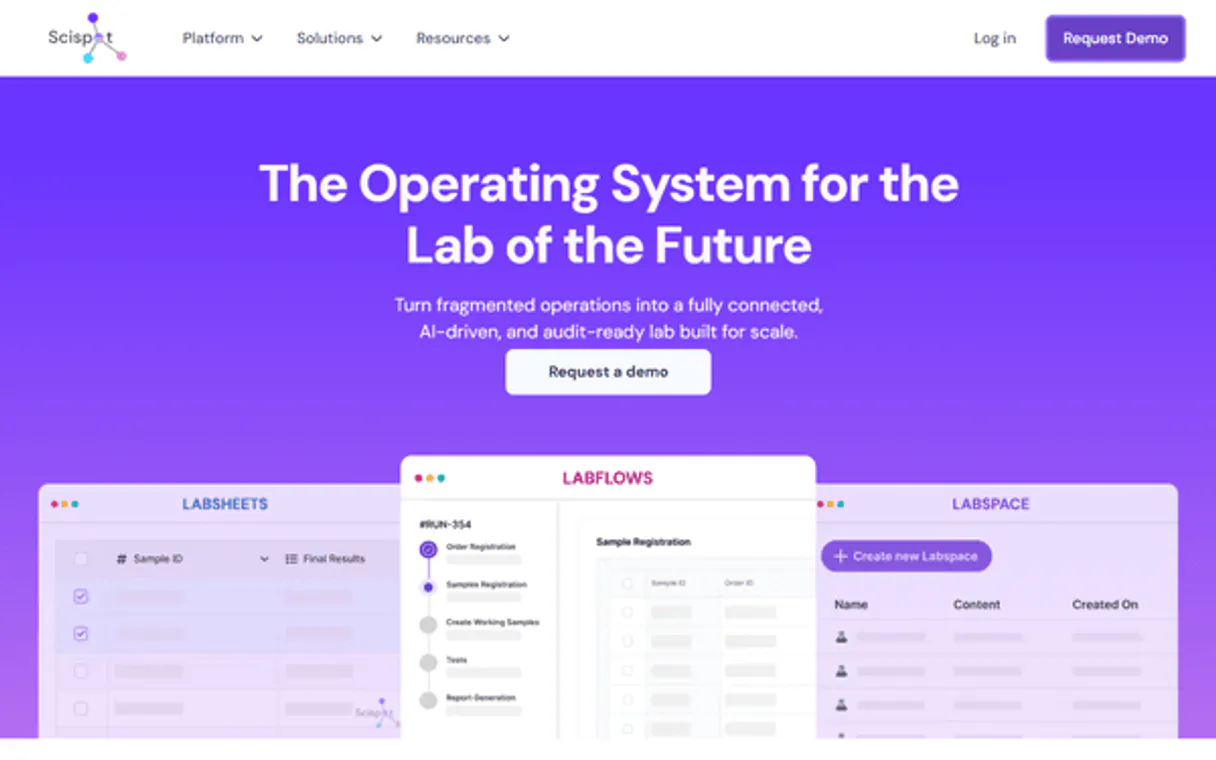
Independent Platform Disclaimer: Vinkius is an independent platform and is not affiliated with, endorsed by, sponsored by, verified by, or otherwise authorized by Scispot. All third-party trademarks, logos, and brand names are the property of their respective owners. Their use on this website is strictly for informational purposes to identify service compatibility and interoperability.
VINKIUS INFRASTRUCTURE
Cloud Hosted
Managed infra
V8 Isolated
Sandboxed per request
Zero-Trust Proxy
No stored credentials
DLP Enforced
Policy on every call
GDPR Compliant
EU data residency
Token Compression
~60% cost reduction
Works with Claude, ChatGPT, Cursor, and more
The Model Context Protocol standardizes how applications expose capabilities to LLMs. Instead of operating in isolation, your AI gains direct access to external platforms, live data, and real-world actions through secure, standardized connections.
This server provides 12 capabilities that interface natively with Claude, ChatGPT, Cursor, and any MCP client. No middleware. No custom integration required.
Available Capabilities
Tracking lab compliance shouldn't involve 15 clicks and three different logins.
Right now, checking if a batch is good requires opening the LIMS dashboard, finding the batch number in one tab, then switching to the 'Results' section to cross-reference sample IDs, and finally logging into a separate module just to print the final CoA. It’s slow, it involves copy-pasting dozens of unique identifiers, and you always worry about missing an update.
With this MCP server, your AI agent handles all that clicking for you. You ask: 'Is Batch XYZ clear for sale?' And in seconds, it queries `list_batches`, pulls the necessary data from `list_results`, verifies regulatory status using `list_certificates`—all without ever opening a dashboard.
Scispot MCP Server: Get full control over your lab data.
You eliminate the manual steps of checking instrument readiness. Instead of going through the maintenance logs to verify if the GC-MS needs a calibration date before running tests, you simply ask the agent via `list_instruments`. It verifies the status and tells you when it's safe to use.
The difference is control. You move from being reactive—responding manually to an audit request—to proactive. Your AI client constantly monitors data integrity using `list_audit_logs`, keeping your operation compliant before the inspector even shows up.
Common Questions About Scispot MCP
How do I use list_certificates with Scispot MCP Server? +
The agent retrieves all CoAs by linking them to a specific batch or sample ID. You can ask it to filter for only those pending review, which is useful before filing regulatory reports.
Can I check instrument status using list_instruments? +
Yes. The agent pulls the model number, serial number, and current calibration date for every piece of equipment. This helps you schedule maintenance or halt testing on faulty gear.
Does list_audit_logs track everything I do? +
It tracks critical actions: who modified a result, when the CoA was issued, and any change to user permissions. It’s your primary tool for demonstrating data integrity during audits.
How does list_samples help with my workflow? +
You can use it to see the entire queue: which samples arrived today, what they are being tested for, and their estimated completion date. It helps you manage client expectations immediately.
How can I use list_orders to monitor overall laboratory capacity? +
The tool lists current order status and estimated completion dates. It shows you the workload by identifying pending orders versus those already invoiced, helping manage your lab's available throughput.
When should I use list_workflows to improve our standard testing procedures? +
You use this tool to map out or audit your standardized processes. It details assigned roles, required quality checkpoints, and helps pinpoint operational bottlenecks in your lab's routine.
If a result is incomplete, how do I check its status using list_results? +
You can filter results by the approval or review status. This shows you exactly which findings need sign-off from quality assurance or require further investigation before they are released.
What compliance details does list_batches provide for regulatory reporting? +
It gives the batch's final disposition, including whether it is released, quarantined, rejected, or destroyed. This provides critical state-to-sale identifiers needed for mandatory regulatory reporting.
Can my AI automatically verify if a cannabis sample has passed all required tests and is ready for Certificate of Analysis issuance? +
Yes! Use the list_results tool to fetch all completed analytical findings for a specific sample. Your AI agent will respond with comprehensive pass/fail determinations across potency, terpenes, pesticides, heavy metals, mycotoxins, and microbial panels. Once all state-mandated tests show passing results, use list_certificates to verify CoA generation status and confirm automatic Metrc submission. Always verify regulatory limit compliance before releasing products to distribution or retail channels.
How do I quickly identify which laboratory instruments are approaching calibration expiry or require preventive maintenance? +
Simply ask the agent to run the list_instruments action. It will compile all analytical equipment tracked via Scispot GLUE integration with calibration status, last service date, next scheduled maintenance, IQ/OQ/PQ qualification records, and current operational state. The AI will proactively highlight any HPLC, GC-MS, ICP-MS, or other systems approaching calibration expiry or overdue for preventive maintenance. This ensures your laboratory maintains ISO/IEC 17025 compliance, analytical data integrity, and inspection readiness at all times.
Does the Scispot integration allow modifying test results, deleting samples, or revoking issued Certificates of Analysis? +
No. The current toolset focuses strictly on read-only querying and analytical operations — listing samples, reviewing results, checking certificates, monitoring workflows, and tracking instrument health. State alteration operations (modifying test data, deleting samples, revoking certificates, or changing approvals) are not currently exposed. This design assures your laboratory records remain secure against destructive queries, maintains complete audit trail integrity for regulatory inspections, and preserves data immutability required by FDA 21 CFR Part 11 and ISO/IEC 17025 standards.
Use it with your favorite AI tools
Connect this server to Cursor, Claude, VS Code, and more.
More in this category

HTML DOM Query Engine
Extract specific text and attributes from massive HTML payloads instantly using CSS selectors. Fast, memory-efficient DOM parsing.
JSONPlaceholder
Access fake online REST API for testing and prototyping — manage posts, comments, albums, photos, and todos directly from your AI agent.

RSS Feed Parser
Turn any RSS 2.0 or Atom feed into clean, structured JSON. Extract titles, links, dates, authors, and full content from blogs, news sites, and podcasts — ready for your agent to process.
You might also like

GlobalGiving
Search nonprofit projects, track crowdfunding goals, and oversee global charities via AI agents with GlobalGiving.

GPTBots
Manage your conversational AI agents, workflows, and knowledge bases via AI.

edX Alternative
Manage Open edX courses, enrollments, and user profiles — list learning paths, track student grades, and handle registrations via AI.