
Spellbook Legal AI MCP Server for AutoGen 13 tools — connect in under 2 minutes
Microsoft AutoGen enables multi-agent conversations where agents negotiate, delegate, and execute tasks collaboratively. Add Spellbook Legal AI as an MCP tool provider through the Vinkius and every agent in the group can access live data and take action.
ASK AI ABOUT THIS MCP SERVER
Vinkius supports streamable HTTP and SSE.
import asyncio
from autogen_agentchat.agents import AssistantAgent
from autogen_ext.tools.mcp import McpWorkbench

async def main():
    # Your Vinkius token — get it at cloud.vinkius.com
    async with McpWorkbench(
        server_params={"url": "https://edge.vinkius.com/[YOUR_TOKEN_HERE]/mcp"},
        transport="streamable_http",
    ) as workbench:
        tools = await workbench.list_tools()
        agent = AssistantAgent(
            name="spellbook_legal_ai_agent",
            tools=tools,
            system_message=(
                "You help users with Spellbook Legal AI. "
                "13 tools available."
            ),
        )
        print(f"Agent ready with {len(tools)} tools")

asyncio.run(main())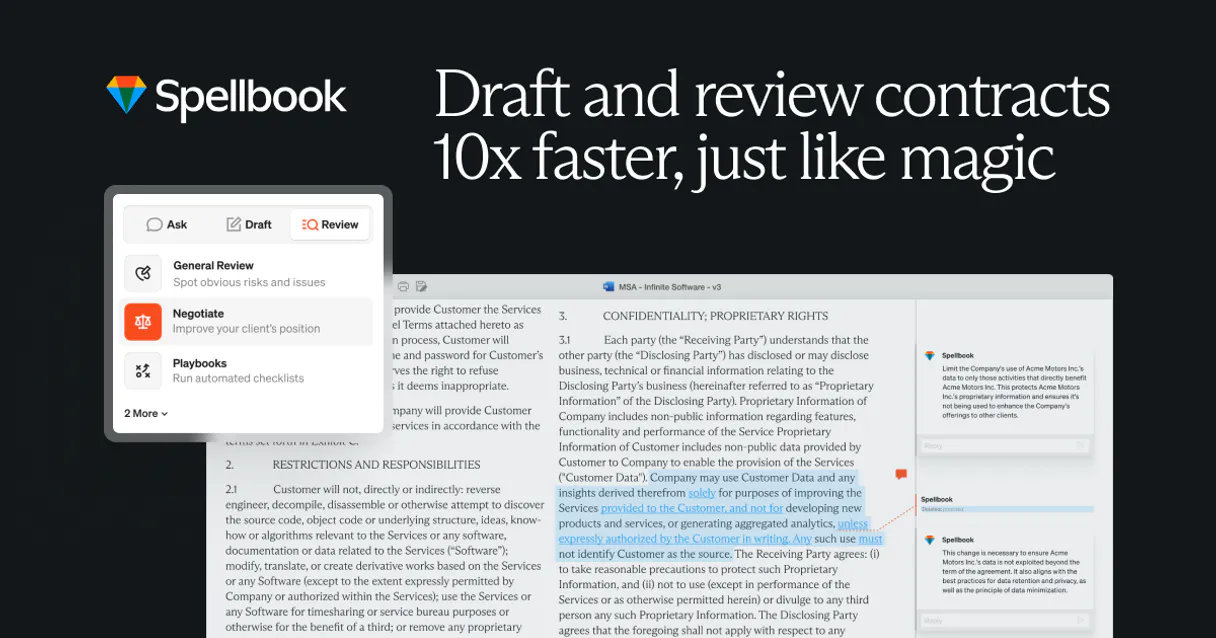
* Every MCP server runs on Vinkius-managed infrastructure inside AWS - a purpose-built runtime with per-request V8 isolates, Ed25519 signed audit chains, and sub-40ms cold starts optimized for native MCP execution. See our infrastructure
About Spellbook Legal AI MCP Server
Connect to Spellbook Legal AI and bring AI-powered contract drafting, review, and analysis to any AI agent. Trusted by 4,000+ in-house teams and law firms worldwide, Spellbook helps transactional lawyers draft and review contracts faster and more accurately.
AutoGen enables multi-agent conversations where agents negotiate, delegate, and collaboratively use Spellbook Legal AI tools. Connect 13 tools through the Vinkius and assign role-based access — a data analyst queries while a reviewer validates, with optional human-in-the-loop approval for sensitive operations.
What you can do
- Contract Analysis — AI-powered review of contracts identifying risks, missing clauses, non-standard terms, and issues
- Clause Suggestions — Get AI-generated clause suggestions based on market standards and best practices
- Contract Comparison — Compare two contract versions to identify additions, deletions, and modifications
- Market Comparison — Compare contract terms against 2,000+ market precedents showing pro-buyer, pro-seller, and market-standard positions
- AI Clause Drafting — Generate AI-drafted clauses based on specified requirements, jurisdiction, and party position
- Contract Summarization — Generate concise summaries highlighting key terms, obligations, and risks
- Risk Assessment — Get comprehensive risk assessments with high, medium, and low risk issues and remediations
- Playbook Compliance — Check contracts against company playbooks to identify deviations from standards
- Clause Library Search — Search Spellbook's extensive clause library for standard, market-tested clauses
- Document Management — Upload, list, and search contract documents with filtering by status and type
The Spellbook Legal AI MCP Server exposes 13 tools through the Vinkius. Connect it to AutoGen in under two minutes — no API keys to rotate, no infrastructure to provision, no vendor lock-in. Your configuration, your data, your control.
How to Connect Spellbook Legal AI to AutoGen via MCP
Follow these steps to integrate the Spellbook Legal AI MCP Server with AutoGen.
Install AutoGen
Run pip install "autogen-ext[mcp]"
Replace the token
Replace [YOUR_TOKEN_HERE] with your Vinkius token
Integrate into workflow
Use the agent in your AutoGen multi-agent orchestration
Explore tools
The workbench discovers 13 tools from Spellbook Legal AI automatically
Why Use AutoGen with the Spellbook Legal AI MCP Server
AutoGen provides unique advantages when paired with Spellbook Legal AI through the Model Context Protocol.
Multi-agent conversations: multiple AutoGen agents discuss, delegate, and collaboratively use Spellbook Legal AI tools to solve complex tasks
Role-based architecture lets you assign Spellbook Legal AI tool access to specific agents — a data analyst queries while a reviewer validates
Human-in-the-loop support: agents can pause for human approval before executing sensitive Spellbook Legal AI tool calls
Code execution sandbox: AutoGen agents can write and run code that processes Spellbook Legal AI tool responses in an isolated environment
Spellbook Legal AI + AutoGen Use Cases
Practical scenarios where AutoGen combined with the Spellbook Legal AI MCP Server delivers measurable value.
Collaborative analysis: one agent queries Spellbook Legal AI while another validates results and a third generates the final report
Automated review pipelines: a researcher agent fetches data from Spellbook Legal AI, a critic agent evaluates quality, and a writer produces the output
Interactive planning: agents negotiate task allocation using Spellbook Legal AI data to make informed decisions about resource distribution
Code generation with live data: an AutoGen coder agent writes scripts that process Spellbook Legal AI responses in a sandboxed execution environment
Spellbook Legal AI MCP Tools for AutoGen (13)
These 13 tools become available when you connect Spellbook Legal AI to AutoGen via MCP:
analyze_spellbook_contract
USE WHEN: - User wants to review a contract for risks - User needs to identify issues in a contract - User asks to "analyze this contract" or "review for risks" PARAMETERS: - document_id (REQUIRED): ID of the document to analyze - analysis_type (OPTIONAL): Type of analysis — "full" (default), "risks_only", "clause_check", "market_comparison" EXAMPLES: - "Analyze document 123 for risks" → call with document_id="123" - "Review this contract for issues" → call with document_id="123", analysis_type="full" - "Check clauses in document 456" → call with document_id="456", analysis_type="clause_check" Analyze a contract document for risks, issues, and suggestions
check_spellbook_playbook
Check contract compliance against a playbook
compare_spellbook_contracts
USE WHEN: - User wants to compare two versions of a contract - User needs to identify changes between drafts - User asks to "compare these contracts" or "show differences" PARAMETERS: - document_id_1 (REQUIRED): ID of the first document - document_id_2 (REQUIRED): ID of the second document - comparison_type (OPTIONAL): Type of comparison — "full" (default), "clauses_only", "risk_comparison" EXAMPLES: - "Compare documents 123 and 456" → call with document_id_1="123", document_id_2="456" - "Show differences between contract versions" → call with document_id_1="123", document_id_2="456", comparison_type="full" Compare two contract versions to identify differences
draft_spellbook_clause
USE WHEN: - User needs to draft a new clause for a contract - User wants AI to generate standard clause language - User asks to "draft a limitation of liability clause" or "write an indemnification clause" PARAMETERS: - clause_type (REQUIRED): Type of clause to draft (e.g. "Limitation of Liability", "Indemnification", "Confidentiality") - party_position (OPTIONAL): Which party position to draft for — "neutral" (default), "pro-buyer", "pro-seller", "pro-vendor" - jurisdiction (OPTIONAL): Jurisdiction for the clause (e.g. "New York", "Delaware", "California", "UK") - custom_instructions (OPTIONAL): Additional instructions or requirements for the clause EXAMPLES: - "Draft a limitation of liability clause" → call with clause_type="Limitation of Liability" - "Draft a pro-buyer indemnification clause for New York" → call with clause_type="Indemnification", party_position="pro-buyer", jurisdiction="New York" - "Write a confidentiality clause with custom instructions" → call with clause_type="Confidentiality", custom_instructions="Include data breach notification requirements" Draft a contract clause using Spellbook AI
get_spellbook_clause_suggestions
Get AI clause suggestions for a contract document
get_spellbook_document
Get detailed information for a specific contract document
get_spellbook_market_comparison
Shows pro-buyer, pro-seller, and market-standard positions. Get market comparison data for a specific clause type
get_spellbook_risk_assessment
Get a detailed risk assessment for a contract document
list_spellbook_documents
Supports filtering by status, document type, and date range. USE WHEN: - User wants to see all their contract documents - User needs to find contracts by status or type - User is exploring their document library - User asks "what contracts do I have" or "list my documents" PARAMETERS: - status (OPTIONAL): Filter by document status (e.g. "Draft", "In Review", "Finalized") - document_type (OPTIONAL): Filter by document type (e.g. "NDA", "MSA", "SOW", "Employment Agreement") - date_from (OPTIONAL): Start date filter (YYYY-MM-DD) - date_to (OPTIONAL): End date filter (YYYY-MM-DD) - page (OPTIONAL): Page number for pagination - page_size (OPTIONAL): Results per page (default: 25, max: 100) EXAMPLES: - "List all my contract documents" → call with no params - "Show contracts in review" → call with status="In Review" - "List NDAs" → call with document_type="NDA" List all contract documents in Spellbook
search_spellbook_clause_library
Search the Spellbook clause library for standard clauses
search_spellbook_documents
Search contract documents by keyword
summarize_spellbook_contract
Generate an AI summary of a contract document
upload_spellbook_document
USE WHEN: - User wants to upload a new contract for review - User needs to analyze a contract received from another party - User asks to "upload this contract" or "analyze this document" PARAMETERS: - file_name (REQUIRED): Name of the document file - file_content (REQUIRED): Base64-encoded file content or document text - document_type (OPTIONAL): Type of document (e.g. "NDA", "MSA", "SOW") EXAMPLES: - "Upload this NDA for review" → call with file_name="NDA.pdf", file_content="[base64 content]", document_type="NDA" - "Analyze this MSA contract" → call with file_name="MSA.docx", file_content="[base64 content]", document_type="MSA" Upload a contract document to Spellbook for analysis
Example Prompts for Spellbook Legal AI in AutoGen
Ready-to-use prompts you can give your AutoGen agent to start working with Spellbook Legal AI immediately.
"Analyze this NDA for risks and issues."
"Draft a pro-buyer limitation of liability clause for Delaware."
"Compare the market standard for indemnification clauses."
Troubleshooting Spellbook Legal AI MCP Server with AutoGen
Common issues when connecting Spellbook Legal AI to AutoGen through the Vinkius, and how to resolve them.
McpWorkbench not found
pip install "autogen-ext[mcp]"Spellbook Legal AI + AutoGen FAQ
Common questions about integrating Spellbook Legal AI MCP Server with AutoGen.
How does AutoGen connect to MCP servers?
Can different agents have different MCP tool access?
Does AutoGen support human approval for tool calls?
Connect Spellbook Legal AI with your favorite client
Step-by-step setup guides for every MCP-compatible client and framework:
Anthropic's native desktop app for Claude with built-in MCP support.
AI-first code editor with integrated LLM-powered coding assistance.
GitHub Copilot in VS Code with Agent mode and MCP support.
Purpose-built IDE for agentic AI coding workflows.
Autonomous AI coding agent that runs inside VS Code.
Anthropic's agentic CLI for terminal-first development.
Python SDK for building production-grade OpenAI agent workflows.
Google's framework for building production AI agents.
Type-safe agent development for Python with first-class MCP support.
TypeScript toolkit for building AI-powered web applications.
TypeScript-native agent framework for modern web stacks.
Python framework for orchestrating collaborative AI agent crews.
Leading Python framework for composable LLM applications.
Data-aware AI agent framework for structured and unstructured sources.
Microsoft's framework for multi-agent collaborative conversations.
Connect Spellbook Legal AI to AutoGen
Get your token, paste the configuration, and start using 13 tools in under 2 minutes. No API key management needed.