
Taiwan Weather (CWA) MCP. Get real-time quakes and multi-day forecasts for Taiwan.
 Gemini
 Works with every AI agent you already use
…and any MCP-compatible client









Just plug in your AI agents and start using Vinkius.
Taiwan Weather (CWA) MCP Server accesses the Central Weather Administration's official records for Taiwan. Use it to get real-time major earthquake reports, 36-hour city forecasts, one-week township predictions, and detailed small-magnitude seismic data.
What your AI agents can do
Get taiwan earthquakes
Retrieves official reports on significant earthquakes, including magnitude and epicenter coordinates.
Get taiwan forecast
Gets the 36-hour weather forecast for major cities across Taiwan, listing temperature ranges and rain probability.
Get taiwan small earthquakes
Retrieves reports on small-magnitude quakes useful for seismological research and monitoring minor activity.
The agent pulls official data on significant seismic events, providing magnitude, depth, and epicenter coordinates.
You request the weather forecast for a specific city or county, receiving predicted temperature ranges and rain probability over three days.
The agent retrieves the 1-week forecast, breaking down conditions by township in 12-hour intervals for detailed itinerary planning.
You pull reports on small-magnitude quakes, useful specifically for research or monitoring minor activity trends.
Ask AI about this MCP
Supported MCP Clients
Gemini Waiting for input…
Taiwan Weather (CWA): 4 Tools for Meteorology & Seismology
Use these four tools to pull official data from the CWA. They cover everything from real-time major earthquake reports to week-long, 12-hour weather predictions across Taiwan.
019d7610get taiwan earthquakes
Retrieves official reports on significant earthquakes, including magnitude and epicenter coordinates.
019d7610get taiwan forecast
Gets the 36-hour weather forecast for major cities across Taiwan, listing temperature ranges and rain probability.
019d7610get taiwan small earthquakes
Retrieves reports on small-magnitude quakes useful for seismological research and monitoring minor activity.
019d7610get taiwan weekly forecast
Provides the 1-week weather forecast, detailing conditions across townships in 12-hour intervals.
Choose How to Get Started
Build a custom MCP for your own tools, or connect a ready-made integration from our catalog.
Build Your Own
Turn any API into an MCP. Import a spec, define Agent Skills, or deploy with MCPFusion.
- Import from OpenAPI, Swagger, or YAML specs
- Create Agent Skills with progressive disclosure
- Deploy to edge with MCPFusion framework
- Built in DLP, auth, and compliance on every call
- Real time usage dashboard and cost metering
- Publish to catalog or keep private
Make Your AI Do More
Start with Taiwan Weather (CWA), then connect any of our 4,700+ other servers whenever your AI needs more. One click, no limits.
- Use this MCP plus 4,700+ others, all in one place
- Add new capabilities to your AI anytime you want
- Every connection is secured and compliant automatically
- Track usage and costs across all your servers
- Works with Claude, ChatGPT, Cursor, and more
- New servers added to the catalog every week
What you can do with this MCP connector
This MCP Server connects your AI client directly to the Central Weather Administration (CWA) of Taiwan. You're getting access to official, real-time seismic and meteorological records from one of Asia’s major monitoring networks. It handles everything from immediate earthquake reports to detailed, long-range weather planning.
When you need to check for significant geological activity, use get_taiwan_earthquakes. This tool pulls verified, official reports on large earthquakes across Taiwan and the surrounding region. You'll get key details like the event's magnitude, its depth, and precise epicenter coordinates—what you really need when assessing risk.
For analyzing background seismic activity, run get_taiwan_small_earthquakes. This function retrieves data specifically on minor-magnitude quakes. It’s critical for seismological research or if you're monitoring subtle shifts in activity that don't trigger major alerts, giving you a granular view of the tectonic environment.
When you need to plan trips, your options are pretty robust. If you only have three days, use get_taiwan_forecast. This function pulls a 36-hour weather forecast for specific major cities or counties across Taiwan. You'll get predicted temperature ranges and the probability of rain over that period.
When you need to plan weeks out, you've got get_taiwan_weekly_forecast. Running this tool gives you a full one-week outlook, but it breaks down conditions by individual townships in 12-hour chunks. This granularity is essential for complex itinerary planning or logistics where timing matters.
Combining these tools lets your agent handle highly specific requests. For instance, if you need to know the weather for a city and check for minor quakes that happened today, you can call both get_taiwan_forecast and get_taiwan_small_earthquakes. If your goal is pure risk assessment, you'll pull major quake reports using get_taiwan_earthquakes, then cross-reference the region with the long-term planning data from get_taiwan_weekly_forecast.
The system pulls together official reports on significant seismic events and detailed weather forecasts for townships across Taiwan. You won't find more direct, actionable government data anywhere else.
How Taiwan Weather (CWA) MCP Works
- 1 Tell your agent exactly what you need. For example: 'What's the 36-hour weather forecast for Kaohsiung?'
- 2 The server executes the appropriate tool (e.g.,
get_taiwan_forecast) and fetches data from the CWA feed. - 3 Your AI client receives a structured JSON payload containing the raw, official predictions or event logs.
The bottom line is: your agent gets verified, multi-source weather and seismic data directly into your workflow without needing to visit multiple government websites.
Who Is Taiwan Weather (CWA) MCP For?
Disaster response coordinators need this. They can't rely on local news feeds; they need the raw, official CWA data for rapid assessment. Logistics managers use it to plot routes around predicted weather closures or unstable ground. Researchers depend on the full spectrum of tools—from major quake reports to small-magnitude event logs—for deep geological modeling.
Uses get_taiwan_earthquakes and get_taiwan_forecast together to model evacuation routes based on immediate seismic risk and expected severe weather.
Runs get_taiwan_weekly_forecast to plan supply chain movements, ensuring vehicles avoid townships expecting high rain probability or seasonal closures.
Calls both get_taiwan_earthquakes and get_taiwan_small_earthquakes to build a complete picture of regional seismic activity over time.
What Changes When You Connect
- Access CWA's official data directly. You skip cross-referencing multiple government sites; the server provides verified reports on both seismic activity and weather conditions using
get_taiwan_earthquakes. - Plan trips with granular detail. The
get_taiwan_weekly_forecasttool delivers 12-hour interval predictions for entire townships, which is way more useful than a single city summary. - Differentiate between risks. You can call both
get_taiwan_earthquakes(big events) andget_taiwan_small_earthquakes(minor data). This lets you build a complete risk model without missing the minor tremors. - Know the immediate conditions. The 36-hour forecast from
get_taiwan_forecastgives you enough lead time to adjust operations—you know if those afternoon thunderstorms are coming early or late in the window.
Real-World Use Cases
Coordinating disaster relief after a tremor
The ground shakes, and you need immediate information. Your agent runs get_taiwan_earthquakes to confirm the quake's magnitude and epicenter. Then, it calls get_taiwan_forecast to see if heavy rain or typhoons are complicating rescue efforts in that specific region.
Planning a multi-day construction project
You need reliable outdoor work for the next two weeks. Instead of checking daily, you run get_taiwan_weekly_forecast to map out when rain probability dips low enough across multiple townships to allow safe material transport.
Writing a scientific paper on regional risk
Your research requires both major and minor data points. You use get_taiwan_earthquakes for the high-impact events, then supplement that with get_taiwan_small_earthquakes to provide a fuller picture of background seismic noise.
Adjusting travel plans around typhoons
A large typhoon is approaching. You use the 36-hour forecast (get_taiwan_forecast) to track the immediate severe weather changes in Taipei, and then cross-check with get_taiwan_weekly_forecast to see how long that impact will last.
The Tradeoffs
Only checking the daily forecast
Assuming a single city's weather report is enough for an entire region or week. This leads to planning gaps when conditions change drastically between townships.
→
For long-term checks, always use get_taiwan_weekly_forecast because it provides 12-hour granularity across multiple townships, giving you a much clearer operational picture.
Ignoring minor quakes
Only running get_taiwan_earthquakes and missing the context of smaller, persistent seismic activity that points to building stress.
→
If your task is research or long-term risk assessment, run both get_taiwan_earthquakes AND get_taiwan_small_earthquakes to get a complete picture.
Relying on anecdotal data
Using local forum posts or non-official sources for critical safety planning. This data can be outdated, biased, or wrong.
→
Always use the MCP Server to call tools like get_taiwan_forecast and get_taiwan_earthquakes. The data comes directly from the CWA.
When It Fits, When It Doesn't
Use this server if your job requires verifiable, layered information that spans both time (36 hours up to one week) and risk (major quakes down to small tremors). Specifically, if you need a combination of get_taiwan_earthquakes AND get_taiwan_forecast, this is the right tool. Don't use it if your only goal is checking today's weather—a simple local app works fine then. If your goal is deep seismology or multi-day logistics, you need the granularity of get_taiwan_weekly_forecast and the detail of get_taiwan_small_earthquakes. Never use this if you are operating outside the Western Pacific typhoon corridor; these tools only cover Taiwan.
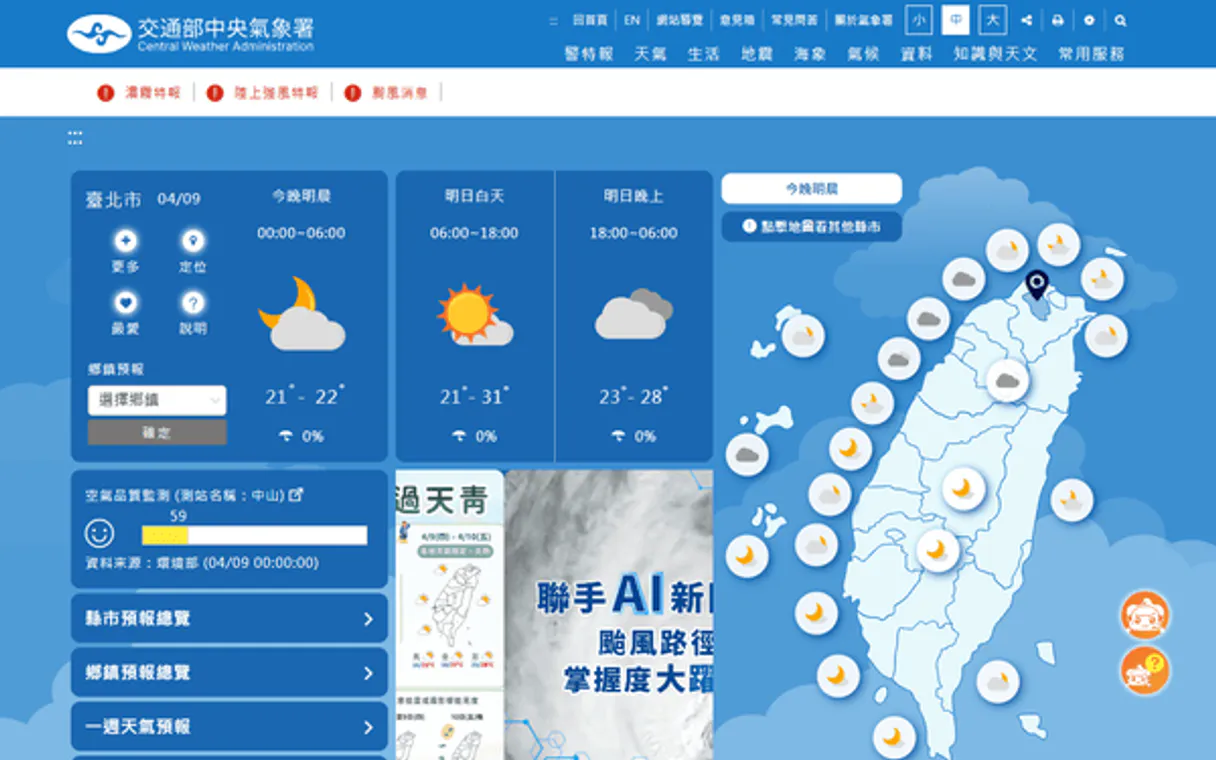
Independent Platform Disclaimer: Vinkius is an independent platform and is not affiliated with, endorsed by, sponsored by, verified by, or otherwise authorized by Central Weather Administration (CWA). All third-party trademarks, logos, and brand names are the property of their respective owners. Their use on this website is strictly for informational purposes to identify service compatibility and interoperability.
VINKIUS INFRASTRUCTURE
Cloud Hosted
Managed infra
V8 Isolated
Sandboxed per request
Zero-Trust Proxy
No stored credentials
DLP Enforced
Policy on every call
GDPR Compliant
EU data residency
Token Compression
~60% cost reduction
Works with Claude, ChatGPT, Cursor, and more
The Model Context Protocol standardizes how applications expose capabilities to LLMs. Instead of operating in isolation, your AI gains direct access to external platforms, live data, and real-world actions through secure, standardized connections.
This server provides 4 capabilities that interface natively with Claude, ChatGPT, Cursor, and any MCP client. No middleware. No custom integration required.
Available Capabilities
Weather planning shouldn't require checking three different government websites.
Before, planning a week-long trip meant opening the local weather site for Taipei, then calling the county office for rainfall probability, and finally cross-referencing a separate seismic monitoring page. You spent hours copy-pasting dates and ranges into a spreadsheet just to compare risk factors.
Now, your agent handles it all. You ask for the week's forecast, and the server uses `get_taiwan_weekly_forecast` to pull 12-hour interval data for every township in one call. It gives you actionable movement patterns, not just pretty graphs.
Taiwan Weather (CWA) MCP Server: Get official seismic and weather reports.
You no longer have to manually track whether the minor quakes are separate from the major alerts. The server lets you run both `get_taiwan_earthquakes` and `get_taiwan_small_earthquakes` back-to-back, consolidating a full risk profile—the big picture plus the background noise.
It's simple: your agent runs the tools, gets the verified data from CWA, and hands you one clean, comprehensive report. It’s immediate.
Common Questions About Taiwan Weather (CWA) MCP
How do I check for major earthquakes using get_taiwan_earthquakes? +
You tell your agent to run get_taiwan_earthquakes. This tool pulls official reports on significant seismic events, giving you the magnitude, depth, and precise epicenter coordinates from the CWA.
Can I get a forecast for more than 3 days using get_taiwan_forecast? +
No. get_taiwan_forecast is limited to the 36-hour window for major cities. For multi-day planning, you must use get_taiwan_weekly_forecast.
Is get_taiwan_small_earthquakes useful for general users? +
It's mainly for researchers and technical teams. This tool provides records on small-magnitude quakes—stuff that doesn't trigger a major public alert but is key data points for monitoring.
What time frame does get_taiwan_weekly_forecast cover? +
This tool covers one full week of predictions. The forecast delivers conditions in 12-hour increments, which helps you plan logistics across entire townships.
Before running `get_taiwan_earthquakes`, what credentials do I need to access the data? +
You'll need a free API key from CWA. The MCP server handles the connection; you simply input your generated key during setup, and it manages rate limiting for you.
When using `get_taiwan_forecast`, what format should I use for city names to get accurate readings? +
You can filter by either Traditional Chinese characters or English romanization. The tool accepts both inputs, giving you flexibility regardless of your source data.
Does `get_taiwan_earthquakes` only report on seismic activity inside Taiwan? +
No, the reports cover both Taiwan and the surrounding Pacific region. This is critical because it provides regional context needed for safety planning across the Western Pacific typhoon corridor.
What specific weather metrics are provided by `get_taiwan_weekly_forecast`? +
The forecast gives you temperature ranges, precipitation probability, and general conditions. This level of detail helps plan logistics down to 12-hour shifts for travel.
How do I get a CWA API key? +
Register for a free account at opendata.cwa.gov.tw. Once logged in, your Authorization key is available immediately in your profile dashboard. No approval wait time required.
Why is Taiwan earthquake data so important? +
Taiwan sits directly on the Pacific Ring of Fire, one of the most seismically active zones on Earth. The CWA operates one of the densest seismological sensor networks in Asia, providing rapid, high-precision earthquake data that is critical for safety, construction, and insurance applications.
Use it with your favorite AI tools
Connect this server to Cursor, Claude, VS Code, and more.
More in this category

Verbit
Automate professional transcription and captioning via Verbit — upload media, track job progress, and retrieve transcripts in multiple formats directly from your AI agent.

Eden AI Alternative
Access 100+ AI models through a single API — route LLMs, generate embeddings, and execute specialized AI tasks like OCR and translation.

Theta
Interact with Theta Network — query blockchain data, manage AI EdgeCloud deployments, and orchestrate decentralized video delivery.
You might also like
IBGE Pesquisas — Brasil Cidades
Query the engine behind Brasil Cidades: health, education, economy, and quality-of-life indicators for every Brazilian municipality — rank cities, compare regions, and build data-driven policy analysis.
Eventee
Equip your AI agent to manage events, track speakers, and monitor attendee engagement via the Eventee API.

Unstructured
Process and transform complex unstructured data into AI-ready inputs by managing sources, destinations, and workflows directly from your AI agent.