
Wiagro MCP. Predict Spoilage and Manage Grain Storage Conditions
 Gemini
 Works with every AI agent you already use
…and any MCP-compatible client









Just plug in your AI agents and start using Vinkius.
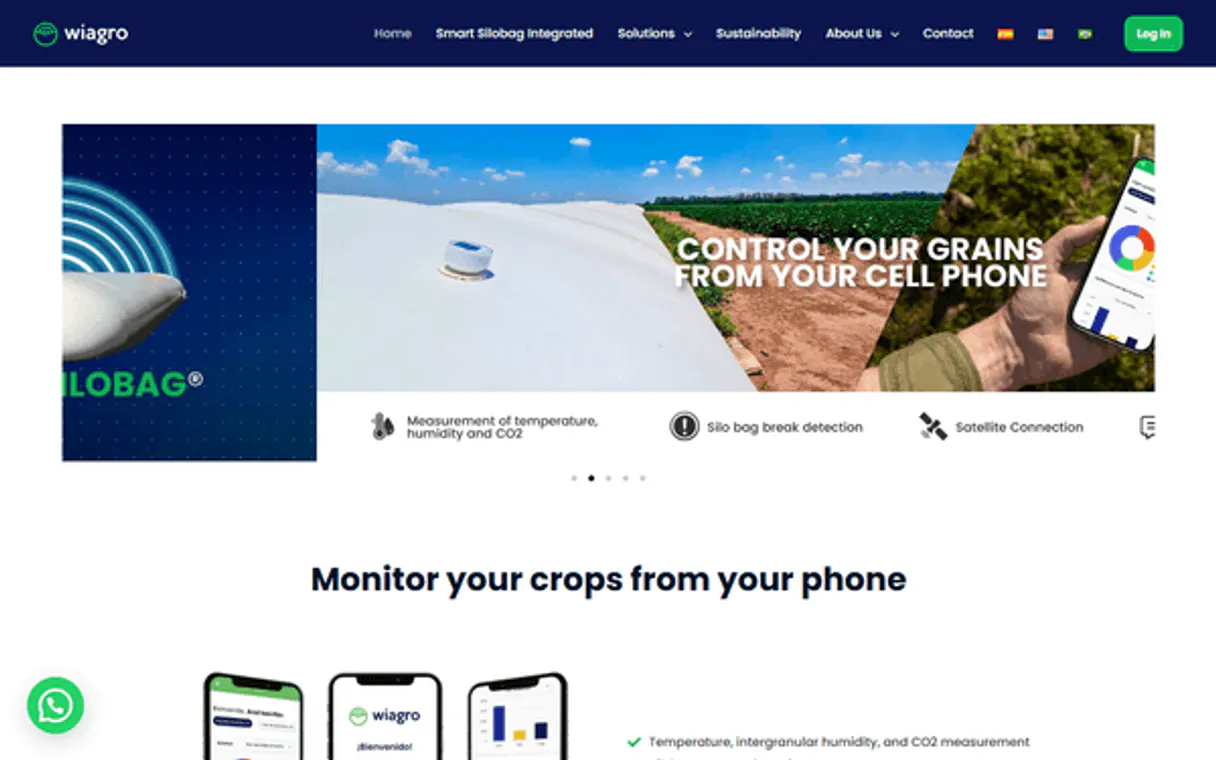
Wiagro monitors grain storage conditions by connecting your AI agent directly to IoT sensor data. It tracks temperature, humidity, CO2 levels, structural ruptures, and sensor health for silobags and conventional silos.
Get real-time quality scores and historical trend analysis—all through natural conversation.
What your AI agents can do
Get alerts
Retrieves an immediate list of active warnings and critical alerts concerning temperature, humidity, or CO2 for monitored silos.
Get co2 history
Gets time-series data showing historical CO2 levels (ppm) to track biological activity and potential spoilage trends in the grain.
Get current readings
Returns immediate temperature, humidity, and CO2 readings from all active sensors within a specific silobag.
The agent retrieves critical alerts, including high temperature, humidity, or CO2 spikes, and checks for physical structural damage like silobag ruptures.
You can pull historical time-series data for CO2 and humidity to pinpoint subtle changes that signal mold growth or moisture migration before they become visible problems.
The server aggregates status reports across all monitored units, giving a high-level quality score and inventory list of every silo on site.
Ask AI about this MCP
Supported MCP Clients
Gemini Waiting for input…
Wiagro MCP Server: 12 Tools for Silo Monitoring
Use these tools to get real-time sensor data, historical trends, alert status, and overall quality assessments for your entire grain storage facility.
019d7622get alerts
Retrieves an immediate list of active warnings and critical alerts concerning temperature, humidity, or CO2 for monitored silos.
019d7622get co2 history
Gets time-series data showing historical CO2 levels (ppm) to track biological activity and potential spoilage trends in the grain.
019d7622get current readings
Returns immediate temperature, humidity, and CO2 readings from all active sensors within a specific silobag.
019d7622get facility overview
Generates a comprehensive summary of the entire facility's status, covering multiple silos and overall quality metrics.
019d7622get humidity history
Provides time-series data on historical intergranular humidity (%) to spot patterns of moisture migration or condensation build-up.
019d7622get quality assessment
Generates an AI-powered score, risk level, and predicted remaining storage life for a specific silobag.
019d7622get rupture alerts
Returns alerts detailing tears, holes, or structural damage detected on the exterior of any monitored silobags.
019d7622get satellite data
Pulls external environmental data from satellite feeds that may affect the stored grain's condition (e.g., extreme weather).
019d7622get sensor health
Checks the operational status, battery life, and signal strength of every IoT sensor deployed in a silo.
019d7622get silobag details
Retrieves metadata about a specific silobag or silo, including its grain type and physical location.
019d7622get silobags
Lists every monitored storage unit by ID, name, capacity, and current fill level for inventory management.
019d7622get temperature history
Tracks historical temperature trends (Celsius) over time to identify developing hot spots or spoilage zones within a silo.
Choose How to Get Started
Build a custom MCP for your own tools, or connect a ready-made integration from our catalog.
Build Your Own
Turn any API into an MCP. Import a spec, define Agent Skills, or deploy with MCPFusion.
- Import from OpenAPI, Swagger, or YAML specs
- Create Agent Skills with progressive disclosure
- Deploy to edge with MCPFusion framework
- Built in DLP, auth, and compliance on every call
- Real time usage dashboard and cost metering
- Publish to catalog or keep private
Make Your AI Do More
Start with Wiagro, then connect any of our 4,700+ other servers whenever your AI needs more. One click, no limits.
- Use this MCP plus 4,700+ others, all in one place
- Add new capabilities to your AI anytime you want
- Every connection is secured and compliant automatically
- Track usage and costs across all your servers
- Works with Claude, ChatGPT, Cursor, and more
- New servers added to the catalog every week
What you can do with this MCP connector
Wiagro connects your AI agent directly to IoT sensor data for grain storage. You'll manage both silobags and conventional silos, tracking everything from environmental metrics to structural integrity with natural conversation. This server lets you act like a dedicated preservation analyst without manually checking dashboards.
Immediate Danger Assessment
You check for immediate dangers by calling get_alerts, which pulls an active list of warnings concerning temperature, humidity, or CO2 spikes across all monitored silos. If that's clear, you can drill down into specific units: get_current_readings returns the live temperature, humidity, and CO2 numbers for a single silobag. You also check physical integrity; calling get_rupture_alerts gives you immediate details on any tears or holes detected on a silobag's exterior.
To make sure your monitoring system itself is good to go, you run get_sensor_health, which checks the operational status, signal strength, and battery life of every sensor deployed.
Trend Analysis for Spoilage Prediction
You analyze long-term spoilage trends by looking at historical time-series data. To spot mold growth or moisture migration before it's visible, you pull get_co2_history to see CO2 levels (ppm) over time. For humidity patterns, get_humidity_history provides the history of intergranular humidity (%). Hot spots and developing spoilage zones show up when you check get_temperature_history, which tracks temperature trends in Celsius over a period.
Knowing this data allows your AI agent to run get_quality_assessment, generating an AI-powered score, risk level, and predicted remaining storage life for any specific silobag.
Facility Overview and Inventory Management
You assess the overall facility health by running get_facility_overview. This single call aggregates status reports across all units, giving you a high-level quality score and summarizing multiple silos. For inventory control, you use get_silobags to get a full list of every monitored storage unit—you'll see its ID, name, capacity, and current fill level.
To understand the specific details of any given container, you call get_silobag_details, which retrieves metadata like the grain type and physical location. For external context, you pull get_satellite_data to get environmental feeds that could affect stored grain conditions, such as extreme weather warnings.
Combining Data Points
When you need a full picture of what's going on, your agent can combine these tools. You first use get_silobags to list every unit ID. Then, for each one, you pull its specific data using get_current_readings and check its status with get_sensor_health. If you want a deep dive into spoilage risk for a single type of grain, you can first use get_silobag_details to confirm the grain type, then run get_co2_history against that specific unit's ID.
You can also get an inventory list and a comprehensive status report simultaneously by running get_facility_overview alongside get_silobags. This lets you keep track of every silo on site while knowing its current quality metrics.
How Wiagro MCP Works
- 1 Subscribe to the Wiagro server and enter your API key and base URL from your platform dashboard.
- 2 Your AI agent uses the provided tools (e.g.,
get_current_readings) to query live sensor data or historical trends. - 3 The system returns structured, analyzed metrics—like an overall facility quality score or a list of active alerts—ready for natural language interpretation.
The bottom line is you get deep, multi-metric insights into grain preservation without leaving your chat interface.
Who Is Wiagro MCP For?
This tool's audience isn't just farmers; it's the operations manager who needs to stop reacting to crises and start predicting them. It’s for the agricultural consultant who has too many client dashboards to track, and the facility engineer tasked with maintaining massive, complex sensor networks across multiple locations.
Uses get_facility_overview to check all silos' status at once, prioritizing which units need immediate physical inspection based on overall health scores.
Runs comparisons between historical data using get_temperature_history and current readings (get_current_readings) to advise clients on optimal harvest or storage timing.
Checks the operational status of the hardware using get_sensor_health to identify which specific sensors need batteries replaced or are reporting weak signals, preventing data gaps.
What Changes When You Connect
- Stop guessing about spoilage. By running
get_co2_historyand comparing it to current readings (get_current_readings), you track biological activity, providing an early warning that temperature spikes alone can't detect. - Don't wait for leaks. Use
get_rupture_alertsto immediately get structural integrity reports, checking for silobag tears or holes before weather or pests cause major loss. - Manage the whole site at a glance. The
get_facility_overviewtool aggregates metrics from every silo—quality score, alert status, and general condition—so you don't have to check 20 separate dashboards. - Know your hardware limits. Running
get_sensor_healthprevents data gaps. It tells you which sensors are low on battery or offline before they fail, keeping your monitoring continuous. - Optimize storage life. The
get_quality_assessmenttool doesn't just give a score; it estimates remaining storage time and suggests actionable next steps based on current trends.
Real-World Use Cases
Responding to an emergency alert.
The ops manager gets an alarm about Silo 7. Instead of calling a technician, they ask their agent to run get_alerts and get_rupture_alerts. The agent confirms the structural integrity is fine but flags a high CO2 warning. Then, running get_co2_history shows the rise started three days ago, allowing them to recommend targeted aeration immediately.
Preparing for a client meeting.
The consultant needs to assess multiple properties quickly. They use get_silobags to list all sites and then run get_quality_assessment on each one. This instantly generates an objective, data-backed report showing the average quality score across their entire portfolio.
Diagnosing a temperature anomaly.
A silo's average temp is up 2 degrees, but it’s unclear why. The engineer runs get_temperature_history to see if the spike is gradual or sudden. They then cross-reference this with get_humidity_history to check for condensation patterns, which might be the actual root cause.
Performing routine site maintenance.
The facility manager needs a status report before year-end audit. They first run get_sensor_health to confirm all 45 sensors are active. Then, they pull the get_facility_overview for the final, auditable snapshot of the entire operation.
The Tradeoffs
Checking only the temperature.
Thinking that a simple check using get_current_readings (only looking at Temp) is enough. This misses major spoilage risks, like mold growth indicated by high CO2 or moisture migration.
→
Always run multiple tools together. Combine get_current_readings with get_co2_history and get_humidity_history. If any of those metrics are trending poorly, you've found the problem.
Ignoring hardware status.
Assuming all sensors are working just because the data stream is active. A sensor might report incorrect readings due to a low battery or poor signal.
→
Always start by running get_sensor_health. If any unit reports 'low battery' or 'offline,' don't trust its readings until maintenance checks it.
Focusing only on the present moment.
Asking for current conditions without context. You see high CO2, but you don't know if that’s a sudden event or part of a slow, developing trend.
→
When issues surface, immediately run get_co2_history or get_temperature_history. Seeing the trend is what tells you whether to panic or just plan for it.
When It Fits, When It Doesn't
Use this server if your primary need is multi-metric risk assessment. If you only care about one thing—say, current temperature—you could use a simpler endpoint. But grain storage involves complex physics; spoilage isn't just high heat. You must check CO2 (biological activity), humidity (moisture migration), and temperature (heat buildup). Use get_facility_overview when you need to compare silos across different grains or locations. Don't use it if you are only checking local weather—that requires a dedicated meteorological service; here, we focus on the impact of that external environment using get_satellite_data. If your goal is maintenance planning, start with get_sensor_health before anything else.
Independent Platform Disclaimer: Vinkius is an independent platform and is not affiliated with, endorsed by, sponsored by, verified by, or otherwise authorized by Wiagro. All third-party trademarks, logos, and brand names are the property of their respective owners. Their use on this website is strictly for informational purposes to identify service compatibility and interoperability.
VINKIUS INFRASTRUCTURE
Cloud Hosted
Managed infra
V8 Isolated
Sandboxed per request
Zero-Trust Proxy
No stored credentials
DLP Enforced
Policy on every call
GDPR Compliant
EU data residency
Token Compression
~60% cost reduction
Works with Claude, ChatGPT, Cursor, and more
The Model Context Protocol standardizes how applications expose capabilities to LLMs. Instead of operating in isolation, your AI gains direct access to external platforms, live data, and real-world actions through secure, standardized connections.
This server provides 12 capabilities that interface natively with Claude, ChatGPT, Cursor, and any MCP client. No middleware. No custom integration required.
Available Capabilities
Manual inspections are slow. They don't track what actually matters in a silo.
Right now, checking storage conditions means logging into multiple vendor dashboards—one for temperature, one for humidity, and another for structural integrity. You have to manually cross-reference these reports to determine if the CO2 levels are climbing, or if a small temperature fluctuation is actually signaling mold growth. It's tedious, reactive work that costs time.
With this MCP server, you ask your agent: 'What's the risk profile for Silo 5?' The tool immediately aggregates current readings (`get_current_readings`), checks historical CO2 trends (`get_co2_history`), and cross-references it with structural alerts (`get_rupture_alerts`). You get an instant, comprehensive assessment without switching tabs or writing a single spreadsheet formula.
Wiagro MCP Server: Get the full picture of your storage capacity.
You currently have to list out every silo ID and then individually check its fill level, grain type, and current monitoring status. This requires running multiple basic API calls just to get an inventory snapshot before you can even start diagnosing a problem.
Now, running `get_silobags` gives you a clean manifest of all monitored units—ID, name, capacity, and what's stored inside—in one go. It’s the foundational step for any serious analysis.
Common Questions About Wiagro MCP
How do I check if there are structural leaks in my silos using get_rupture_alerts? +
Running get_rupture_alerts gives you immediate status on silobag tears or holes. The system reports the severity and location, telling you exactly where to send a physical inspection team.
Can I see if CO2 is rising in Silo 3 over time with get_co2_history? +
Yes. get_co2_history returns the full timeline of CO2 readings (ppm). This lets you identify when and how fast biological activity started, which is key for preventative action.
What does get_sensor_health tell me about my facility? +
This tool checks every physical sensor. It tells you the battery level, signal strength, and last reported time for each unit, letting you fix hardware problems before they become data problems.
Do I need to run get_facility_overview every day? +
It's best practice. get_facility_overview aggregates all the critical status reports into one view, ensuring you don't miss an alert on a secondary unit.
Before using `get_silobags`, what specific credentials do I need to authenticate my AI client? +
You must provide a valid API key and the base URL from your Wiagro platform dashboard. Your agent needs these two pieces of information set up for initial connection. This ensures your AI client can properly identify and access all monitored storage units.
How should I interpret time-series data when using `get_humidity_history`? +
Look for rapid, localized spikes or sustained drops in humidity readings. These patterns often signal condensation events or moisture migration within the grain mass. The historical trend helps you pinpoint exactly when and where these shifts occurred.
Are there any rate limits if I run `get_current_readings` frequently? +
The API has standard rate limiting measures to ensure stability across all users. If your agent makes too many requests in a short period, you'll receive an error. It’s best practice to batch multiple sensor checks into one request or wait 60 seconds between sequential queries.
How do I correlate local data with external risk factors using `get_satellite_data`? +
Use this tool before making major decisions. By fetching satellite data, you add regional environmental context—like recent rainfall or extreme weather—to your current sensor readings. This helps predict how external conditions might impact stored grain quality.
Can my AI detect if a silobag has been ruptured or damaged? +
Yes! Use the get_rupture_alerts tool to check for satellite-detected silobag ruptures, tears, or structural damage. Wiagro uses satellite imagery analysis to identify breaches in silobag integrity that could expose grain to weather and pests. For a complete picture, combine with get_alerts to see temperature, humidity, and CO2 alerts that may indicate secondary effects of a rupture.
How do I monitor CO2 levels to detect early grain spoilage in silobags? +
Use the get_co2_history tool with your silobag ID and a date range (e.g., 30 days) to see CO2 trends over time. Rising CO2 levels indicate biological activity from mold, insects, or grain respiration — often appearing before temperature changes. Combine with get_current_readings for real-time CO2 status and get_alerts to check for any active CO2 warnings.
Can I check the health status of sensors in my silobag monitoring system? +
Yes! Use the get_sensor_health tool with your silobag ID to check battery levels, signal strength, and operational status of all IoT sensors. This helps you identify sensors that need battery replacement or have gone offline, ensuring continuous monitoring coverage. For a facility-wide view, use get_facility_overview to see the overall health of your monitoring system.
Use it with your favorite AI tools
Connect this server to Cursor, Claude, VS Code, and more.
More in this category

Hologram.io
Automate IoT connectivity via Hologram.io — manage devices, SIM cards, and data usage directly from any AI agent.
HyperTrack
Manage location tracking, trips, and geofences via HyperTrack API.
Zapier Smart Home
Control smart home devices via natural language through Zapier NLA API — access 5000+ app integrations for home automation.
You might also like

Vanta
Manage your automated compliance and security posture. Audit users, devices, vendors, and vulnerabilities directly from your AI agent.
Zippopotam.us
Global postal code intelligence — lookup city, state, and coordinates by zip code via AI.

Blastscan (Blast Network Explorer)
Explore the Blast Network—check balances, track transactions, and inspect smart contracts directly from your AI agent.