
World Bank Full Access MCP. Query any global economic or social indicator instantly.
 Gemini
 Works with every AI agent you already use
…and any MCP-compatible client









Just plug in your AI agents and start using Vinkius.
World Bank Full Access grants your AI client access to 30 specific tools, covering over 29,506 indicators across all World Bank categories.
You can instantly query global metrics—from GDP and CO2 emissions to literacy rates and gender parity—for any country or region.
What your AI agents can do
Get agriculture gdp
Retrieves the value added percentage of agriculture, forestry, and fishing relative to GDP.
Get co2 emissions
Gets the metric tons per capita for CO2 emissions from a given country.
Get electricity access
Checks what percentage of the population has access to electricity.
Retrieve key economic metrics such as GDP, annual growth rates, exports, total external debt, and foreign direct investment inflows.
Pull population data points including life expectancy at birth, literacy rates, infant mortality rates, and the Gini coefficient.
Access metrics on CO2 emissions, forest area percentage, renewable energy consumption, and electricity access across populations.
Get detailed data points related to health expenditure (% of GDP), education levels (literacy rate), and labor force participation.
Use get_indicator_data combined with country lists (list_countries) or regional searches (search_regions) to query specific data points across complex geographies.
Ask AI about this MCP
Supported MCP Clients
Gemini Waiting for input…
World Bank Full Access MCP Server: 30 Tools for Global Metrics
Access thirty specific data retrieval tools to query global economic, social, and environmental indicators from the World Bank catalog.
019d7620get agriculture gdp
Retrieves the value added percentage of agriculture, forestry, and fishing relative to GDP.
019d7620get co2 emissions
Gets the metric tons per capita for CO2 emissions from a given country.
019d7620get electricity access
Checks what percentage of the population has access to electricity.
019d7620get exports
Gets the value of goods/services exported as a percentage of GDP.
019d7620get external debt
Calculates total external debt stocks as a percentage of GNI.
019d7620get fdi
Retrieves Foreign Direct Investment net inflows as a percentage of GDP.
019d7620get forest area
Gets the forest area as a percentage of total land area for a country.
019d7620get gdp
Provides the Gross Domestic Product (GDP) value in current US dollars.
019d7620get gdp growth
Returns the annual percentage change in GDP from one year to the next.
019d7620get gini index
Gets the Gini coefficient, a measure of income inequality within a country.
019d7620get health expenditure
Calculates current health expenditure as a percentage of GDP.
019d7620get indicator data
Queries any specific World Bank indicator for any country or region using its code and the target entity.
019d7620get infant mortality
Returns the infant mortality rate, a key health indicator.
019d7620get inflation
Gets the annual percentage change in consumer prices (inflation rate).
019d7620get internet usage
Determines the percentage of individuals using the internet.
019d7620get labor force
Gets the total estimated labor force size for a given country or region.
019d7620get life expectancy
Provides the average life expectancy at birth in years.
019d7620get literacy rate
Calculates the adult literacy rate for a specific country or region.
019d7620get population growth
Returns the annual percentage growth rate of the population.
019d7620get poverty
Gets the poverty headcount ratio based on a defined international income threshold (e.g., $2.15/day).
019d7620get renewable energy
Calculates renewable energy consumption as a percentage of total energy use.
019d7620get research dev expenditure
Gets Research and development expenditure as a percentage of GDP.
019d7620get total population
Retrieves the total estimated population count for a country or region.
019d7620get unemployment rate
Gets the unemployment rate as a percentage of the total labor force.
019d7620get women in parliament
Determines the proportion of national parliament seats held by women.
019d7620list countries
Provides a list of all countries recognized by the World Bank database.
019d7620list topics
Lists all 21 major macro-categories (Topics) available in the data catalog.
019d7620search income levels
Lists the World Bank's standard classifications for national income levels (e.g., High Income, Low Income).
019d7620search indicators
Searches the full catalog of 29,506 indicators using a required search term.
019d7620search regions
Lists all major geographic regions defined by the World Bank database (e.g., East Asia & Pacific).
Choose How to Get Started
Build a custom MCP for your own tools, or connect a ready-made integration from our catalog.
Build Your Own
Turn any API into an MCP. Import a spec, define Agent Skills, or deploy with MCPFusion.
- Import from OpenAPI, Swagger, or YAML specs
- Create Agent Skills with progressive disclosure
- Deploy to edge with MCPFusion framework
- Built in DLP, auth, and compliance on every call
- Real time usage dashboard and cost metering
- Publish to catalog or keep private
Make Your AI Do More
Start with World Bank Full Access, then connect any of our 4,700+ other servers whenever your AI needs more. One click, no limits.
- Use this MCP plus 4,700+ others, all in one place
- Add new capabilities to your AI anytime you want
- Every connection is secured and compliant automatically
- Track usage and costs across all your servers
- Works with Claude, ChatGPT, Cursor, and more
- New servers added to the catalog every week
What you can do with this MCP connector
This server connects your agent straight to the World Bank's entire data catalog, giving you access to 30 tools covering over 29,506 indicators. You don't have to jump between a dozen different APIs; you just ask for it.
Economic Performance Metrics:
You can build out any economic profile. Use get_gdp to grab the Gross Domestic Product in current US dollars, and then track its annual movement with get_gdp_growth. You'll get a clear picture of trade by checking goods/services exported as a percentage of GDP using get_exports, or tracking Foreign Direct Investment net inflows via get_fdi.
Need to know about debt? Calculate total external debt stocks as a percentage of GNI with get_external_debt. For deeper dives, you've got tools for the value added percentage from agriculture, forestry, and fishing (get_agriculture_gdp), along with tracking research and development expenditure as a percentage of GDP via get_research_dev_expenditure, or seeing how inflation has changed using get_inflation.
Socio-Demographics and Human Capital:
Understanding people's status is huge. You can pull the total estimated population count with get_total_population, then check out labor force size with get_labor_force to calculate the unemployment rate using get_unemployment_rate. When it comes to education, you get the adult literacy rate via get_literacy_rate, and you can see how much people know about the internet by checking get_internet_usage.
Health data is covered too; grab the average life expectancy at birth in years using get_life_expectancy, or look into the infant mortality rate with get_infant_mortality. You'll also find metrics on poverty, getting the headcount ratio based on defined international income thresholds via get_poverty. To understand inequality, you can get the Gini coefficient through get_gini_index, and check out how many women hold seats in a national parliament using get_women_in_parliament.
Environment and Sustainability:
If your project touches on climate or resources, you're covered. You can pull CO2 emissions per capita with get_co2_emissions. Need to know about green energy? Calculate renewable energy consumption as a percentage of total energy use using get_renewable_energy, and check what percentage of the population has access to electricity via get_electricity_access.
Forest coverage is tracked by getting the forest area as a percentage of total land area with get_forest_area. You also get current health expenditure as a percentage of GDP through get_health_expenditure.
Structuring Global Queries and Indexing:
You don't want to manually search every single piece of data. The toolset helps you structure the query itself. Use list_topics to see all 21 major macro-categories available in the catalog, or use search_indicators to pull up a specific indicator using a required search term across the full set of indicators.
You can also scope your search by calling list_countries, which gives you every country recognized by World Bank, or running search_regions to list major geographic zones like 'East Asia & Pacific.' For even more targeted data pulls, run search_income_levels to get the standard classifications (like High Income). Finally, combine all this power using get_indicator_data; you feed it an indicator code and a target country or region, and your agent gets the exact number.
You've got everything from analyzing how agriculture contributes to GDP (get_agriculture_gdp) to figuring out which countries are listed in the database (list_countries).
How World Bank Full Access MCP Works
- 1 First, tell your AI agent the global indicator you need and the target countries. Use
get_indicator_dataif you know the exact code or a combination of variables. - 2 Next, if you're exploring, use discovery tools like
list_topicsorsearch_indicatorsto narrow down the metric. You can also list regions usingsearch_regions. - 3 Finally, your agent executes the request and returns structured data (e.g., a table) containing the requested indicator values for every specified country/region.
The bottom line is: you tell the agent what question to ask; it runs the complex World Bank query behind the scenes and gives you clean, usable metrics.
Who Is World Bank Full Access MCP For?
Anyone building an AI agent that needs global data access—economists, policy researchers, or advanced data science students. If your job requires comparing development indicators (e.g., income vs. health) across multiple countries, this server eliminates weeks of API setup and manual data scraping.
Running comparative analyses that link external debt (get_external_debt) to poverty headcount ratios (get_poverty) across different income groups.
Creating reports comparing gender indicators (like get_women_in_parliament) against educational metrics (get_literacy_rate) for targeted advocacy work.
Developing multi-variable models that correlate environmental data (get_co2_emissions, get_forest_area) with economic growth indicators (get_gdp_growth).
What Changes When You Connect
- Compare development metrics across entire regions. Need to compare
get_gini_indexagainstget_povertylevels for all Latin American countries? Use the server's grouping tools to run one query instead of dozens. - Access specialized data points that usually require manual API calls. Tools like
get_women_in_parliamentandget_research_dev_expenditureprovide granular, niche indicators without needing a specific country code first. - Go beyond simple metrics by linking related concepts. You can cross-reference the link between energy sources (
get_renewable_energy) and population growth (get_population_growth) in a single agent workflow. - Avoid credential headaches. The server manages World Bank access, so you never have to worry about API keys or rate limits when running complex multi-indicator queries.
- Structure your research by topic or region first. Use
list_topicsto see all available categories (like 'Environment' or 'Health'), then feed that into a general query viaget_indicator_data.
Real-World Use Cases
Analyzing the impact of technology on health.
A public health researcher wants to see if internet access correlates with life expectancy. They ask their agent: 'What is the relationship between get_internet_usage and get_life_expectancy for Southeast Asia?' The agent uses both tools, pulls data for the region, and returns a structured comparison table.
Modeling sustainable energy transitions.
An environmental consultant needs to model carbon reduction goals. They ask: 'Compare get_co2_emissions against get_renewable_energy for major emerging economies.' The agent runs the comparison, identifying which countries have both high emissions and low renewable usage.
Assessing economic resilience after a crisis.
A financial analyst needs to assess if external debt is manageable. They ask: 'Show me get_external_debt relative to current GDP (get_gdp) and annual growth rate (get_gdp_growth).' The agent runs the ratio analysis, highlighting countries where debt burden remains high despite growth.
Comparing gender equity across continents.
A policy advisor needs to compare political representation. They ask: 'What is the average get_women_in_parliament rate compared to literacy rates (get_literacy_rate) in North America vs. Africa?' The agent runs two distinct, cross-continental comparisons.
The Tradeoffs
Asking for too much detail at once
I need everything about the economy: GDP growth, debt, forest area, and labor force. I'll just ask 'Give me all global economic data.'
→
Break it down. First, establish the scope using list_topics. Then, run targeted queries like 'Get get_gdp_growth and get_external_debt for G7 nations,' keeping variables separate.
Forgetting to specify the region
What is the infant mortality rate? I'll just ask: 'Tell me about baby deaths.' The agent fails because it needs a country or region code.
→
Always include geographic scope. Use get_indicator_data and explicitly state the target area, e.g., 'Get get_infant_mortality for Brazil (BRA).'
Confusing correlation with causation
I see that high GDP always means low poverty. I'll just ask the agent to prove it, assuming a direct link.
→
Use these tools for data points only. The agent provides numbers (get_gdp, get_poverty); you must write the analysis and draw the conclusion yourself.
When It Fits, When It Doesn't
Use this server if your job requires comparing multiple, disparate global metrics across large sets of countries (e.g., linking climate data to health outcomes). It's built for complex, multi-variable statistical research.
Don't use it if you only need a single metric for one country. For instance, if you just need the total population of Canada, a simple database query is faster and simpler than invoking get_total_population. Also, don't rely on the agent to interpret causality; it runs numbers. Use this when you need the data points—like pulling both get_gini_index and get_labor_force for comparison—not when you need a definitive answer about why they correlate.
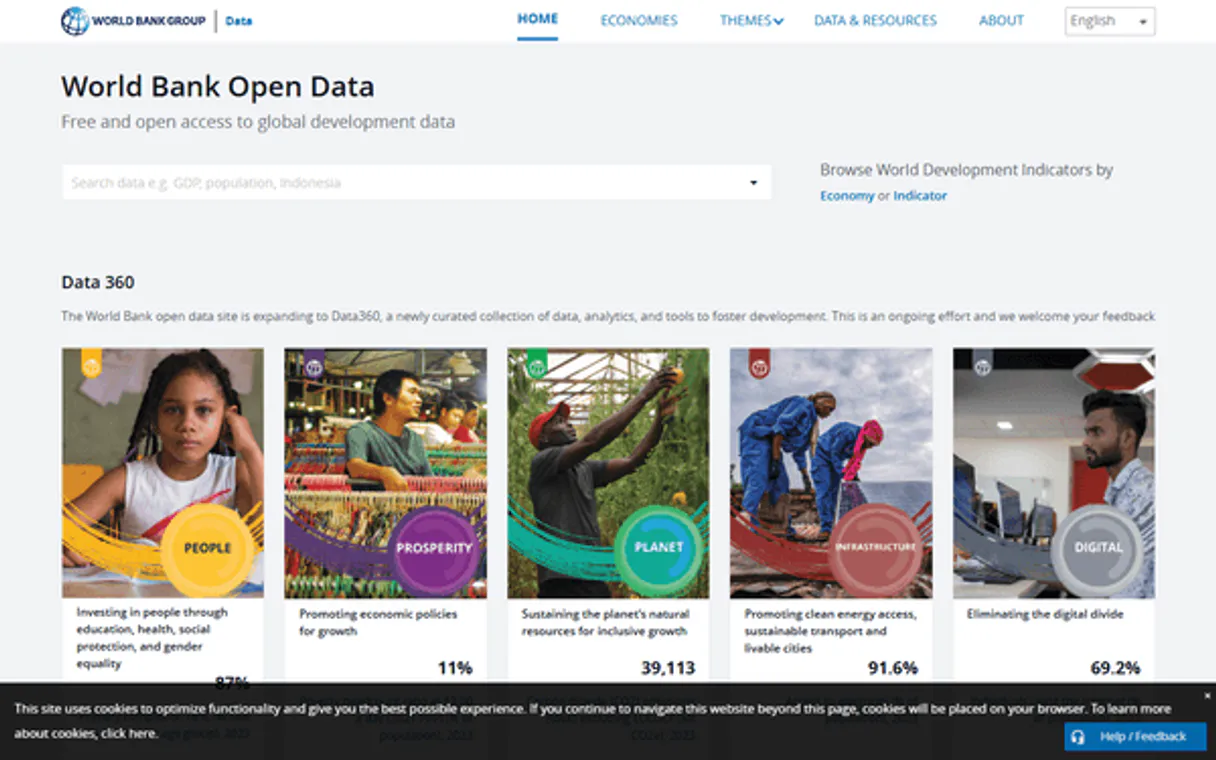
Independent Platform Disclaimer: Vinkius is an independent platform and is not affiliated with, endorsed by, sponsored by, verified by, or otherwise authorized by World Bank Open Data. All third-party trademarks, logos, and brand names are the property of their respective owners. Their use on this website is strictly for informational purposes to identify service compatibility and interoperability.
VINKIUS INFRASTRUCTURE
Cloud Hosted
Managed infra
V8 Isolated
Sandboxed per request
Zero-Trust Proxy
No stored credentials
DLP Enforced
Policy on every call
GDPR Compliant
EU data residency
Token Compression
~60% cost reduction
Works with Claude, ChatGPT, Cursor, and more
The Model Context Protocol standardizes how applications expose capabilities to LLMs. Instead of operating in isolation, your AI gains direct access to external platforms, live data, and real-world actions through secure, standardized connections.
This server provides 30 capabilities that interface natively with Claude, ChatGPT, Cursor, and any MCP client. No middleware. No custom integration required.
Available Capabilities
Sifting through global datasets used to take weeks of API calls.
Today, compiling a cross-country comparative report is a manual nightmare. You spend days hopping between data portals, remembering which specific indicator code you need for gender parity (`get_women_in_parliament`) versus education levels (`get_literacy_rate`). Then you waste hours cleaning up the spreadsheets and reconciling regional variations.
With this World Bank Full Access MCP Server, that whole process shrinks to a single prompt. You name your variables—like comparing `get_fdi` against `get_gdp` across 20 countries—and the agent handles the retrieval, structure, and cross-referencing instantly.
World Bank Full Access MCP Server: Get every global metric you need.
You stop worrying about which API endpoint controls what. You don't have to remember if it's the 'development metrics endpoint' or the 'social indicators endpoint.' The 30 tools—from `get_co2_emissions` to `get_total_population`—are all available in one place.
It's raw data power. You get immediate, structured access to foundational global knowledge without writing boilerplate API code.
Common Questions About World Bank Full Access MCP
How do I get started? +
Our World Bank Open Data servers require absolutely zero authentication. You do not need to register, get an API key, or setup webhooks. Just instantly connect and your AI agent can begin querying decades of global data.
How does the AI know which of the 29,506 indicators to use? +
The server includes an incredibly powerful search_indicators tool. The agent can search by concept (like 'Renewable Energy') and the server returns the precise indicator codes (like 'EG.FEC.RNEW.ZS') needed to pull the data directly.
Is there any rate limit or API key required to process deep geographical queries? +
No! This provides frictionless access across the massive public array without writing SDK codes or navigating Webhooks; just connect instantly to the largest global indicator pool on earth.
What is the scale of the data I can access? +
You have direct access to 64 years of historical data covering 196+ sovereign states and global regional aggregates, powered directly by the World Bank's robust open data initiatives.
Does the World Bank Full Access MCP Server require me to handle any complex API key management? +
No. The server uses zero-authentication methods for access. You simply connect your AI client, and it manages all credentialing internally. This means you never have to worry about refreshing keys or managing private tokens when querying global data.
If I use get_indicator_data and the data for a specific country is missing, how does the server handle errors? +
The tool returns an explicit error message detailing exactly which indicator or country combination failed. It won't fail silently. This immediate feedback lets you adjust your prompt with the necessary details to try the query again.
How efficiently can I run multiple queries, like using get_gdp for dozens of countries over many years? +
The server is built to process batch requests quickly. While network speed plays a factor, the underlying data mechanisms aggregate results efficiently for large multi-country comparisons. It handles scale reliably.
Before using specific tools like get_external_debt, how do I verify the correct country codes or region inputs? +
You should run the list_countries tool first. This provides an up-to-date catalog of all valid World Bank codes you can use as reliable input parameters for any other data retrieval function.
Use it with your favorite AI tools
Connect this server to Cursor, Claude, VS Code, and more.
More in this category
NASA APOD — Astronomy Picture of the Day
Access NASA's most popular service: the Astronomy Picture of the Day. Browse today's image, explore the 30-year archive back to 1995, retrieve images by date range, or discover random astronomical treasures — each with expert explanations from professional astronomers.

Wikidata
Access the world's largest open knowledge graph—query entities via SPARQL, perform vector searches, and manage structured data directly from your AI agent.

WHO GHO
Access 2,200+ health indicators from 194 countries — life expectancy, disease prevalence, mortality rates, immunization coverage, and environmental health data from the World Health Organization.
You might also like

AskHandle
Integrate custom AI agents with AskHandle.
Wayfront
Manage your parking operations with digital permits, enforcement tracking, and revenue analytics for parking facility operators.

NCREIF
Access institutional commercial real estate data via NCREIF — track property performance, indices, and fund returns directly from your AI agent.