
ADB MCP. Pull structured economic data for Asia-Pacific markets.
 Gemini
 Works with every AI agent you already use
…and any MCP-compatible client









Just plug in your AI agents and start using Vinkius.
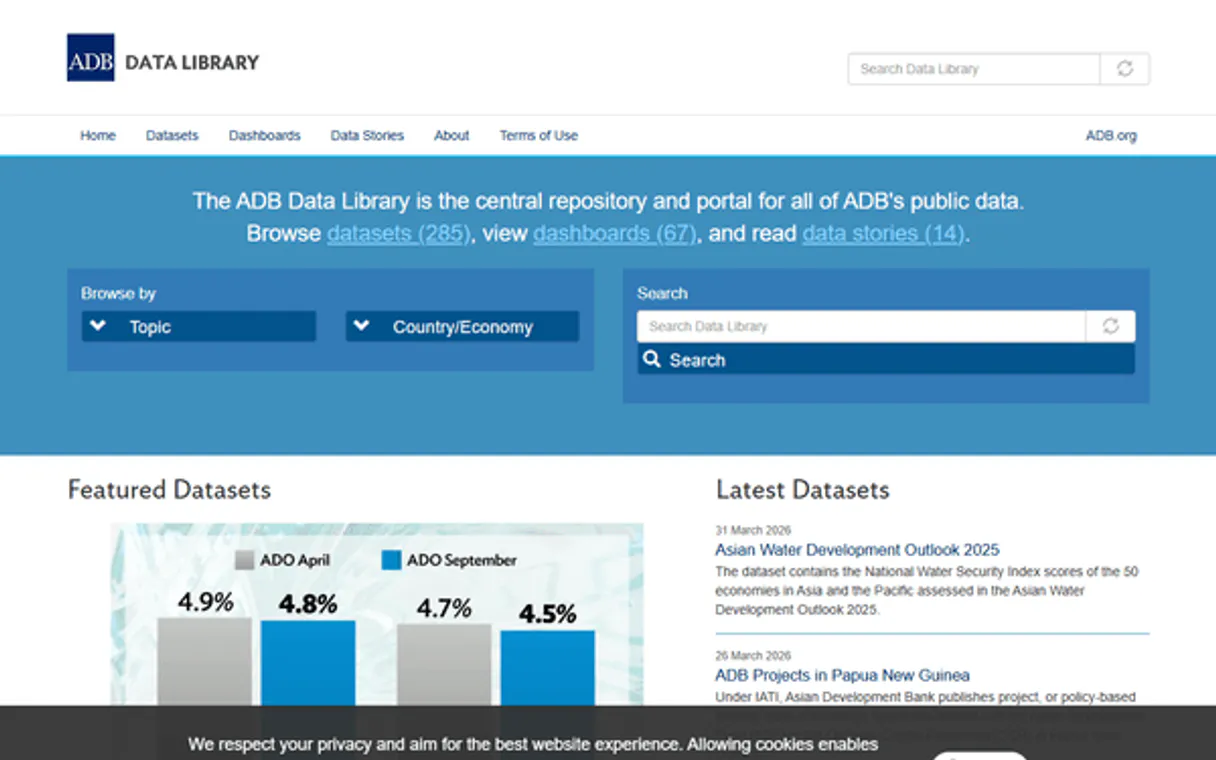
Asian Development Bank MCP Server gives your agent direct access to the Key Indicators Database (KIDB). Pull macroeconomic data for 49 Asia-Pacific economies, including GDP, inflation, and trade balances.
You can query specific indicators (like CPI or NGDP) or run quick checks for key countries (China, Japan, India, etc.) across historical time ranges.
What your AI agents can do
Get gdp asia
Retrieves GDP data for selected Asia-Pacific economies (PRC, JPN, IND, KOR, INO, THA, VIE, PHI).
Get inflation asia
Retrieves consumer price inflation rates for selected Asia-Pacific economies (PRC, JPN, IND, KOR, INO, THA, VIE, PHI).
Query adb indicators
Queries specific macroeconomic indicators (GDP, Inflation, Trade) from the ADB using dataflow IDs and economy codes.
The get_gdp_asia tool fetches Gross Domestic Product data for a list of major Asia-Pacific economies.
The get_inflation_asia tool gathers Consumer Price Index (CPI) inflation rates for major Asia-Pacific economies.
The query_adb_indicators tool pulls detailed macroeconomic data, including GDP, inflation, and trade balances, using specific ADB dataflow IDs.
Ask AI about this MCP
Supported MCP Clients
Gemini Waiting for input…
Asian Development Bank MCP Server: 3 Tools for Macroeconomic Data
Use these three tools to retrieve GDP, inflation, and trade statistics for various Asian economies and markets.
019d7546get gdp asia
Retrieves GDP data for selected Asia-Pacific economies (PRC, JPN, IND, KOR, INO, THA, VIE, PHI).
019d7546get inflation asia
Retrieves consumer price inflation rates for selected Asia-Pacific economies (PRC, JPN, IND, KOR, INO, THA, VIE, PHI).
019d7546query adb indicators
Queries specific macroeconomic indicators (GDP, Inflation, Trade) from the ADB using dataflow IDs and economy codes.
Choose How to Get Started
Build a custom MCP for your own tools, or connect a ready-made integration from our catalog.
Build Your Own
Turn any API into an MCP. Import a spec, define Agent Skills, or deploy with MCPFusion.
- Import from OpenAPI, Swagger, or YAML specs
- Create Agent Skills with progressive disclosure
- Deploy to edge with MCPFusion framework
- Built in DLP, auth, and compliance on every call
- Real time usage dashboard and cost metering
- Publish to catalog or keep private
Make Your AI Do More
Start with Asian Development Bank, then connect any of our 4,700+ other servers whenever your AI needs more. One click, no limits.
- Use this MCP plus 4,700+ others, all in one place
- Add new capabilities to your AI anytime you want
- Every connection is secured and compliant automatically
- Track usage and costs across all your servers
- Works with Claude, ChatGPT, Cursor, and more
- New servers added to the catalog every week
What you can do with this MCP connector
Your agent hits the Asian Development Bank's Key Indicators Database (KIDB) directly. You pull macro data for 49 Asia-Pacific economies, covering GDP, inflation, and trade balances. You can check specific indicators (like CPI or NGDP) or run quick checks for key countries, like China, Japan, or India, across any historical time range.
get_gdp_asia fetches Gross Domestic Product data for a list of major Asia-Pacific economies, including the PRC, JPN, IND, KOR, INO, THA, VIE, and PHI.
get_inflation_asia gathers Consumer Price Index (CPI) inflation rates for major Asia-Pacific economies, covering the PRC, JPN, IND, KOR, INO, THA, VIE, and PHI.
query_adb_indicators pulls detailed macroeconomic data from the ADB. You can use specific dataflow IDs and economy codes to get info on GDP, inflation, and trade balances.
How ADB MCP Works
- 1 Specify the required indicators and economy codes. For general queries, use the
query_adb_indicatorstool and list the dataflow IDs (e.g., ADB,EO_NA for GDP). - 2 Alternatively, use the specialized endpoints:
get_gdp_asiafor GDP orget_inflation_asiafor inflation, passing the desired economy codes. - 3 Your agent receives a structured JSON output containing the historical data points, which you can then use for direct analysis.
The bottom line is that you get structured, historical economic data for Asian markets in a single, actionable format.
Who Is ADB MCP For?
The macroeconomist who needs to compare growth rates across multiple Asian markets without visiting three different statistical websites. The fund manager who needs quick, reliable historical inflation data for due diligence. The policy researcher who needs to combine GDP, trade, and inflation data points for a single report. This is for anyone whose job depends on accurate, cross-regional economic metrics.
Compares long-term trends in GDP, inflation, and trade balances across different Asia-Pacific nations to identify structural economic shifts.
Performs country-level due diligence by pulling historical CPI inflation and GDP data for portfolio markets.
Analyzes import/export volumes and current account balances (Balance of Payments) across ASEAN economies.
What Changes When You Connect
- GDP & National Accounts: Track economic output, growth rates, and GDP deflators for China, Japan, and 45 other economies. The
get_gdp_asiatool lets you track core economic output easily. - Inflation Monitoring: Monitor CPI-based inflation trends across the fastest-growing Asian markets. Use
get_inflation_asiato see year-over-year cost changes. - Trade Analysis: Analyze import/export volumes and current account balances (Balance of Payments). The
query_adb_indicatorstool handles the trade flow data. - Universal Coverage: The server covers the full range of ADB member economies, from Afghanistan to Vanuatu, not just the major markets. This breadth is key for comprehensive research.
- Efficiency: Instead of running multiple manual lookups, you combine indicators using
query_adb_indicators, passing multiple dataflow IDs in one request. - Zero Friction: No authentication is needed to access this massive dataset. You just need to tell your agent which indicators you need.
Real-World Use Cases
Comparing Post-Pandemic Growth
A fund manager needs to compare the GDP recovery trajectory of China, Japan, and India since 2020. Instead of pulling three separate reports, they ask their agent to run get_gdp_asia. The agent compiles the data, showing all three economies' growth paths in one place.
Assessing Inflation Volatility in ASEAN
A policy researcher needs to know if inflation stability varies across Southeast Asia. They use get_inflation_asia to compare CPI rates for Thailand, Philippines, and Indonesia over five years, revealing which markets experienced higher volatility.
Building a Comprehensive Market Snapshot
An analyst needs a single data pull covering GDP, inflation, and trade for a developing market. They use query_adb_indicators by combining the necessary dataflow IDs (e.g., ADB,EO_NA + ADB,EO_INF + ADB,EO_BOP) to get a complete picture in one go.
Checking a Niche Market's Economic Status
A consultant needs data on a smaller ADB member economy, like Vanuatu, which isn't covered by the quick tools. They use query_adb_indicators with the correct economy code and dataflow ID to get precise metrics.
The Tradeoffs
Manual Web Scraping
Opening the ADB website, finding the GDP section, downloading a CSV, then repeating the process for inflation, and a third time for trade balance. You end up with three separate files and hours of cleaning.
→
Use the specialized tools. For GDP, run get_gdp_asia. For inflation, run get_inflation_asia. Then, for a complete picture, combine everything using query_adb_indicators in one go.
Using Only Quick Tools
Limiting your analysis only to the major economies listed in get_gdp_asia and ignoring the full scope of the ADB database. This misses crucial comparative data.
→
Rely on query_adb_indicators. This tool accepts a broader range of dataflow IDs and economy codes, giving you access to the full breadth of ADB member economies.
Sequential Data Pulls
Asking your agent to pull GDP data, wait for the response, and then ask it to pull inflation data. This is slow and requires multiple conversational turns.
→
Combine your requests into a single instruction. Use query_adb_indicators and list all necessary dataflow IDs and economy codes in the same prompt for parallel processing.
When It Fits, When It Doesn't
Use this if your analysis requires cross-regional comparisons of key economic indicators (GDP, CPI, Trade) across multiple Asia-Pacific nations. You need structured, historical data that can be immediately fed into a financial model.
Don't use this if you only need a single, isolated data point (e.g., just the population of one country). For that, a simple search or a dedicated, single-metric API might be better. Don't use this if you need real-time, minute-by-minute data—this data is based on official, often quarterly or annual reports. This server is for macro trends, not moment-to-moment market ticks.
Independent Platform Disclaimer: Vinkius is an independent platform and is not affiliated with, endorsed by, sponsored by, verified by, or otherwise authorized by Asian Development Bank. All third-party trademarks, logos, and brand names are the property of their respective owners. Their use on this website is strictly for informational purposes to identify service compatibility and interoperability.
VINKIUS INFRASTRUCTURE
Cloud Hosted
Managed infra
V8 Isolated
Sandboxed per request
Zero-Trust Proxy
No stored credentials
DLP Enforced
Policy on every call
GDPR Compliant
EU data residency
Token Compression
~60% cost reduction
Works with Claude, ChatGPT, Cursor, and more
The Model Context Protocol standardizes how applications expose capabilities to LLMs. Instead of operating in isolation, your AI gains direct access to external platforms, live data, and real-world actions through secure, standardized connections.
This server provides 3 capabilities that interface natively with Claude, ChatGPT, Cursor, and any MCP client. No middleware. No custom integration required.
Available Capabilities
Compiling Asian Economic Data used to take hours of clicks and spreadsheet cleanup.
Before this server, pulling a set of comparable metrics—say, GDP, CPI, and trade—for three different countries meant logging into multiple portals. You'd spend time jumping between indicator definitions, downloading separate CSVs, and then manually aligning the date columns. It's a massive, repetitive data wrangling chore.
Now, you ask your agent to pull the data. It executes the necessary tools, pulls the indicators, and returns a single, structured object. You get the data ready for analysis immediately. It’s just that simple.
Asian Development Bank MCP Server: Structured Macroeconomic Data Retrieval
The need for the `query_adb_indicators` tool is obvious. It eliminates the need to manage multiple API endpoints and dataflow IDs separately. You give it the IDs, and it handles the complex combination of indicators and economies.
This server gives you a single source of truth for Asia-Pacific economic data, eliminating the need to stitch together data from disparate sources and saving you hours of post-processing time.
Common Questions About ADB MCP
Does the get_gdp_asia tool cover all ADB member countries? +
No. The get_gdp_asia tool is a quick-access endpoint focused on major economies (PRC, JPN, IND, etc.). For the full list of 49 ADB member countries, you must use the query_adb_indicators tool.
How do I compare inflation rates using get_inflation_asia and query_adb_indicators? +
You can use either. get_inflation_asia is faster if you only need the standard CPI rates for the listed countries. For maximum flexibility and to combine inflation with other indicators (like GDP or trade), use query_adb_indicators.
Can I pull data for a country not listed in get_gdp_asia? +
Yes. The query_adb_indicators tool uses ADB dataflow IDs and economy codes, giving you access to the full breadth of ADB member economies, regardless of the quick tool list.
What data is returned by query_adb_indicators? +
The tool returns a structured set of macroeconomic indicators. You specify the dataflow IDs (like ADB,EO_NA for GDP) and the economy codes, and it compiles the results.
When using query_adb_indicators, what dataflow IDs should I combine for a full macro picture? +
You combine the core dataflow IDs: ADB,EO_NA for GDP, ADB,EO_INF for inflation, and ADB,EO_BOP for trade. This combination lets you query comprehensive economic indicators across the region.
What are the limitations of the economy codes used in get_gdp_asia and get_inflation_asia? +
These dedicated tools only accept specific economy codes (PRC, JPN, IND, KOR, INO, THA, VIE, PHI). For broader coverage, use the more flexible query_adb_indicators tool.
If I need to query indicators beyond those listed in query_adb_indicators, can I still get them? +
No. The query_adb_indicators tool is limited to the established ADB dataflow IDs (like ADB,EO_NA or ADB,EO_INF). You must stick to the defined indicators.
How does the system handle rate limits when querying multiple indicators with query_adb_indicators? +
The Vinkius platform manages rate limiting automatically. If you hit a limit, your AI client receives a specific error, allowing your agent to retry the request later.
Do I need an API Key? +
No. The ADB KIDB API is completely open and requires zero authentication. The only limit is 20 queries per minute to maintain service stability.
What economies are covered? +
The database covers all 49 ADB member economies across the Asia-Pacific region, including China, Japan, India, South Korea, all ASEAN nations, Central Asian republics, and Pacific Island states.
Use it with your favorite AI tools
Connect this server to Cursor, Claude, VS Code, and more.
More in this category

JSONCargo Maritime
Track global vessels — audit voyages and ports via AI.

Blockscout
Explore Ethereum-based blockchains directly from your AI agent. Query addresses, tokens, transactions, and smart contracts via Blockscout's open-source API.

EOD Historical Data
Access global financial market data — historical EOD, intraday, real-time prices, and deep fundamentals for stocks, ETFs, and indices.
You might also like

LocalAI
Run LLMs, generate images, and process audio locally. OpenAI-compatible API for your own hardware.

Metrc
Cannabis track-and-trace via Metrc — track facilities, items, plants, and harvests.

Georef Argentina
Access official Argentine geographic data—normalize addresses, list administrative divisions, and perform reverse geocoding directly from your AI.